San Francisco Opera raises the curtain on Verdi's Simon Boccanegra on Tuesday 22 September, ten days later than it meant to.
On 12 September, at 7:25pm and about half an hour before the scheduled curtain, the San Francisco Opera Orchestra went on strike. The company's 104th season-opening performance was cancelled, and so was the free Opera in the Park concert the following afternoon. Four more performances went before it ended.
On 17 September the two sides announced a tentative four-year agreement running from 1 August 2026 to 31 July 2030, subject to ratification by the musicians. The orchestra agreed to end the strike. Nobody has published what the new contract pays.
Cadenza has followed this since the contract ran out. We reported the expiry on 31 July, and on 7 September, five days before the walkout, we set out the company's case and the musicians' answer to it, including what a twenty per cent cut would take out of a section player's pay.
This piece picks up where that one stopped, because management then made a third offer that the earlier reporting could not have covered, and because that offer rested on an arithmetical claim neither side showed its working for.
The three offers, in the musicians' own words
The orchestra's own negotiating page sets out the sequence, and it is the clearest account either side has published.
"Management instead initially proposed a 26% pay cut, which would have returned us to 2015 wages, and later 'improved' that offer to a 20% cut. Coming into today, their latest proposal was a five-year wage freeze, which, factoring in inflation, is equivalent to roughly a 20% cut over the life of the contract."
Three offers, then. A cut of just over a quarter. A cut of a fifth. And a freeze that the musicians say is a cut of a fifth by another route.
The previous contract had expired on 31 July. Negotiations had been running since the spring.
Is a five-year freeze really a twenty per cent cut?
This is the claim the strike turned on, and it is checkable.
Start with what a wage freeze does. If your pay does not move for five years while prices rise, you lose ground at the rate of inflation. The size of the loss depends on which of two perfectly honest measures you use, and the difference between them is large enough to matter.
Take a five-year period in which consumer prices in the San Francisco area rise by about nineteen and a half per cent, which is close to the recent run rate for the Bay Area and is the figure the musicians' own argument rests on.
Under the contract that has just expired, San Francisco Classical Voice reported the guaranteed minimum for a section musician as $118,326.75. Put that salary through both measures.
| Measure | What it asks | Result | On $118,326.75 |
|---|---|---|---|
| Shortfall against inflation-matched pay | How far behind a colleague whose pay tracked prices would you finish? | 19.5 per cent | about $23,074 a year by 2030 |
| Loss of purchasing power | How much less can your unchanged salary actually buy? | 16.3 per cent | about $19,300 a year in today's money |
Both numbers describe the same freeze. The first divides the gap by the salary you started on. The second divides it by the salary you would have needed, which is a larger denominator and so a smaller percentage.
The musicians used the first measure, and on that measure "roughly a 20 per cent cut" is not rhetoric. It is 19.5 per cent, which rounds to twenty. Their claim stands up.
That is the finding, and the dollars make it sharper. Cadenza reported on 7 September that a twenty per cent cut on that minimum is roughly $23,700 a year. The five-year freeze works out at about $23,074 a year by 2030. The two offers land within about $600 of each other.
A five-year freeze and a twenty per cent cut were not two different offers dressed differently. Measured against the salary a player is on today, they arrive at very nearly the same place. The musicians had already rejected the twenty per cent cut. The freeze asked them to accept the same destination by a slower road, and that is what they struck over.
The company's case, and the number that supports it
None of that means the company invented its problem.
San Francisco Opera has said throughout that it faces a structural deficit and cannot carry its existing cost base. General Director Matthew Shilvock, announcing the cancellation of the opening, said he was "very disappointed" and that the company "cannot sustain a compensation structure that originated 45 years ago."
The most recent financial year for which the association's return is publicly filed is 2023. In that year San Francisco Opera Association reported total revenue of $85.3 million against total functional expenses of $98.4 million. That is a shortfall of $13.1 million in a single year, and expenses in 2023 were some $29.8 million higher than in 2022.
Those are not the company's own framing; they are the filed figures. They corroborate the existence of the gap that management says it is trying to close. What they do not settle is who should close it, which is what the dispute was about.
Cadenza's 7 September piece ran that question through thirteen years of the company's returns and found that for a twenty per cent orchestra cut to close a fifteen million dollar gap on its own, the orchestra's payroll would have to be seventy-five million dollars, which is more than the company's entire artistic budget. That arithmetic has not changed.
What is not known, and will not be guessed
Three things are worth stating plainly because they are absent from every account of this settlement, including this one.
The wage terms of the tentative agreement have not been published. Neither side has said what the musicians will be paid from 1 August 2026. Until that is disclosed or the contract is ratified and reported, nobody outside the room can say whether the orchestra protected its pay, conceded some of it, or traded it for something else.
The agreement is tentative. It requires a ratification vote by the musicians, which had not been reported as completed when this was written.
And the settlement's own architects have been careful. Gabe Young, speaking for the orchestra's negotiating committee, said the musicians were "heartened to have reached a tentative deal that provides a fair contract and stability for the members of the orchestra," and thanked the mayor and his team. Shilvock said he was "deeply grateful" that an agreement had been reached and framed it as putting the company "on a path toward long-term fiscal stability." Both statements are warm and neither contains a number.
One claim Cadenza is not printing as a fact
The orchestra's negotiating page carries a further argument: that the general director's salary rose 72 per cent between the 2022 and 2025 financial years, from $424,000 to $729,000, according to the company's public filings.
Cadenza cannot stand that up. The returns available in the public nonprofit databases run only to the 2023 financial year, and the figure they carry is aggregate compensation for all current officers rather than any individual's salary. The 2024 and 2025 filings that would settle it are not yet accessible.
So it is recorded here as what it is: an assertion by one party to a dispute about the pay of a named individual on the other side, citing documents this newsroom has not been able to read. It may well be accurate. It is not verified, and a number like that should not travel on trust.
The conductor who did not resign
One story attached itself to this dispute and deserves closing off.
The San Francisco Chronicle reported, sourced to two musicians who said they were present, that the company's music director Eun Sun Kim told players at a rehearsal she would resign in solidarity if they struck. Kim did not confirm it and did not respond to the paper. A company spokesperson described her as expressing solidarity with the orchestra, which confirms a conversation without confirming a threat.
She did not resign. San Francisco Opera's own production page for Simon Boccanegra lists Eun Sun Kim as conductor, still carries her title as Caroline H. Hume Music Director, and schedules her for a post-performance talkback. A conditional remark reported at second hand, about a condition that has now ended, is not a resignation.
A year ago it was a contract with an expiry date on it
Every element of this began as a date in a document. The previous agreement ran out on 31 July. Talks opened months before that. The strike came six weeks after expiry, and the settlement five days after the strike, with the mayor's office helping to broker it.
Cadenza carries auditions, vacancies and schemes with open deadlines, free to musicians, on its jobs board and competitions board. It has spent this month counting what institutions actually pay the people who play for them, from a four-year cello loan in Brussels to $1.3 million shared among sixteen jazz veterans.
If you go. Simon Boccanegra opens at the War Memorial Opera House, 301 Van Ness Avenue, on Tuesday 22 September, conducted by Eun Sun Kim. Ticket holders for the five cancelled performances were offered a credit, a donation option or a full refund. The free Opera in the Park concert that was lost on 13 September is an annual fixture and is not being restaged this season.
The question both sides will be asked next is the one their own statements avoided. The company says the settlement puts it on a path to fiscal stability and the musicians say it delivers a fair contract, and those two claims can only both be true if the numbers are known. Will either side publish what the orchestra will actually be paid from 1 August?
Sources: San Francisco Opera's own press release of 12 September 2026, which records the 7:25pm strike call, the cancellation of the 104th season-opening Simon Boccanegra and of Opera in the Park; the company's own economics page, carrying Matthew Shilvock's statements including the tentative agreement and the end of the strike; and the San Francisco Opera Orchestra's own negotiations page, which is the source for the sequence of the three offers in the musicians' own words, for the claim that a five-year freeze equals roughly a 20 per cent cut, for the 2015-wages comparison, for the terms and dates of the tentative four-year agreement, and for the assertion about the general director's compensation. Gabe Young's quotation is as carried by San Francisco Classical Voice.
The 2023 financial figures are from San Francisco Opera Association's public return, EIN 94-0836240, as published in ProPublica's Nonprofit Explorer: total revenue $85,335,694 and total functional expenses $98,402,775, against total expenses of $68,630,368 in 2022. The inflation arithmetic is Cadenza's own, worked from a five-year price rise of about 19.5 per cent and shown both ways in the table above. Eun Sun Kim's continuing engagement is from San Francisco Opera's own Simon Boccanegra production page, read on 19 September 2026.
The $118,326.75 guaranteed section minimum under the expired contract is as reported by San Francisco Classical Voice and used in Cadenza's 7 September piece, which also carries the thirteen-year review of the company's Form 990 filings.
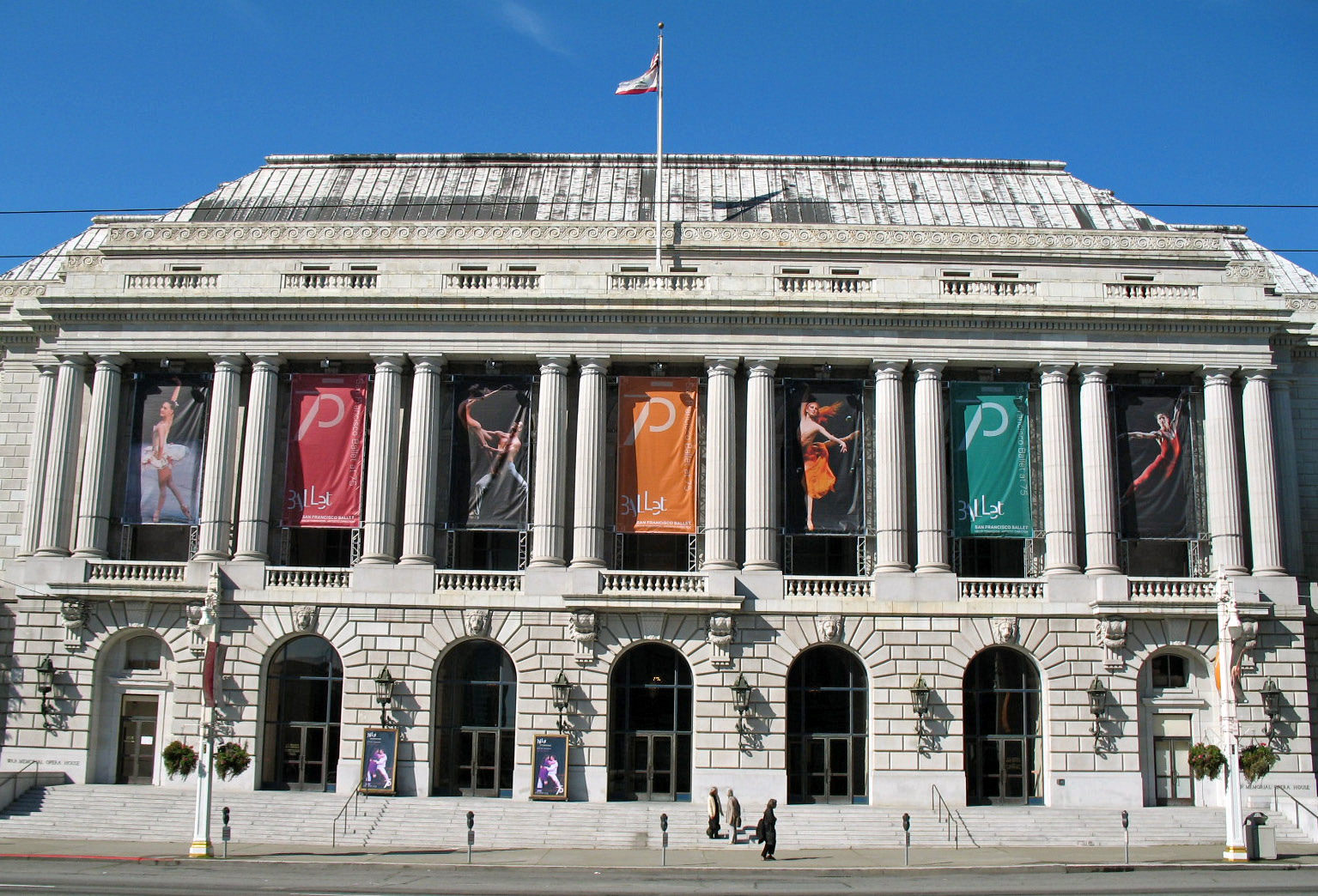
Cover photograph: the War Memorial Opera House, San Francisco. Sanfranman59, CC BY-SA 3.0, via Wikimedia Commons.
Cover photograph: The War Memorial Opera House on Van Ness Avenue, San Francisco, home of San Francisco Opera. Sanfranman59, CC BY-SA 3.0, via Wikimedia Commons.
Comments
Sign in to join the discussion.