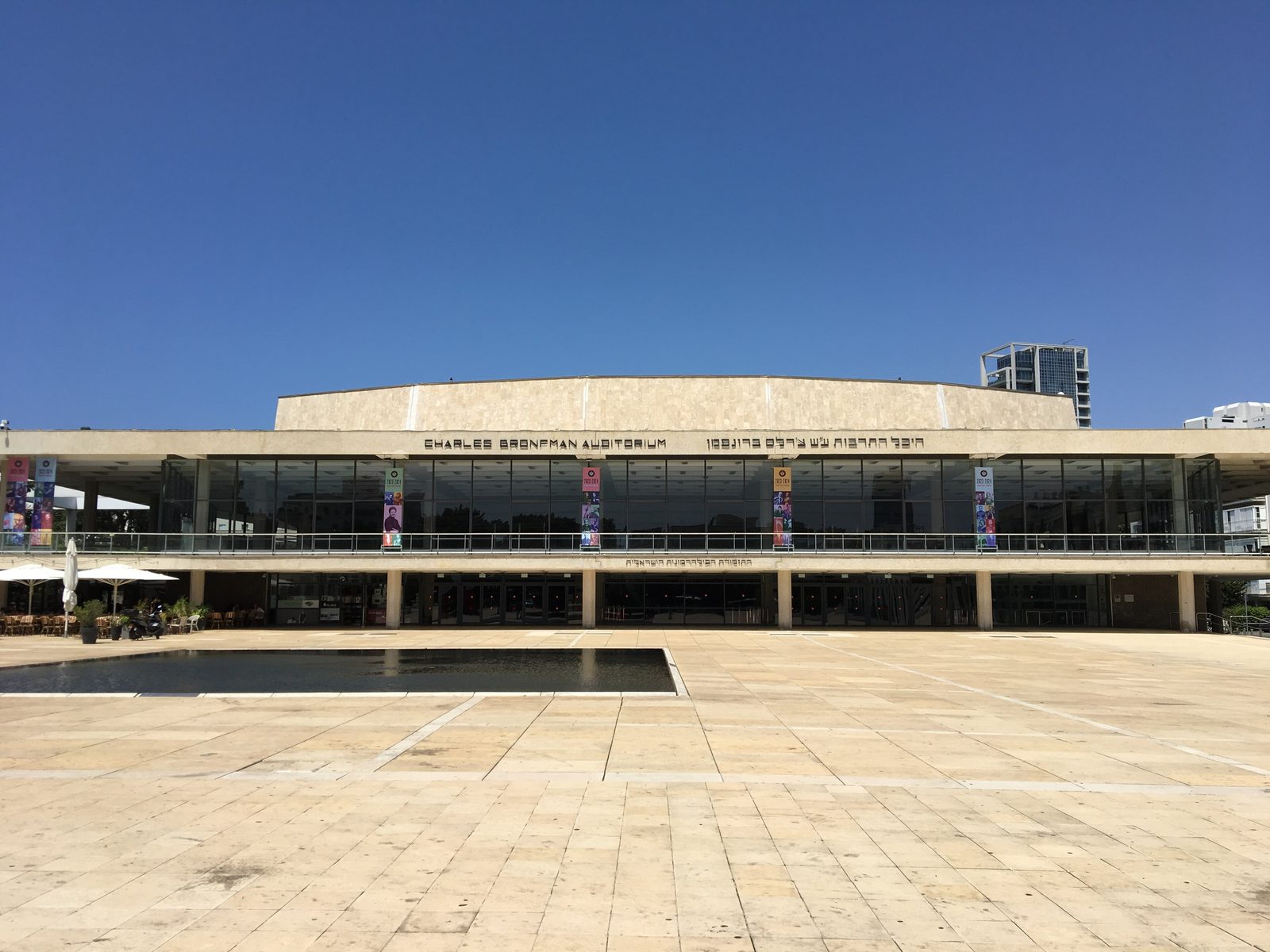
On Monday evening the Israel Philharmonic will sit down in the Charles Bronfman Auditorium with Yoel Levi on the podium and play Prokofiev's Second Concerto, Brahms's Second and Bartók's Second, one after another, for three young pianists who last competed against each other in a 550-seat hall in Germany four months ago. The 18th Arthur Rubinstein International Piano Master Competition, which announced 42 pianists in December, moved its first two stages to Kronberg im Taunus in March, played them there from 28 April to 4 May and postponed its finals from May to September, reaches its awards ceremony on Wednesday 9 September. Six finalists are left. The gold medal carries $40,000 and a further $10,000 for a career fund.
It is a competition that has been held in Tel Aviv since 1974, eighteen editions in fifty-two years on a three-year cycle that Covid and the calendar have bent more than once, and this edition has been held in two cities. The reason for the move was stated in one sentence by the World Federation of International Music Competitions on 29 March: the relocation was "a pragmatic response to a fraught reality: ongoing war in the Middle East, daily missile alarms in Israel's capital and widespread flight suspensions to the region." The story is what the competition did with it.
The document
| Item | Figure | Source |
|---|---|---|
| Pianists announced, 12 December 2025 | 42, "selected from more than 500 applicants" | The Violin Channel |
| Pianists on the competition's competitors page today | 39 | arims.org.il |
| Geographic split given by the artistic director in May | 16 East Asia, 10 North and South America, 13 Europe (five Israelis) | The Jerusalem Post |
| Stage I and II venue | Casals Forum, Kronberg Academy, 28 April to 4 May | Kronberg Academy |
| Stage II | 16 competitors, 50 to 60 minute recitals, 2 to 4 May | Kronberg Academy |
| Seats in the Casals Forum hall | 550 | casalsforum.de |
| Finalists | 6 | arims.org.il |
| Finals | 3 to 9 September, Tel Aviv | arims.org.il |
| Finals venues | Tel Aviv Museum of Art (Assia Auditorium); Charles Bronfman Auditorium | arims.org.il |
| Orchestras | Israel Camerata Jerusalem (Avner Biron); Israel Philharmonic (Yoel Levi) | arims.org.il |
| Jury | 12, chaired by Arie Vardi | arims.org.il |
| Gold medal | $40,000 plus $10,000 to a career enhancement fund | arims.org.il, rules |
| Silver / Bronze | $20,000 / $10,000 | arims.org.il, rules |
| Flight reimbursement per competitor | up to USD 500 | arims.org.il, rules |
| Registration fee | USD 190, non-refundable | arims.org.il, rules |
Two numbers in that table do not match, and the difference is worth stating plainly. In December the competition published 42 names. On 29 March the federation wrote that "forty-two accepted competitors remain fully committed. None has withdrawn", The competitors page on arims.org.il now lists 39. Against the December list, four names are absent and one, Salome Jordania, is new. The split the artistic director gave The Jerusalem Post in May, 16 plus 10 plus 13, also comes to 39. Nothing in the fetched sources says when or why the field changed. What can be said is that 39 pianists remain on the competition's list, and that the edition went ahead a month after its venue changed.
How it happened, in order
The competition announced its participants on 12 December 2025: 42 pianists aged between 18 and 32, to be heard in Tel Aviv from 28 April to 15 May. The rules contained one requirement particular to this edition. Alongside a Classical and a Romantic work, every competitor had to include "one mandatory piece to be chosen from a list of three pieces written by Jewish composers from the Holocaust period", of ten minutes' duration, in Stage I or Stage II.
On 29 March 2026 the federation reported that Stages 1 and 2 would move to the Casals Forum at Kronberg Academy. Its piece set the decision in the competition's own history: "The Rubinstein has repeatedly refused to yield to crisis. The 2020 edition was postponed by Covid; in 2023, missile attacks began almost as soon as the competition ended." It added a policy that would matter six weeks later: "If security prevents the finals from taking place as scheduled, they will be postponed, not relocated."
Ariel Cohen, the competition's artistic director, was quoted by the federation the same day: "Even in these challenging times, we believe that music is a healing force which transcends borders. It is precisely in periods of uncertainty that music has a deeper role – to remind us of who we are and what connects us. The existence of this year's competition is a clear statement: culture never stops."
The Violin Channel reported the move on 30 March with a detail ticket-holders would have cared about: buyers for the opening night and Stages 1 and 2 would be reimbursed by Eventim. "During a time when reality is complex and fragile, music serves as an anchor," Cohen said in that report.
Kronberg Academy, whose Casals Forum hall seats 550, put the competition on its calendar as "a guest at the Casals Forum". Its page records the mechanics: the ballot deciding the order of appearance on 27 April, Stage II from 2 to 4 May with 16 competitors, tickets at 30 or 40 euros. One element did not travel. "Presentation, interviews, and discussion panels will be broadcast from the Tel Aviv Museum of Art," the academy's page says, so the presentation, interviews and discussion panels were broadcast from the city the pianists could not yet reach.
On 5 May, the day after Stage II closed, Slipped Disc reported that six pianists had been chosen for the finals, "expected to be held in Tel Aviv some time later this year". Norman Lebrecht's post gave their origins rather than their names: "Three are Russian. One is from Belarus, a fifth from Ukraine," and one from South Korea. "All are male."
On 12 May The Jerusalem Post named them and fixed the dates: Roman Fediurko, Uladzislau Khandohi, Stanislav Korchagin, Philipp Lynov, Jinhyung Park and Dmitry Yudin, to play in Tel Aviv from 3 to 9 September. The competition's homepage carried a line for anyone who had already paid: "Tickets purchased for the final stages in May are valid for the events taking place in September." The Violin Channel's preview on 25 August set out what the format asks of each of the six: a piano trio, a classical concerto with the Israel Camerata Jerusalem, and a grand concerto with the Israel Philharmonic. Nobody is eliminated between those three. Each finalist plays all of them.
Who is playing what
The six were, at the December announcement, aged 21 (Fediurko), 24 (Khandohi and Yudin), 27 (Lynov), 30 (Park) and 32 (Korchagin), the last at the upper limit of the age rule. The finals programme, as published by The Violin Channel, which is streaming it, and, for the remaining sessions, by the competition:
| Date, Tel Aviv time | Round | Pianist and work |
|---|---|---|
| Thu 3 Sept, 20:00 | Classical concerto, Camerata Jerusalem, Biron | Korchagin, Hummel No. 5 in A flat, Op. 113; Lynov, Beethoven No. 2 in B flat, Op. 19; Yudin, Mozart No. 22 in E flat, K. 482 |
| Fri 4 Sept, 14:00 | Piano trios with Saida Bar-Lev and Hillel Zori | Khandohi, Tchaikovsky Op. 50; Fediurko, Mendelssohn No. 1 Op. 49; Park, Dvořák "Dumky" Op. 90 |
| Sat 5 Sept, 11:00 | Piano trios with Bar-Lev and Zori | Korchagin, Rachmaninov Trio élégiaque No. 2; Lynov, Ravel Trio in A minor; Yudin, Rachmaninov Trio élégiaque No. 2 |
| Sat 5 Sept, 21:00 | Classical concerto, Camerata Jerusalem, Biron | Khandohi, Mozart No. 24 K. 491; Fediurko, Mozart No. 24 K. 491; Park, Mozart No. 20 K. 466 |
| Mon 7 Sept, 20:00 | Grand concerto, Israel Philharmonic, Levi | Korchagin, Prokofiev No. 2 Op. 16; Lynov, Brahms No. 2 Op. 83; Yudin, Bartók No. 2 Sz. 95 |
| Tue 8 Sept, 19:00 | Grand concerto, Israel Philharmonic, Levi | Khandohi, Prokofiev No. 2 Op. 16; Fediurko, Rachmaninov No. 3 Op. 30; Park, Prokofiev No. 2 Op. 16 |
| Wed 9 Sept, 19:00 | Awards ceremony and winners' concert, Camerata Jerusalem, Biron | Prizewinners to be announced |
Read down the right-hand column and a pattern shows. Three of the six chose Prokofiev's Second for the Philharmonic round, two chose Mozart's C minor for the Camerata, and two chose the Rachmaninov trio. The Israel Philharmonic will play the Prokofiev for Korchagin on Monday and for Khandohi and Park on Tuesday, three times in two nights. The rules give the finalists a list of trios and concertos to choose from, so the clustering is the pianists' decision, not the competition's. Lynov is the one finalist whose three choices avoid every duplicate: Beethoven, Ravel and Brahms.
The second half is ours
Start with the ratio. More than 500 applications produced 42 invitations, roughly one place for every twelve applicants. Thirty-nine names on the competitors page produced 16 Stage II recitals and six finalists, one for every six and a half names on the list. By Tuesday night each of the six will have given five public performances in front of the same jury in two countries: two recitals, a trio, a classical concerto and a grand concerto. That is the format set out in the rules. What changed in 2026 is the distance between performance two and performance three. Stage II closed on 4 May. The first classical concerto was on 3 September. The finalists carried a live competition across 122 days, a summer and a border.
Then the halls. The Casals Forum seats 550. The Charles Bronfman Auditorium, by its own account, was inaugurated on 1 October 1957 as the Israel Philharmonic's home, was rebuilt in 2013 and today seats 2,479. Time magazine's report of the opening week records Leonard Bernstein on the podium and Arthur Rubinstein as soloist in Beethoven's "Emperor" Concerto. The pianist who plays Prokofiev on Monday will do so in a room more than four times the size of the one where the jury first heard him, with the orchestra whose inaugural concert the competition's namesake played.
Then the money. The Rubinstein's gold medal is $40,000 and a $10,000 career enhancement fund, its silver $20,000, its bronze $10,000, all stated in the competition's rules and, as the rules also say, "subject to taxation in accordance with the Israeli tax regulations". For comparison with two prizes Cadenza has covered this year, the Queen Elisabeth Competition's cello first prize in May was €25,000 with a four-year loan of the Casals Gofriller cello (the cellists' year), and the Éva Marton Competition's first prize in Budapest on Saturday was €30,000 (Budapest crowns a soprano). At current exchange rates the Rubinstein gold is the largest of the three, and the only one with a separate career fund on top of the medal money. Beyond cash there are engagements. The rules say winners "may be required to give one concert a year, free of charge, for the Arthur Rubinstein Society" over three years; The Violin Channel put the terms more generously in December: "During the three years following the 2026 competition, the winners will be invited to play concerts in different venues in Israel and around the world," as The Violin Channel reported the terms in December. The rules also cover the cost side competitors notice first: hotel accommodation from two days before Stage I, each room "equipped with a practice piano", and up to USD 500 towards a flight, against a registration fee of USD 190.
Then the three-years-ago view, since the Rubinstein is triennial. The 2023 edition, the federation wrote at the time, "features 36 contestants, aged 18-32, from 18 countries." It was won by an 18-year-old from Calgary, Kevin Chen, with Tchaikovsky in the final, in what the federation called his "second major international competition in six months". The 2026 field, at 42 announced and 39 listed, is larger than 2023's, and it was moved to another country with, in the federation's words, "barely a month to go". The finalist list is narrower in one way Slipped Disc pointed out on the day: six men from four countries, Russia, Belarus, Ukraine and South Korea, which, if the artistic director's regional split is read by origin, means none of the ten from the Americas reached the final.
And then the lineage, which is why the prize matters more than its face value. The competition's laureates page records Emanuel Ax as first prize in 1974, the founding year. In 2005 the first prize went to Alexander Gavrylyuk and the second to Igor Levit, with Yeol Eum Son third. In 2011 Daniil Trifonov took first prize, with Boris Giltburg second. In 2014 Seong-Jin Cho was third behind Antonii Baryshevskyi. In 2023 Kevin Chen was first, Giorgi Gigashvili second and Yukine Kuroki third. The same page records that in 2008 no first prize was awarded, and that Khatia Buniatishvili was third that year. Two things follow for Wednesday. On the evidence of Levit, Cho and Buniatishvili, a silver or bronze here has not held anyone back. And the jury has shown at least once that it will withhold the top prize if it does not hear a winner.
If you go, or watch
- Grand concerto finals: Monday 7 September at 20:00 and Tuesday 8 September at 19:00, Charles Bronfman Auditorium, Tel Aviv, Israel Philharmonic Orchestra under Yoel Levi. Tickets through Eventim, linked from the competition's finals page; May tickets remain valid.
- Awards ceremony and winners' concert: Wednesday 9 September at 19:00, Charles Bronfman Auditorium, Israel Camerata Jerusalem under Avner Biron.
- Streams: the competition's rules state that "all stages of the Competition will be open to the public and available through live streams." The Violin Channel's live page says "Tune in from September 3 - 9"; its schedule lists the six competition sessions through 8 September and does not list the awards ceremony, with the grand concerto sessions at 1 pm and 12 pm Eastern time on 7 and 8 September. The competition's finals page links to its YouTube channel, youtube.com/ArthurRubinstein.
- The next Rubinstein: the competition is held every three years for pianists aged 18 to 32, which would put the 19th edition in 2029; no date has been announced. Cadenza's competitions lane listed 73 open calls at the time of writing (browse competitions).
The question
The Rubinstein Society answered the question every institution in its position gets asked, whether to hold the event at all, and answered it twice: once by moving the recitals, once by refusing to move the finals. Wednesday's awards will settle six careers' worth of questions. The one the Society will be asked next is the one it has already answered once this year and will have to answer again before the 19th edition: where the first recital of 2029 will be played.
Sources: arims.org.il, Finals Schedule 2026; arims.org.il, homepage; arims.org.il, Competitors 2026; arims.org.il, Jury 2026; arims.org.il, Rules and Repertoire 2026; arims.org.il, Past Laureates; arims.org.il, About the Competition 2026; WFIMC, 29 March 2026; WFIMC, 31 March 2023; Kronberg Academy, calendar; Casals Forum, the building; The Violin Channel, 12 December 2025; The Violin Channel, 30 March 2026; The Violin Channel, 25 August 2026; The Violin Channel, VC LIVE schedule; Slipped Disc, 5 May 2026; The Jerusalem Post, 12 May 2026; Cadenza listings API; Heichal HaTarbut, hall information; Time, 14 October 1957, Music: Home for Wanderers.
Cover photograph: The Charles Bronfman Auditorium, Tel Aviv, home of the Israel Philharmonic and the venue for the Rubinstein grand-concerto finals. Yossipik, CC BY-SA 4.0, via Wikimedia Commons.
Comments
Sign in to join the discussion.