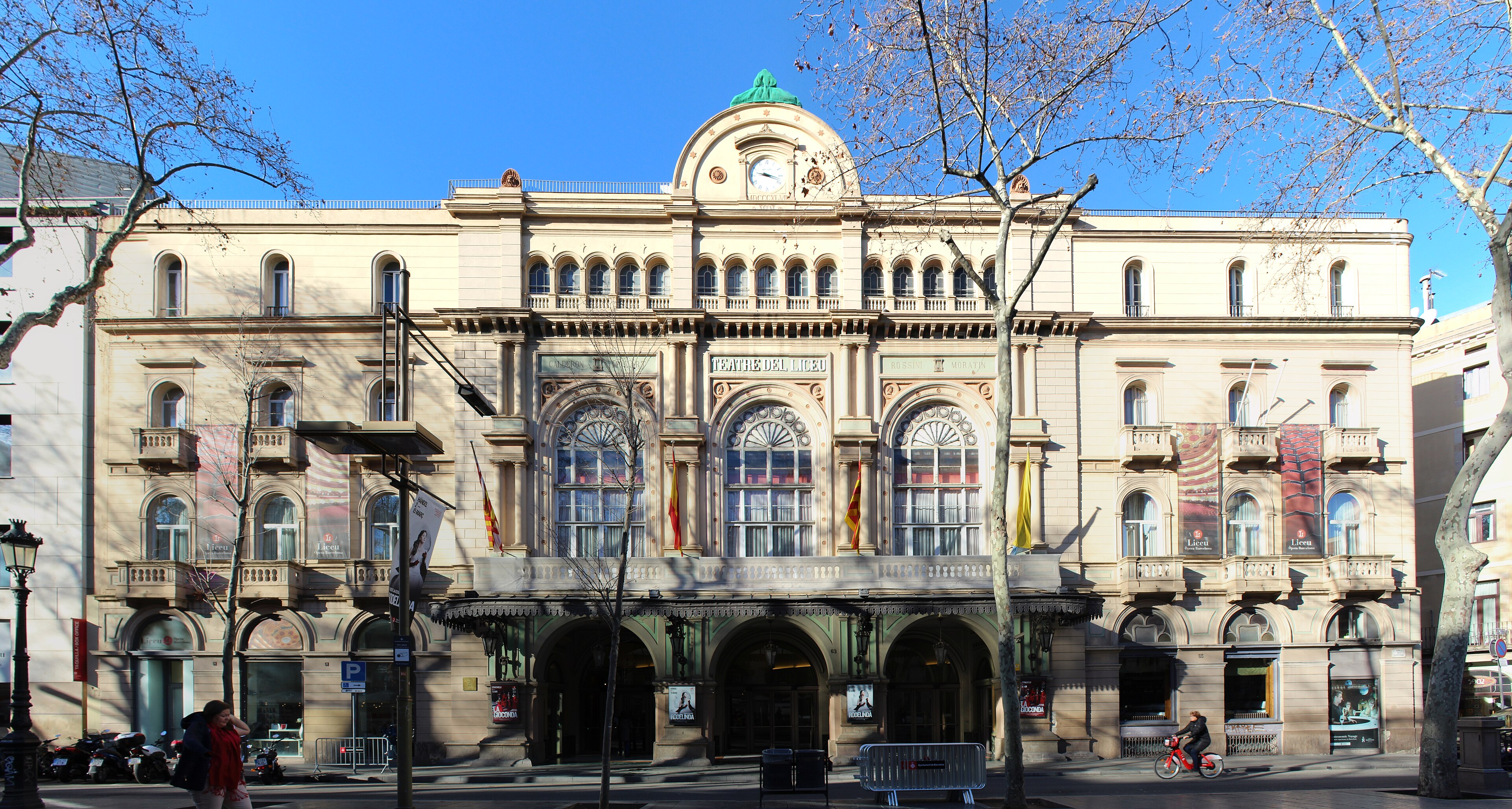
The Concurso Internacional de Canto Tenor Viñas is named after Francesc Viñas, the Catalan tenor who lived from 1863 to 1933. Its 63rd edition delivered its verdict at the Gran Teatre del Liceu in Barcelona on 16 January 2026.
Of the six singers who took its official numbered prizes, not one is a tenor.
The competition is named for a tenor, not reserved for them, and it has never claimed otherwise. But six official laureates and no tenor among them is still a striking result, and it says something about who is entering voice competitions now.
The six, and their voices
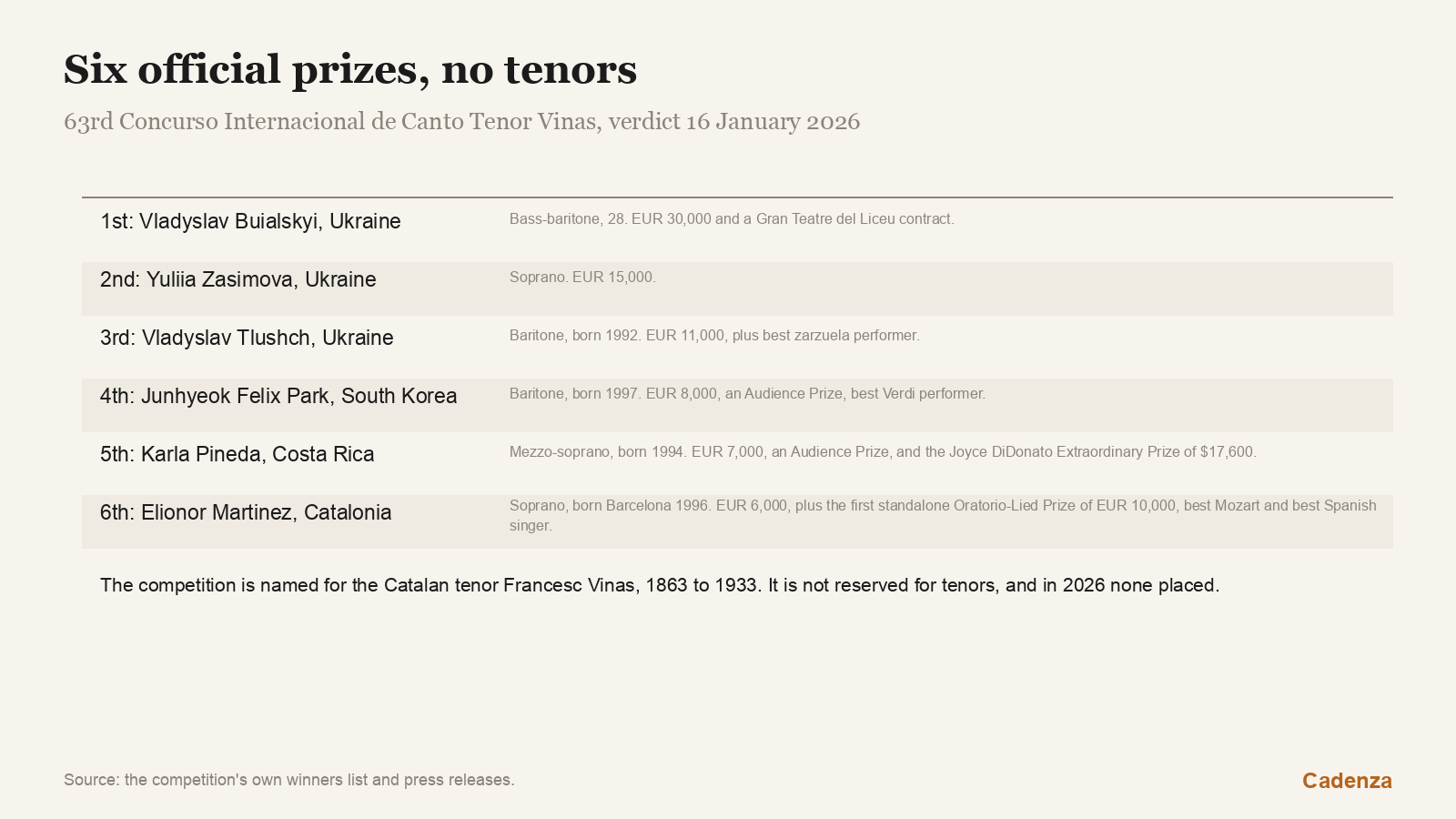
The First Grand Prize, worth €30,000 and a contract with the Gran Teatre del Liceu, went to Vladyslav Buialskyi, a Ukrainian bass-baritone whom the competition's own release describes as 28.
Second Prize, €15,000, went to Yuliia Zasimova, a Ukrainian soprano. The Third Prize, named the Maria Esperança Salvans Piera Prize and worth €11,000, went to Vladyslav Tlushch, a Ukrainian baritone born in 1992, who also took the special prize for the best zarzuela performer.
Fourth Prize, €8,000, went to Junhyeok Park, who performs as Felix Park, a South Korean baritone born in 1997. He also took an Audience Prize and the special prize for the best Verdi performer.
Fifth Prize, €7,000, went to Karla Pineda, a Costa Rican mezzo-soprano born in 1994, who also took an Audience Prize and the Joyce DiDonato Extraordinary Prize from Houston Grand Opera, worth $17,600.
Sixth Prize, €6,000, went to Elionor Martínez, a Catalan soprano born in Barcelona in 1996, who also took the special prizes for the best Mozart performer and the best Spanish singer, the latter named for Plácido Domingo.
Bass-baritone, soprano, baritone, baritone, mezzo-soprano, soprano. No tenor.
Three of the six are Ukrainian
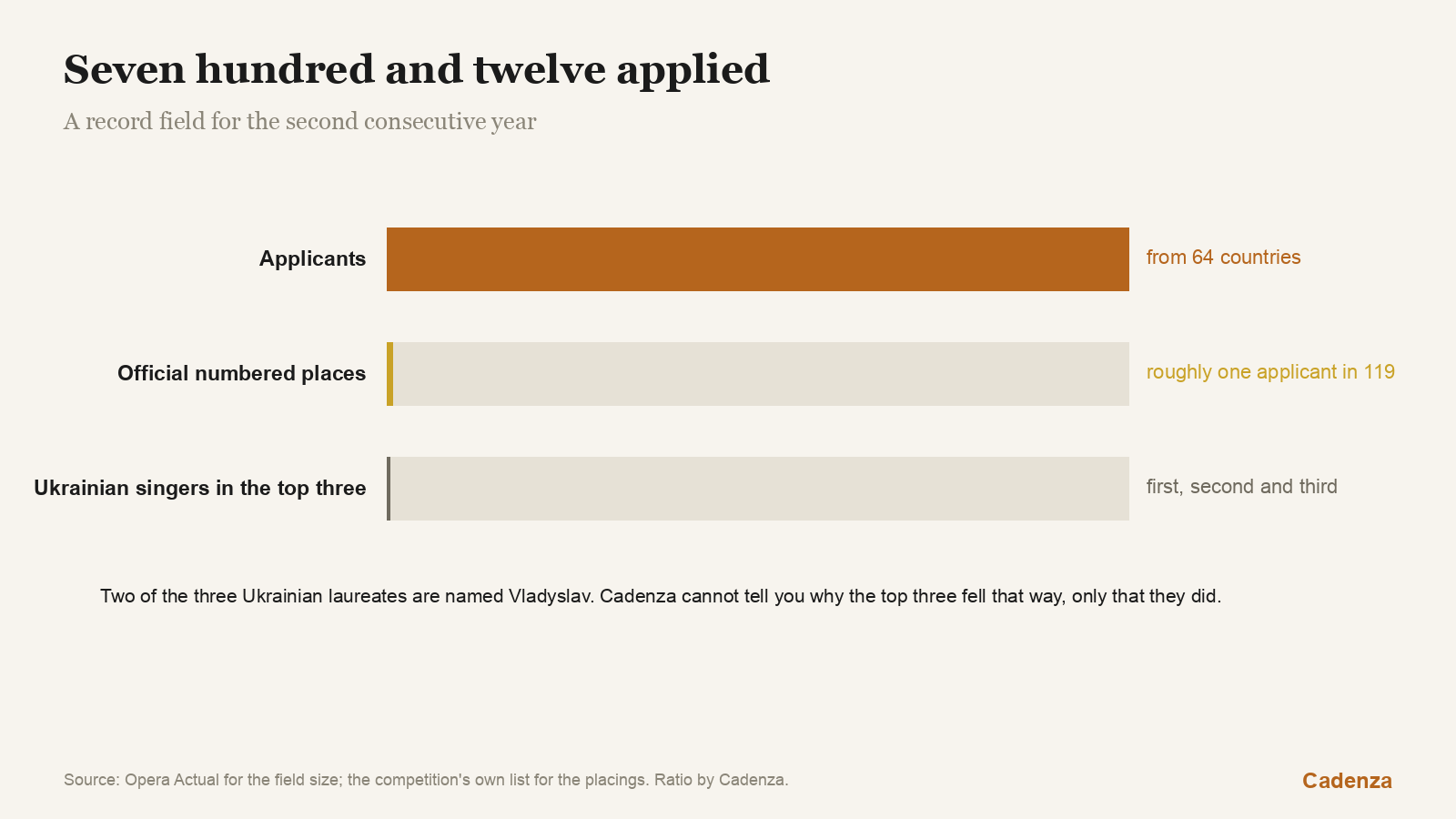
The top three places all went to Ukrainian singers, which is half the official podium.
That is worth stating plainly and without embroidery, because Cadenza cannot tell you why from the documents. What the record shows is that a competition drawing a record 712 applicants from 64 countries placed three Ukrainians first, second and third, and that two of them are named Vladyslav.
The scale of the field is the other number to carry. Seven hundred and twelve applicants for six numbered places is roughly one in 119. The competition reports it as a record for the second consecutive year.
A new category, judged on its own for the first time
The finding Cadenza would lead on if the tenor arithmetic were not so strange is this. In 2026 the Oratorio-Lied category was judged and awarded independently of the opera category for the first time.
That prize, worth €10,000, went to Elionor Martínez, who also placed sixth in the opera ranking. So the first singer ever to hold a standalone Tenor Viñas Oratorio-Lied prize is a Barcelona soprano who took three other awards the same night.
Separating oratorio and song from opera matters more than it sounds. The skills diverge sharply: an opera competition rewards projection, stage instinct and the ability to fill a house, while oratorio and Lieder reward line, text and restraint. A singer built for the second set has historically had to compete in a format designed for the first. Judging them separately is a structural fix, and this is the first year it has been applied here.
What the prize money actually is
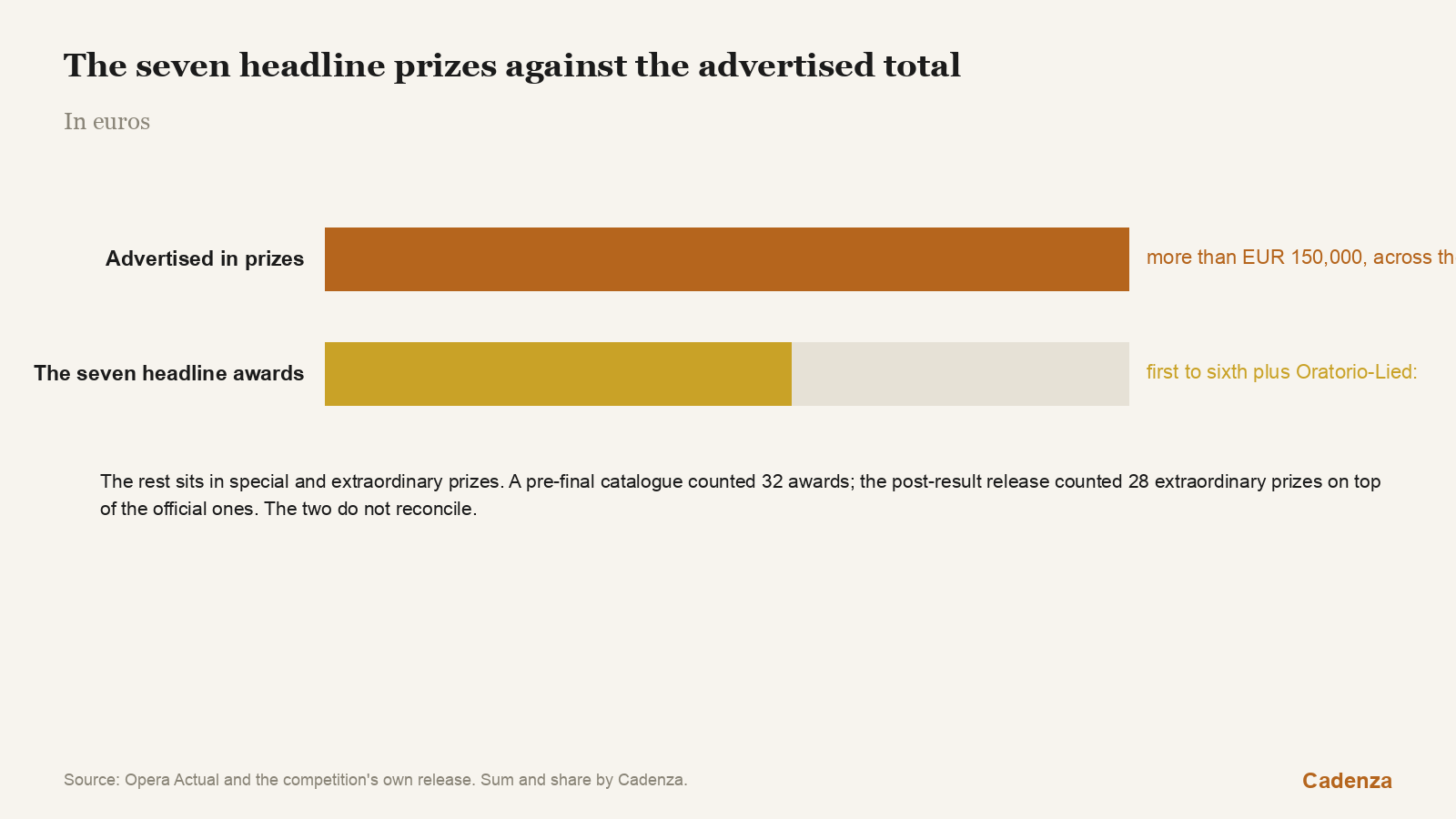
The competition advertises more than €150,000 in prizes. The seven headline cash awards, meaning first through sixth plus the Oratorio-Lied prize, come to €87,000. That is 58 per cent of the advertised total.
The rest sits in special and extraordinary prizes, and this is where Cadenza has to be careful. Before the final, Ópera Actual reported the prize catalogue as 32 separate awards. After the result, the competition's own release said 28 extraordinary prizes had been awarded on top of the official ones. Seven plus 28 is 35, which does not reconcile with 32. Those are two different documents counting two different things, a catalogue of what was on offer and a tally of what was given, so Cadenza is reporting both and asserting neither as the final count.
What is not in doubt is the shape. A singer entering this competition is competing for a very large number of small named awards as well as for six numbered places, and several laureates took three or four things each.
What a Liceu contract is worth
The first prize is not really EUR 30,000. It is EUR 30,000 and a contract with the Gran Teatre del Liceu, and for a singer at this stage the second half is the larger number.
A house contract is paid work, a rehearsal period with a professional company, colleagues who will remember you, and a credit that opens the next audition. Cash is spent. A debut at a house of that standing is permanent on a CV. Cadenza made the same point about the five-concert tour attached to the Premio Jaen and about the four-year cello loan that came with the Queen Elisabeth first prize.
The pattern across all three is the same and it is the most useful thing a competition-hunting musician can know. At the top of a serious competition, the money is rarely the prize. The prize is access to the thing that cannot be bought: an orchestra, a house, an instrument, a diary of dates.
Karla Pineda's night illustrates the point from below. Her Fifth Prize paid EUR 7,000. The Joyce DiDonato Extraordinary Prize from Houston Grand Opera that she took alongside it was worth $17,600, more than twice as much, and it carries an American company's name attached to hers.
Corrections worth making
Cadenza checked the coverage against the competition's own published winners list, and found four errors circulating.
The first prize winner has been called a baritone in at least one headline. The competition and his own listing classify him as a bass-baritone, which is a different voice.
His surname is Buialskyi, with a final i. One outlet renders it Buialsky. The third prize winner is Tlushch, with a final ch; the same outlet renders it Tlushc. Both spellings drop the last letter.
And OperaWire dated the competition to 18 January. The verdict was issued on 16 January, a Friday. The 18th was the winners' concert, held at the same theatre two days later.
One more trap, for anyone writing about Karla Pineda. The competition's own biography page for her lists her special prizes and omits the Fifth Prize entirely. A writer checking only that page would conclude she did not place. The press release states it explicitly, with the amount.
None of these is a scandal. Together they are the reason this newsroom reads the competition's own list before anybody else's.
No missing coverage here
For once the coverage claim runs the other way, and Cadenza tested it.
Every one of the six laureates has genuine English-language coverage: OperaWire articles naming each winner, Operabase profiles for all of them, and the competition's own English pages. Buialskyi has an English Wikipedia article and a Metropolitan Opera artist biography.
So this is not a story about invisibility. It is a story about a well-covered result whose most interesting features, the absent tenors and the new category, nobody has written down.
A year ago it was an application
Seven hundred and twelve people applied to this edition, and the competition publishes its winners list, its prize values and its categories. The 64th edition will run.
Cadenza carries competitions with open deadlines, free to musicians, on its competitions board, and opera and orchestral vacancies on its jobs board.
If you are a singer entering. Read the special-prize list as carefully as the numbered places, because that is where most of the €150,000 sits and where several of this year's laureates made their money. The Joyce DiDonato Extraordinary Prize from Houston Grand Opera was worth $17,600 to the fifth-placed singer, which is more than the €7,000 that came with the placing itself. Note also that from 2026 the Oratorio-Lied category is judged separately, so a singer whose strength is song and oratorio no longer has to be assessed as an opera prospect.
The question the competition will be asked next is a friendly one. It has just separated Oratorio-Lied into its own judged category, and a Barcelona soprano won it while also placing sixth in opera. Will the 64th edition let singers enter one category without the other?
Sources: the competition's own winners list and its news and press releases, which carry every laureate's voice type, nationality and birth year, each prize name and cash value, the 16 January 2026 verdict date, the description of Buialskyi as a 28-year-old Ukrainian bass-baritone, the €10,000 Oratorio-Lied prize and the statement that it was judged independently for the first time, and the tally of 28 extraordinary prizes; Ópera Actual for the field of 712 applicants from 64 countries, the more than €150,000 in prizes and the 32-award catalogue, and for the 18 January winners' concert at the Liceu; and OperaWire and Beckmesser, which are the sources of the date and spelling errors noted above. English-language coverage of all six laureates was verified individually. The prize totals, the applicant ratio and the share of the advertised purse are Cadenza's arithmetic.
Cover photograph: the Gran Teatre del Liceu, Barcelona. Chabe01, CC BY-SA 4.0, via Wikimedia Commons. Charts by Cadenza.
Cover photograph: The Gran Teatre del Liceu in Barcelona, where the Concurso Internacional de Canto Tenor Viñas holds its final and its winners' concert. Chabe01, CC BY-SA 4.0, via Wikimedia Commons.
Comments
Sign in to join the discussion.