This investigation follows a single contract — extended to 2031 by a unanimous vote, dissolved in 2026 behind a confidentiality clause, and still unpriced — and the court decision that has ordered the Salzburg Festival Fund to say what it cost.
Appointed until 2031. Paid to leave in 2026. A court has now ordered the Salzburg Festival Fund to reveal the total cost — and whether it is examining claims against the trustees who made the deal.
Cadenza Investigations · 2 August 2026
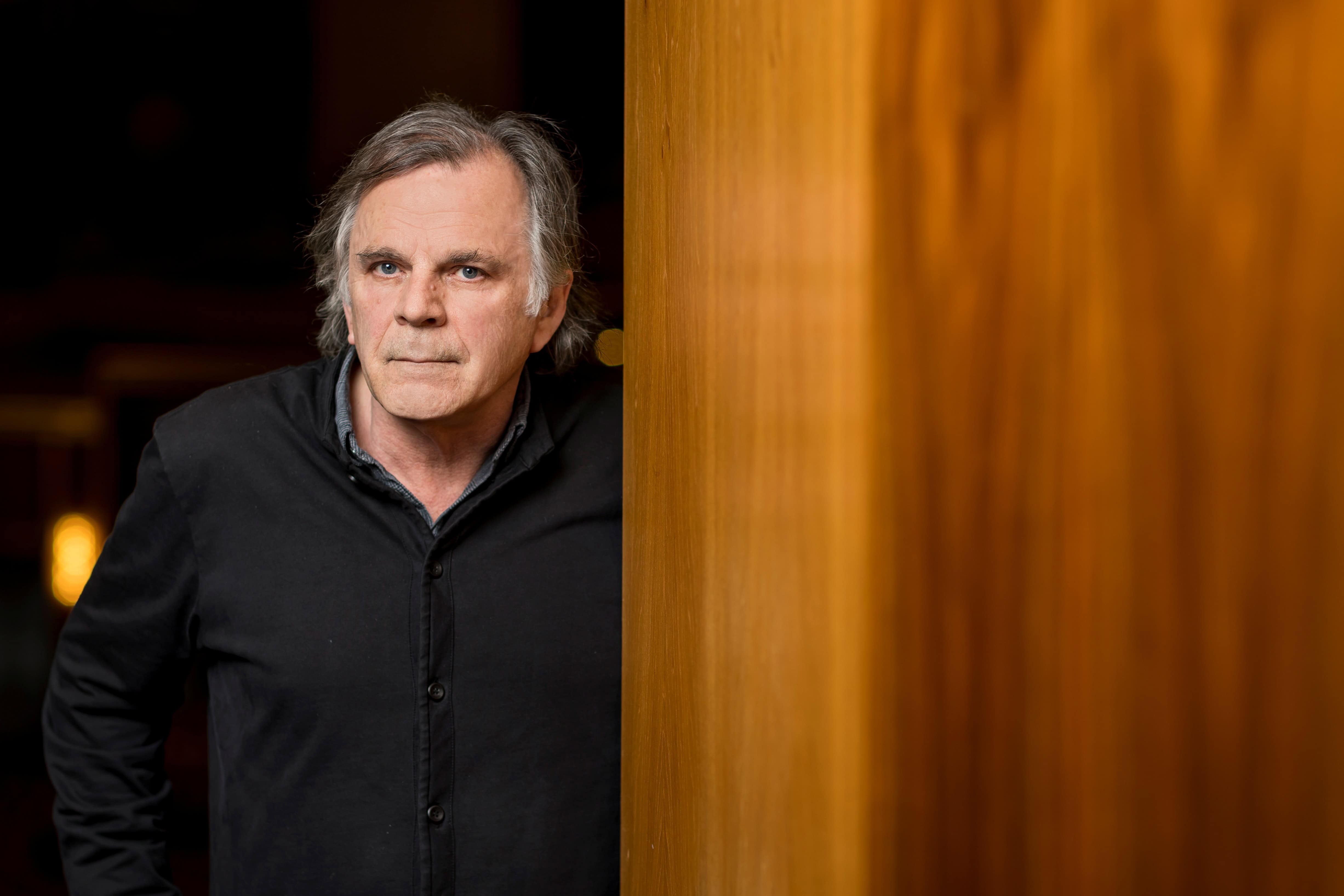
Markus Hinterhäuser. Credit: © SF/Neumayr/Leo. Used for current editorial reporting under the Salzburg Festival photo-service terms.
On 4 April 2024, the Salzburg Festival announced what it called an important decision for its future.
Markus Hinterhäuser had emerged from a formal selection process as the clear favourite to remain artistic director. The Festival said his contract would be extended by five years, from 1 October 2026 through 30 September 2031. The five voting trustees approved the decision unanimously. They praised continuity, international success, planning security, artistic courage and Hinterhäuser’s detailed knowledge of the vast renovation project facing the Festival. A mutual break option existed for 30 September 2029, but the message was unmistakable: Salzburg had chosen its artistic future.[1]
Twenty-three months later, that future was cancelled.
On 26 March 2026, the Festival said Hinterhäuser and the Fund were separating with immediate effect because of irreconcilable differences. He would perform no further executive duties. He would remain on paid leave until the end of his existing contract on 30 September. The extension through 2031 would be dissolved. The parties agreed not to disclose the terms.[8]
The Festival had moved from a unanimous vote of confidence to a confidential exit agreement in less than two years.
Then the public asked what it cost.
The Fund refused to say.
On 27 July 2026, the Salzburg Regional Administrative Court ruled that the requested information had been unlawfully withheld. It ordered the Salzburg Festival Fund to disclose, within six weeks, the total cost arising from Hinterhäuser’s paid leave through 30 September 2026 and the early dissolution of the contract that would have run from 1 October 2026 to 30 September 2031. The court also ordered the Fund to say whether it was examining recourse or damages claims against members of its own Supervisory Board — and, if such an examination had occurred, to disclose its result.[11][12]
The ruling did not declare the separation unlawful. It did not find that any trustee had breached a duty. It did not establish a seven-figure payout. It did not decide whether Hinterhäuser, the Board or both had acted reasonably during the conflict.
It decided something narrower and devastatingly simple:
A public festival cannot hide the total public cost of a leadership agreement merely because the people who signed it promised one another silence.
The Fund’s defence made the case larger.
At the public hearing, its representative argued that disclosure could unsettle sponsors, damage the Festival economically and intensify reputational harm. She said the exact agreement was known only to the five voting trustees. Not even the Festival’s Directorate — the collective executive body responsible for running the institution — knew its precise terms.[11][12]
That statement transforms this from a dispute about one artistic director into a test of cultural governance.
Who authorised the agreement? Who calculated the liability? Who recorded it in the accounts? Who assessed whether the 2024 extension had been designed responsibly? Who decided that the Festival’s own executive leadership should not know the exact arrangement? And why did a court have to order a publicly constituted Fund to disclose the single number that would allow citizens to judge the financial consequence?
The answer is still hidden.
This is the story of the bill Salzburg refused to show.
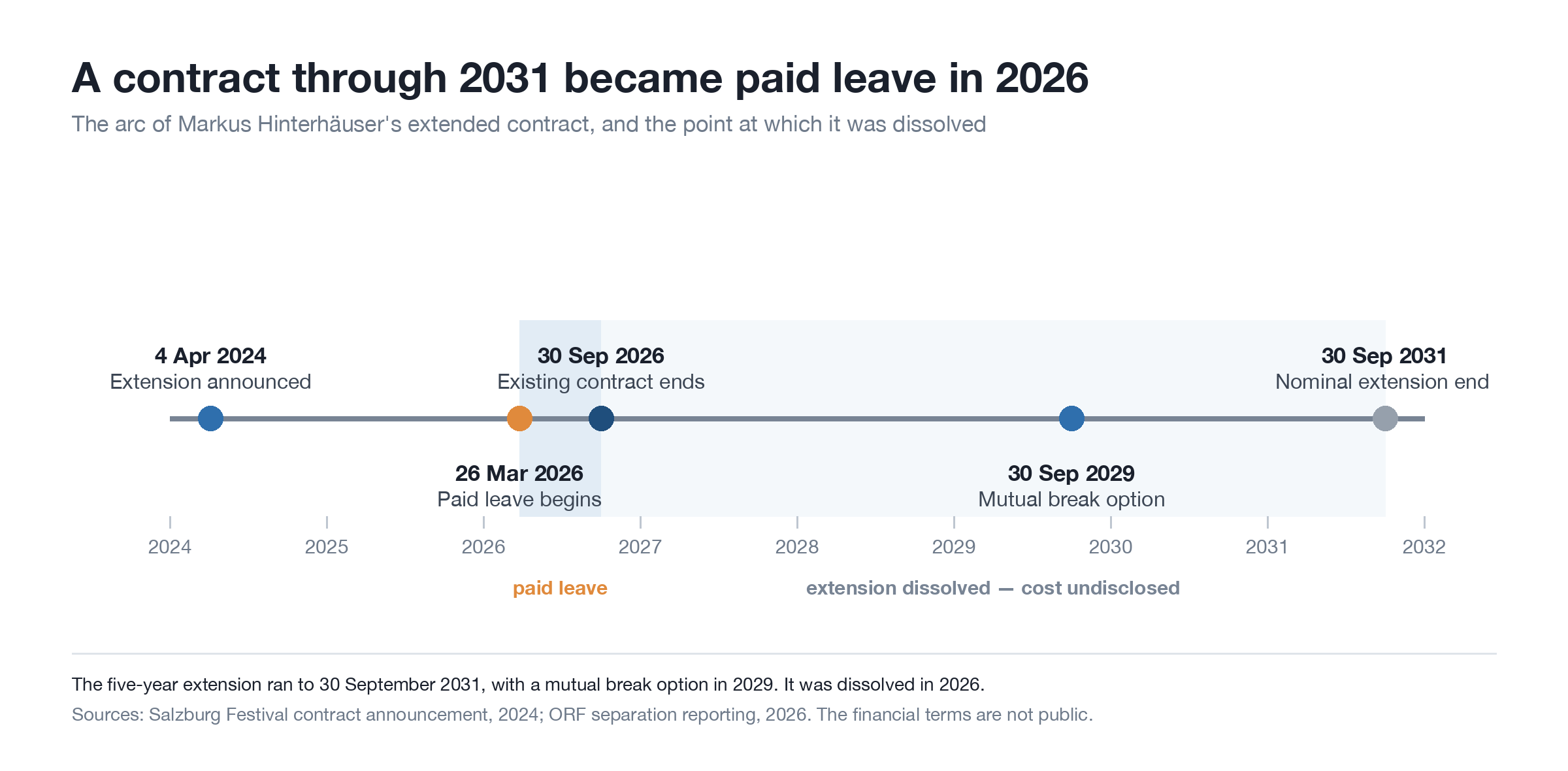
Figure 1. A contract through 2031 became paid leave in 2026. The shaded periods show paid leave and the dissolved extension; they do not estimate the financial settlement.
The facts at a glance
- On 4 April 2024 the Salzburg Festival announced a five-year extension of Markus Hinterhäuser's contract to 30 September 2031, approved unanimously by the five voting trustees, with a mutual break option for 30 September 2029.
- On 26 March 2026 the Festival and Hinterhäuser announced an immediate separation, with paid leave running to the end of the existing contract on 30 September 2026. The terms were kept confidential.
- On 27 July 2026 the Salzburg Regional Administrative Court ordered the Fund to disclose the total cost of the paid leave and the early dissolution — and to say whether it is examining recourse or damages claims against members of its own Supervisory Board.
- The decision concerns access to information. It does not establish that the separation was unlawful, or that any trustee is liable.
- Three of the five voting trustee seats were held by the same individual in 2024 and in 2026.
- Hinterhäuser's FY 2023/24 total remuneration was €336,136.31. This article uses that figure only for transparent arithmetic benchmarks. It is not an estimate of the settlement.
- The 2025/26 Festival budget was €77.28 million, including €22.28 million in direct public contributions.
- The aggregate cost remains undisclosed. This article does not invent a figure.
1. The court asked for one number
The information request at the centre of the judgment was deliberately limited.
The applicant, lawyer and former cultural manager Sven Hartberger, did not ask the court to publish Hinterhäuser’s private correspondence, medical information, bank details or every clause in the exit agreement. According to reports of the hearing and judgment, he asked for the aggregate cost to the Festival Fund.
That total could contain several elements:
- remuneration and employment costs during paid leave;
- compensation connected with terminating the 2026–2031 extension;
- legal fees;
- additional staffing or interim-leadership expense;
- recruitment and consultancy costs created by an unscheduled search;
- other liabilities produced by the agreement.
The court’s order focuses on the combined cost of the leave and dissolution. It also requires an answer on whether possible recourse or damages claims against trustees are being examined.[11][12]
Hartberger told the court that he suspected a loss in the seven-figure range. That is his allegation, not a finding. He withdrew questions about the Festival’s motivation and maintained the request for the total cost on public-interest grounds.[11]
The distinction matters.
A demand for an aggregate number is not equivalent to publishing a personnel file. A public body can protect genuinely private details while disclosing the financial consequence of its decision. Indeed, Austria’s Information Freedom Act, which took effect on 1 September 2025, requires public bodies to balance protected interests against the public right to information. The court concluded that the public interest prevailed here.[13]
The Fund argued the opposite.
It relied on the confidentiality agreement, business and professional secrecy, possible sponsor irritation and reputational or economic damage. According to the court reporting, it said that only the voting Supervisory Board members knew the exact agreement.[11][12]
This defence contains a circular danger.
If the embarrassment caused by disclosure can itself justify secrecy, then the more consequential a public decision becomes, the easier it is to hide. If sponsors might dislike learning the cost, the public is denied the cost. If the public might criticise the agreement, the agreement becomes commercially sensitive. If disclosure might intensify a controversy, controversy becomes the reason not to disclose.
That logic would turn reputational management into an exemption from accountability.
The court rejected it.
The ruling is still open to challenge, and the office of Provincial Governor Karoline Edtstadler said on 30 July that an appeal was being examined. The six-week period therefore should not be converted into a confident calendar deadline without knowing when the judgment was formally served and whether any appeal receives suspensive effect.[11]
But the legal direction is already clear.
The public interest is not an inconvenience surrounding this agreement.
It is the reason the number must be revealed.
2. The unanimous future
To understand the cost question, return to the confidence with which Salzburg created the liability.
The Festival’s 2024 announcement did not sound provisional. It described a competitive hearing, a clear favourite and a unanimous decision. Hinterhäuser’s artistic success, his leadership through the pandemic and his familiarity with the Festival’s coming construction programme were presented as reasons to secure him through 2031.[1]
The extension had three important dates:
| Contract stage | Date | Meaning |
|---|---|---|
| Existing term ends | 30 September 2026 | The contract under which Hinterhäuser was placed on paid leave |
| New term begins | 1 October 2026 | Start of the five-year extension announced in 2024 |
| Mutual break option | 30 September 2029 | Either side could end the extension at this point |
| Nominal extension end | 30 September 2031 | End date publicly announced by the Festival |
The wording matters because the later public conflict blurred two different propositions.
The first was uncontested: Hinterhäuser’s existing term ran to 30 September 2026.
The second became disputed: whether the extension from October 2026 was fully binding, conditional, or capable of being withheld because of a conduct provision. In February and March 2026, the Board said conditions for continuation had not been met. Hinterhäuser maintained that a valid contract through 2031 existed. The disagreement went to lawyers and was then resolved through a confidential settlement.[5][7][8]
The settlement removed the legal contest from public view.
It did not remove its cost.
The people who voted
The 2024 extension was approved under the chairmanship of Hans Scharfetter. The five voting trustees then were:
- Theresia Niedermüller and Maria Fekter for the Republic of Austria;
- Wilfried Haslauer for the Province of Salzburg;
- Harald Preuner for the City of Salzburg;
- Hans Scharfetter for the Salzburg Tourism Promotion Fund.[2]
By 2026, two political seats had changed. Karoline Edtstadler represented the Province and Bernhard Auinger the City. Niedermüller, Fekter and Scharfetter remained.[15]
| Appointing body | Voting member in 2024 | Voting member in 2026 | Continuity |
|---|---|---|---|
| Republic of Austria — seat 1 | Theresia Niedermüller | Theresia Niedermüller | Retained |
| Republic of Austria — seat 2 | Maria Fekter | Maria Fekter | Retained |
| Province of Salzburg | Wilfried Haslauer | Karoline Edtstadler | Changed |
| City of Salzburg | Harald Preuner | Bernhard Auinger | Changed |
| Tourism Promotion Fund | Hans Scharfetter | Hans Scharfetter | Retained |
That distinction prevents an easy but inaccurate accusation. The exact same five people did not both extend and end the relationship.
But institutional continuity was substantial: three of the five voting trustees remained. The legal body was the same. The public funders were the same. The extension survived political changes until the Board declared that its conditions had not been met.
The public is therefore entitled to know not only what the exit cost, but how an agreement celebrated as long-term planning security became a liability within twenty-three months.
| Appointing body | 2024 | 2026 | |
|---|---|---|---|
| Republic of Austria | Theresia Niedermüller | Theresia Niedermüller | same |
| Republic of Austria | Maria Fekter | Maria Fekter | same |
| Province of Salzburg | Wilfried Haslauer | Karoline Edtstadler | changed |
| City of Salzburg | Harald Preuner | Bernhard Auinger | changed |
| Salzburg Tourism Promotion Fund | Hans Scharfetter | Hans Scharfetter | same |
Table 1. The five voting seats of the Salzburg Festival Fund, from the unanimous 2024 extension to the 2026 separation. Hans Scharfetter chaired the 2024 vote. Three seats kept the same person; this does not establish how any individual voted on the separation agreement.
3. The recruitment process that detonated the contract
The immediate crisis concerned the leadership of drama.
After the Festival’s earlier separation from drama director Marina Davydova, the Supervisory Board required a transparent recruitment process for her successor. Twenty-three people applied. Six were invited to a hearing and five attended.[3][4]
Karin Bergmann did not apply and did not attend.
Hinterhäuser nevertheless identified the former Burgtheater director publicly as his preferred candidate. The Board said this undermined the process and risked humiliating applicants who had taken part in good faith. On 3 February, Edtstadler described the warning to Hinterhäuser as a “yellow card”. Auinger publicly raised the question of trust.[3]
The Board’s strongest case is not trivial.
A public cultural institution cannot invite applicants into a supposedly fair process and then behave as though the process never mattered. Even when final artistic authority belongs to an artistic director, recruitment may carry budgetary, employment-law and reputational consequences requiring supervisory approval. ORF reported that Hinterhäuser probably retained formal authority under the rules to appoint the drama director, while the salary likely crossed a threshold requiring Board approval.[5]
The dispute was therefore not a clean battle between art and politics.
It involved overlapping powers.
The artists supporting Hinterhäuser framed it differently. In a public memorandum, prominent signatories including Elfriede Jelinek and Peter Handke warned the Board against interference in artistic decisions and argued that its role should remain focused on financial oversight.[4]
Hinterhäuser’s reported defence was that he had involved Christian Kircher, then connected to the Supervisory Board through the Bundestheater-Holding, and had been told Bergmann could be considered without applying or attending a hearing. He acknowledged communication errors but questioned whether they justified the public declaration of a severe loss of trust.[5][6]
The Board said the problem extended beyond one appointment.
Edtstadler referred to repeated difficulties in cooperation within the Directorate and between the Directorate and Supervisory Board. Anonymous participants later alleged that the 26 February meeting had become confrontational and that concerns included Hinterhäuser’s leadership style and behaviour.[3][6]
Those anonymous descriptions are allegations, not independently established findings. They may reflect genuine workplace concerns. They may also reflect the perspectives of participants in an escalating power struggle. Cadenza cannot resolve them without personnel records, attributable testimony and the parties’ responses.
What can be established is the speed of escalation.
| Date | Event |
|---|---|
| 3 Feb 2026 | The Supervisory Board issues a public "yellow card" over the drama-director recruitment; 23 people had applied |
| 20 Feb 2026 | Prominent artists publish a memorandum backing Hinterhäuser |
| 26 Feb 2026 | No agreement: the Board says a contractual conduct condition is not met |
| 13 Mar 2026 | The one-year transition proposal expires without acceptance |
| 20 Mar 2026 | Board and Hinterhäuser take conflicting positions on the 2031 agreement; lawyers are engaged |
| 26 Mar 2026 | Immediate separation announced; paid leave to 30 September; the extension is dissolved |
| 8 Apr 2026 | Karin Bergmann is presented as interim artistic director through autumn 2027 |
| 30 Apr 2026 | Artistic-director and president posts are advertised |
| 6 Jul 2026 | A public oral hearing is held on the information-access dispute |
| 27 Jul 2026 | The court rules the information was unlawfully withheld and orders disclosure |
| 30 Jul 2026 | The decision becomes public; an appeal is said to be under examination |
Table 2. In 174 days, a recruitment dispute became an information-freedom judgment. Compiled from official Festival material and ORF/APA reporting. The judgment concerns information access, not the legality of the separation.
4. Five hours, one year, then lawyers
On 26 February, the Supervisory Board said it was collectively of the view that Hinterhäuser had not met conditions for continuing beyond September 2026. It presented an alternative offer, initially without details.[5]
Subsequent reporting described that offer as one additional year, through September 2027, including permission for Hinterhäuser to appoint Bergmann to lead drama. The arrangement was framed as a path to an orderly transition.[6]
The meeting lasted for hours and ended without agreement.
Accounts attributed to unnamed Board participants said the session had escalated and that attempts to produce a face-saving joint statement failed. Hinterhäuser reportedly asked political Board members to apologise for their public statements. He said he had kept a Board representative informed. The Board believed that broader conduct and trust conditions had not been satisfied.[6]
A deadline was set for 13 March.
Hinterhäuser did not accept the one-year offer by that date. He maintained that the extension through 2031 was valid. On 20 March, Edtstadler publicly acknowledged that the Board and Hinterhäuser held different legal views about the contract and that lawyers would have to resolve them.[7]
Six days later, the dispute was over.
Not adjudicated.
Settled.
The Festival announced an immediate separation. Hinterhäuser would be on leave until 30 September. The extension would not proceed. Both sides would remain silent on the terms.[8]
The settlement achieved operational certainty.
It also created the secrecy now condemned by the court.
There is a basic governance trade-off in employment disputes. Confidential settlements can stop litigation, protect staff, prevent years of legal expenditure and let an institution continue working. Public bodies are not prohibited from settling. Nor should every private allegation be placed online.
But a settlement can be commercially rational and still require financial disclosure.
Salzburg’s error was to treat those propositions as opposites.
5. The Bergmann paradox
The crisis began because Hinterhäuser wanted Karin Bergmann to run drama without her participating in the advertised process.
The crisis ended with the Supervisory Board appointing Karin Bergmann to run the entire artistic institution on an interim basis.
That sequence does not establish wrongdoing by Bergmann.
She said she would have had no problem attending a hearing but had been told that she did not need to. At her April press conference, she acknowledged the extraordinary optics and described herself as a bridge-builder. She praised Hinterhäuser’s artistic achievement, said she was not taking the role against him and noted that the unresolved questions remained difficult because neither side was speaking clearly.[9]
Her appointment may have been the Board’s most practical solution. She had major institutional experience, was already central to the dispute and could provide continuity for programming planned years in advance.
But the decision produces an unavoidable public question:
If Bergmann’s exclusion from the recruitment process was serious enough to help destroy trust in Hinterhäuser, why was she suitable for appointment to a more powerful role without the same process?
The positions were different. Drama director and interim artistic director are not interchangeable jobs. An emergency interim appointment is not the same as a permanent recruitment. The Board may have had lawful authority and urgent operational reasons.
That is the strongest distinction.
It does not eliminate the contradiction in public perception.
The person presented as evidence that Hinterhäuser had disrespected a transparent process became the person chosen to manage the consequences of his removal.
By 30 April, the Festival had advertised both the presidency and artistic directorship. The presidency search was scheduled because Kristina Hammer’s term was ending. The artistic-director search was unscheduled because of the March separation. Bergmann was to bridge the institution until the new permanent artistic leadership began.[10]
The cost of that unplanned transition is part of the public-interest ledger, even if it is not separately itemised in the court’s order.
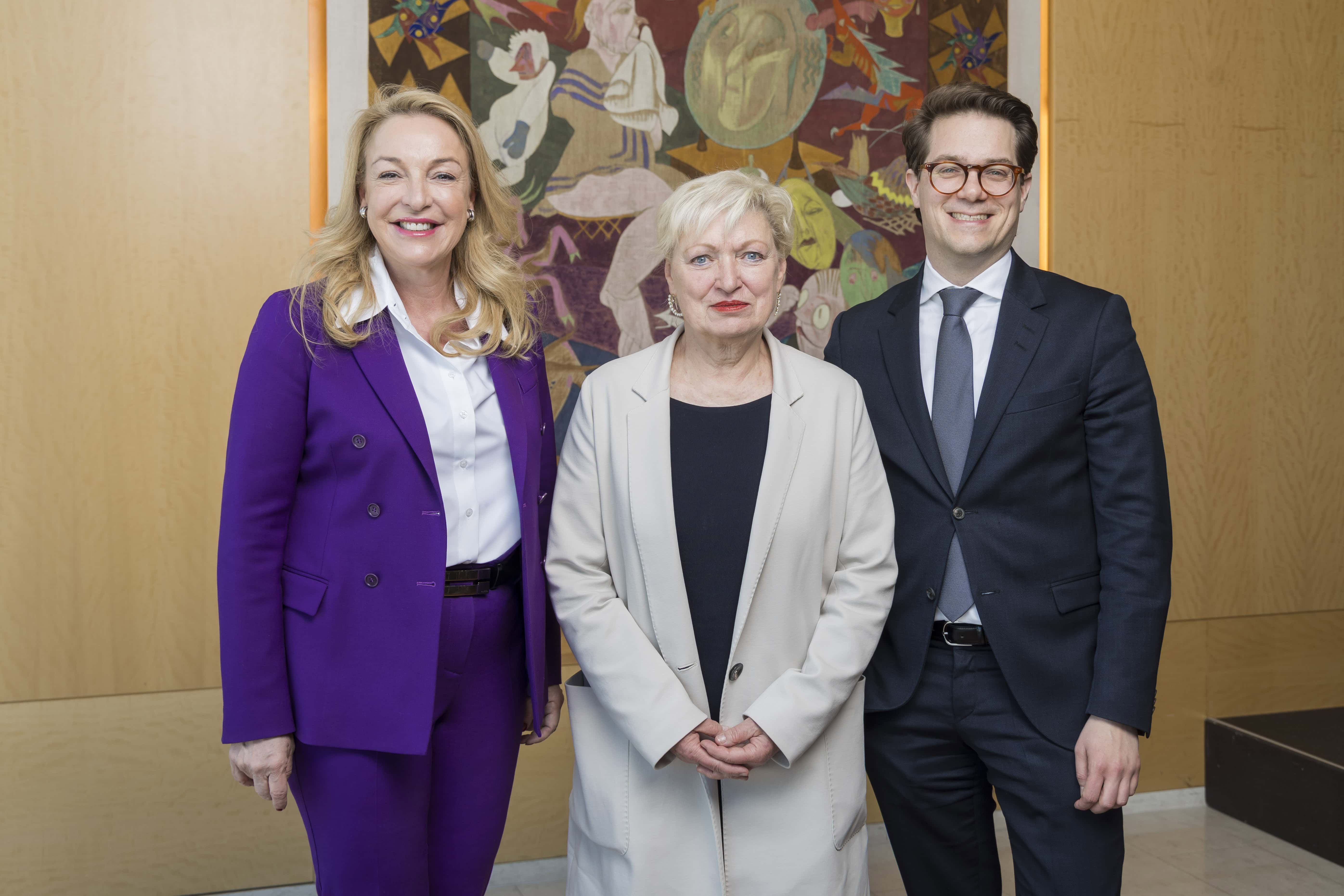
The interim Directorate on 8 April 2026: President Kristina Hammer, Interim Artistic Director Karin Bergmann and Executive Director Lukas Crepaz. Credit: © SF/Neumayr/Leo. Used for current editorial reporting under the Festival’s photo-service terms.
6. The agreement the Directorate did not know
The Salzburg Festival is not a private club with a single owner.
Its legal body is the Salzburger Festspielfonds, a public-law fund established by federal statute. Its organs include a Supervisory Board and a Directorate. The Festival’s own organisational description says the Directorate runs the Festival and proposes the budget, while the Supervisory Board appoints the directors and approves the programme, budget and accounts.[14][15]
Its Corporate Governance Code goes further.
The Directorate is designed as a collective body. Its members share responsibility for managing the Fund, owe one another information, and make important decisions together. The Supervisory Board oversees management, approves central plans and is subject to a duty of care comparable to that of a corporate supervisory board. The Code emphasises timely reporting, coordination and transparency while also protecting the confidentiality of Board deliberations.[16][17]
Against that structure, the Fund’s statement in court is extraordinary:
Only the five voting trustees knew the exact separation agreement. The Directorate did not.[11][12]
That may have a lawful explanation.
One member of the Directorate was the counterparty to the agreement. The other executive members might have had conflicts, or the Board might have concluded that negotiations had to remain tightly contained. External lawyers may have handled the matter. “The exact agreement” may also mean the full legal document rather than the aggregate financial provision recorded by finance staff.
But those possibilities are not answers.
They are questions requiring answers.
The Directorate includes the executive director responsible for operational and financial administration. If the Directorate did not know the exact arrangement, who instructed the accounting treatment? What liability was recognised? Which budget line absorbed it? Which executive officers were told the total, even if they did not see every clause? When did the auditors learn it? Was the agreement disclosed to the Assembly of Delegates? Was it recorded in minutes? Was its confidentiality expressly approved under the governance rules?
The Festival’s governance code says Board meetings are confidential, but Board resolutions are not automatically confidential unless confidentiality is expressly decided.[16]
Cadenza has found no public document answering whether such a decision was made for the Hinterhäuser agreement, who supported it or how the financial consequences were communicated to the institution’s other organs.
The court has now required the Fund to disclose the total.
The Fund should disclose the governance trail too, with legitimate personal and legal details redacted.
7. What could be inside the bill
As of 31 July 2026, the actual total is unknown.
That sentence is the most important financial fact in this article.
Anyone publishing a confident payout number before disclosure is estimating, alleging or guessing.
The cost could include the following components:
| Component | Public amount | Status |
|---|---|---|
| Paid leave through 30 September 2026 | Unknown | Explicitly included in court order |
| Dissolution of the 2026–2031 extension | Unknown | Explicitly included in court order |
| Settlement or damages payment | Unknown | Possible component; not established |
| Legal fees | Unknown | Possible component; not separately ordered |
| Interim leadership or additional staffing | Unknown | Possible component; not separately ordered |
| Unscheduled recruitment and consultancy | Unknown | Search confirmed; amount not published |
| Review of possible claims against trustees | Unknown | Whether it exists, and any result, must be disclosed |
One official figure provides a benchmark, not an answer.
The Festival’s Corporate Governance Report says Hinterhäuser received total remuneration of €336,136.31, including benefits, in the 2023/24 financial year.[2]
If that annual amount were mechanically prorated across the 189 calendar days from 26 March through 30 September 2026, it would equal approximately €174,054. One year equals €336,136. Three years — the period from the extension’s start to its 2029 break point — equals about €1.008 million. Five years equals about €1.681 million.
None of those numbers is the settlement.
They do not account for salary changes, pension and payroll treatment, contractual definitions, mitigation, tax, legal rights, severance classification, the 2029 option, or the negotiations that ended the dispute. They do not prove that Hinterhäuser received three or five years of remuneration. They do not prove a seven-figure loss.
They show why disclosure matters.
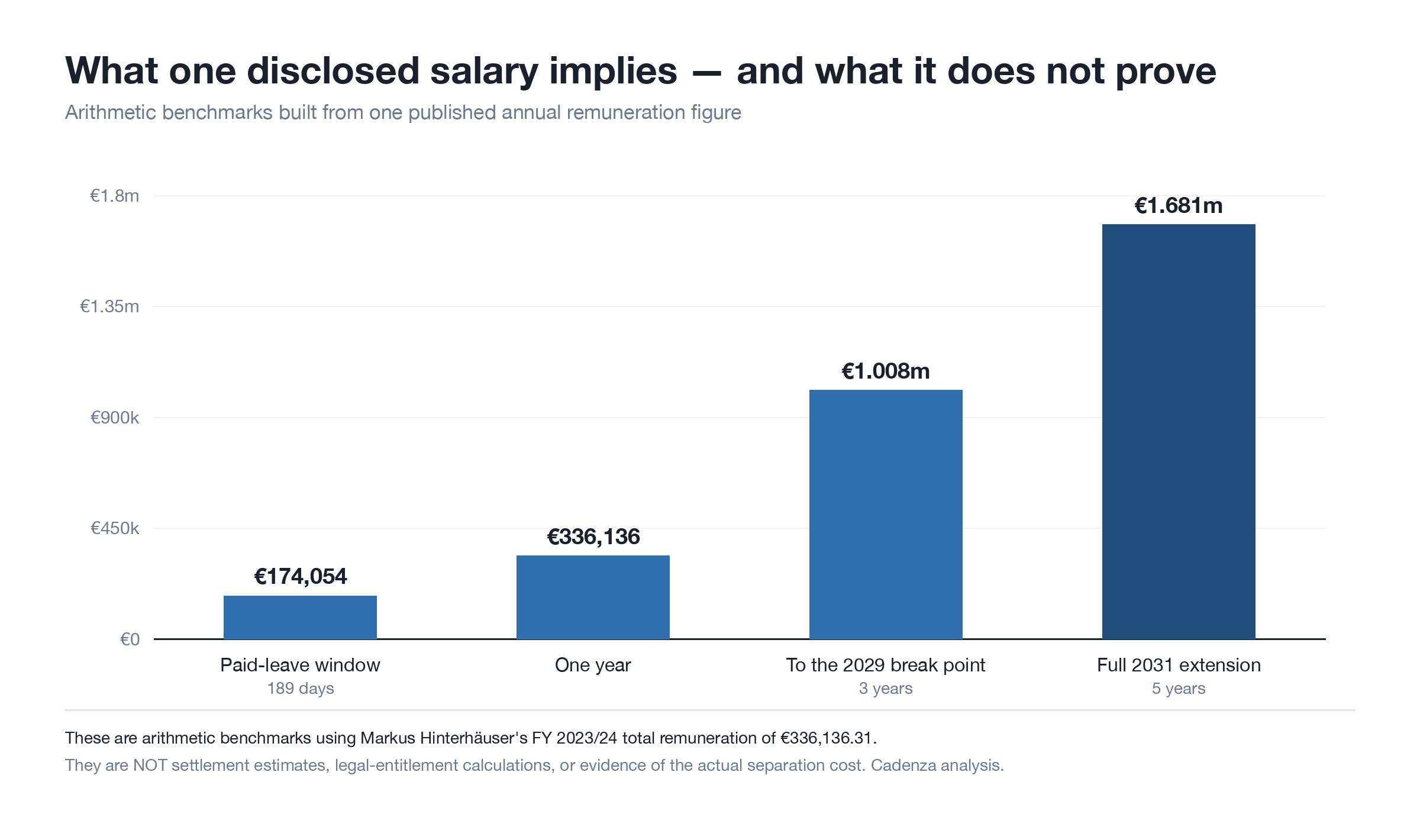
Figure 2. Arithmetic benchmarks based on the disclosed FY 2023/24 remuneration. These are not estimates of the actual agreement.
The Festival’s own severance rule
The Corporate Governance Code contains another crucial provision. It says service contracts for Directorate members should be structured so that severance on early termination without important cause does not exceed one year’s total remuneration and does not compensate beyond the remaining term. If termination arises from an important cause attributable to the director, the Code says no severance should be paid.[16]
That provision narrows the questions but does not answer them.
Was the 2024 extension drafted in accordance with that rule? Did the parties dispute whether an important cause existed? Was any payment classified as severance, damages, salary, consideration for dissolving a disputed future agreement, legal costs or something else? Did the agreement include non-cash terms? Did the 2029 break option limit exposure? Did the Fund’s lawyers advise that settlement was cheaper than litigation?
The court-ordered total will not necessarily resolve every category.
The Fund should publish the components.
Otherwise the public may receive a single number without learning which decision created it.
8. The public money structure
The Salzburg Festival is commercially powerful.
Its 2025 final report recorded €31.14 million in gross summer revenue, 256,600 visitors and 98.4 per cent occupied seats.[19]
It is also publicly financed and publicly backstopped.
The approved 2025/26 budget was €77.28 million. Direct contributions were €8.9 million from the Republic of Austria and €4.46 million each from the Province of Salzburg, the City of Salzburg and the Tourism Promotion Fund — €22.28 million in total, approximately 28.8 per cent of the budget.[18]
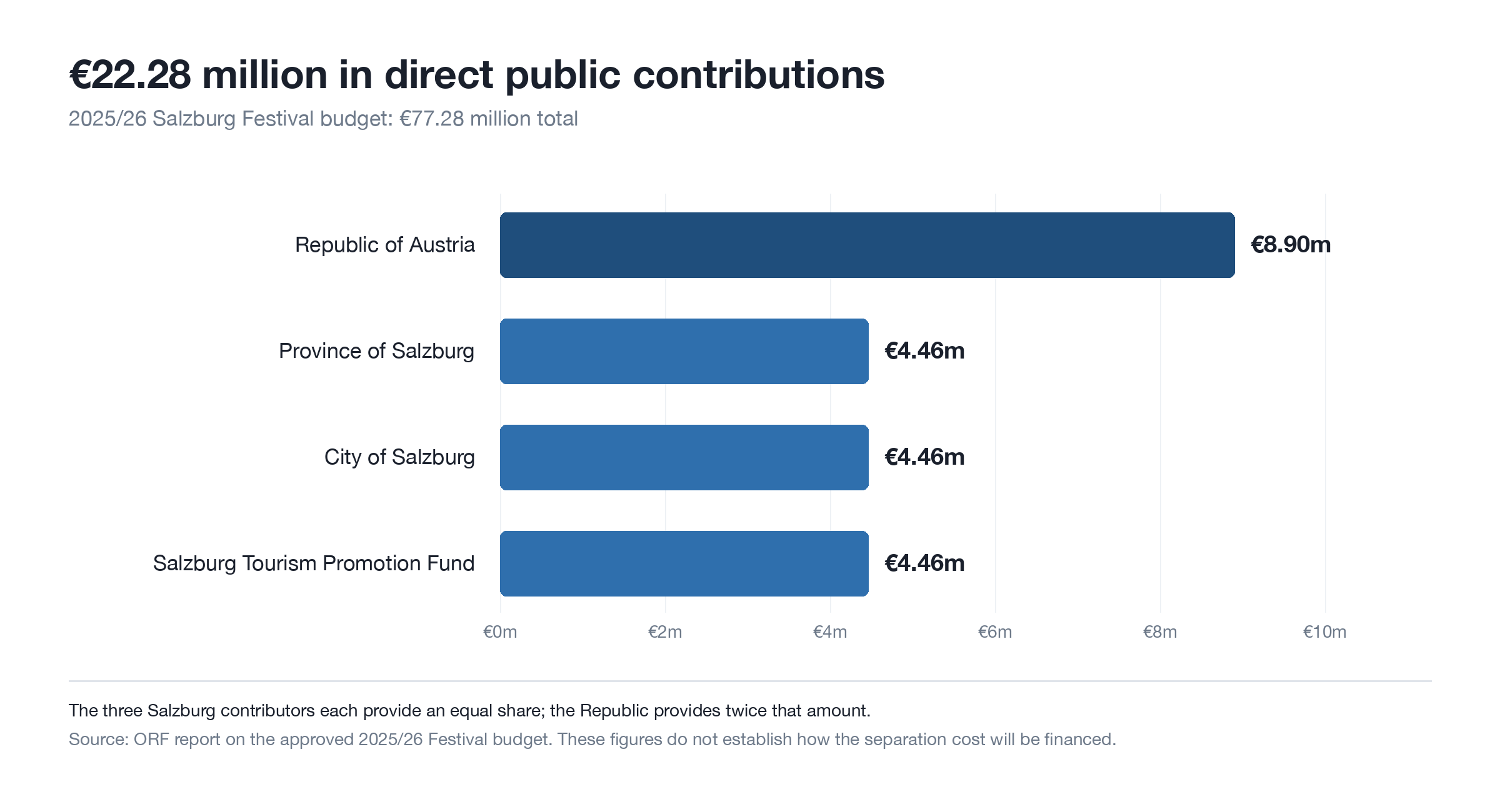
Figure 3. Direct public contributions to the 2025/26 Festival budget. These figures do not establish which revenue source will bear the separation cost.
The founding law also provides a deficit backstop: uncovered deficits are allocated 40 per cent to the federal government and 20 per cent each to the Province, City and Tourism Promotion Fund.[14]
That does not mean the Hinterhäuser agreement will automatically be invoiced in those proportions. The cost may be met through operating revenue, reserves, savings, insurance, budget reallocations or another accounting route. The Festival reported that its existing budget gap from the absence of inflation adjustment was already being addressed through higher revenue, administrative and personnel savings, and the release of programme reserves.[18]
The conditional point is still important.
This is not an institution whose financial downside belongs exclusively to private owners. Public bodies fund it directly and stand behind its deficits under law.
The public has a legitimate interest in knowing whether a confidential leadership settlement consumed money that otherwise would support productions, staff, infrastructure, reserves or public contributions.
The Fund argued that revealing the amount might disturb sponsors.
There is evidence that sponsor relations were already affected by the separation. At least one named supporter was reported to have announced the end of sponsorship from 2027 in protest at the treatment of Hinterhäuser.[21]
That makes transparent accounting more necessary, not less.
Sponsors can judge the facts. Taxpayers can judge the facts. Artists can judge the facts. Concealing the total does not protect confidence indefinitely. It converts every estimate into a rumour and every refusal into evidence for the most extreme suspicion.
9. The governance standard Salzburg wrote for itself
The Festival’s Corporate Governance Code begins from an ambitious premise: the institution depends on trust among public funders, audiences, artists, sponsors and partners, and therefore requires transparent, responsible leadership.[16]
Its rules assign distinct duties:
- the Directorate manages the Fund collectively;
- the Supervisory Board controls and supports management in decisions of fundamental importance;
- the Board appoints and removes Directorate members;
- the Board approves budgets, accounts and artistic planning;
- trustees carry a duty of care comparable to supervisory directors of a company;
- Board members are unpaid;
- important information should be communicated regularly, promptly and comprehensively;
- resolutions are distinct from confidential deliberations.
The court case exposes a gap between the stated model and the public record.
The Board exercised its strongest power: it ended the relationship with the artistic director.
It entered a confidential agreement whose exact terms, according to its own court representative, were not known to the Directorate.
It refused to disclose the total cost.
It argued that the reputational consequences of disclosure justified secrecy.
The court ruled that the refusal was unlawful.
This does not prove that the agreement itself violated the governance code. Cadenza has not seen the contract, minutes, legal opinions, accounting entries or the judgment in its complete authenticated form. The Board may have obtained extensive advice and concluded that settlement protected the Festival from a larger exposure.
But responsible governance is not demonstrated by the existence of advice that the public cannot see.
It is demonstrated by a record showing that decision-makers identified the alternatives, quantified the risks, managed conflicts, documented the vote and disclosed the financial consequence.
Salzburg has disclosed none of that.
An old warning, not a current verdict
The Austrian Court of Audit examined the Festival Fund’s operations for the years 2004/05 through 2009/10 and published critical findings in 2012. Among other matters, it identified weaknesses in structural separation, documentation, internal controls, procurement and conflict management. Follow-up reporting recorded substantial reforms and implementation of many recommendations.[20]
That audit is old. It does not prove misconduct in 2026.
Its relevance is institutional rather than accusatory. The Festival Fund has known for more than a decade that blurred lines between supervision, operations and public accountability can become financial risks. Its later governance code was designed in part to create clearer responsibilities.
The current crisis tests whether those improvements function when the decision is politically difficult, artistically explosive and financially sensitive.
10. The strongest defence of the Board
A serious investigation must state the Supervisory Board’s case at full strength.
The Board had a duty to protect the Festival, not one individual.
It may have received complaints or evidence about workplace conduct that could not responsibly be published. It may have believed Hinterhäuser repeatedly undermined collective governance. It may have concluded that his handling of the drama recruitment process damaged applicants and made trust impossible. It faced a massive construction programme, leadership turnover and long-range artistic commitments that require stable cooperation.
The Board did not simply dismiss him without discussion. It demanded an explanation. It held multiple meetings. It reportedly offered a one-year transition and allowed him to appoint Bergmann to drama. When the legal positions diverged, it used lawyers. A negotiated separation may have avoided litigation, injunctions, further management paralysis and a larger cost.
Confidentiality can be legitimate in employment agreements. It can protect complainants, private information, legal strategy and the dignity of the departing person. Public disclosure of every allegation could harm staff and expose the Fund to liability.
The Board’s obligation to act cannot be paralysed by the artistic status of the person involved.
Successful art is not immunity from management standards.
All of that may be true.
None of it requires hiding the total cost.
The court did not order the Festival to publish untested allegations or private personal material. It ordered the aggregate financial consequence and an answer about whether claims against trustees are being examined.
The Board can protect privacy and still show the bill.
11. Why the defence of secrecy fails
The number belongs to the public-interest side of the line
The Fund is a public-law body. Its budget is approved by representatives of public funders. Its deficits are statutorily backstopped. The agreement terminated a publicly announced leadership contract central to the institution’s future.
An aggregate cost is not an intimate detail.
Confidentiality cannot bind the public out of a statutory right
The Fund and Hinterhäuser were free to promise each other silence within the limits of law. They were not free to contract away the Information Freedom Act.
The court’s ruling confirms that distinction.
Sponsor sensitivity is not a substitute for accountability
Sponsors may dislike the amount. They may dislike the removal. They may dislike the secrecy. The Fund cannot know which fact will cause the greatest damage until the facts are disclosed.
Reputation is not protected by forcing the public to guess.
The Directorate’s exclusion raises operational questions
The claim that the Directorate did not know the exact agreement may reflect a narrow legal meaning. But the statement requires an explanation of how management, accounting, budgeting and audit were performed.
The public body must show who knew what, when.
The 2024 decision cannot disappear
The Board publicly sold the extension as planning security. It praised Hinterhäuser’s knowledge of the renovation challenge. That decision created potential exposure. The 2026 Board may have inherited part of it, but three voting trustees were continuous.
Accountability must cover both moments: the extension and the exit.
The question about trustee claims is not optional
The court specifically ordered the Fund to say whether recourse or damages claims against trustees are being examined.
The answer may be no.
A no would not prove a failure. A yes would not prove liability. But silence is no longer sufficient.
12. What the court did — and did not — decide
Precision is essential because this case is already surrounded by rhetoric.
The court did decide:
- the Festival Fund unlawfully withheld the requested information;
- the public interest outweighed the asserted secrecy interests for the requested total;
- the Fund must disclose the combined cost arising from paid leave and dissolution of the extension;
- the Fund must answer whether possible recourse or damages claims against trustees are being examined and disclose any completed result;
- the order allows six weeks, subject to the procedural realities of service and any appeal.
The court did not decide:
- that Hinterhäuser’s removal was unlawful;
- that the extension was enforceable through 2031 on Hinterhäuser’s interpretation;
- that the Board’s interpretation of a conduct clause was correct or incorrect;
- that any trustee acted negligently or is personally liable;
- that the total is seven figures;
- that the agreement was financially irrational;
- that Bergmann’s appointment was improper;
- that an appeal will fail.
Cadenza will not convert an information-access victory into findings the court did not make.
The facts are powerful enough without exaggeration.
13. The documents Salzburg should publish
The court-ordered number should be the beginning of disclosure, not the end.
The Festival Fund should publish, with necessary personal redactions:
- The total cost, as ordered by the court.
- A component breakdown separating paid leave, extension dissolution, legal expense, interim staffing, recruitment and other material costs.
- The accounting treatment: when the liability was recognised, which period bears it and which funding source or reserve covers it.
- The legal basis for the agreement, including the effect of the 2029 break option and the disputed conduct condition.
- The decision record: date, responsible organ, attendance, conflicts, vote and whether confidentiality of the resolution was expressly approved.
- The options analysis comparing settlement with litigation, a 2029 termination, the one-year transition and other alternatives.
- The information trail showing what the Directorate, auditors, Assembly of Delegates and public funders were told.
- The recourse review, including whether claims against trustees were considered, by whom and with what conclusion.
- The transition costs of interim leadership and the unscheduled recruitment process.
- A permanent disclosure policy for future executive settlements above a defined public threshold.
This is not a demand that every private sentence be exposed.
It is a demand that public governance become legible.
14. The programme remained. The director did not.
The 2026 Salzburg Festival is still artistically Hinterhäuser’s festival.
The Festival’s own website credits him with the “Artistic Concept 2026”. Programme presentations, productions and long-planned artistic relationships continue under the institution that placed him on leave.[15]
That fact makes the separation unusual in a way no legal formula can conceal.
The Board removed the person while presenting the world he had planned.
The Festival opened. The performances continued. Tickets were sold. Sponsors were thanked. The interim leadership stood before the cameras. The institution did what great institutions are designed to do: survive the departure of an individual.
But institutional survival is not institutional innocence.
The Board may ultimately show that it protected staff, preserved operations and negotiated the least expensive exit available. It may show that the 2024 contract contained enforceable conditions and that the settlement remained within the Festival’s own severance limits. It may show that no claim against any trustee is warranted.
Those are possible conclusions.
They require evidence.
What Salzburg cannot credibly say is that the cost itself is none of the public’s business.
The Fund was established by law. Its governors represent the Republic, the Province, the City and the Tourism Fund. Its deficits have a public backstop. Its own code promises responsible and transparent governance. It created the contract, ended the contract, kept the agreement inside five voting seats and refused the number.
A court has now said no.
Salzburg can remove an artistic director.
It cannot remove the public from the invoice.
The curtain has already risen.
The bill remains backstage.
The court has ordered it brought into the light.
Right of reply and response status
On 2 August 2026 Cadenza sent tailored questions to the Salzburg Festival press office and to the Salzburg Festival Fund, asking that they be forwarded to the Supervisory Board, Kristina Hammer, Lukas Crepaz, Karin Bergmann and Markus Hinterhäuser; and to the Province of Salzburg, the City of Salzburg, the Salzburg Tourism Promotion Fund and the federal culture ministry, with a response deadline of 15 August 2026. Cadenza separately asked the Salzburg Regional Administrative Court for the complete written judgment and for confirmation of whether an appeal has been filed and whether it has suspensive effect. At the time of publication the complete written judgment had been requested but not obtained, the appeal status was not known, and no response had been received from any recipient. Silence is not treated here as an admission. Any response will be published in full or summarised accurately and attributed, and this article will be updated to carry it.
Methodology and evidence standard
Cadenza reconstructed the sequence using:
- the Salzburg Festival’s official 2024 contract-extension announcement;
- the Festival’s current organisation page;
- its Corporate Governance Report, Corporate Governance Code and Directorate rules;
- the federal statute establishing the Salzburg Festival Fund;
- official Festival budget and final-report material;
- contemporaneous ORF and APA reporting from February through July 2026;
- reporting on the 27 July judgment and 6 July public hearing;
- arithmetic calculations based on the Festival’s disclosed FY 2023/24 remuneration figure.
The full judgment was not publicly available in an authenticated court database when this draft was prepared. The court findings are therefore described from consistent reports quoting the decision. Cadenza should replace or supplement those reports with the complete judgment if it becomes available before publication.
The salary-equivalent calculations are simple benchmarks. They are not estimates of the settlement, the legal value of the extension or any person’s entitlement.
The historical Austrian Court of Audit material is used only as institutional context. It concerns earlier periods and is not evidence of current misconduct.
The article distinguishes:
- confirmed events and official records;
- claims attributed to the Board, Hinterhäuser, the applicant or anonymous participants;
- Cadenza’s calculations;
- Cadenza’s analysis and questions;
- facts that remain unknown.
Sources
- Salzburg Festival, “Markus Hinterhäuser Remains Artistic Director of the Salzburg Festival,” 4 April 2024. Open source
- Salzburg Festival, Corporate Governance Report FY 2023/24. Open source
- ORF Salzburg, “Festspiele: ‘Gelbe Karte’ für Intendant Hinterhäuser,” 3 February 2026. Open source
- ORF Salzburg, “Künstler stellen sich hinter Hinterhäuser,” 20 February 2026. Open source
- ORF Salzburg, “Keine Einigung über Hinterhäuser-Zukunft,” 26 February 2026. Open source
- ORF Salzburg, “Kuratoriumssitzung mit Hinterhäuser eskalierte,” 27 February 2026. Open source
- ORF Salzburg, “Intendanz wird Fall für Rechtsanwälte,” 20 March 2026. Open source
- ORF Salzburg, “Festspiele trennen sich sofort von Hinterhäuser,” 26 March 2026. Open source
- Salzburg Festival, “Karin Bergmann appointed Interim Artistic Director,” 8 April 2026; ORF Salzburg, “Bergmann sieht sich als ‘Brückenbauerin’,” 8 April 2026. Open source
- ORF Salzburg, “Festspiele: Intendanz und Präsidentschaft ausgeschrieben,” 30 April 2026. Open source
- ORF Salzburg / APA, “Hinterhäuser-Trennung: Festspiele müssen Kosten offenlegen,” 30 July 2026. Open source
- Der Standard / APA, “Festspielfonds muss Gesamtkosten der Hinterhäuser-Trennung offenlegen,” 30 July 2026. Open source
- Republic of Austria, Information Freedom Act, consolidated version effective 1 September 2025. Open source
- Republic of Austria, federal law establishing the Salzburger Festspielfonds, 1950. Open source
- Salzburg Festival, “Organisation,” accessed 31 July 2026. Open source
- Salzburg Festival, Corporate Governance Code. Open source
- Salzburg Festival, Rules of Procedure for the Directorate. Open source
- ORF Salzburg, “Festspielkuratorium gibt Haushaltsplan 2025/26 frei,” 19 May 2025. Open source
- Salzburg Festival, Final Report on the 2025 Salzburg Festival. Open source
- Austrian Court of Audit, “Salzburger Festspielfonds,” 2012, and follow-up reporting. Open source
- The Violin Channel, “Sponsors Withdraw Funding From the Salzburg Festival Over Artistic Director Dismissal,” 13 April 2026. Open source
Related Cadenza coverage.
- Salzburg Festival Faces Leadership Chaos as Board Forces Hinterhäuser Decision — the board conflict as it broke, March 2026
- Salzburg Festival Suspends Artistic Director Markus Hinterhäuser After Ten-Year Tenure — the separation announcement and what was disclosed at the time
- Boston, Salzburg, and the New Brutality: When Boards Turn on Their Own Artists — the same governance pattern across two continents
- Do Not Destroy What Orbán Built — public money, cultural institutions and who controls them
- Who Really Pays the Musicians? — how public money reaches musicians across Europe and beyond
Images
- Lead image: Markus Hinterhäuser. © SF/Neumayr/Leo. Salzburg Festival Photo Service.
- Interim Directorate: Kristina Hammer, Karin Bergmann and Lukas Crepaz. © SF/Neumayr/Leo, Photo ID #282362. Salzburg Festival Photo Service states that current editorial reporting may use the image without fee when the credit is reproduced.
- Charts: Cadenza analysis, 2026.
Comments
Sign in to join the discussion.