The musicians of the Chicago Symphony Orchestra ratified a new three-year contract on Friday 18 September. The Board of Trustees ratified it on Saturday the 19th. It runs from September 2026 to September 2029.
The joint announcement from the orchestra's association and the Chicago Federation of Musicians sets out the pay terms in one sentence: base compensation "will increase by 4% in the first two years and 4.5% in the final year of the three-year agreement."
Add those up and you get 12.5 per cent. That is the figure being repeated.
It is the wrong figure, and the right one is better.
Four, four and four and a half is not twelve and a half
Pay rises compound. Each one applies to a base the previous rise has already raised, so they multiply rather than add.
| Year | Rise | Base, indexed to 100 |
|---|---|---|
| Start | 100.00 | |
| One | 4 per cent | 104.00 |
| Two | 4 per cent | 108.16 |
| Three | 4.5 per cent | 113.03 |
By the third year a musician's base is 13.03 per cent above where it started, not 12.5. The gap is 0.53 of a percentage point, and it exists because the 4.5 per cent in the final year lands on a base that has already grown by 8.16.
It is a small difference and it is real money, and it is in the players' favour. Anyone reporting this contract as a twelve-and-a-half per cent deal is understating what the negotiating committee actually brought back.
Put it in money rather than index points. On a base of $100,000, a round number chosen because it makes the arithmetic legible and not a figure for any Chicago player, the simple reading gives $112,500 in the third year and the compounded one gives $113,027. The gap is $527 a year. It also does not stop when the contract does, because the higher base is the number the next negotiation starts from. That is why orchestra committees argue about compounding in the first place: a rise is not a payment, it is a new floor.
The rest of the terms
Pay is not the whole of it, and two other clauses are worth recording.
All insurance and retirement benefits are retained. On top of that, the association's contribution to each musician's defined contribution retirement account rises by 0.25 per cent from the second year, in the release's own wording. The release gives the size of the increase but not the rate it increases from, so what a Chicago musician's retirement contribution will actually be cannot be stated here.
The release is also candid that this went both ways. It records changes that "improve working conditions for the musicians, enable the expansion of media activities and create efficiencies and cost reductions, including in healthcare, for the CSOA." Cost reductions in healthcare, in an American contract, is not a phrase that means nothing. What it means here is not specified.
The same week, the opposite direction
This is why the Chicago number is worth the trouble of getting right.
Cadenza reported yesterday that San Francisco Opera's musicians had just ended a five-day strike. What they struck over was a sequence of proposals: a 26 per cent pay cut, then 20 per cent, then a five-year wage freeze that on their own arithmetic amounted to roughly the same 20 per cent in real terms.
| Same week, two American orchestras | |
|---|---|
| Chicago Symphony, ratified | +13.03 per cent compounded over three years |
| San Francisco Opera, the offer that caused a strike | about −20 per cent |
Both institutions describe themselves as facing financial pressure. Both settled within six days of each other. One settled on a rise of thirteen per cent and the other on terms neither side will describe, after the musicians walked out half an hour before an opening night.
Cadenza is not going to pretend to know why two American orchestras of comparable standing reached such different places. Chicago is a symphony orchestra with a 52-week season; San Francisco Opera is a seasonal opera company whose most recent public filing shows expenses exceeding revenue by $13.1 million. They are different businesses. But the contrast is the single most useful fact available to any orchestral musician in America this month, and it is the kind of thing that gets lost when each settlement is reported only in its own city.
The seven people who did it
Contracts are not negotiated by institutions. They are negotiated by players who take time away from practising to sit in rooms.
The release names the CSO's negotiating committee in full, and it is worth reproducing because almost nobody does:
- William Buchman, Assistant Principal Bassoon, Chair of the Orchestra Members' Committee
- Cynthia Yeh, Principal Percussion, Vice-Chair
- Robert Kassinger, Bass
- Ken Olsen, Assistant Principal Cello
- Carol Keller, Librarian
- Dan Katz, Cello
- Andrew Sommer, Bass
Buchman's statement is the least triumphal in the release and the most worth reading. "While this settlement required difficult compromises on both sides, it establishes a stable foundation that protects our musicians' financial security and keeps live symphonic music on the Symphony Center stage," he said. "It ensures we can maintain our legacy of exceptional artistry in a time of uncertainty. Ultimately, this contract represents a shared investment in the long-term viability of our ensemble, keeping our musicians doing the work they love."
Difficult compromises on both sides, in a time of uncertainty, is not how a side that thinks it won describes an outcome.
How close it came
The timeline in the release is worth setting out, because it shows how near this got to the edge.
| Negotiations opened | May 2026 |
| Talks continued through | 13 September |
| Tentative agreement reached | the evening of 13 September, before a midnight expiry |
| Musicians ratified | Friday 18 September |
| Board ratified | Saturday 19 September |
A tentative deal on the evening the old contract was due to expire at midnight. Four months of talking, settled in the last few hours available.
For comparison, San Francisco Opera's contract expired on 31 July and its musicians were still without one when they struck on 12 September. Chicago made its deadline. San Francisco missed it by six weeks.
What management said
The association's president, Jeff Alexander, called it "a pivotal moment for the CSOA and the musicians of the CSO," and credited "the spirit of cooperation and partnership sustained throughout these negotiations." The board chair, Mary Louise Gorno, framed it as an agreement "that ensures financial sustainability while preserving our standard of artistic excellence."
BJ Levy, president of the Chicago Federation of Musicians Local 10-208, honoured the musicians "for their distinguished artistry and unwavering dedication," and, notably, recognised "management's commitment to preserving this vital cultural institution." Union presidents do not always say that.
A year ago it was a contract with an expiry date
Everything here began as a date in a document, and the whole of it was settled in the four months before that date arrived.
Cadenza carries auditions and vacancies with open deadlines, free to musicians, on its jobs board and competitions on its competitions board. It has spent this month counting what orchestras actually pay, from a New York principal chair whose salary the orchestra publishes to a Finnish contract that states a floor of six weeks a year.
If you go. The Chicago Symphony's 2026-27 season at Symphony Center runs uninterrupted, which is the practical consequence of all the above. Details are on the orchestra's own site.
The question is for whoever settles next. Chicago published its percentages and its timeline on the day the board ratified, and anyone can now check the arithmetic, including the part that flatters the musicians. San Francisco has settled and published nothing about what its musicians will be paid. Which of those two is the harder thing to do, and which one builds more trust?
Sources: the joint press release of the Chicago Symphony Orchestra Association and the Chicago Federation of Musicians Local 10-208, dated 19 September 2026 and published as a PDF on the orchestra's own site, read in full. It is the source for the three-year term of September 2026 to September 2029, the rises of 4 per cent in the first two years and 4.5 per cent in the final year, the retention of insurance and retirement benefits, the 0.25 per cent increase in the association's defined contribution from year two, the language about working conditions, media activities and healthcare cost reductions, the full negotiating-committee membership, the timeline from May 2026 to the ratifications on 18 and 19 September, and every quotation from Mary Louise Gorno, Jeff Alexander, William Buchman and BJ Levy.
The compounded figure of 13.03 per cent is Cadenza's arithmetic: 1.04 × 1.04 × 1.045 = 1.1303. The San Francisco Opera comparison, including the sequence of proposals and the $13.1 million gap between revenue and expenses in the most recent public filing, is from Cadenza's own report of that settlement.
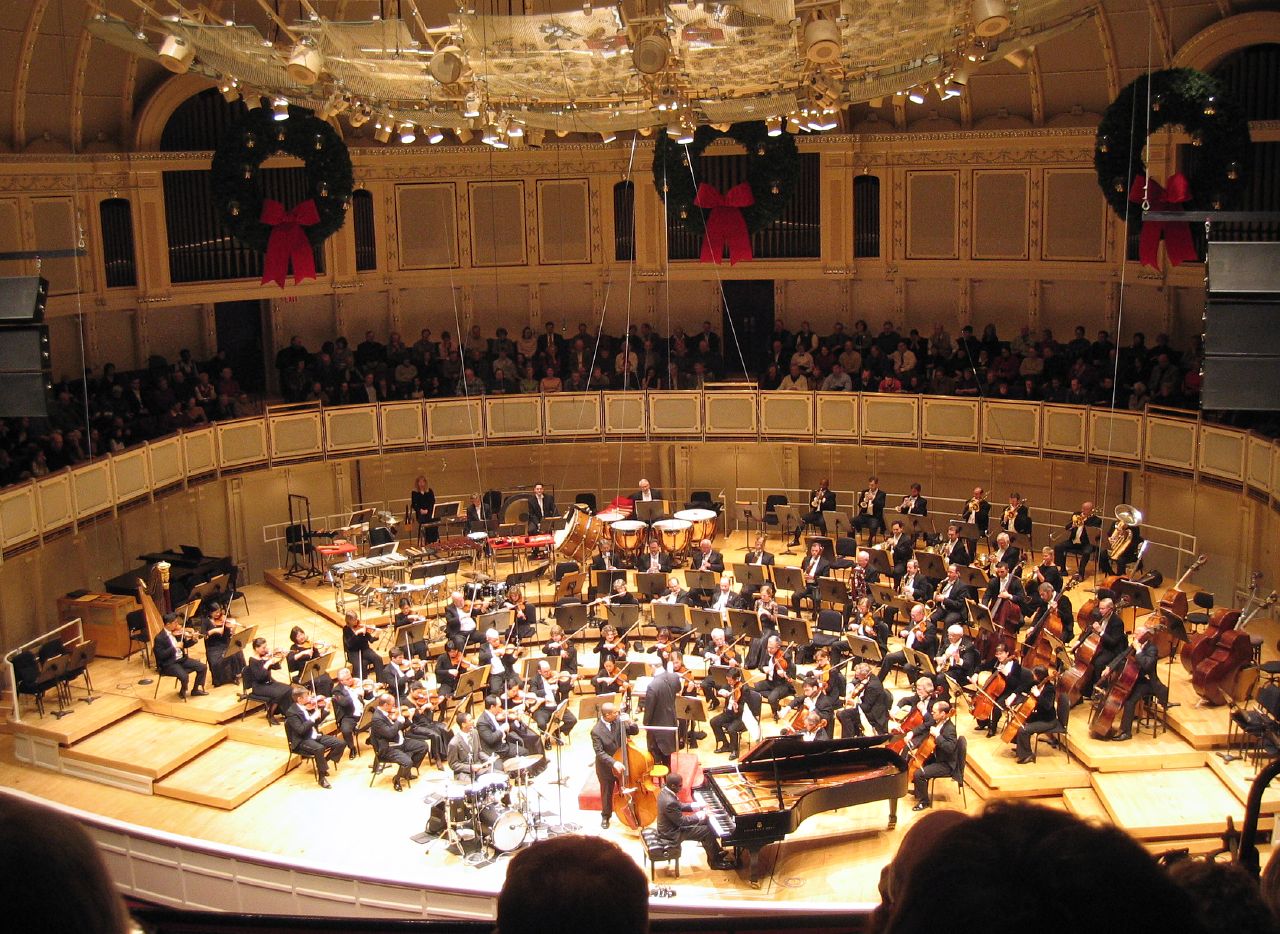
Cover photograph: the Chicago Symphony Orchestra at Symphony Center in 2005, during a collaboration with the Marcus Roberts Trio, which is why a jazz trio and seasonal decorations are visible. It illustrates the orchestra and the hall, not this week's news. Jordan Fischer, CC BY 2.0, via Wikimedia Commons.
Cover photograph: The Chicago Symphony Orchestra on stage at Symphony Center, photographed in 2005 during a collaboration with the Marcus Roberts Trio. Jordan Fischer, CC BY 2.0, via Wikimedia Commons.
Comments
Sign in to join the discussion.