Connor Sobieri is 23. He plays alto saxophone, writes, and leads his own band. On 21 October he releases his debut album, First Steps, and with every purchase ten per cent of the proceeds goes to the Crohn's and Colitis Foundation.
The album took five years to write. Part of that time he was in hospital, unable to play, with Crohn's disease.
He has chosen to say so himself, publicly and repeatedly, and to attach a charitable pledge to the record rather than a press narrative. That is his framing, and it is the reason this piece uses it.
Seventeen months, four rooms
Sobieri took a Bachelor of Music in Jazz Studies from New York University in May 2025.
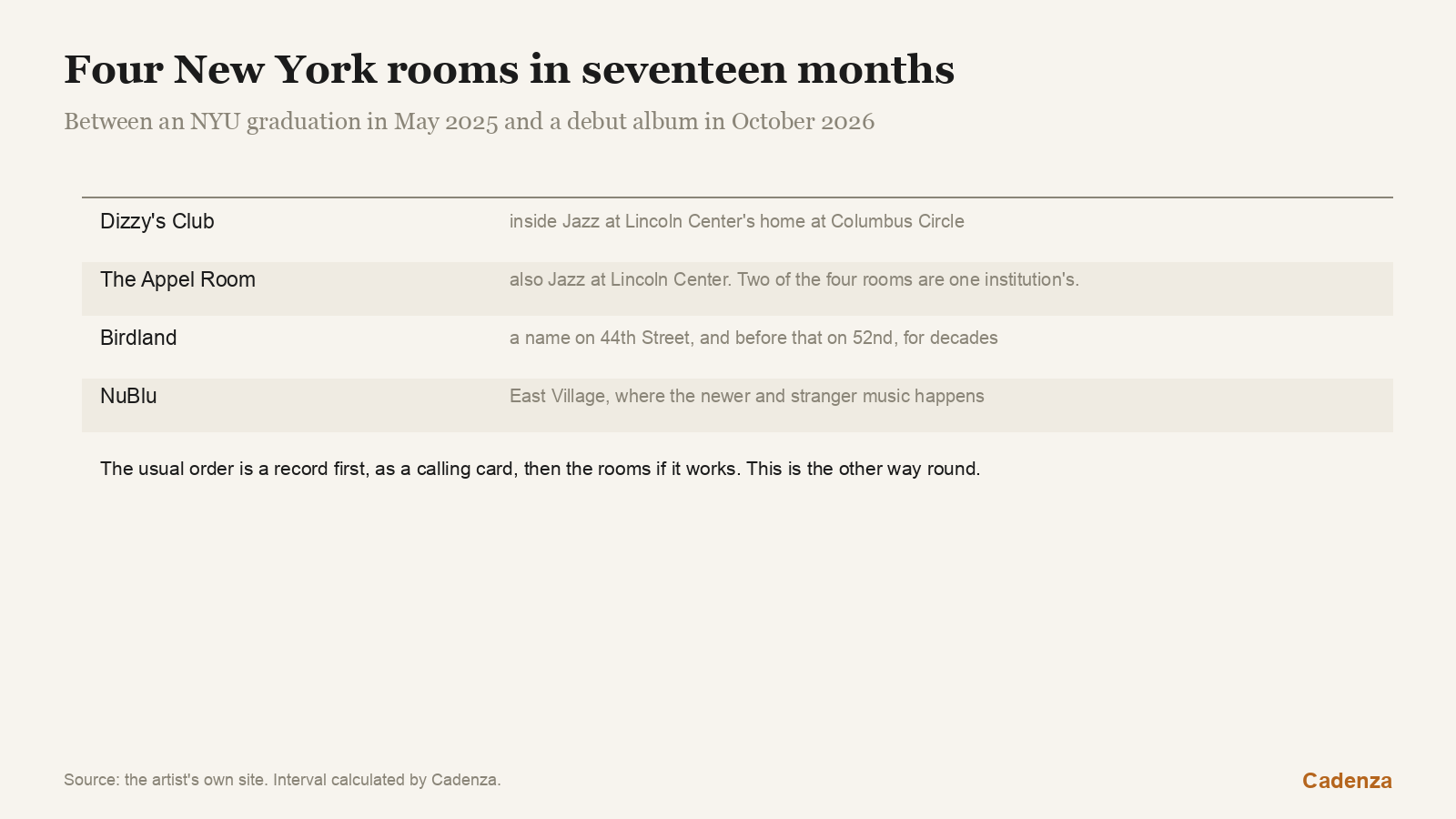
Between that graduation and this release there are roughly seventeen months, and in them he has performed at Dizzy's Club, Birdland, The Appel Room and NuBlu.
For anyone who does not know New York's jazz geography, that list is the point. Dizzy's Club and The Appel Room are both inside Jazz at Lincoln Center's home at Columbus Circle. Birdland has been a name on 44th Street and before that 52nd Street for decades. NuBlu, in the East Village, is the room where the newer and stranger music happens. A player who has been heard in all four inside seventeen months of leaving school has been heard by the whole spread of the city's audience, from the institutional to the experimental.
Most debut albums arrive without that. The usual order is a record first, as a calling card, and then the rooms if the record works. Sobieri has done it the other way round.
The album, and the pledge
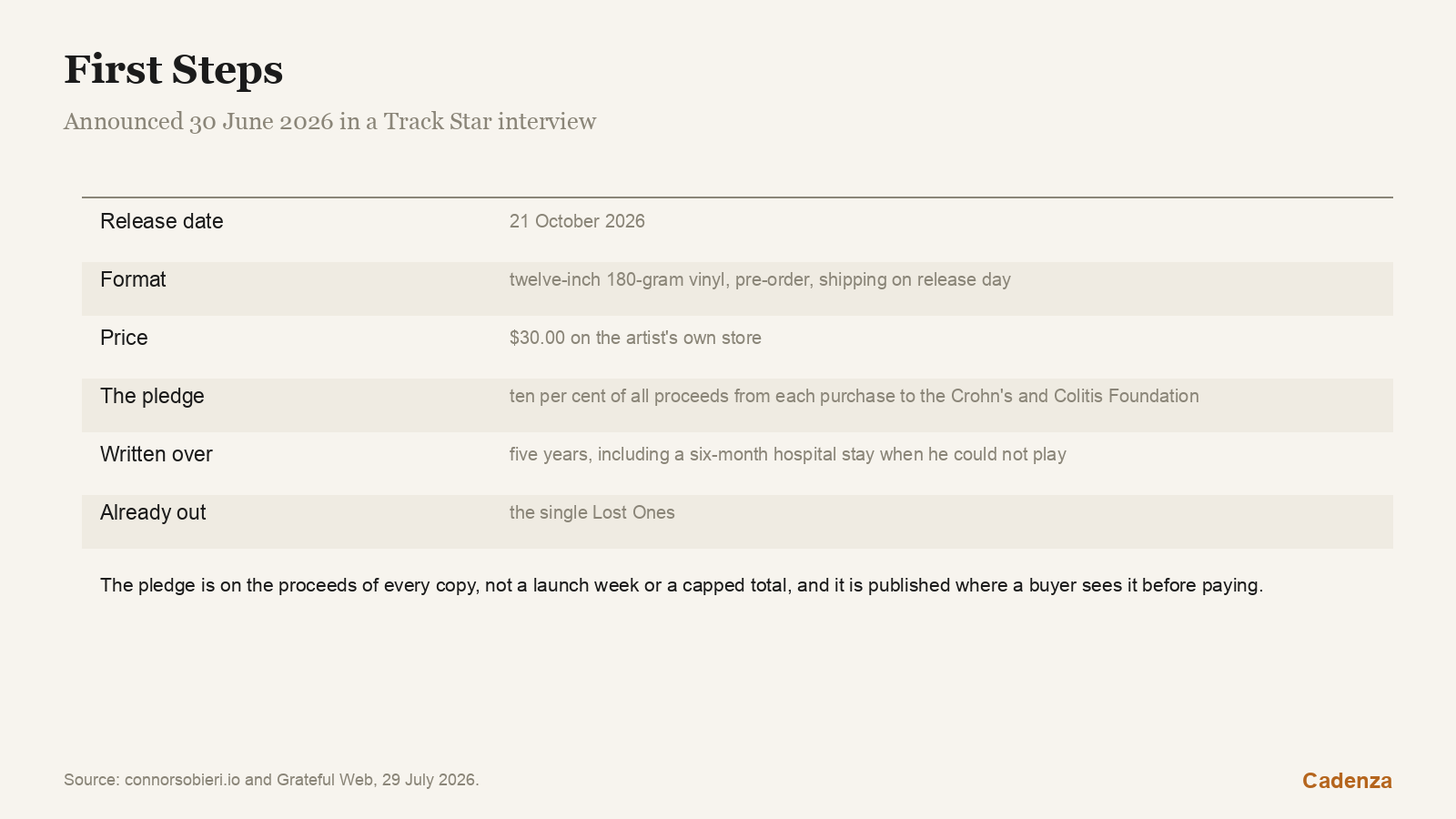
He announced First Steps on 30 June, in an interview with the social media platform Track Star, and the release date is 21 October 2026. His own store lists a twelve-inch 180-gram vinyl pre-order at $30, shipping on the release date.
The pledge is stated on his own site in plain terms: with each purchase of the album, ten per cent of all proceeds will go to the Crohn's and Colitis Foundation.
Cadenza is not going to model what that raises, because nobody knows what a self-released debut sells and a guess would be worthless. What can be said is that the pledge is on the proceeds of every copy rather than on a launch week or a capped total, and that it is published on the artist's own page where a buyer can see it before paying.
The music is described as combining the jazz tradition with rock, R&B and hip-hop, which is the ordinary listening diet of a musician born around 2003 and is worth noting only because it is still sometimes treated as a departure.
Why the five years matter more than the illness
There is a way of writing this story that Cadenza is deliberately avoiding, which is the one where the illness is the subject and the record is the moral.
The more interesting fact is the duration. Five years of writing for a debut album is a long time, and it is longer than most artists get or take. A great many first records are assembled in a few months, from whatever material exists, because a window has opened and it will close. Five years produces something else: material revisited, discarded and rewritten, by somebody whose playing and taste changed substantially across the period.
That the five years included a six-month stretch in hospital, when he could not play at all, changes the character of the writing rather than supplying a headline. A composer who cannot pick up the instrument writes differently. What comes out is conceived rather than found under the fingers.
Whether that is audible on the record is a question for a reviewer, and Cadenza has not heard it.
What a debut actually costs now
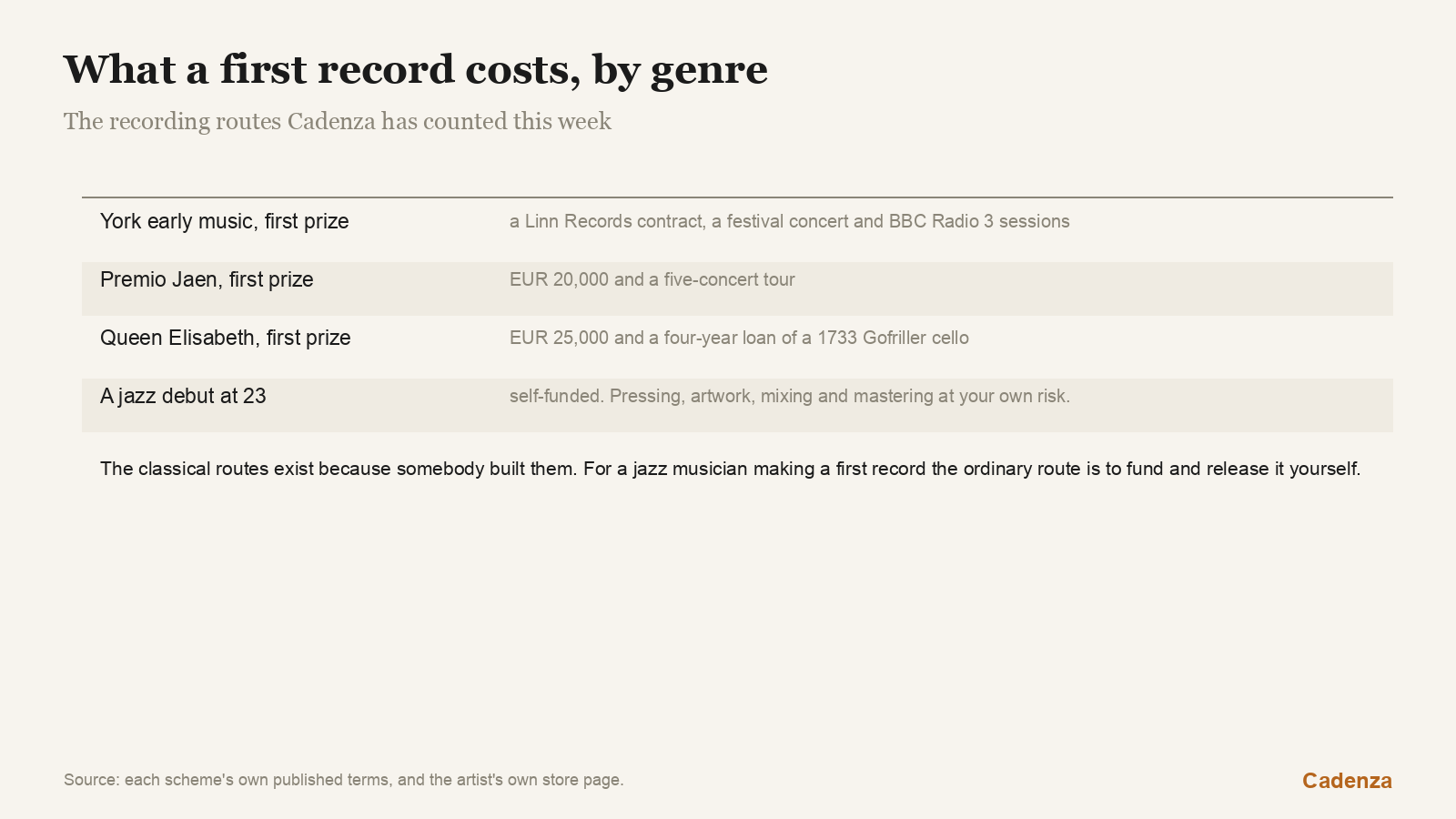
The release is independent, which is worth setting against the schemes Cadenza has counted this week.
A young classical player can win a Linn Records contract at York, or a five-concert tour in Jaén, or a loaned Gofriller cello in Brussels. Those are the institutional routes, and they exist because somebody built them.
A young jazz musician making a first record usually has none of that. The competitions are fewer and smaller, the labels are fewer, and the ordinary route is to fund and release it yourself, which is what a $30 vinyl pre-order on your own store page actually represents. It means the pressing, the artwork, the mixing and the mastering were somebody's own risk.
That is why the charitable pledge is more striking than it first appears. Taking ten per cent off the top of your own self-funded debut is a real decision about money you may need.
What NYU's jazz degree actually is
One detail worth expanding for anyone considering the same route. A Bachelor of Music in Jazz Studies from New York University puts a player in Greenwich Village, a short walk from the clubs, for four years. That geography is part of the qualification.
Jazz education has always worked differently from classical conservatoire training. A classical student practises for an audition that may happen years later, in another city, behind a screen. A jazz student in New York is expected to be on bandstands while still enrolled, because the apprenticeship is the sitting-in. The degree certifies that somebody has done that, in front of people who could hire them.
It also explains the seventeen months. A player does not walk out of a Village degree and cold-call Birdland. The relationships that produce four rooms in under two years were built during the course, which is the part of the timeline that does not appear on any announcement.
The other end of the same week
Cadenza has written twice today about the institutional end of jazz. Sixteen veteran musicians received $1.3 million from the Mellon Foundation and the National Endowment for the Arts, in recognition of careers that in several cases span five decades. And Weston Sprott takes over as Executive Director of Jazz at Lincoln Center on 21 September, arriving from Juilliard and the Met pit.
Sobieri is at the opposite end of that structure, and the connection is not sentimental. Two of the four rooms on his list are Jazz at Lincoln Center's own. The institution that has just changed its leadership is the same institution that books players seventeen months out of school.
A year ago it was a degree and a pre-order page
The route here ran through a conservatoire degree, a run of New York rooms and a self-funded record, with a pre-order page doing the work a label advance would once have done.
Cadenza carries competitions, schemes and vacancies with open deadlines, free to musicians, on its competitions board and its jobs board.
If you want the record. First Steps is out on 21 October 2026. The twelve-inch 180-gram vinyl is $30 on Sobieri's own store and ships on the release date, and ten per cent of all proceeds goes to the Crohn's and Colitis Foundation. The single Lost Ones is already out. Buying direct from an artist's own store rather than through an aggregator is the version where the largest share reaches the musician.
The question worth putting to the institutions rather than to him is this. A 23-year-old has played Dizzy's Club, Birdland, The Appel Room and NuBlu within seventeen months of graduating, and still had to fund his own first album. What would it take for a jazz musician at that stage to have the recording route a classical competition winner gets handed?
Sources: Connor Sobieri's own site at connorsobieri.io, which carries the 30 June announcement via the Track Star interview, the 21 October 2026 release date, the pledge that ten per cent of all proceeds from each purchase goes to the Crohn's and Colitis Foundation, the twelve-inch 180-gram vinyl pre-order at $30 shipping on the release date, his May 2025 Bachelor of Music in Jazz Studies from New York University, and his performances at Dizzy's Club, Birdland, The Appel Room and NuBlu; and Grateful Web's report of 29 July 2026, which states his age as 23 and describes the album as combining the jazz tradition with rock, R&B and hip-hop. The five years of writing including a six-month hospital stay is stated in a feature carried on his own site and corroborated by an iHeartRadio segment. Cadenza has not heard the record and offers no assessment of it, and has not modelled what the charitable pledge will raise because no reliable basis for such a figure exists. The seventeen-month interval is Cadenza's arithmetic.
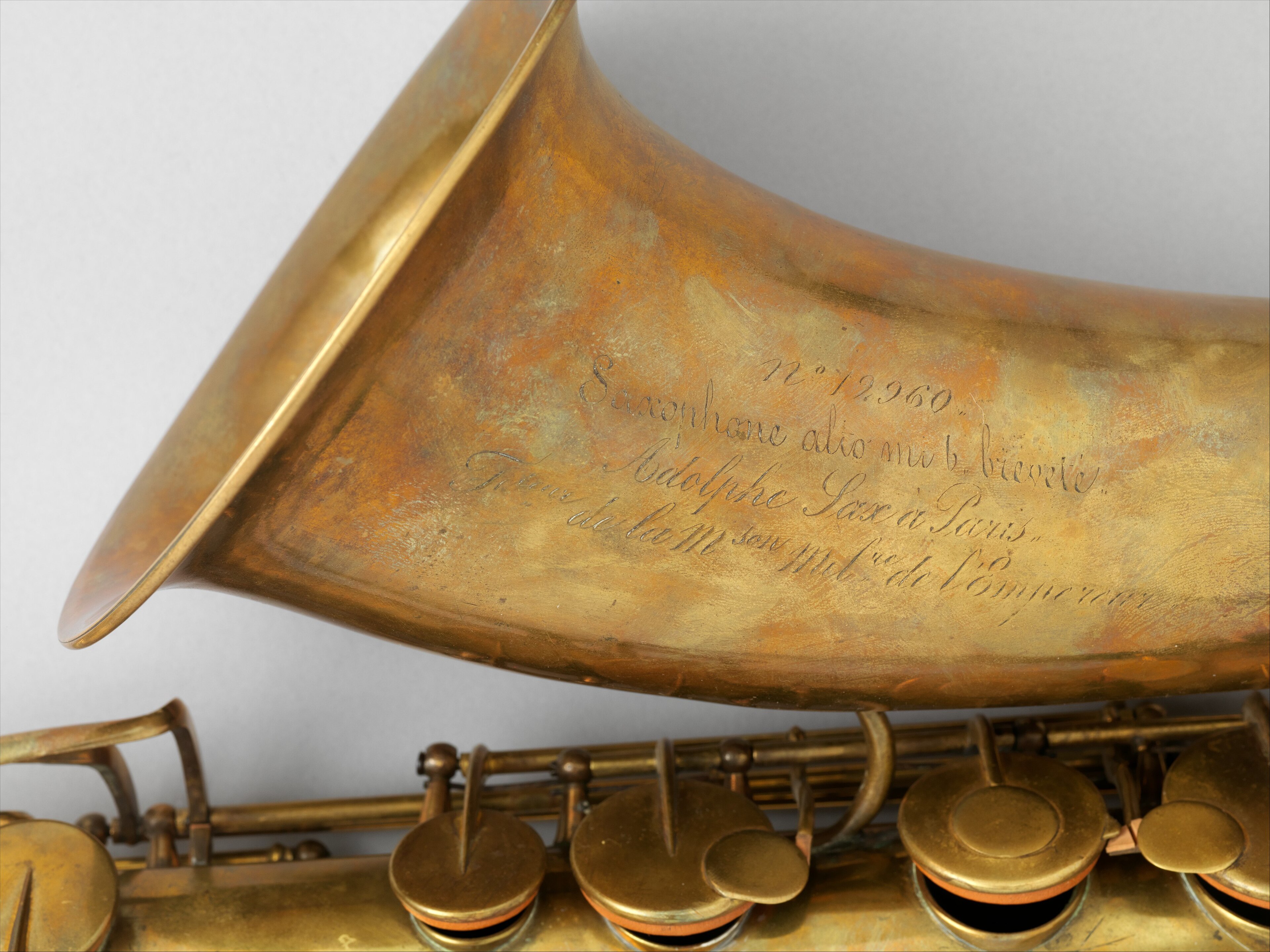
Cover photograph: Birdland Jazz Club, New York. Ajay Suresh, CC BY 4.0. In-body photograph: an alto saxophone in E flat by Adolphe Sax, in the Metropolitan Museum of Art collection, CC0. Both via Wikimedia Commons. Charts by Cadenza.
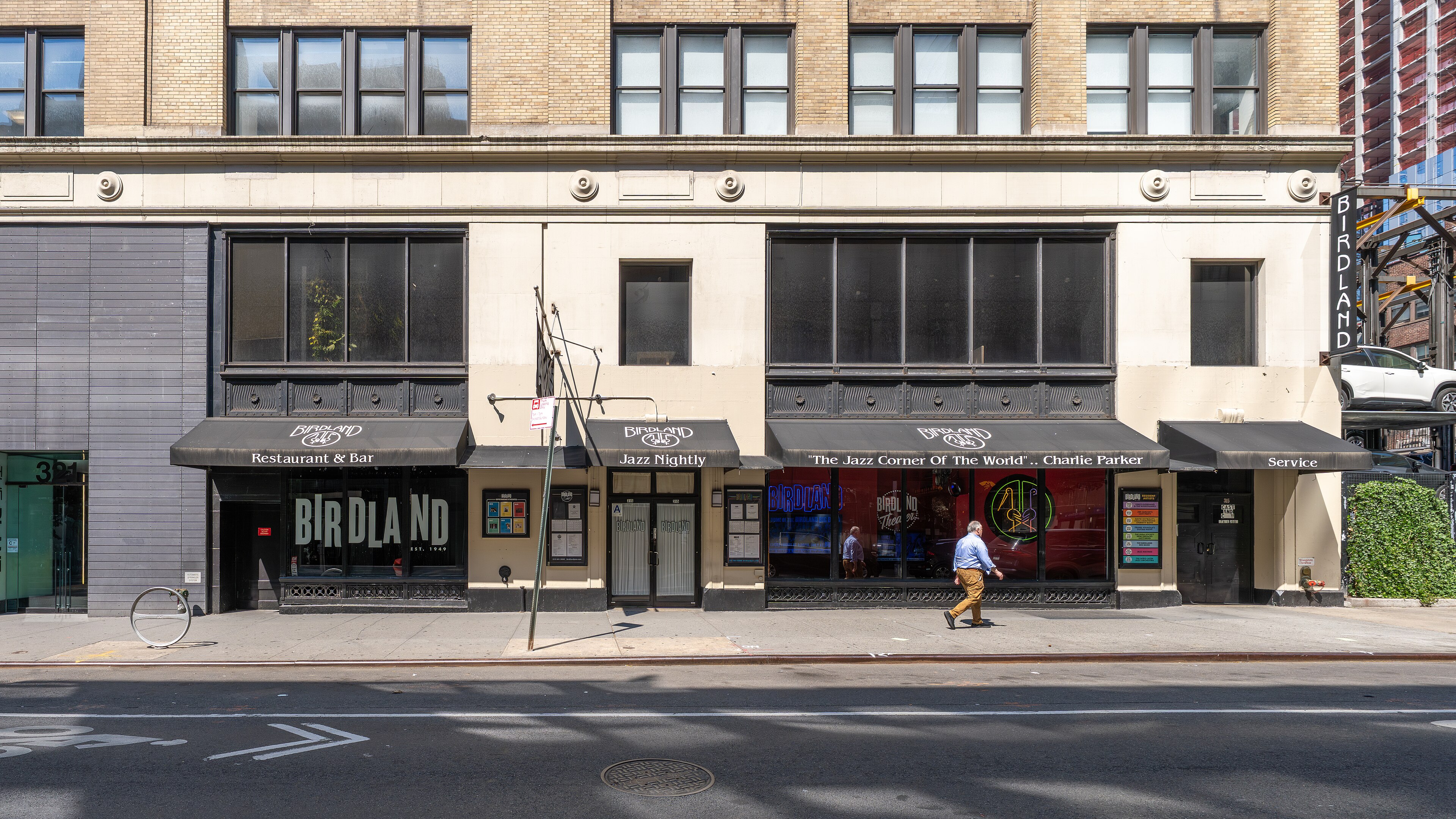
Cover photograph: Birdland Jazz Club in New York, one of the rooms Connor Sobieri has played since graduating in 2025. Ajay Suresh, CC BY 4.0, via Wikimedia Commons.
Comments
Sign in to join the discussion.