Most music prizes pay the winner and send everybody else home.
The Deutscher Jazzpreis does something else, and it is written into its own published rules rather than buried in a press release. Every one of its prize categories carries a minimum of €10,000. And a musician who is nominated in a category and does not win still receives a minimum of €1,000.
The prize puts that in plain German on its own website, in its frequently-asked-questions: «Alle Preiskategorien sind jeweils mit einem Preisgeld von mindestens 10.000 Euro dotiert. Nominierte, die in einer Kategorie keinen Preis gewinnen, erhalten ein Nominierungsgeld von mindestens 1.000 Euro.»
Every prize category is endowed with prize money of at least €10,000. Nominees who do not win a prize in a category receive nomination money of at least €1,000.
What that is worth, at the floor
The 2026 edition was awarded on 25 April in Bremen and made 22 awards, to individuals, ensembles and projects.
Twenty-two categories at a floor of €10,000 each is a minimum of €220,000 to the winners alone. The word doing the work there is minimum: the rules set a floor, not a ceiling, so the real figure is at least that and may be higher.
Then the nomination money goes on top. Cadenza has not been able to establish how many musicians were nominated across the 22 categories in 2026, because the prize does not publish a single consolidated nominee count, so no total for that part can honestly be given here. What can be said is the shape of it. Every shortlisted musician who went home without a trophy went home with at least a thousand euros.
The other model, and what it costs
Set that against the competition Cadenza counted earlier this month.
The George Enescu International Competition in Bucharest paid out €139,500 across its four sections this year. It received 645 instrumental applications at €120 each and 111 composition entries at €50 each. That means applicants put €82,950 into the competition to be considered.
Eighty-two thousand nine hundred and fifty euros against a hundred and thirty-nine thousand five hundred paid out. The people who entered funded 46 per cent of the prize money they were competing for, and the overwhelming majority of them went home with nothing, having paid for the privilege of being heard.
| Deutscher Jazzpreis | Enescu Competition | |
|---|---|---|
| Cost to be considered | No fee published | €120 per instrumental section |
| If you are shortlisted and lose | At least €1,000 | Nothing |
| Minimum to each winning category | €10,000 | €15,000 for first place |
| Who funds the pool | Federal initiative | Applicants covered 46 per cent |
Neither model is a scandal. They are different instruments built for different jobs, in different countries, under different funding systems. A competition with rounds, juries and an orchestra to pay has costs an awards ceremony does not.
But a musician deciding where to spend a month of preparation is entitled to know which of the two can leave them out of pocket, and that is the comparison nobody prints.
Where the money comes from
The Deutscher Jazzpreis exists because the German federal government decided it should. Its own account credits the former Minister of State for Culture, Monika Grütters, acting as the federal government's commissioner for culture and media, with establishing it, and states the aim directly: that alongside the attention the ceremony brings, the prize's various awards should be appropriately financed.
That phrase, angemessen finanziell dotiert, appropriately financially endowed, is the design principle the nomination money follows from. If the point is that recognition should carry money, then recognising somebody as one of the best in a category and paying them nothing is a contradiction. The prize resolves it by paying them.
The 2026 winners
The award went to 22 recipients. Among the central ones the prize itself highlights:
- Aki Takase, the lifetime achievement award.
- Rebekka Salomea, Artist of the Year.
- Phil Donkin, Album of the Year.
- Sullivan Fortner, International Artist of the Year.
- Johnathan Blake, also among the internationally honoured.
The scale of the process behind those names is published too: around 1,200 submissions and 22 categories, decided through a multi-stage procedure by an internationally composed panel.
Two different jury numbers circulate, and they turn out not to be a contradiction. The prize's explanatory page says the specialist jury, the Fachjury, comprises 25 people. Its announcement of the 2026 nominations refers to 30 jury members, and the same sentence names the body as the Fach- und Sonderjury, the specialist and special juries together. The larger figure is the combined panel, the smaller one is the specialist jury inside it.
That announcement also states what the panel was choosing between, and it is wider than a performance prize. The juries selected among artists, productions, festivals, journalistic work and music-education projects. A prize that hands €10,000 to a festival programmer or a music journalist is doing something a competition cannot, because a competition can only reward playing.
This was the sixth edition. Aki Takase's lifetime award was announced separately on 15 April, ten days before the ceremony, and the prize's own citation describes the Japanese pianist as standing for decades for an independent musical language moving between composition and improvisation, and between cultural contexts and aesthetic traditions.
What Cadenza checked, and what it could not
That first row of the table deserves its own paragraph, because an absence is a weaker claim than a figure and should be described as one.
The Deutscher Jazzpreis's own application page carries no application fee. Cadenza searched the page for every word a German fee would be hiding behind, Gebühr, Bewerbungsgebühr, Teilnahmegebühr, Kosten, and found none of them. The prize's frequently-asked-questions answers the question "how high is the prize money" and never raises the question of what it costs to apply.
So the honest statement is not that applying is free. It is that no fee is published, in a document set that is otherwise specific about money. The Enescu competition, by contrast, publishes its €120 instrumental fee plainly, which is the more transparent behaviour even though it is the more expensive one.
Anyone weighing a competition should look for three numbers before entering: what it costs to apply, what the prize actually pays net of tax, and whether anything at all reaches the people who are shortlisted and lose. Most competitions publish the second. Fewer publish the first. Almost none have an answer to the third.
For musicians, and the deadline question
Applications to the Deutscher Jazzpreis are open in most of its categories rather than being nomination-only, which is the part that matters if you are reading this as a working player. The prize publishes its application route and its category list on its own site, and the cycle runs annually.
Cadenza carries competitions, prizes and schemes with open deadlines, free to musicians, on its competitions board and current vacancies on its jobs board. It has spent this month counting what these things actually pay: what the Enescu competition charged and paid, an eleven-year-old's clean sweep of its violin section, $3.5 million counted across American jazz funding, and $1.3 million shared among sixteen jazz veterans.
A year ago it was an application form
Every name above began as a submission, one of roughly 1,200, read by a jury over several rounds. The 2027 cycle will open the same way.
The question worth putting to every other prize in Europe is the one the Deutscher Jazzpreis has already answered in writing. It costs a musician time, travel and preparation to be shortlisted, and most shortlisted musicians lose. Which other prize pays them anything at all for turning up?
Sources: the Deutscher Jazzpreis's own website, which records that the 2026 prize was awarded on 25 April in Bremen to 22 recipients, names Aki Takase for the lifetime award, Rebekka Salomea as Artist of the Year, Phil Donkin for Album of the Year and Sullivan Fortner as International Artist of the Year, and gives the figures of around 1,200 submissions and 22 categories; and its own about page, which carries the quoted rule that every prize category is endowed with at least €10,000 and that nominees who do not win receive at least €1,000, states that the specialist jury comprises 25 people, and credits Monika Grütters as the federal government's culture commissioner with establishing the prize. The prize's news item on the 2026 result refers to 30 jury members, which is not reconciled with the figure of 25 on the about page; both are reported here.
The Enescu comparison figures are from Cadenza's own count of that competition, which established the €139,500 paid out, the 645 instrumental applications at €120 and 111 composition entries at €50, and the resulting €82,950 paid in by applicants. The minimum of €220,000 to the 2026 Jazzpreis winners, and the 46 per cent share, are Cadenza's arithmetic from those published figures. No total for nomination money is given because the prize does not publish a consolidated nominee count.
The reconciliation of the two jury figures, the sixth-edition count, the breadth of the categories and the Takase citation are all from the prize's own news items of 26 February and 15 April 2026.
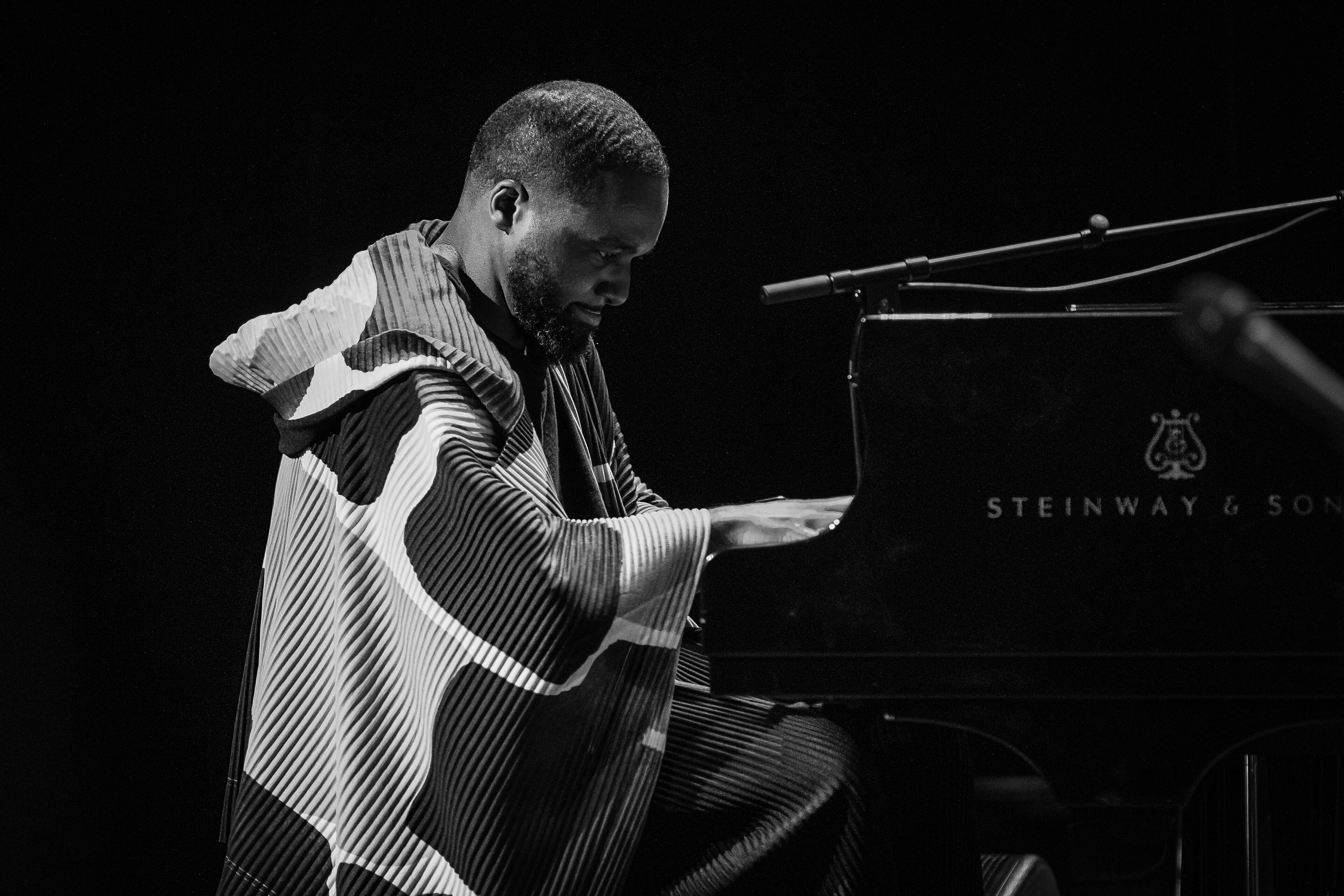
Cover photograph: Sullivan Fortner at the Kongsberg Jazzfestival, 2024. Tore Sætre, CC BY-SA 4.0, via Wikimedia Commons.
Cover photograph: Sullivan Fortner, named International Artist of the Year at the 2026 Deutscher Jazzpreis, playing at the Kongsberg Jazzfestival in 2024. Tore Sætre, CC BY-SA 4.0, via Wikimedia Commons.
Comments
Sign in to join the discussion.