Most composition competitions are judged by a panel. The Toru Takemitsu Composition Award is judged by one person, and that person changes every year.
For 2026 the judge was Jörg Widmann. He read 112 orchestral scores submitted from 25 countries, selected four of them, heard those four played by the Tokyo Philharmonic under Yoichi Sugiyama at the Tokyo Opera City Concert Hall on Sunday 12 July, and then decided the order.
That is the whole process. No committee, no averaging of scores, no deciding vote. One composer's ear.
What he chose, and what it paid
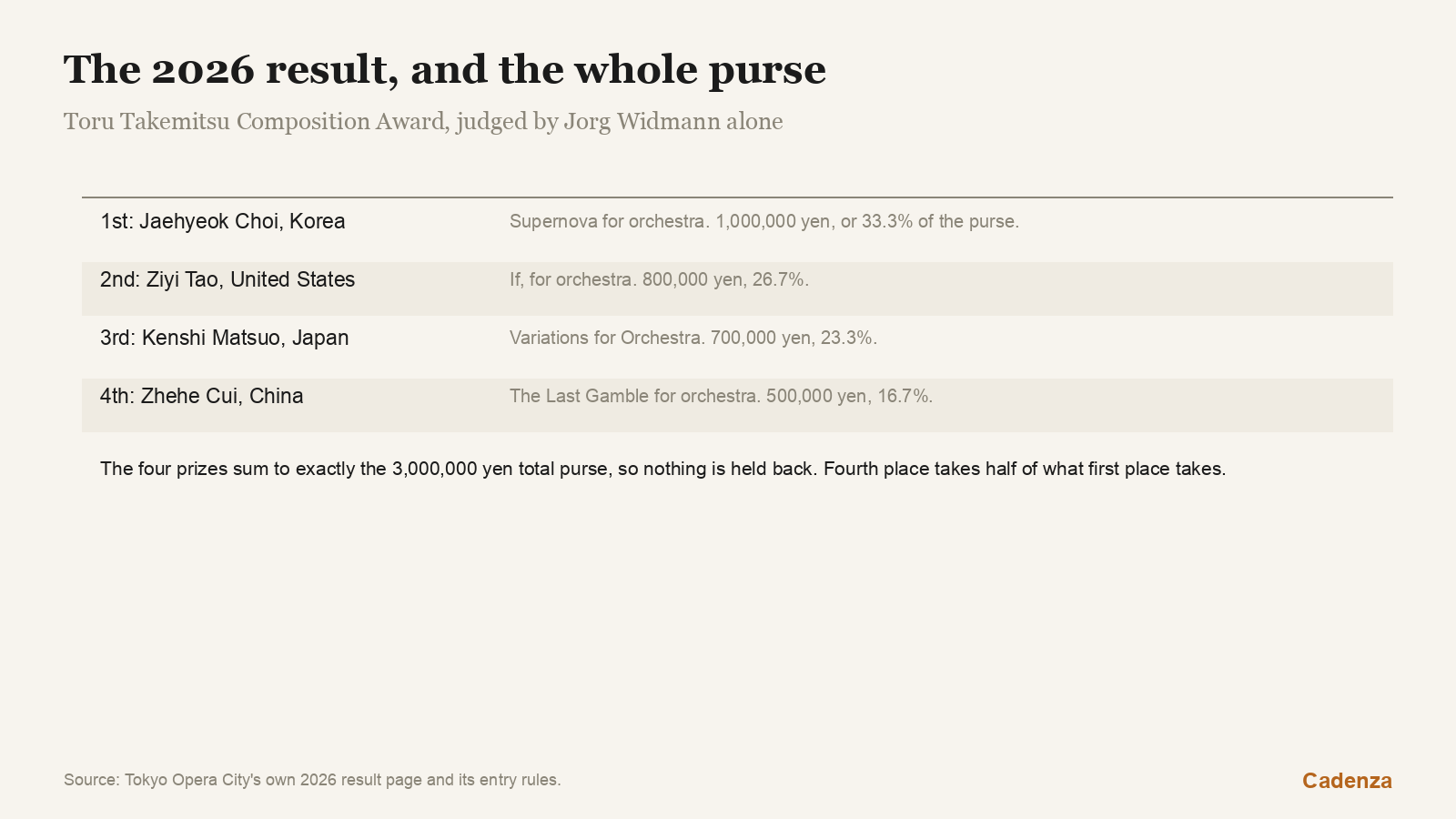
First prize went to Jaehyeok Choi of Korea for Supernova for orchestra, worth ¥1,000,000. Second went to Ziyi Tao of the United States for If for orchestra, ¥800,000. Third to Kenshi Matsuo of Japan for Variations for Orchestra, ¥700,000. Fourth to Zhehe Cui of China for The Last Gamble for orchestra, ¥500,000.
Those four sum to exactly ¥3,000,000, which is the total purse the award states on its own entry rules. So unlike most competitions, the whole pot is distributed and nothing is held back.
The Korea Herald reported Choi's ¥1,000,000 as roughly $6,140. That is the only dollar figure any source states, so Cadenza is not converting the other three.
The distribution is flatter than a competition podium usually is. First prize is 33.3 per cent of the purse, second 26.7, third 23.3, fourth 16.7. Fourth place takes half of what first place takes, which is a far narrower gap than the six-and-a-quarter-times spread Cadenza found at the Queen Elisabeth cello competition this week.
Four from a hundred and twelve
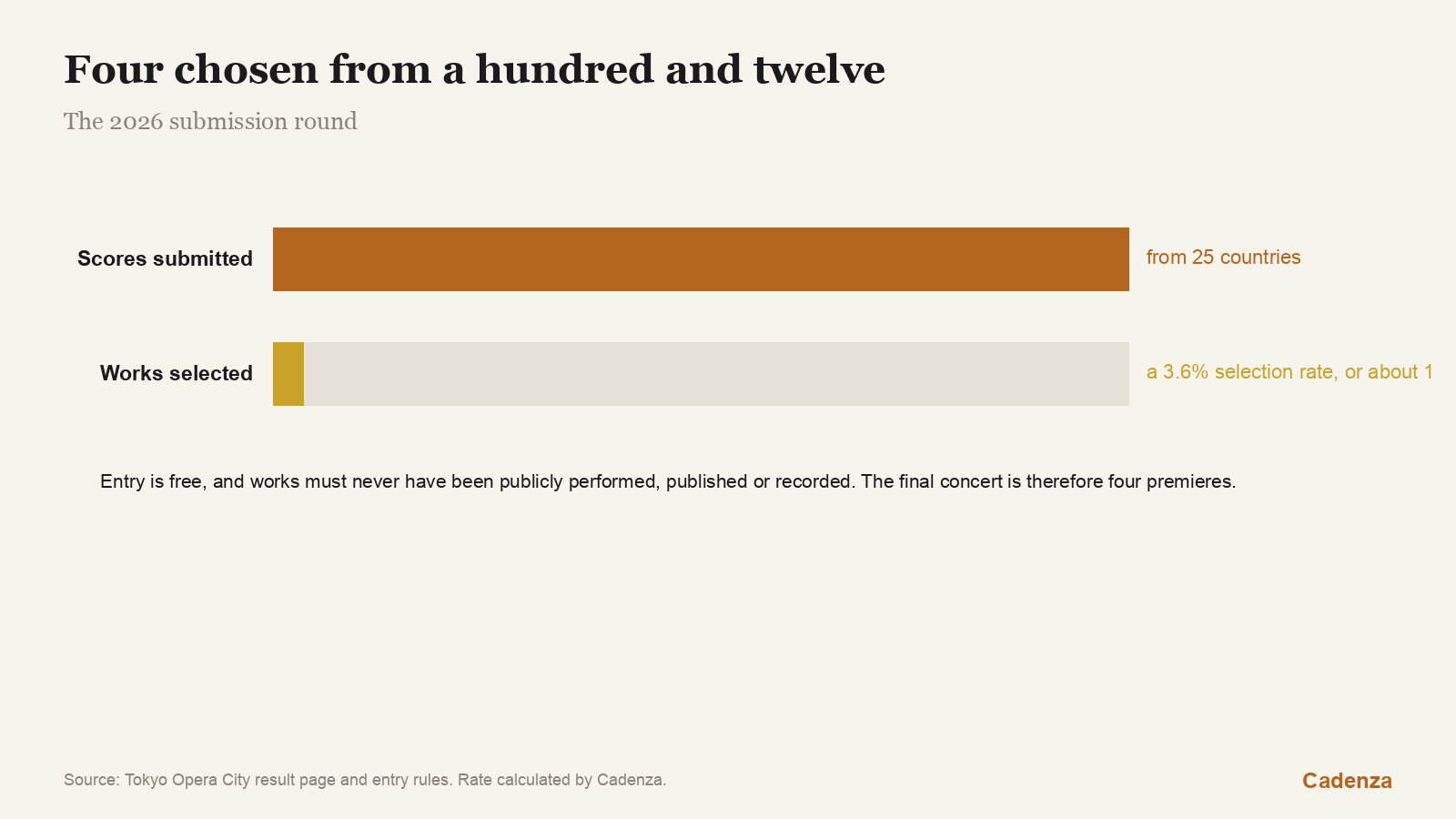
One hundred and twelve scores from 25 countries, cut to four. That is a selection rate of 3.6 per cent, or roughly one in 28.
Two rules make that figure mean more than it would elsewhere.
Entry is free. There is no fee at all, which is unusual and worth stating plainly after a week in which Cadenza found that entry fees covered 59 per cent of everything the Enescu competition paid out. A young composer risks postage and the months of work, not money.
And eligible works must be unperformed. Scores that have already been publicly performed, published or commercially recorded before the final concert are ineligible. So the four selected pieces arrive at that concert as premieres, and the award is not rewarding a piece that has already proved itself somewhere else. It is commissioning by selection.
Applicants must be 35 or under at the year-end of the deadline, and the work must be orchestral, excluding concertos.
What a single judge actually means
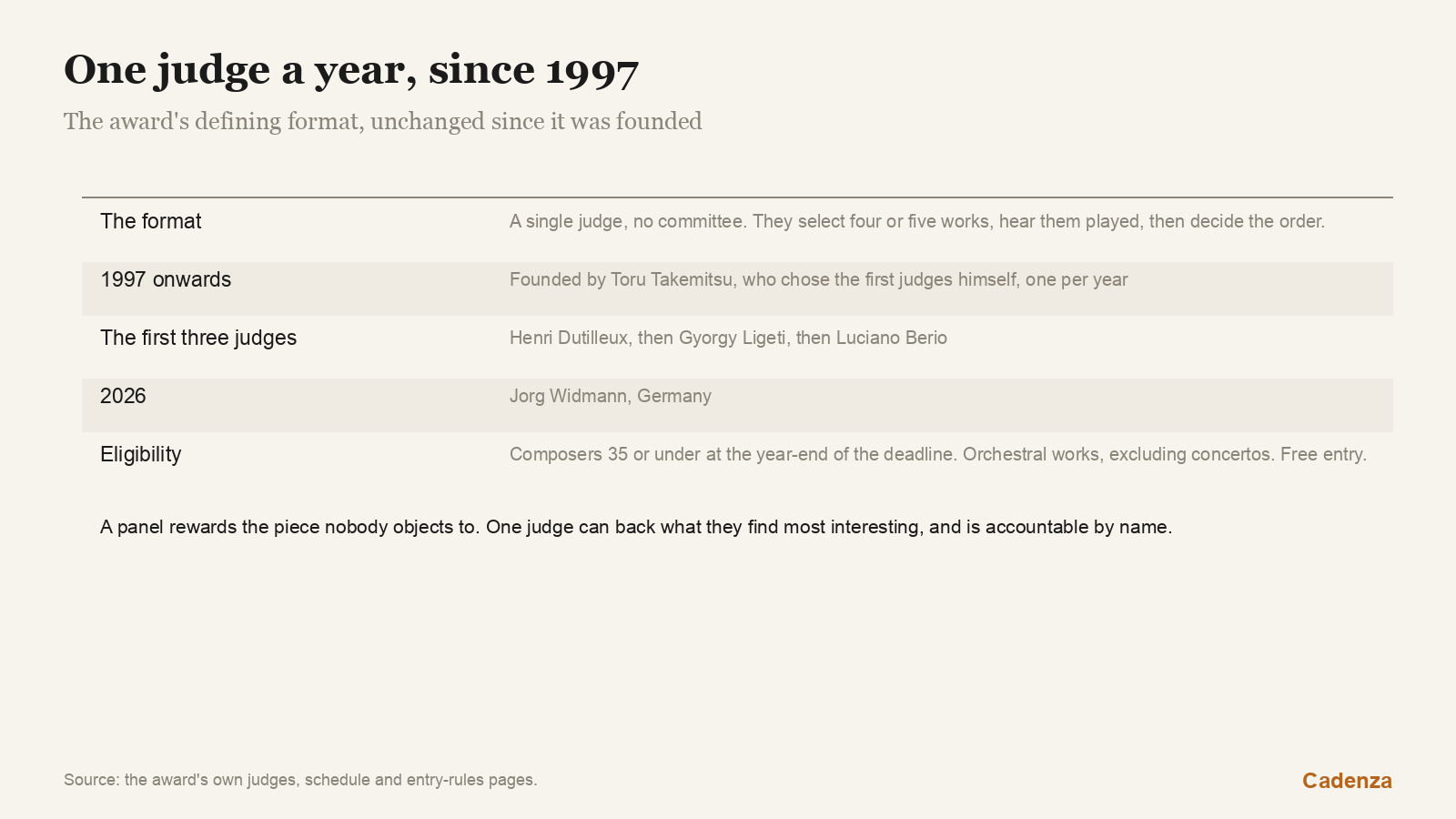
The one-judge format is the award's defining choice and it cuts both ways, which is presumably why it has survived since 1997.
A panel produces a consensus, and consensus in composition competitions tends to reward competence over risk, because the piece nobody objects to wins. A single judge can simply back what they find most interesting, and is accountable for it by name. The result is legible: you know exactly whose taste produced it.
The cost is obvious too. One ear is one ear. A composer whose music is not to that year's judge's taste has no route around it, and the answer is to enter again when somebody else is deciding.
Toru Takemitsu established the award in 1997 and chose the first judges himself, one per year: Henri Dutilleux, then György Ligeti, then Luciano Berio. Starting a competition by handing successive years to those three is a statement about what the award was for, and the format has not changed since.
Where the coverage stops
Cadenza's first research pass suggested the second, third and fourth prize winners had no English-language coverage. That claim was tested rather than published, after a similar one collapsed earlier in the week, and the position is more nuanced.
The result itself is published in English on Tokyo Opera City's own site, with the composers' names, nationalities, work titles and prize amounts. What does not exist in English is anything beyond the result: no profiles, no interviews, no reviews of the premieres for three of the four names.
There is also a live risk of confusing the winner with somebody else, and it is worth flagging for anyone writing about him. There is another Korean composer whose name renders identically in Hangul and very nearly identically in Latin script. Biographical details circulating about a Juilliard training and a particular teacher belong to that other person, not to the 2026 Takemitsu winner. Cadenza is therefore publishing Jaehyeok Choi's name, nationality, work title and prize, and nothing else, because nothing else is safely his.
That is the second time this week that an early-career musician's record has been at risk from a name collision. A pianist's surname was misspelled in a trade report on his Rubinstein result, and here two composers share a name in one alphabet.
What the award is for, on its own terms
Read the rules together and a purpose emerges that the word competition does not capture.
The age cap keeps the field early-career. The free entry removes money as a filter. The orchestral requirement means the submitted work is the hardest and most expensive kind a young composer can write, and the one they are least likely to get played. The exclusion of previously performed works means the piece has no track record to trade on. And the prize is not only cash but a professional orchestra, a major hall and an audience.
Put those together and the award functions as a commissioning scheme with the order reversed. A commission normally pays a composer to write something. This pays a composer for something already written and then supplies the thing a score cannot buy, which is an orchestra willing to play it properly.
For a composer under 35 with an orchestral score in a drawer, unperformed because no orchestra has a reason to read it, that is a specific and rare offer. It also explains why 112 people sent scores to one judge in Tokyo.
Four premieres in one evening
The final concert deserves its own note, because it is the part a listener can actually attend.
On 12 July the Tokyo Philharmonic under Yoichi Sugiyama played all four selected works in the Tokyo Opera City Concert Hall, the hall that carries Takemitsu's name as a memorial. Because the eligibility rules exclude anything previously performed, every one of those four pieces was heard in public for the first time that evening.
Four orchestral premieres by composers aged 35 or under, played by a professional orchestra in a major hall, decided by one of the more interesting composers working today. For the price of a concert ticket, that is as concentrated a sample of what young orchestral composition sounds like as exists anywhere.
A year ago it was a free entry form
Every one of those 112 scores was submitted at no cost, months before the concert. The rules, the age cap, the unperformed requirement and the full purse are all published on the award's own pages.
Cadenza carries competitions with open deadlines, free to musicians, on its competitions board, and orchestral vacancies on its jobs board.
If you are a composer under 35. This is one of the few significant awards with no entry fee, so the only cost of applying is the work. Read the unperformed rule carefully before you submit, because a piece that has had a reading or a student performance may be disqualified, and that rule is stricter than most. Check who the judge is for the year you are entering, since one person decides everything and their published music tells you what they are likely to respond to.
The question the award will be asked next is the one its own transparency invites. It publishes the judge, the purse, the rules and the submission count, which is more than almost any competition Cadenza has examined this week. Will it also publish how many of the 112 came from each country, so composers can see who actually enters?
Sources: Tokyo Opera City's own 2026 result page, in English and Japanese, which names all four composers with their nationalities, work titles and prize amounts, and states the 112 scores from 25 countries; the award's own entry-rules page for the ¥3,000,000 total purse, the age cap of 35, the orchestral-works-excluding-concertos requirement, the free entry and the rule excluding previously performed, published or recorded works; the award's own judges and schedule page for the 1997 founding and the Dutilleux, Ligeti and Berio judging years; Jörg Widmann's own spoken remarks at the final concert, which independently give the 112 figure; and the Korea Herald for the single stated dollar equivalent of the first prize. Cadenza tested and rejected an internal claim that three of the four laureates have no English-language coverage, and separately established that biographical details circulating under a near-identical name belong to a different composer. The prize shares, the selection rate and the comparison with other 2026 competitions are Cadenza's arithmetic.
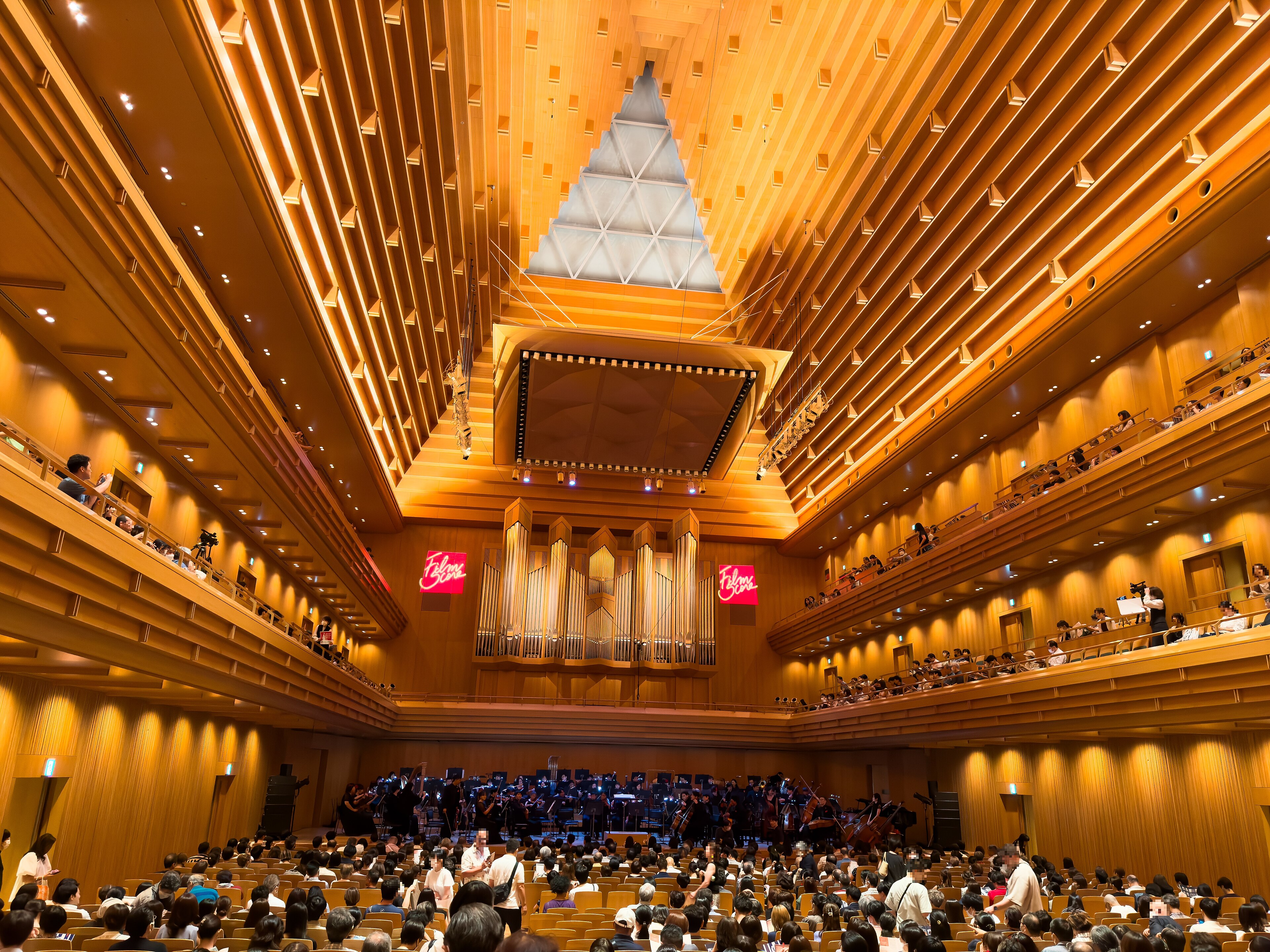
Cover photograph: the Tokyo Opera City Concert Hall, Takemitsu Memorial, August 2023. Dick Thomas Johnson, CC BY 2.0, via Wikimedia Commons. Charts by Cadenza.
Cover photograph: The Tokyo Opera City Concert Hall, Takemitsu Memorial, where the Toru Takemitsu Composition Award final concert is played, photographed in August 2023. Dick Thomas Johnson, CC BY 2.0, via Wikimedia Commons.
Comments
Sign in to join the discussion.