This investigation examines what happens when a conductor pays an orchestra to perform with them, and whether the audience is told. It rests on published reporting, ticket and programme pages, and filed charity accounts, recorded as they stood when checked. Three cautions travel with it. Hiring an orchestra is entirely lawful and entirely normal: promoters, festivals and record labels do it constantly, and nothing here suggests otherwise. Where this article describes a transaction, it describes what has been published about it — it does not allege that any conductor, orchestra or promoter has broken a rule or misled anyone. And the central figures for the London concert are not in the public record at all; the article says so rather than estimating them.
How to read this investigation
The RPO identifies Cheung simply as conductor of Mahler’s Second Symphony at Alexandra Palace Theatre on 21 August 2026. Its description says he will shape the score with soprano Elizabeth Watts, mezzo-soprano Jennifer Johnston and the Brighton Festival Chorus. It lists his 2025 appearance with the Toronto Symphony Orchestra as part of his experience. The listing contains no statement that he or an affiliated organization has hired the orchestra. [S01]
Cheung’s representative has confirmed that he is paying the RPO. The amount has not been disclosed. The orchestra says the engagement will materially support its community and education work. [S02]
That follows a transaction in Toronto. In June 2025, Cheung covered approximately US$400,000 in costs to conduct the Toronto Symphony Orchestra in the same symphony. Published breakdowns put the orchestra fee at about US$337,000, the Roy Thomson Hall rental at about US$45,000 and the soloists at about US$15,000. British reporting later summarized the total as roughly C$500,000. The currencies and totals are approximate, but the order of magnitude is not in dispute. [S03] [S02]
Cheung then said the Toronto appearance might operate as “sort of like a credential” when he approached orchestras in the United States and Europe. The Royal Philharmonic’s own page now cites that Toronto engagement without stating that the earlier appearance was also financed by Cheung. [S03] [S01]
The payment disappears. The orchestra’s name remains.
What Cadenza found
1. The concert that looks ordinary
The RPO’s listing contains no obvious falsehood. Cheung will conduct. Watts and Johnston will sing. The Brighton Festival Chorus will participate. Mahler’s Second will be performed. Cheung founded the Mandle Philharmonic and has led a substantial series of concerts. He did conduct the Toronto Symphony in 2025. [S01] [S10]
The problem lies in the category the page invites the audience to assign to the event. A named conductor on the website of a major orchestra normally carries an implied set of claims: that the orchestra or presenter chose the conductor through an artistic process; that the conductor met the institution’s professional threshold; and that the engagement constitutes an institutional endorsement rather than a customer purchase.
None of those assumptions is universal. Guest artists are selected through agents, personal relationships, sponsorship, recording partnerships, political considerations and institutional exchange. Classical music has never been a controlled experiment in pure merit. But in this case the decisive commercial fact is known. Cheung is paying.
The public page does not identify the concert as a private presentation, external promotion, orchestral hire, paid podium, fundraising arrangement or co-production. It tells the buyer the date, venue, repertoire, artists and ticket price. It omits the fact that changes the meaning of the conductor’s appointment.
What the RPO ticket buyer can see—and what remains hidden
Visible on the ticket page
- Date, time and venue
- Mahler’s Second Symphony
- Conductor, soloists, chorus and orchestra
- Tickets from £25.05
- Cheung’s Toronto Symphony credit
- Cheung’s Mandle Philharmonic biography
Not disclosed on the ticket page
- That Cheung is paying the orchestra
- The amount or even a fee band
- The production category or contracting party
- The artistic assessment and approval process
- The expected net contribution to education work
- Whether the engagement differs from normal guest selection
The listing is accurate in the narrow sense and incomplete in the material sense. The omitted fact is not an incidental sponsor credit; it is the commercial cause of the engagement.
An orchestra’s website does more than publish logistics. It classifies artists. A performance credit from the Royal Philharmonic Orchestra is valuable because the institution is presumed to be selective. Thousands of conductors could prepare a concert. Only a small number are normally invited to place the orchestra’s name in their biographies.
The institution’s reputation converts an appearance into evidence. That evidence becomes ambiguous when future presenters and audiences are not told whether the artist was selected or whether the orchestra was hired.
2. The Toronto transaction
Cheung is chairman and chief executive of ComputerTalk, a Toronto technology company, and describes himself as a self-taught conductor. He founded the Mandle Philharmonic in 2017 as a vehicle for large orchestral projects. By the time the RPO announced his London appearance, its biography said the orchestra had presented nineteen programs, many to strong audiences, including Beethoven, Brahms, Tchaikovsky and Mahler. [S01] [S10]
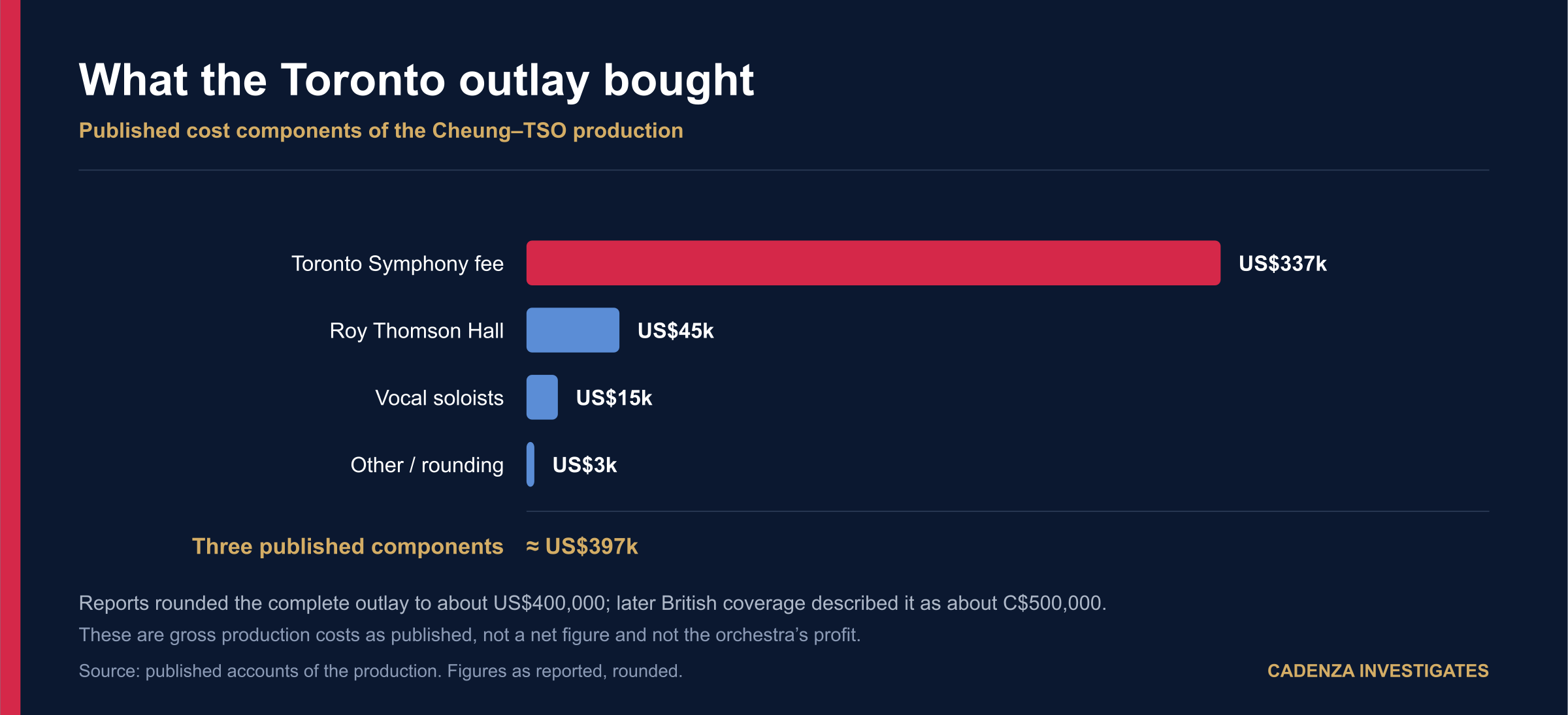
Gross production costs as published, rounded. Not a net figure, and not the orchestra's profit.
That activity is not inherently suspect. Producers hire musicians. Composers finance premieres. Singers rent halls. Wealthy enthusiasts establish ensembles. Musicians themselves routinely create institutions before any established orchestra, agent or critic grants them legitimacy.
The Mandle Philharmonic is, in fact, the cleanest part of Cheung’s project. It carries his name. Its public identity makes clear that it is his initiative. He bears the financial risk, organizes the concerts and stands before the ensemble he created. Audiences are not asked to infer that a separate institution selected him.
The 2025 Toronto Symphony engagement changed the nature of the exchange. Cheung was no longer only financing his own orchestra. He was purchasing the services and accumulated authority of a 102-year-old institution.
The performance took place on 25 June 2025 at Roy Thomson Hall and was outside the TSO’s ordinary subscription season. It was presented by the Mandle Philharmonic, while the TSO supplied the orchestra. Published accounts said Cheung covered the complete cost. [S03] [S16]
What approximately US$400,000 bought in Toronto
The largest identifiable line was the orchestra itself. The chart does not include a separate figure for chorus, administration, marketing or other production costs because no reliable public breakdown has been located.
The financial incentive was understandable. The TSO reported that ticket sales covered about 38 percent of its roughly C$24 million annual budget at the time. It later ended fiscal 2025 with a surplus of just under C$60,000. [S03] [S05]
One event’s gross cost beside the TSO’s full-year surplus
This comparison is about scale, not profit. The event budget paid the orchestra, hall, soloists and other expenses; it cannot be treated as a C$500,000 contribution to the TSO’s bottom line.
Some musicians nevertheless objected. Toronto Symphony violinist Bridget Hunt, then chair of the orchestra’s artistic advisory committee, said Cheung’s inexperience made him difficult to follow even after rehearsals. She described the players compensating by listening internally, almost as if they were an enormous chamber ensemble. [S03]
That testimony exposes a fact hidden from the audience. A highly experienced orchestra can conceal a conductor’s limitations. Players know the repertoire. Principals stabilize pulse and entries. The concertmaster provides information. Musicians repair unclear or late gestures in real time. The final result may be impressive while revealing little about the conductor’s contribution.
Cheung prepared seriously. He spent months studying and reportedly held more than ten rehearsals with his own ensemble before meeting the TSO. The performance attracted a large audience and ended with an enthusiastic standing ovation. Those facts matter. They show commitment, organizational ability and a public appetite for the event. They do not answer the institutional question. [S03]
The TSO did not only sell labour and production capacity. It supplied a line for a biography. Cheung immediately understood that the line could be used elsewhere.
3. From Toronto to London: the paid-credential loop
A conventional professional credential tells a future employer that someone else evaluated the candidate. A degree means a student completed defined work. A competition prize means a jury compared entrants. An assistantship means an institution entrusted a conductor with specific responsibilities. A guest engagement normally implies that an artistic administration wanted that conductor.
A purchased engagement proves something different. It proves that the buyer had sufficient money, organization and persistence to make the performance happen. It may also reveal musical competence. But the payment changes the signal unless it is disclosed.
How a commercial transaction becomes an artistic credential
Cheung finances the Mandle Philharmonic and gains real rehearsal and production experience.
The Toronto Symphony name enters his biography after a fully financed concert.
Cheung says the appearance may help him approach American and European orchestras.
He pays the Royal Philharmonic Orchestra; the fee remains private.
The RPO cites the TSO credit without its financial context; two names now validate each other.
No performance is invented. The issue is classification: the orchestra names remain visible after the commercial terms disappear.
This is not a fabricated credential. Cheung did conduct the TSO and is scheduled to conduct the RPO. It is an incompletely labelled credential. Each institution borrows authority from the previous one. The payment recedes. The prestige compounds.
The distinction matters because the RPO listing does not merely report Cheung’s history. It uses the Toronto appearance as evidence supporting the London one. A commercially purchased event has been converted into a qualification for the next commercially purchased event.
Disclosure determines what the credit means. “Conducted the Toronto Symphony Orchestra” and “privately financed a concert in which he conducted the Toronto Symphony Orchestra” describe the same evening and communicate different information.
4. London repeats the transaction—and hides the price
The Royal Philharmonic Orchestra has confirmed the existence of the payment through reporting, but the amount remains confidential. Its position is that it does not disclose concert fees. That is ordinary practice for guest-artist compensation, promoter guarantees and private-hire rates. [S02]
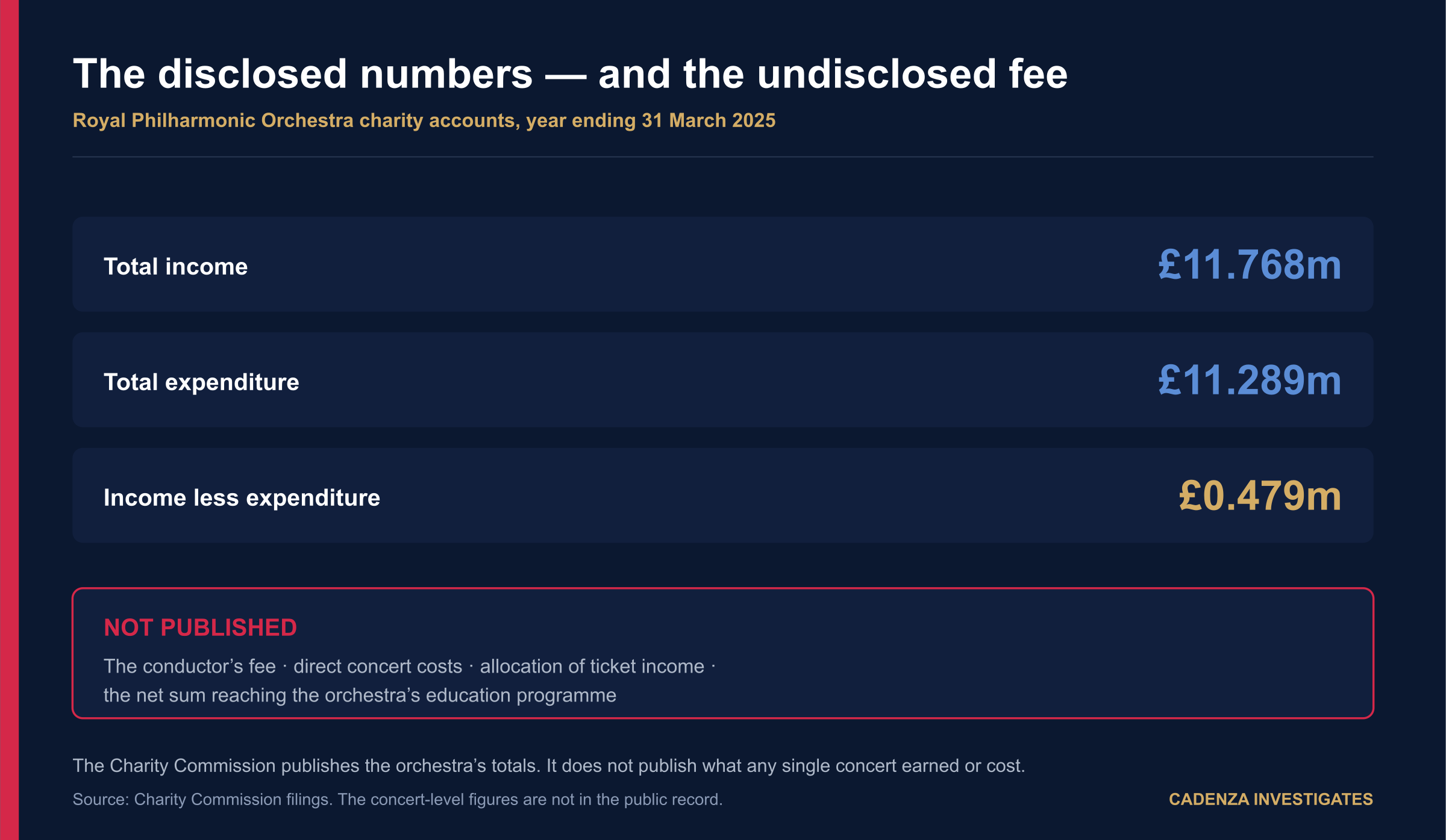
The Charity Commission publishes the orchestra's totals. It does not publish what any single concert earned or cost.
This fee is not ordinary artist compensation. It runs in the opposite direction. The conductor is not being paid by the orchestra; the conductor is paying the orchestra. The financial term is therefore not peripheral to the appearance. It is the reason the appearance exists.
The RPO has linked the arrangement to RPO Resound, its community and education program. The orchestra advertises more than 250 sessions, projects and concerts a year involving approximately 7,500 participants. That work is substantial. [S09]
But the public cannot test the phrase “materially supporting” without a fee, cost or net-contribution range. It does not know the gross amount; musician, chorus, soloist and venue costs; the allocation of ticket income; or the net sum remaining for education work.
The disclosed annual numbers—and the undisclosed concert fee
The Charity Commission reports the orchestra’s total income and expenditure. The Cheung fee, direct concert costs and net contribution to RPO Resound are not public. The £479,319 difference is not presented here as an operating surplus; it is simply total income minus total expenditure.
The RPO’s 2024–25 charity record lists total income of £11,768,305 and total expenditure of £11,288,986, a difference of £479,319. The unknown Cheung payment may be large beside that figure, or it may be substantially consumed by the cost of mounting Mahler’s Second. The available record does not permit a conclusion. [S06]
A contract does not need to be published in full. The orchestra could disclose a band, such as less than £100,000, £100,000–£250,000 or more than £250,000. It could disclose only the expected net contribution after costs. It could identify the education projects supported. Commercial sensitivity and public accountability are not mutually exclusive.
Instead, the charitable justification is public and the arithmetic supporting it is private.
5. Cheung is not the central villain
The easiest version of this story is a caricature: a rich businessman buys a baton, indulges his ego and corrupts an otherwise noble art form. That version is emotionally satisfying and analytically weak.
Cheung has invested years in his interest. He has created paid work for musicians, choristers, soloists and production staff. He has mounted large concerts that might not otherwise have happened. He has attracted audiences to long symphonies. He openly describes himself as self-taught and has resisted the conventional maestro label. [S10] [S02]
The term amateur should not function as an automatic insult. Some amateurs possess formidable knowledge. Some professionals are mediocre. Formal study does not guarantee imagination, authority, clarity or musicianship. Unconventional paths have produced serious artists.
The relevant distinction is not amateur against professional. It is independently selected against financially self-selected.
Cheung is entitled to produce concerts and hire willing musicians. The orchestra is responsible for describing the basis on which its name and reputation entered the exchange. The institution controls the category label. That makes its omission more consequential than the buyer’s ambition.
Cheung also appears to understand the objection. He has acknowledged the tension between musicians who spent their lives earning professional positions and an unrecognized conductor who can enter by writing a cheque. [S03]
The institutions have been less direct. They defend the revenue, the public experience and the educational benefit. None of those answers the question the ticket page avoids: was the conductor chosen, or did he buy the orchestra’s services?
6. Hiring an orchestra is normal
Major orchestras are not monasteries sealed off from commerce. They are employers, charities, companies, recording organizations and service providers. They play soundtracks, corporate events, private celebrations, studio sessions, touring productions, film-with-orchestra programs and independently promoted concerts.
The RPO openly invites clients to hire the orchestra or its sister ensemble. Its enquiry form asks for event type, venue, budget, ensemble size, repertoire and schedule. Categories include concerts, recordings, corporate occasions and private events. [S08]
There is no scandal in that. Musicians sell professional services. Orchestras require commercial income. A client may commission a recording or finance an event. A donor may underwrite repertoire the institution could not otherwise afford.
The ethical distinction emerges when four elements appear together:
- the client purchases the right to occupy the conductor’s position;
- the client leads a complete major work rather than making a ceremonial appearance;
- tickets are sold to the general public;
- the orchestra’s marketing does not clearly identify the client relationship.
At that point, the orchestra is no longer only renting musicians. It is transferring institutional status.
7. Five different things that look like “paying to conduct”
Debate becomes confused because several legitimate practices are described with the same language. Payment alone does not establish deception. The product, selection process and public label matter.
Five paid-podium models—and the point at which status is sold
Conducting masterclass
The participant buys rehearsal time, instruction and video. The event is explicitly labelled as training; selection may require a CV and conducting sample.
Ceremonial donor appearance
A bidder conducts an anthem or encore. The payment, charitable purpose and limited artistic role are obvious to the audience.
Private orchestra hire
A client hires musicians for a closed event, recording or private concert. No independent artistic appointment is implied.
Self-produced ensemble
The payer creates and presents an orchestra under his or her own organization. The source of authority is visible.
Purchased public engagement
A full public concert with an established orchestra is marketed like an ordinary guest appointment while the payer relationship is omitted.
The Los Angeles Philharmonic’s current auction for a donor to conduct “The Star-Spangled Banner” starts at US$15,000 and clearly identifies the appearance as a fundraiser. A conducting masterclass currently advertises professional-orchestra podium time for €1,450–€1,650 and labels it as education. Neither transaction carries the same disclosure problem as a full public Mahler performance presented as a conventional engagement.
A current conducting masterclass in Bulgaria advertises more than sixty minutes with a professional orchestra, a final concert and career-useful video for €1,450 at its early rate or €1,650 standard. Applicants submit a CV and conducting video. The transaction is explicit: the participant is buying education and documented podium time. [S14]
The Los Angeles Philharmonic is auctioning an opportunity to conduct “The Star-Spangled Banner” before a 2027 Hollywood Bowl concert. Bidding begins at US$15,000, and the package includes a private lesson. The page openly identifies the appearance as a fundraising experience. No reasonable observer would confuse the winner with an ordinarily engaged LA Phil guest conductor. [S13]
Cheung’s own Mandle Philharmonic also provides a clearer category. The ensemble exists because he created and finances it. Its name contains the relationship.
The Toronto and London engagements enter a different market because the established orchestra’s name authenticates the payer while the payment is removed from the public description.
8. Why Mahler’s Second is not a ceremonial encore
The repertoire matters. Mahler’s Second Symphony is not a three-minute anthem that an orchestra can guide through while a donor enjoys a theatrical moment. It is an enormous work, commonly lasting around eighty to ninety minutes, requiring a large orchestra, chorus, two vocal soloists and offstage forces.
The conductor must manage tempo relationships across five movements, balance dense textures, coordinate the chorus and offstage players, prepare entries after long silences and maintain an architecture whose meaning depends on events an hour earlier.
A professional orchestra can play much standard repertoire without a conductor in the narrow sense of someone showing every beat. That does not make the conductor ornamental. The work lies in preparation, diagnosis, choice and trust: hearing balance from outside the ensemble; deciding which details require rehearsal; communicating corrections efficiently; and responding when the acoustic, players or momentum differ from expectation.
When the conductor lacks experience, those tasks do not disappear. They migrate into the orchestra. Section leaders provide more information. Players watch one another more intensely. The concertmaster clarifies pulse. Musicians ignore gestures that would destabilize the ensemble. The chorus relies on its own preparation.
The resulting performance may still succeed. Success may show the orchestra’s capacity to survive the conductor rather than the conductor’s capacity to transform the orchestra.
A standing ovation measures the final sound. It does not identify who made that sound possible.
9. What the orchestra actually sells
A contract of this kind contains several products.
Labour. Rehearsals and a performance by professional musicians.
Infrastructure. Personnel management, library, contracting, stage planning, marketing, administration and production.
Collective sound. The precision, experience and internal reflexes of an established ensemble.
Reputational insurance. The probability that the players will stabilize the performance when the podium provides incomplete information.
Institutional identity. The right to say that one conducted the Toronto Symphony Orchestra or the Royal Philharmonic Orchestra.
The final product may be the most valuable. Cheung could hire elite freelance players in London and present a Mandle Philharmonic project. The city contains enough musicians to build an exceptional Mahler orchestra. He chose the RPO because its name carries accumulated authority that a temporary ensemble cannot supply.
That authority was built by generations of players, conductors, staff, audiences, donors and public funders. The current institution can monetize the asset, but it did not create it alone.
The fee is collected once. The altered meaning of the credential persists.
10. The orchestra’s strongest defence
The musicians are paid
This is true and important. Orchestral musicians need work. An additional engagement can provide income without displacing a subscription concert. Cheung’s projects employ large numbers of professionals.
A blanket rule preventing unconventional work could reduce musician income while protecting an abstract idea of purity. That is not a sufficient reason to prohibit the concert. It is a reason to structure and label it honestly.
The audience receives a real performance
Also true. The RPO will remain a highly trained orchestra. The soloists and chorus bring their own artistry. Mahler’s score retains its force. The concert may be moving.
A strong result would not convert a private hire into an ordinary artistic appointment. Outcome and classification are different questions.
The fee supports education
This may be true. RPO Resound reports more than 250 activities and approximately 7,500 participants a year. Additional unrestricted income can protect work that ticket revenue and public support do not fully cover. [S09]
The scale of the program strengthens the case for raising money. It does not remove the obligation to state when the person on the podium is also the person financing the engagement.
Classical music should be open to everyone
Access has several meanings. Everyone should be able to hear an orchestra. Everyone should have opportunities to learn. Amateur musicians deserve respect. Community ensembles and participatory projects should not be treated as lesser forms of music-making.
None of that implies that every person is entitled to conduct Mahler’s Second with the Royal Philharmonic Orchestra. The opportunity is not open to everyone. It is open to a person able to finance it.
Calling that inclusivity confuses access to music with access to institutional authority.
11. The musicians are not props
The RPO’s governance complicates any simple story about management imposing an engagement on powerless players. It is a registered charity and a company limited by shares. Musicians who are members are shareholders. Its May 2026 applicant guide says seven musicians elected by their peers sit on the board with six non-executive directors. [S07]
Musicians form the largest single bloc on the RPO board
The structure means critics should not assume universal player opposition. It also makes the undisclosed internal approval process a legitimate governance question.
Public records do not state whether the musician-directors, the full orchestra or a separate artistic committee assessed and approved the Cheung engagement.
The structure means that player interests can be represented at the highest level. It also means critics should not presume that the musicians uniformly oppose the project. Some may welcome the work. Some may regard it as an ordinary professional service. Others may object but accept a collective decision.
The public does not know whether the musician-directors approved the engagement, whether an artistic committee assessed Cheung, whether the full orchestra was consulted, whether players could decline, or whether additional rehearsal and compensation were negotiated.
At Toronto, at least some players raised direct concerns. Hunt’s account indicates that the orchestra had to assume greater coordinating responsibility because of the conductor’s limited experience. [S03]
Professionalism should not be misread as consent. Musicians are trained to deliver under weak conductors, poor acoustics, inadequate rehearsal and unstable production. Their capacity to rescue an event can conceal the conditions management asked them to tolerate.
Their competence makes the product saleable. It also hides the product’s weakness.
12. Gilbert Kaplan: the precedent that proves both sides
Cheung is not the first wealthy businessman to become consumed by Mahler’s Second. Gilbert Kaplan, founder of Institutional Investor, heard the symphony in 1965 and built an extraordinary second life around it.
In 1982 he hired the American Symphony Orchestra and rented Avery Fisher Hall for his conducting debut. Accounts of the event describe it as a private or restricted performance, with the orchestra initially seeking to keep critics away. The commercial origin of the evening was not disguised as a routine guest appointment. [S12]
What followed prevents Kaplan from being dismissed as a simple vanity conductor. He continued studying, conducted the symphony more than one hundred times, recorded it with the London Symphony Orchestra and Vienna Philharmonic, acquired Mahler’s manuscript and co-edited scholarly material connected with the work. [S12]
He remained controversial. Some musicians attacked his conducting; some critics defended particular performances. His knowledge was deep and narrow. Mahler’s Second was effectively his public repertoire.
Kaplan shows that money can purchase an initial opportunity from which genuine expertise develops. He also shows why independent validation after the initial purchase matters. His standing did not rest permanently on the cheque that opened Avery Fisher Hall. It rested on years of study, repeat engagements, recordings, criticism and decisions by institutions that later chose to work with him.
Cheung may be pursuing a related path. The difference is that his Toronto purchase was explicitly described as potentially useful for obtaining future orchestras, and the RPO is now repeating the paid model while citing the earlier purchase as evidence of qualification.
Kaplan does not eliminate the disclosure problem. He demonstrates the route by which a purchased beginning can become an earned later career—and why the two stages must remain distinguishable.
13. The RPO was built by a wealthy conductor
The Royal Philharmonic cannot tell its own history without money, entrepreneurship and unconventional authority. Sir Thomas Beecham founded the orchestra in 1946. The RPO describes him as an entrepreneur and conductor who set out to establish a new great orchestra for Britain. [S11]
Beecham’s career defeats the proposition that private wealth and artistic legitimacy are incompatible. He used resources and influence to create opportunities unavailable to a person without them.
But he did not merely buy one evening with an existing orchestra and use its name elsewhere. He built institutions, recruited musicians, assumed risk, shaped repertoire, conducted for decades and left an organization that survived him.
Cheung’s Mandle Philharmonic belongs more closely to that entrepreneurial tradition than the RPO hire does. By creating his own ensemble, he places his money, judgment and identity behind the project. The public can assess the institution on its own terms.
Hiring an established orchestra reverses the exchange. Instead of using money to build an institution, the client uses money to borrow one.
Wealth is not the disqualifying fact. The question is whether wealth creates artistic value or purchases the appearance that another institution has already recognized it.
14. Classical music was never a pure meritocracy
The strongest criticism of paid conducting is often framed as a defence of meritocracy. That defence requires honesty.
Conducting is among the least economically equal routes in music. A violinist can practise alone. A pianist can work at a keyboard. A composer can write without hiring one hundred people. A conductor needs bodies.
Access to orchestras is scarce and expensive. Emerging conductors pay tuition, travel to masterclasses, organize ensembles, accept unpaid assistantships and purchase rehearsal time. They need video before they can secure opportunities and need opportunities before they can produce video.
The market therefore sells access long before a person reaches the RPO. Family wealth can fund conservatory study, private tuition, languages, travel, workshops and years of low-paid career development. Networks matter. Agents and artistic administrators do not operate through blind auditions.
The answer is not to pretend that every conventional conductor arrived through a flawless meritocracy. The answer is to preserve the meaning of the signals the profession still uses.
A paid masterclass should be labelled training. A self-produced concert should be labelled self-produced. A donor appearance should be labelled fundraising. A private hire should be labelled private hire. An independently offered professional engagement should remain distinguishable from all four.
From private orchestra to public controversy
Mandle Philharmonic founded
Cheung creates an orchestra under his own name and begins presenting large symphonic programs.
Toronto Symphony performance
Cheung finances a Mahler Two concert outside the TSO subscription season; reported total cost is about US$400,000.
The “credential” statement
Cheung says the Toronto appearance may help him approach American and European orchestras.
RPO engagement publicized
The Royal Philharmonic Orchestra appearance is announced; the financial arrangement is not initially reported.
Payment confirmed
Cheung’s representative confirms that he is paying the RPO. The amount remains private.
London concert scheduled
Mahler’s Second at Alexandra Palace with the RPO, Brighton Festival Chorus, Elizabeth Watts and Jennifer Johnston.
The RPO page cites the Toronto performance but does not state the financial basis of either engagement.
15. The standing-ovation problem
Defenders point to the audience response in Toronto. Reports described a nearly full hall and a prolonged standing ovation. That is evidence that the event connected with its public. It is not a controlled measurement of the conductor.
A standing ovation can express the emotional power of Mahler’s ending, admiration for the orchestra and chorus, identification with Cheung’s personal story, relief after a difficult project, social momentum in the hall or genuine approval of the conducting. The response contains all those possibilities at once.
Mahler’s Second is designed to produce overwhelming collective effect. The chorus enters after a long wait. The closing pages combine voices, organ, bells, brass and full orchestra. A competent performance often brings an audience to its feet.
A major orchestra can create that effect while receiving limited assistance from the podium. The same will be true in London. A successful concert would not settle the ethical question because the ethical question concerns what the institution sold and how the sale was described.
Outcome matters. Process matters when the institution’s reputation is itself part of the product.
16. What should have appeared on the ticket page
The RPO could eliminate most of the problem with one sentence:
This concert is privately funded and presented by Mandle Cheung, who has engaged the Royal Philharmonic Orchestra to perform under his direction.
That statement would not insult Cheung. It would not predict a weak performance. It would not prevent ticket sales. It would not require publication of the exact fee.
It would classify the transaction.
The orchestra could then explain that the engagement is expected to support RPO Resound. Cheung’s biography could describe his Mandle Philharmonic work and Toronto appearance. The audience could make an informed decision.
The current wording protects the value of the product being sold. “Mandle Cheung conducts the Royal Philharmonic Orchestra” carries more status than “Mandle Cheung privately hires the Royal Philharmonic Orchestra.” The linguistic difference is the commercial difference.
17. A disclosure standard for paid podiums
A ban on every paid-conducting engagement would be excessive. It would deny orchestras legitimate revenue, prevent unusual projects and impose a rigid distinction between professional and amateur that musical history does not support.
The appropriate response is a formal disclosure and governance standard.
Eight rules that allow the concert without preserving the illusion
Identify the payer
State when the conductor, an affiliated company or a family foundation materially finances the engagement.
Label the production category
Distinguish an orchestra-presented program, co-production, external promotion, private hire, education project or fundraiser.
Separate artistic and financial approval
Require an independent artistic assessment before the final commercial agreement is approved.
Give musicians a defined role
Use elected player representatives to approve the governing policy, rehearsal conditions and safeguards.
State the net public benefit
When education is cited, publish the net contribution, a range or the specific work funded.
Preserve credential meaning
Describe the later biography accurately: “privately funded presentation,” not an unlabeled guest appointment.
Publish aggregate annual data
Report the number of payer-conductor engagements and their net institutional contribution without exposing full contracts.
Require musical safeguards
Set rehearsal minimums, assessment, cover-conductor arrangements and authority to intervene if ensemble stability is at risk.
The standard does not decide whether an amateur is artistically worthy. It ensures that the audience and future institutions know which kind of transaction produced the credit.
18. The limits of the current evidence
Several important facts remain unavailable.
The RPO has not disclosed the fee, contract, full production budget or net educational contribution. It has not publicly described how Cheung was artistically assessed, whether musician representatives approved the engagement, whether players received additional compensation, or whether a cover conductor will be present.
The Toronto Symphony’s published fee was substantial, but the public record does not establish its net profit after musician pay, administration and other expenses.
No public contract shows that Cheung purchased a permanent title, music directorship, subscription-series appointment or control of future programming. The evidence concerns two one-off engagements.
There is no evidence that either arrangement is unlawful.
There is no basis, before the London performance, to conclude that it will be musically unsuccessful.
There is also no basis for treating the RPO appearance as equivalent to a conventional engagement awarded through an ordinary artistic process.
The payment is confirmed. The amount and approval process are not. The marketing omits the payer relationship. The analysis should go no further than the evidence permits.
19. The choice facing orchestras
The financial pressures behind these decisions are real. An orchestra must pay dozens of musicians before it sells a ticket. It must secure venues, transport instruments, maintain a library, employ staff, market performances and support education. Large symphonic repertoire is expensive. Ticket income rarely covers the full cost.
The RPO describes itself as one of the world’s most versatile orchestras and performs across concert, recording, touring, film and commercial work. That versatility is not a betrayal of its identity. It is part of how the institution survives. [S07]
The genuine institutional question is therefore not whether an orchestra may sell anything. It is what it may sell without changing the meaning of its artistic authority.
It may sell performances, recordings, private events, sponsorship, hospitality and naming opportunities. It may let a donor conduct an anthem when the fundraiser is clear. It may collaborate with an unconventional artist who finances a project when the production relationship is disclosed.
The boundary is crossed when an orchestra sells an artistic credential and continues to market that credential as though it had not been sold.
One concert will not destroy the profession. One undisclosed hire will not erase eighty years of RPO history. The danger is normalization.
If the arrangement generates money and the musicians prevent artistic failure, another buyer will appear. Private networks will establish a market price. Agents may begin representing wealthy enthusiasts. Orchestras will develop unofficial thresholds. An isolated controversy will become a revenue category.
The podium would then contain two career systems.
One would require study, assistantships, competitions, recommendations, artistic selection and luck.
The other would require a sufficiently large transfer.
The public program might not reveal which system produced the conductor.
20. The missing sentence
Mandle Cheung has every right to love Mahler. He has every right to spend his money creating concerts. Professional musicians have every right to accept the work. The Royal Philharmonic Orchestra has every right to decide that a commercial engagement serves its financial and charitable interests.
The audience has a corresponding right to know why the conductor is there.
That right does not depend on whether the London performance is good. It does not depend on whether Cheung is sincere. It does not depend on whether the fee funds workshops, salaries, reserves or another Mahler concert.
It depends on the elementary distinction between an artistic selection and a purchased service.
On 21 August, the audience at Alexandra Palace will see Cheung’s name, the RPO’s name and Mahler’s name on the same ticket. The musicians will carry the responsibility of making the performance work. The applause will belong collectively to hundreds of people.
Only one person will have bought the position from which the concert is publicly understood to have been led.
The RPO does not need to cancel the performance.
It needs to print the missing sentence.
Until it does, the orchestra is not simply selling a performance. It is selling the appearance of having chosen a conductor.
Methodology
This investigation reviewed public information available through 6 August 2026: the Royal Philharmonic Orchestra and Alexandra Palace event pages; the RPO’s hire, governance, history and sponsorship materials; Charity Commission filings; Toronto Symphony financial reporting; Mandle Philharmonic materials; contemporary coverage of the Toronto and London engagements; and published material on Gilbert Kaplan, paid conducting education and donor-podium fundraising.
The Toronto cost appears in two rounded forms: approximately US$400,000 and approximately C$500,000. The detailed components—US$337,000 for the orchestra, US$45,000 for the hall and US$15,000 for soloists—sum to US$397,000. This article treats all of them as reported approximations rather than audited figures.
No calculation treats the gross Toronto production budget as orchestra profit. No claim is made about the size of the RPO fee because it is undisclosed. The comparison between the Toronto event cost and the TSO annual surplus is included only to show scale and is explicitly not a profit comparison.
Cadenza has not reviewed contracts among Cheung, the Toronto Symphony Orchestra, the Royal Philharmonic Orchestra, Alexandra Palace or associated promoters. The internal approval processes of the two orchestras remain unknown.
Numbered source register
- Royal Philharmonic Orchestra — event listingMandle Cheung conducts Mahler’s Symphony No. 2, 21 August 2026. Date, venue, performers, ticket price, biography and public description.
- The Guardian — payment confirmation and RPO responseTom Service, 5 August 2026. Confirms through Cheung’s representative that he is paying the RPO; reports the fee is undisclosed and records the RPO’s education-work justification.
- The Violin Channel — Toronto transaction2 July 2025. Reported cost components, TSO budget context, musician comments, rehearsal preparation and Cheung’s credential statement.
- The Violin Channel — London engagement announcement5 May 2026. RPO appearance, Mandle Philharmonic history and summary of the Toronto costs.
- Toronto Symphony Orchestra — fiscal 2025 result21 October 2025. Reports a fiscal-year surplus of just under C$60,000 and accumulated surplus above C$925,000.
- Charity Commission for England and Wales — RPO overviewFinancial year ending 31 March 2025. Total income £11,768,305; total expenditure £11,288,986.
- Royal Philharmonic Orchestra — Guide for ApplicantsMay 2026 PDF. Charity and company structure, musician shareholders, seven elected musician-directors and six non-executive directors.
- Royal Philharmonic Orchestra — Hire the OrchestraOfficial commercial-hire page. Demonstrates that external concert, recording, corporate and private engagements are a normal part of orchestra business.
- Royal Philharmonic Orchestra — Corporate SponsorshipOfficial RPO page. States that RPO Resound provides more than 250 sessions, projects and concerts involving approximately 7,500 participants annually.
- Mandle Philharmonic — official siteOrganization history and current presentation. Cheung’s self-produced orchestra, repertoire, artists and forthcoming programs.
- Royal Philharmonic Orchestra — Our HistoryOfficial institutional timeline. Thomas Beecham’s founding of the orchestra in 1946 and the RPO’s description of his entrepreneurial role.
- Mahler Foundation — Gilbert KaplanBiographical record. Kaplan’s Mahler specialization, recordings, scholarship, critical reception and later performances.
- Los Angeles Philharmonic — Ultimate Maestro ExperienceOfficial 2026 auction page. Opening bid of US$15,000 for a clearly disclosed fundraising appearance conducting the national anthem at a 2027 Hollywood Bowl concert.
- Passion for Conducting — International Conducting MasterclassOfficial program page. Published rates, professional-orchestra podium time, final concert, video and application requirements.
- Alexandra Palace — RPO and Mandle CheungVenue event listing. Scheduled date and performance times.
- Mandle Philharmonic — 25 June 2025 event recordOfficial site archive. Roy Thomson Hall date and the organization’s account of its orchestral activity.
- Toronto Symphony Orchestra — annual reportsOfficial reporting hub. Access point for audited statements and annual community reporting.
- Royal Philharmonic Orchestra — hero photographPhotograph credited to Shayne Grey. Included in this standalone preview for layout purposes; publication rights have not been independently verified.
Methodology. Cost components are those published in reporting on the Toronto production and are gross figures, rounded. Charity figures are taken from filed Charity Commission accounts for the year ending 31 March 2025 and are organisation-wide totals; no concert-level figure for the London performance is in the public record, and none is estimated here. Ticket and programme pages were reviewed as they stood when checked.
What this investigation does not claim. It does not claim that hiring an orchestra is improper, that any conductor lacks ability, that any orchestra acted unlawfully, that any specific fee was paid, or that any musician endorsed or objected to an engagement. Hiring an orchestra is lawful and common. The question this article raises is disclosure to the audience, not legality.
Right of reply. Any orchestra, promoter, venue or individual named here may respond at any time and this article will be updated to carry the response in full. Corrections and responses are welcomed at hello@cadenza.work.
Images. All charts are original Cadenza analysis built from the published figures cited in the section they accompany; each states its own source and limitation. The cover is original Cadenza artwork and depicts no person or place.
Related Cadenza coverage.
- The Competition Machine — what it costs to be discovered
- The Summer Gate — the price of the credential
- The Visa Wall — what it costs to cross a border and play
Comments
Sign in to join the discussion.