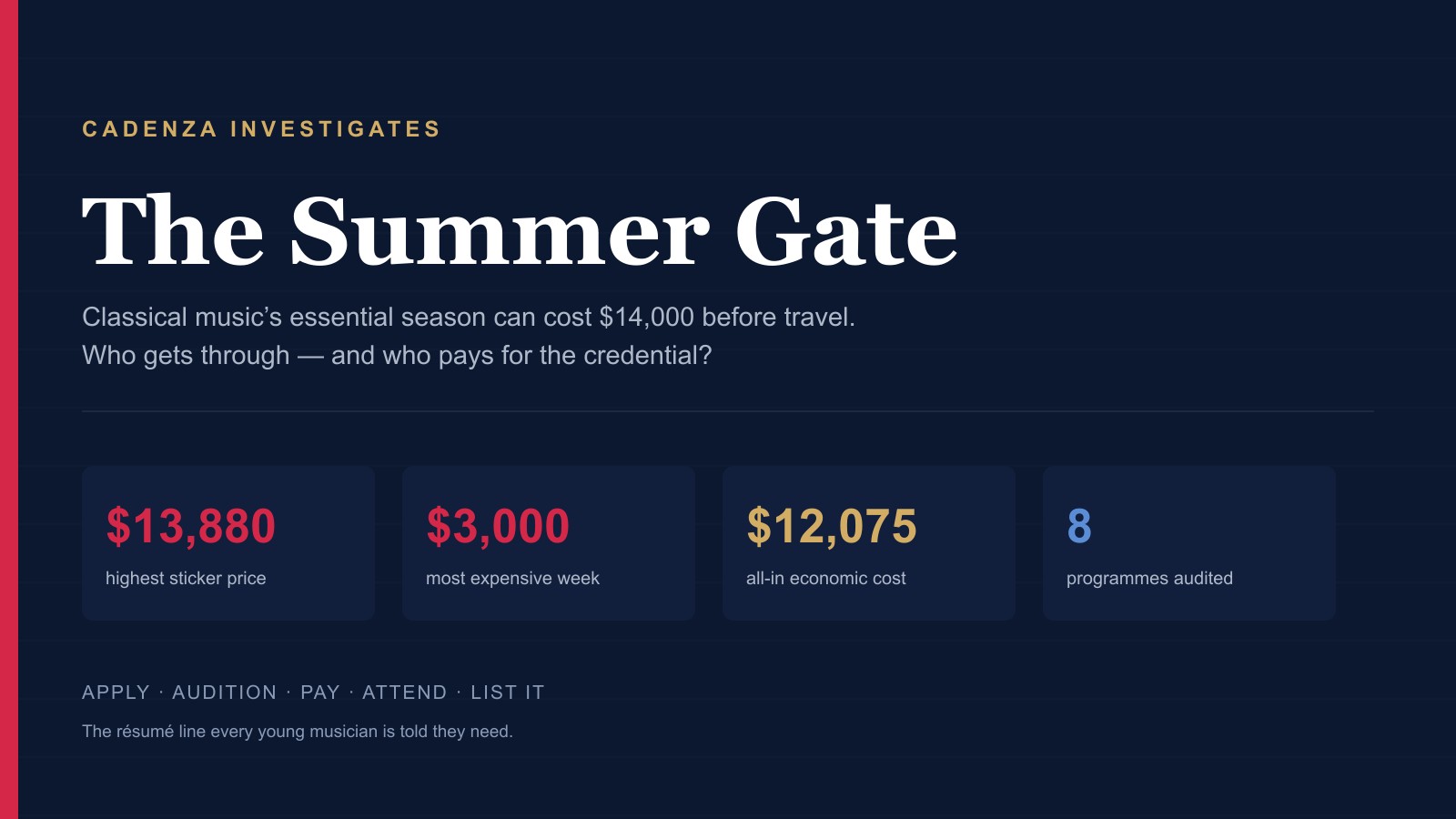
This investigation examines what a summer at a leading American music programme actually costs, and who is filtered out by the price. It rests on published fee pages and programme documents for the 2026 and 2027 sessions, recorded as they stood when checked. Three cautions travel with it. Sticker price is not what every participant pays: scholarships, institution-funded places and fee waivers all change the bill, and this article says so throughout. Cost-per-week figures are Cadenza's own arithmetic on published fees and session lengths, not programme disclosures. And an audit of eight programmes describes those eight — it does not measure the whole summer market.
What Cadenza found
The highest mandatory residential charge in the audited set is Aspen’s 2027 full session at $13,880 before travel. Interlochen’s 2027 six-week price is $10,500.
Aspen says more than 85% of students receive some aid and that a majority receive full support through fellowships. Interlochen reports aid to 85% of applicants who sought it in the prior summer. Neither publishes a median net price.
Boston University Tanglewood Institute’s six-week Young Artists Orchestra costs $8,865 in 2026. The advanced Tanglewood Music Center charges no tuition and supplies core living support.
Programs differ sharply: some reduce refunds after a student begins; others make most payments effectively nonrefundable weeks before the program starts.
Passports, visas, insurance, travel to the starting point, instrument baggage, local transit and foregone work can remain with the participant even when tuition and housing are covered.
A festival credit does not state whether the musician paid full price, received partial aid, exchanged labor for support, or won a fully funded fellowship.
1. The hidden admissions season
Conservatory admissions are visible. Schools publish tuition. Governments collect enrollment data. Students compare degrees, faculty, housing and financial aid. Families know that a four-year institution is selling education.
Summer study occupies a less legible category. It can be camp, festival, academy, fellowship, institute, residency, orchestra, masterclass and professional engagement at the same time. A teenager may live in a dormitory, take private lessons, rehearse six days a week and play ticketed concerts. A graduate student may do nearly identical work at a neighboring program while paying nothing. A young professional may receive housing and travel because the festival requires a high-level orchestra. The public sees music. The participant sees a contract.
The season has become structurally important because classical music rewards accumulated association. A teacher can introduce a student to another teacher. A chamber coach can later sit on a hiring panel. A conductor can remember a reliable section player. A festival colleague can recommend a substitute years later. A summer line can signal that the musician survived an audition, worked intensively and entered a recognized network.
None of this means a musician without elite summer credits cannot succeed. It means the programs operate as a parallel infrastructure of selection. They distribute instruction, peer groups, references, recordings and social proof during the months when ordinary schools are closed.
The entrance requirement is usually described as musical: repertoire, recordings, recommendation and audition quality.
The financial requirement appears later. It is fragmented across tuition pages, housing pages, aid pages, deposit rules, refund schedules, travel policies and application portals. A family can know that a program costs $9,000 without knowing whether the typical admitted student pays $9,000. It can know that scholarships exist without knowing the median award. It can know that housing is included without knowing whether flights, instrument seats, insurance or meals during travel are not.
Summer classical music does not have one price. It has a sticker price, a net price, a cash-flow schedule, a cancellation exposure and an opportunity cost. Most institutions publish only part of that equation.
2. What Cadenza audited
Cadenza reviewed fifteen program tracks at fourteen institutions whose public materials were available on August 7, 2026.
Eight are residential programs with a published mandatory charge: Aspen’s full session, Interlochen’s six-week camp, Boston University Tanglewood Institute’s Young Artists Orchestra, Meadowmount, Brevard’s college orchestral program, Bowdoin’s six-week instrumental program, Eastern Festival of Music’s five-week program and the Music Academy of the West’s two-week High School Intensive.
Six are institution-funded fellowships or academies: the Tanglewood Music Center, Music Academy of the West’s Fellowship Institute, NYO-USA, Pacific Music Festival, Lucerne Festival Academy and Schleswig-Holstein Festival Orchestra. Heifetz was included in the application-fee review because its published 2026 application charge illustrates a cost incurred before admission; Cadenza did not include it in the residential-price comparison.
The central price chart uses the most recently published cycle on each official site. Most figures are for summer 2026. Aspen and Interlochen had already published 2027 figures, so those are identified as 2027 throughout. Refundable security deposits are excluded from the headline charge. Application fees, flights, personal spending and opportunity cost are also excluded unless an institution explicitly includes them.
This is not a quality ranking. A two-week high-school intensive cannot be compared artistically with a seven-week string program or an advanced orchestral fellowship. Their faculty, mission, intensity, participant age and production costs differ. The audit asks a narrower question:
What does a musician have to finance in order to enter, attend and survive the program?
3. The sticker-price map
The published charges reveal the scale of the market before aid.
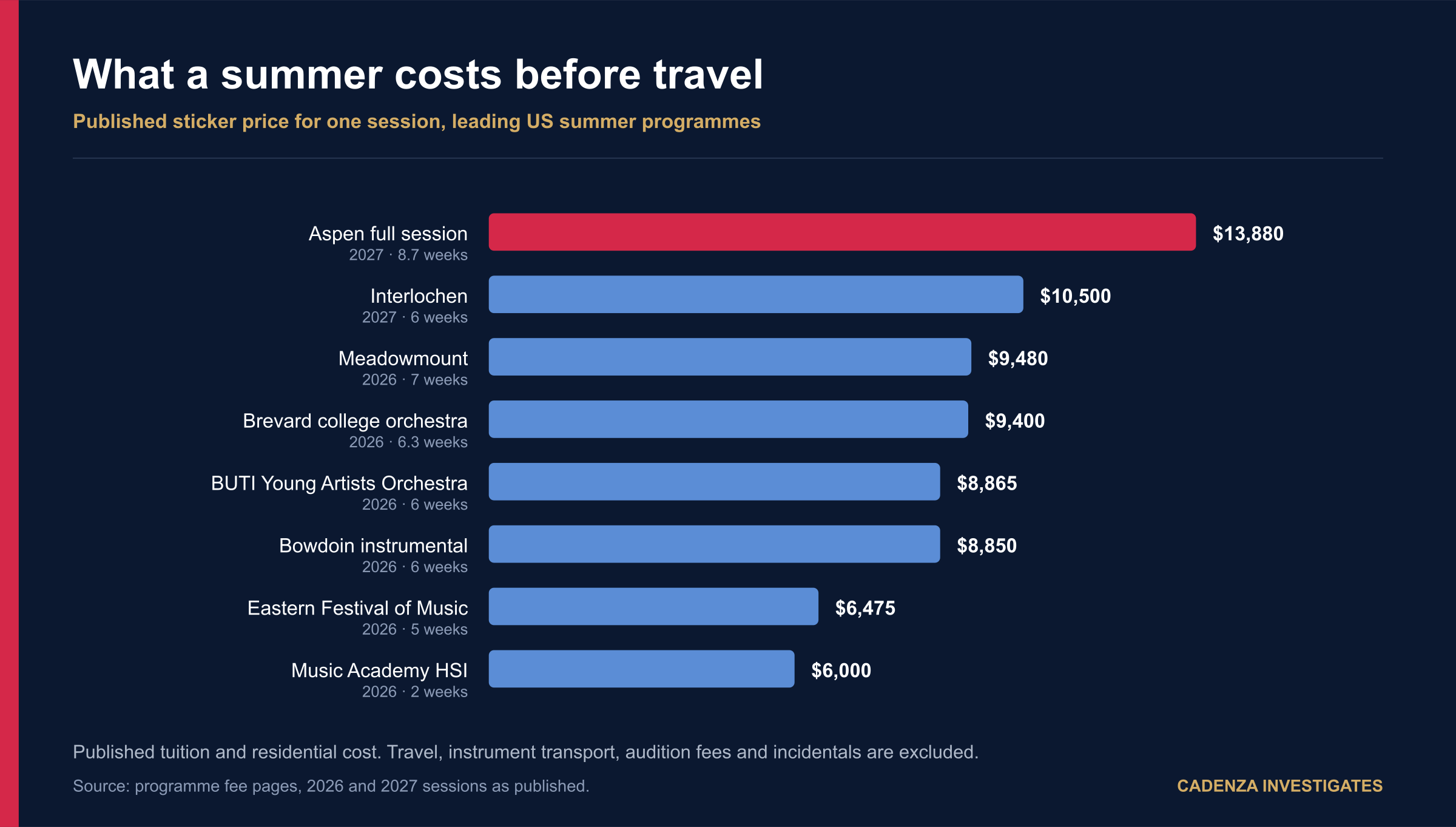
Published tuition and residential cost for one session. Travel, instrument transport, audition fees and incidentals are excluded.
Aspen’s 2027 full session lists $6,590 in tuition, $6,995 in room and board, a $195 health-service charge and a $100 facility fee. The mandatory total is $13,880, plus a $100 refundable security deposit. The full session runs from June 23 to August 22. 14
Interlochen lists $10,500 for a six-week 2027 program. Its shorter 2027 offerings range from $2,125 for one week to $8,400 for four weeks. The one-week programs are not eligible for financial aid. Interlochen separately warns families to plan for travel, personal and program-specific costs. 5
Meadowmount’s 2026 seven-week schedule totals $9,480: $5,450 in tuition and $4,030 in room and board, plus a refundable $65 security deposit. Brevard’s 2026 college orchestral program is $9,400 and states that the amount covers instruction, housing, meals, health services and concert admission, with travel paid by the student. 1215
BUTI’s six-week Young Artists Orchestra costs $8,865 in 2026: $4,615 in tuition, $3,600 in room and board and $650 in required fees. Bowdoin’s six-week instrumental program totals $8,850: $4,850 in participation fees, $3,400 in room and board and $600 in facilities charges. Eastern Festival of Music lists $6,475 for five weeks. Music Academy’s two-week High School Intensive is $6,000 and describes the charge as all-inclusive for housing, meals, instruction and performance activity. 7171920
Published mandatory residential charge
A published charge is useful because it tells a student the maximum institutional bill before aid. It is misleading when treated as the market price.
Aspen says it distributes nearly $4 million in aid each summer, that more than 85% of its student body receives some assistance and that a majority receive full support through fellowships. Interlochen says 85% of students who applied for aid received it in the previous summer and that it distributed $5.1 million in 2025. Bowdoin says 70% receive scholarships. Brevard says more than 80% receive some scholarship. Meadowmount says approximately 40% receive scholarship funds. 25181513
These percentages describe different denominators. Aspen refers to the student body. Interlochen’s figure refers to students who applied for assistance. Brevard says “some scholarship,” which can range from a small reduction to near-complete support. None of the audited fee-based programs publishes a median amount actually paid by all enrolled participants.
The public can compare sticker prices.
It cannot compare typical prices.
4. Cost per week changes the picture
Duration matters because a long residential program necessarily purchases more housing, meals, supervision, facilities and instruction. Dividing by weeks does not create a perfect unit price, but it separates the scale of the full bill from the intensity of the charge.
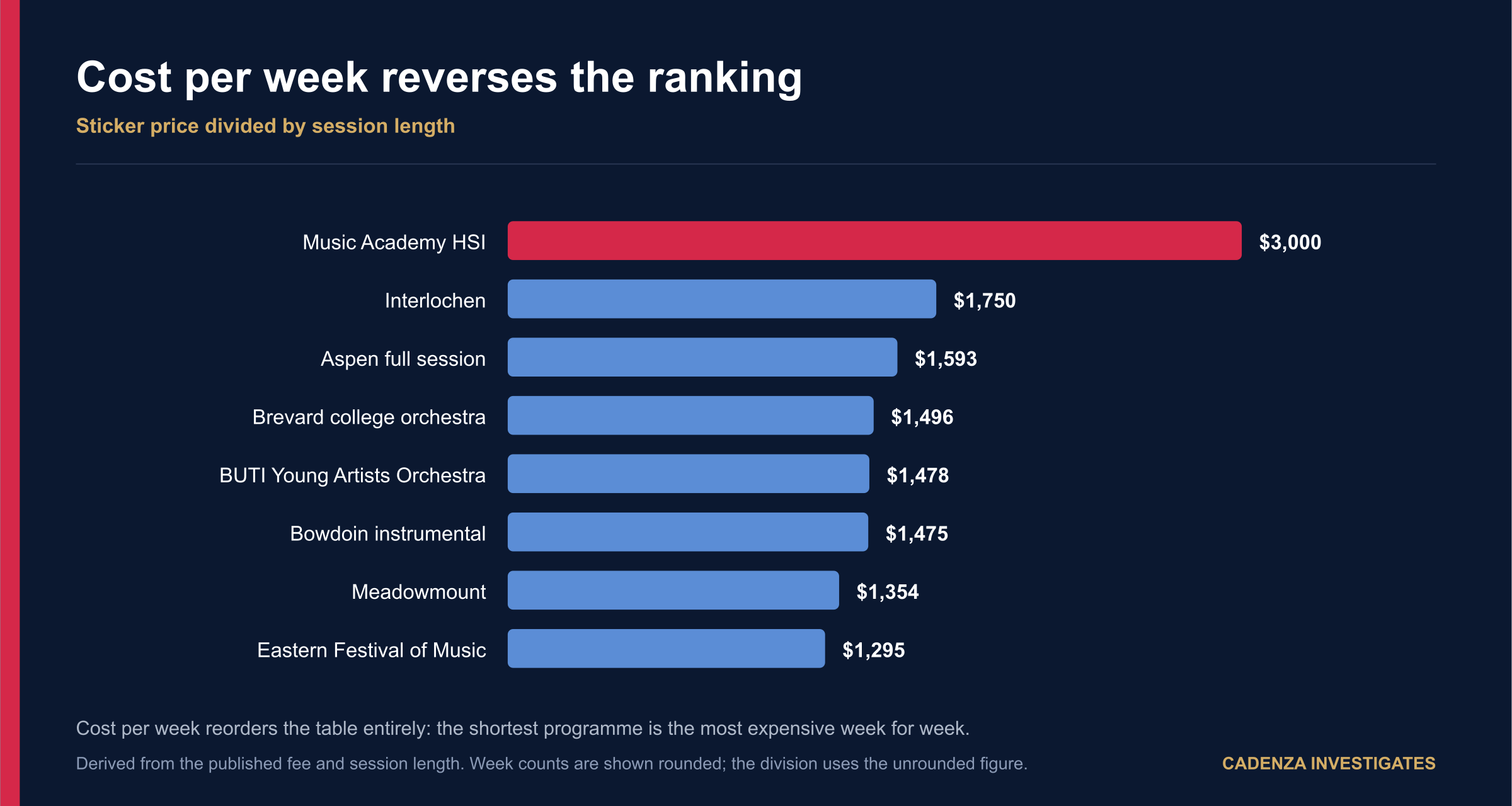
Cadenza's arithmetic on the published fee and session length. Week counts are shown rounded; the division uses the unrounded figure.
Music Academy’s two-week High School Intensive is the least expensive program in the gross-price chart at $6,000. It is also the most expensive by week: $3,000. Interlochen’s six-week price is $1,750 per week. Aspen is approximately $1,593 per week. Brevard is about $1,495, BUTI $1,478, Bowdoin $1,475, Meadowmount $1,354 and Eastern $1,295.
Published charge per program week
The weekly chart reveals why the phrase “all-inclusive” is incomplete. A short intensive can carry high fixed costs: faculty travel, residence staffing, venues, meals and administration are compressed into fewer days. A long program spreads those costs but asks the participant to surrender more of the summer.
The correct question is not whether $1,500 per week is inherently excessive. A private lesson, chamber coaching, orchestral rehearsals, room, meals, concerts and supervised residential life are expensive to provide. The correct question is whether the institution publishes enough information for a family to understand the package, the likely net price and the alternative funding routes.
5. Two Tanglewoods, two economic systems
The Berkshire campus offers the cleanest demonstration of the split market.
Boston University Tanglewood Institute’s Young Artists Orchestra is a six-week program for musicians aged 14 to 19. Its 2026 charge is $8,865, including tuition, room and board and required fees. Scholarships range from $500 to full tuition, and the institute says it distributes hundreds of thousands of dollars annually. Its refund schedule reduces the recoverable amount after arrival: for five-to-eight-week programs, the published schedule is 100% before the program begins, 80% during the first week, 70% during the second and zero after that, with deposits nonrefundable. 789
The Tanglewood Music Center, operated by the Boston Symphony Orchestra for advanced musicians, runs nearby and uses the opposite financial model. It charges no tuition. It provides housing, breakfast and dinner, plus a stipend for lunch. Fellows pay a $75 application fee and, if accepted, a registration charge of $250 for first-year participants or $200 for returning participants. They fund their own travel and incidental costs, and international fellows bear specified visa-related responsibilities. Fellows are not permitted to take outside performance engagements during the program. 1011
One musical destination, two financial bargains
BUTI Young Artists Orchestra
- Six weeks, ages 14–19
- Tuition, room and board, required fees
- Scholarships from $500 to full tuition
- Travel and personal costs remain
- Refund value falls after arrival
Tanglewood Music Center
- Advanced fellowship
- Housing, breakfast and dinner supplied
- Lunch stipend provided
- $75 application and registration charge
- Travel, incidentals and some visa costs remain
An informed musician knows that BUTI and TMC are different institutions with different admissions standards. A biography may preserve the distinction. The broader public often sees only “Tanglewood.” More important, the two programs demonstrate that prestige itself does not determine who pays. The participant’s age, scarcity and usefulness to the producing institution do.
The younger musician purchases a concentrated educational environment.
The advanced fellow supplies artistic capacity that the festival needs enough to subsidize.
6. The Aspen paradox
Aspen has both the highest audited sticker price and one of the strongest published aid claims.
Its $13,880 mandatory charge can be presented as evidence that elite summer music is inaccessible. Its aid page can be presented as the opposite: nearly $4 million distributed each summer, more than 85% of students receiving support and a majority receiving full support through fellowship awards. Both descriptions can be true. 12
The paradox exists because a sticker-price system allows one institution to serve several financial groups at once.
A fully supported fellow may pay little or none of the listed tuition and housing. A partially supported student may face several thousand dollars. A student without aid may pay the entire amount. Every participant enters the same general ecosystem, but the transfer runs in different quantities.
The published percentage receiving aid does not tell an admitted musician where they are likely to land in that distribution. “Some aid” can mean a modest reduction. “Full support” can cover different components. A majority receiving full support is unusually strong information, but it still leaves the remaining students divided across unknown net-price bands.
Aspen’s application fee also varies by timing: $30 at the early deadline, $60 later and $110 at the final deadline. Once admitted, the cash-flow risk intensifies. The school states that a $500 enrollment deposit is nonrefundable and that students taking on-campus housing make a $1,000 nonrefundable housing deposit; both are credited toward charges, but withdrawal can forfeit them. Once students enroll and register, payments are generally nonrefundable except in specified medical or visa circumstances. 31
The important number is therefore not $13,880 alone.
It is the amount charged to a particular student, minus the award, plus the amount that becomes irreversible before the student can know every future circumstance.
7. “Scholarship” is not a price
Summer-program marketing uses scholarship language because it signals access and generosity. For comparison, it is often insufficient.
Cadenza coded five public information fields for each fee-based program: a complete sticker price; the share of participants receiving aid; a total aid pool or award range; an identified full-funding pathway; and a median net price or distribution of actual participant payments.
Aspen and Interlochen publish four of the five. Aspen gives the sticker price, recipient share, total aid pool and the fact that a majority receive full support. Interlochen gives the sticker price, the share of aid applicants receiving awards, the 2025 aid total and examples of full-tuition scholarships. Neither provides a median net price.
Bowdoin publishes its complete price, says 70% receive scholarships and identifies thirty full-support places in its Fellowship, String Quartet and Collaborative Piano tracks. It does not publish a median award for the fee-paying instrumental cohort. Brevard publishes price, says more than 80% receive some scholarship and identifies teaching-assistant and resident-assistant routes that reduce the student’s payment to a $950 enrollment fee. It does not publish the distribution of ordinary scholarship amounts. 1815
Meadowmount says approximately 40% receive scholarship support and describes awards ranging from $500 to $10,000. It also offers room-and-board credit to resident assistants, a $2,700 tuition credit to junior counselors and a $1,000 service award tied to an average of ten hours of weekly work. Those routes are economically useful but not interchangeable. A merit grant, a need grant and a work obligation have different consequences for practice time and participant life. 1314
What the public price pages reveal
The missing statistic is the one families need most:
What did the middle student actually pay?
Colleges increasingly use net-price calculators because sticker tuition alone is an unreliable description of the bill. Summer music programs have no comparable common standard. A program can publish that 80% receive aid while charging most of those recipients nearly full price. Another can support a smaller share but give every recipient a full fellowship. The same percentage can describe opposite distributions.
Scholarship is not a price. It is a reduction from a price. Until the distribution is published, the market remains unreadable.
8. One résumé line, four payment paths
A festival name on a biography records artistic participation. It rarely records how the participation was financed.
Four musicians can leave with the same institutional name
Full-price student
Family or musician pays tuition, housing and fees, then adds travel, instrument transport and incidentals.
Partially aided student
A merit or need award reduces the bill, but the remaining amount may still be several thousand dollars.
Work-supported participant
Resident-assistant, teaching-assistant or service duties exchange time and responsibility for a reduced charge.
Fully funded fellow
The institution covers tuition and core living costs because the participant has won a fellowship or supplies needed artistic capacity.
All four musicians may have passed an audition. All may receive serious teaching. All may perform in the same concerts. Their artistic work can be equivalent even when their financial transactions are not.
The problem is not that a full-paying student’s credit is false. Admission can still be selective, and the program can still be demanding. The problem is that the name alone cannot function as clean evidence of either artistic scarcity or financial support.
This matters because résumé lines are used as shorthand. Teachers cite summer placements when recruiting. Young-artist biographies list festivals before professional credits exist. Grant committees read institutional names as evidence of momentum. Orchestra colleagues use them as social coordinates.
The more expensive the fee-funded track, the more that shorthand risks confusing access with selection. A highly talented student who cannot finance the remaining bill after aid may disappear from the cohort. A less constrained student can accept. The final roster then reflects both artistic judgment and the ability to complete the transaction.
Programs cannot eliminate family wealth. They can disclose how much it shaped the class.
9. The institution-funded model
The funded programs show that intensive summer music can be organized without tuition.
Tanglewood Music Center supplies tuition-free participation, housing, two meals and a lunch stipend. Music Academy of the West describes its six-week Fellowship Institute for musicians aged 18 to 34 as full-scholarship and provides housing and three meals daily. NYO-USA covers tuition, room, board, instruction, rehearsal and performance expenses, tour visas, flights during the tour, ground transport, hotels, meals and group sightseeing. 102122
Pacific Music Festival covers education, a round-trip flight from the participant’s origin to Sapporo, domestic travel in Japan, shared accommodation and meals or stipends. Lucerne covers travel, accommodation, meals and instrumental parts and charges no application fee. Schleswig-Holstein’s orchestra grant covers travel, bed, board and tuition, though its application charge varies by region. 232526
What six funded programs publicly cover
| Program | Tuition | Housing | Meals | Program travel | Travel to start | Application fee |
|---|---|---|---|---|---|---|
| Tanglewood Music Center | ✓ | ✓ | 2 + stipend | — | self | $75 |
| Music Academy Fellowship | ✓ | ✓ | ✓ | — | self | Published by track |
| NYO-USA | ✓ | ✓ | ✓ | ✓ | self | $30 |
| Pacific Music Festival | ✓ | ✓ | ✓ | ✓ | flight | $35 (Acceptd submission fee) |
| Lucerne Festival Academy | ✓ | ✓ | ✓ | travel | travel | $0 |
| Schleswig-Holstein Orchestra | ✓ | ✓ | ✓ | grant | grant | €15–€50 |
These programs are not charitable replicas of fee-based camps. They can fund participants because they occupy a different place in the production chain.
An advanced academy needs a complete orchestra, ensemble or cohort to produce concerts. The participant is simultaneously learning and supplying a scarce artistic input. A festival can raise donations and sponsorship around the public result. It can treat travel and housing as production costs rather than education revenue.
Selectivity also concentrates subsidy. Pacific Music Festival reported 1,466 applications from 70 countries for its 2026 academy and selected 92 musicians. A fully funded place can therefore be dramatically less expensive to the participant and dramatically harder to obtain. 24
The funded model does not prove that every summer program should be free. A high-school camp has safeguarding, supervision and educational costs that an adult fellowship does not. A small string school may have limited donor capacity. A program designed primarily as instruction cannot necessarily finance itself through concerts.
It proves something narrower and important:
Tuition is a choice of institutional model, not an unavoidable property of summer music.
10. Zero tuition is not zero cost
“Fully funded” usually refers to the program’s core package. It does not mean the participant’s summer has no price.
Tanglewood fellows finance travel and incidentals and may bear visa costs. NYO-USA participants must reach and leave the program’s starting point and obtain a passport, though need-based assistance can be available. Pacific Music Festival requires participants to carry travel insurance and pay visa expenses, local airport costs and some instrument-related charges. Lucerne requires travel-cancellation and foreign health insurance. 11222325
Instrumentalists can face costs that ordinary travelers do not. A cello may require an extra seat. A contrabass may move as cargo. A bow can trigger documentation questions at a border. Insurance must cover an object whose replacement value can exceed the participant’s annual income. A delayed instrument can make arrival useless even when the person arrives on time.
International participants may also pay before knowing whether documents will be approved. Passport renewal, consular travel, visa fees, translations and insurance can be separate from the institution’s support. A funded place can become unaffordable when the remaining costs fall due immediately and reimbursement arrives later.
The largest hidden cost may be time.
Tanglewood’s rules say fellows may not take outside performance engagements during the program. Other academies impose schedules that make outside teaching or gig work impractical even without a formal ban. A six-week fellowship can save $9,000 in tuition and housing while costing a freelancer six weeks of paid weddings, church services, teaching and substitute work.
That trade can still be rational. The fellowship may create artistic and professional value far beyond the lost income. But the correct net-cost calculation includes both.
11. The application before admission
The summer bill begins before a musician knows whether there will be a summer place.
Heifetz’s 2026 application charge is $125, or $100 at the early rate. Aspen ranges from $30 to $110 depending on timing. Bowdoin lists $99 for Fellowship, String Quartet and Collaborative Piano applications and $79 for instrumental or composition applications by the ordinary deadline, with higher late charges where available. Tanglewood Music Center charges $75. Brevard charges $65. Music Academy’s High School Intensive charges $50. NYO-USA charges $30. Lucerne charges no application fee. 273171016202225
Selected published application charges
The fee is the measurable part. Audition production can cost more.
A musician may need a pianist, a hall, an engineer, instrument tuning, editing within the rules and several hours of recording. Even when a phone recording is technically accepted, applicants know that sound quality changes how a performance is perceived. Students with conservatory access can borrow halls and institutional equipment. Independent musicians may rent the same conditions.
Application volume multiplies every line. A musician applying to eight programs can spend hundreds of dollars in fees and substantially more on evidence. None of it guarantees admission. A fee waiver can help, but waivers themselves may require proof, forms and early action.
The result is a pre-selection before the artistic panel hears the recording. Musicians who cannot finance repeated applications apply more narrowly. They accept more risk from each choice. They may avoid the programs where a late deadline or specialized recording requirement raises the cost.
12. The refund cliff
An acceptance creates a new decision under time pressure: commit money before the musician knows every competing result, travel price, health condition or family event.
Programs need deposits because an empty place is expensive. Faculty, dormitories, orchestras and chamber assignments are planned around a cohort. A late withdrawal can leave an instrumentation gap that cannot be repaired. The institution therefore transfers part of the cancellation risk to the participant.
The amount and timing differ sharply.
Aspen’s enrollment and housing deposits are nonrefundable and applied to the bill. The school states that payments are generally nonrefundable after enrollment and registration, subject to specified exceptions. BUTI’s long-program schedule allows a full tuition refund before the start, excluding deposits, then 80% during the first week, 70% during the second and zero afterward. Meadowmount’s $1,500 enrollment deposit becomes nonrefundable within ninety days of the program, and the balance is refundable only under limited timing and replacement conditions; no refund is offered within thirty days. Brevard states that no refunds are available after May 15 and that earlier refund consideration is limited to serious illness supported by medical verification. 171216
Four refund cliffs
Aspen
BUTI, 5–8 weeks
Meadowmount
Brevard
The refund page is often more important than the scholarship page. A $4,000 award does not protect a student who must forfeit a $1,500 deposit while waiting for another program’s result. A fully funded place can still be inaccessible if the first program’s commitment deadline arrives earlier.
This is where unequal liquidity matters. A family with available cash can hold an option, lose a deposit and choose the better later result. A family without it must accept the first affordable offer or decline while waiting.
The artistic decision is shaped by the order in which invoices become irreversible.
13. The family balance sheet
The program charge is only one line in the decision.
What a summer actually costs
The interactive version of this table let readers set their own figures. Held at the default scenario used in this investigation — a $9,400 programme reduced to $6,900 by scholarship, over a seven-week session — the bill assembles like this:
| Line | Amount |
|---|---|
| Institutional bill after scholarship | $6,900 |
| Applications | $350 |
| Recording and accompanist | $600 |
| Travel | $700 |
| Instrument transport | $200 |
| Weekly incidentals | $525 |
| Cash outlay | $9,275 |
| Foregone earnings, 7 weeks at $400 | $2,800 |
| All-in economic cost | $12,075 |
In the default scenario, the scholarship reduces the institutional bill from $9,400 to $6,900. The participant then spends $350 on applications, $600 on recording and accompanist costs, $700 on travel, $200 on instrument transport and $525 on weekly incidentals. Cash outlay becomes $9,275. Seven weeks of foregone earnings at $400 per week raise the economic cost to $12,075.
The example is not a claim about any program or participant. It demonstrates why scholarship percentages cannot answer affordability.
A family may also carry interest. A credit-card balance used for a deposit can accrue before the program begins. A parent may lose work while transporting a minor. An international student may travel to a consulate. A musician may need maintenance before departure because a repair in a remote summer location is impossible.
Conversely, an all-inclusive residential charge can replace expenses the participant would have incurred at home: food, local transport and some instruction. The correct comparison is not the program bill against zero. It is the program’s incremental cost against the realistic alternative summer.
Institutions cannot calculate every family’s balance sheet. They can publish the inputs.
14. The cost of disappearing for six weeks
Summer is not empty time for musicians.
It is wedding season, festival season, church season, teaching season and the period when freelancers build relationships that lead to autumn work. A six-week absence can mean lost students, substitute calls, services and local contracts. For a conservatory student, the alternative may be a paid internship or ordinary job that helps finance the next academic year.
Summer programs ask participants to convert current income into future possibility. That is a familiar investment, but its risk is unusually private. The institution can state that alumni have succeeded. It cannot promise that one participant’s lesson, contact or résumé line will generate work.
An illustrative $12,075 summer
The burden is not uniform by instrument. A pianist cannot take a concert grand on the road but may need guaranteed practice access. A string player may pay for a second airline seat. A percussionist can rely on program equipment but may need to transport personal instruments. A singer may carry no valuable instrument but lose more paid church work. A composer may need software, printing and travel without the meal and housing structure designed around an orchestra.
That variation makes a standardized net-price disclosure more—not less—important. The institution should publish what it covers. The musician can add what it does not.
15. Age changes the bargain
The audit suggests a broad progression.
Younger programs are more likely to charge tuition because they provide supervised residential education. Intermediate programs combine fees, scholarships and work-supported roles. Advanced programs are more likely to fund the participant because they require a highly selective ensemble capable of producing professional-level public performance.
How the economic model tends to change with career stage
Camp and intensive
High supervision, broad education and residence services. Family-funded price is common; aid can be substantial.
Selective training
Audition-based orchestras, private study and public concerts. Tuition remains common, with merit and need aid.
Mixed economy
Fee-paying cohorts coexist with fellowships, assistantships, resident roles and full-support tracks.
Funded academy
Institution finances core costs when participant scarcity and performance output become central to the festival.
Music Academy of the West contains both ends of the progression. Its two-week High School Intensive costs $6,000 and offers limited need-based assistance. Its six-week Fellowship Institute for musicians aged 18 to 34 is full-scholarship. Both use the same institutional campus and brand. 2021
Bowdoin contains the middle. Its ordinary six-week instrumental program costs $8,850 before scholarship. Its Fellowship, String Quartet and Collaborative Piano tracks carry no program fees, and the festival says thirty participants in those tracks receive full tuition, room and board. Resident assistants can receive full room and board in exchange for scheduled duties and on-call responsibility. 1718
These internal splits are more informative than comparisons between unrelated institutions. They show how one organization values different participant roles.
The student pays when the institution defines the primary product as education.
The institution pays when it defines the participant as necessary to the product it presents.
16. Student, performer, or both?
Public concerts complicate the economic story because fee-paying students can produce work that has value to an institution.
A summer orchestra may sell tickets, attract donors, create recordings, populate marketing and fulfill a festival’s artistic calendar. Students rehearse for many hours and appear before the public. It is tempting to conclude that any participant who performs is therefore an employee who should be paid.
That conclusion is too simple.
Education can include productive work. A student journalist publishes. A film student completes a production. A medical trainee contributes to care under supervision. The existence of a public result does not by itself determine employment status. The legal analysis can depend on jurisdiction, control, educational benefit, compensation, institutional purpose and the actual relationship. This investigation does not classify any audited participant as an employee or independent contractor.
The economic question remains legitimate even where the legal answer is education.
How much of the program’s value flows to the student, and how much flows to the institution?
A fee-funded program can be fair when the participant receives intensive instruction, safe housing, meals, facilities, performance opportunities and genuine mentorship worth the charge. It becomes harder to evaluate when the public concert is central to fundraising and marketing but the participant’s net price remains hidden.
A work-supported scholarship should also be described honestly. A resident assistant may receive substantial value, but on-call duties can reduce practice, rest and participation. Calling the entire reduction a “scholarship” hides the exchange. Calling it compensation alone hides the education.
The correct label can be both.
17. What the programs actually deliver
A cost investigation can become dishonest by treating every bill as extraction.
Summer programs can offer conditions that ordinary academic years cannot.
A student may receive weekly private study from a teacher unavailable at home, daily chamber coaching, orchestral experience, masterclasses, performance recordings and uninterrupted practice. The residential setting compresses a network into every meal and rehearsal. Musicians hear peers from other schools, test themselves against a wider field and discover that their local standard was either stronger or weaker than they believed.
For a teenager, the experience can reveal whether a professional path is tolerable before a family commits to conservatory tuition. For an emerging professional, it can provide a conductor, principal player or faculty member who later becomes a reference. For an international musician, it can create a first point of entry into another country’s professional system.
Housing and meals are not incidental. Running a safe residential community for minors requires staff, health provision, transportation, facilities, insurance and safeguarding. A remote campus can cost more to operate precisely because participants cannot purchase alternatives outside it. A two-week intensive may have a high weekly charge because faculty and production costs do not fall proportionally with duration.
The institutions also assume risk. They contract faculty before final enrollment, reserve beds, prepare repertoire and schedule concerts. Scholarship fundraising can begin years before the student arrives. A full orchestra requires exact instrumentation; one withdrawal can force emergency recruitment.
The purpose of transparency is not to prove that programs cost too much.
It is to make the price legible enough that musicians can decide whether the value is worth it.
18. The résumé distortion
Classical biographies are built from nouns: Juilliard, Curtis, Aspen, Tanglewood, Lucerne, Verbier, Marlboro. The verb disappears.
Studied at. Paid to attend. Won a fellowship. Performed with. Worked as an assistant. Received full support. Joined through an open audition. Entered through a teacher’s studio. Those are different relationships.
The compression benefits institutions because every alumnus extends the brand. It benefits musicians because a recognizable name fits into a short biography. It harms comparison when readers assume every line carries the same selection and financing meaning.
The strongest example is not a fraudulent résumé. It is a technically accurate but incomplete one:
“Appeared at Tanglewood, Aspen and the Music Academy of the West.”
That sentence could describe a teenager who attended three fee-funded programs with family support. It could describe a musician who received three full fellowships. It could combine a paid high-school intensive with an advanced funded academy. It could describe public masterclasses rather than an orchestral appointment.
Industry insiders often recognize program names and age tracks. General audiences, journalists, donors and automated biography systems do not. As credentials become searchable data, the missing verbs become more consequential. A model ranking artists by institutional associations may treat a purchased educational place and a fully funded fellowship as equivalent evidence.
The solution is not to place private financial aid on a public résumé. A musician should not have to disclose family income.
The institution can standardize the credential instead:
“Admitted participant, six-week instrumental program.” “Full fellowship, orchestral academy.” “Resident assistant and instrumental participant.” “High School Intensive student.”
Those labels preserve dignity and make the nature of the selection legible without publishing an individual’s bill.
19. A disclosure standard for the summer gate
Summer music does not need one price. It needs one vocabulary.
Combine tuition, housing, meals, health, facilities and required fees in one visible total. Identify refundable deposits separately.
Report what the middle enrolled participant paid after institutional grants, plus the 25th and 75th percentiles.
Distinguish need grants, merit awards, instrument-specific fellowships, assistantships and work exchange. Do not collapse labor into scholarship.
State how many enrolled participants paid no tuition and how many also received housing, meals and travel.
Give realistic ranges for travel, instrument baggage, visas, insurance, local transport, concert dress, scores and incidentals.
Place deposit deadlines, aid notification dates and refund cliffs on one timeline so musicians can compare competing offers.
Report applications, offers, enrollments, aid recipients and withdrawals by program track, not only institution-wide.
Give participants a precise résumé label identifying the track and whether it was an educational program, fellowship or assistantship.
Publish geographic and socioeconomic participation data in aggregate, with privacy safeguards, and track who declines for financial reasons.
Tuition-only support is not the same as tuition, housing, meals, travel and incidentals. List every included component.
No program needs to reveal an individual student’s award. Aggregate distribution is enough.
A simple table could transform the market:
Published price: $9,400. Median net price: $3,100. Twenty-five percent paid zero. Twenty-five percent paid more than $6,500. Median travel grant: zero. Eight percent declined after admission for financial reasons. Deposits become nonrefundable on May 15.
That information would not reduce prestige. It would distinguish programs confident enough to show how access actually works.
20. The gate is the hidden bill
Classical music needs summer institutions.
Schools close. Orchestras reduce seasons. Young musicians need concentrated time, new teachers, unfamiliar peers and stages on which failure is still education. Festivals need artists. Remote campuses create communities that cannot be replicated by an online lesson or a weekly rehearsal.
The gate is not the existence of elite training.
It is not even the existence of a high price. A transparent $10,000 program that provides housing, meals, intensive instruction, strong aid and a clear refund policy may be more accessible than a nominally free program that leaves an international participant with unaffordable travel and document costs.
The gate is the hidden bill.
It is the sticker price without the median net price. The scholarship percentage without the award distribution. The nonrefundable deposit before competing decisions arrive. The “fully funded” fellowship that excludes the flight to the starting point. The work-study award that quietly consumes practice time. The résumé line that preserves the institution’s name while erasing whether the musician paid it, worked for it or was chosen strongly enough that it paid for the musician.
Summer programs do not merely teach music. They distribute professional proximity. They determine who spends six weeks beside a future colleague, who receives a reference, who appears in the photograph and who can place the name on a biography.
That power does not require tuition to be abolished.
It requires the price of entry to be visible before the gate closes.
Methodology and limitations
This investigation is a documentary audit of public program materials available on August 7, 2026. Cadenza reviewed official tuition, financial-aid, application, program, housing, travel and refund pages for fifteen program tracks at fourteen institutions.
- Cycle handling: Most price observations are for summer 2026. Aspen and Interlochen had published 2027 prices, so those are used and visibly labelled. The audit does not inflate or deflate prices to a common year.
- Headline charge: The price chart adds mandatory tuition, room and board, health, facility and required program fees where itemized. Refundable security deposits are excluded. Application fees, travel, visas, insurance, personal spending and opportunity cost are excluded unless explicitly included by the institution.
- Duration: Weekly amounts are simple divisions by published length. Aspen is approximately 8.7 weeks; Brevard is approximately 6.3 weeks from stated dates. They are not measures of instructional hours or quality.
- Aid: Published aid percentages use different denominators and definitions. “Some aid,” “scholarship,” “full tuition” and “full support” are not treated as equivalent. Cadenza did not estimate unpublished awards.
- Coverage: Funded-program matrices simplify official language. Participants must consult current contracts for exclusions, reimbursement timing and documentation.
- Legal status: The article makes no determination that participants are employees, contractors or consumers under any jurisdiction.
- No participant survey: Cadenza did not claim a typical family budget, debt load or career return because institutions do not publish standardized net-price data and this audit did not survey alumni.
- Changing pages: Programs may revise fees and policies after publication. The source register preserves the official pages used, but live content can change.
Full program audit
| Program | Track | Cycle | Weeks | Published participant charge | Core coverage | Aid / funding disclosure | Selected application fee |
|---|---|---|---|---|---|---|---|
| Aspen Music Festival and School | Full session | 2027 | 8.7 | $13,880 | Tuition, room/board, health, facility | 85%+ aid; majority full support | $30–$110 |
| Interlochen | Six-week camp | 2027 | 6 | $10,500 | Published residential program price | 85% of aid applicants aided | By application path |
| Meadowmount School of Music | Seven-week program | 2026 | 7 | $9,480 | Tuition, room/board | 40% receive funds; $500–$10,000 | Published portal |
| Brevard Music Center | College orchestral studies | 2026 | 6.3 | $9,400 | Instruction, housing, meals, health, concerts | 80%+ some aid; TA/RA route | $65 |
| Boston University Tanglewood Institute | Young Artists Orchestra | 2026 | 6 | $8,865 | Tuition, room/board, required fees | $500 to full tuition | Published by program |
| Bowdoin International Music Festival | Six-week instrumental | 2026 | 6 | $8,850 | Participation, room/board, facility | 70% scholarships; RA/fellowship routes | $79 |
| Eastern Festival of Music | Five-week program | 2026 | 5 | $6,475 | Tuition, room/board, fees | Aid not standardized in audit | Published portal |
| Music Academy of the West | High School Intensive | 2026 | 2 | $6,000 | Housing, meals, instruction, performance | Limited need-based aid | $50 |
| Tanglewood Music Center | Fellowship | 2026 | 7.4 | $0 tuition | Housing, breakfast/dinner, lunch stipend | Core living support | $75 + registration |
| Music Academy of the West | Fellowship Institute | 2026 | 6 | Full scholarship | Housing and three meals daily | Full-scholarship track | By discipline |
| Carnegie Hall NYO-USA | National youth ensemble | 2026 | Tour | $0 tuition | Room/board, instruction, tour transport, hotels, meals | Core program and tour funded | $30 |
| Pacific Music Festival | Orchestra academy | 2026 | 3.9 | Funded | Education, round-trip flight, domestic travel, housing, meals/stipend | Broad travel and living support | $35 (Acceptd submission fee) |
| Lucerne Festival Academy | Academy | 2026 | Varies | Funded | Travel, accommodation, meals, parts | Core attendance funded | $0 |
| Schleswig-Holstein Festival Orchestra | Orchestral academy | 2026 | Varies | Grant funded | Travel, bed/board, tuition | Grant covers core package | €15–€50 |
Source registerOfficial documents and program pages
- Aspen Music Festival and School — Costs, payment and refund policy2027 tuition, room and board, health, facility and deposit terms.
- Aspen — Fellowships and financial assistanceNearly $4 million in aid, recipient share and full-support statement.
- Aspen — Application fees and deadlines$30, $60 and $110 application-fee schedule.
- Aspen — Programs of study2027 full-session dates.
- Interlochen — Summer tuition and financial aid2027 program prices, aid-recipient statement and 2025 aid total.
- Interlochen — Music camp programsProgram structure, age and performance context.
- Boston University Tanglewood Institute — Tuition and fees2026 charges and refund schedule.
- BUTI — ScholarshipsAward range and annual scholarship description.
- BUTI — Young Artists Orchestra2026 dates and ages.
- Tanglewood Music Center — Program fees and requirementsNo tuition, application and registration charges, housing and meal support.
- Tanglewood Music Center — FAQTravel, visa, outside-engagement and program details.
- Meadowmount — Tuition and fees2026 tuition, room and board, deposit and refund terms.
- Meadowmount — Scholarships and supportScholarship framework; recipient share; award range.
- Meadowmount — Work-study opportunitiesResident-assistant, junior-counselor and service-award terms.
- Brevard Music Center — College orchestral studies2026 cost, dates, coverage, scholarship share and assistantship terms.
- Brevard — Program FAQsApplication fee, enrollment payment and refund rules.
- Bowdoin International Music Festival — Institute2026 dates, six-week charges, fee-free tracks, application fees and resident-assistant terms.
- Bowdoin — 2026 applications and scholarshipsScholarship share and thirty full-support positions; financial-assistance framework.
- Eastern Festival of Music — 2026 programFive-week dates, ages and published charge.
- Music Academy of the West — High School Intensive2026 two-week tuition and aid description; application and security-deposit details.
- Music Academy of the West — Fellowship InstituteFull-scholarship six-week fellowship and age range; housing and meal provision.
- Carnegie Hall — NYO-USA FAQTuition-free participation, program and tour coverage, application charge and participant-paid travel items.
- Pacific Music Festival — Audition information2026 dates, flight, domestic travel, accommodation, meals and participant exclusions.
- Pacific Music Festival — 2026 audition result1,466 applications, 92 selected musicians and geographic reach.
- Lucerne Festival Academy — FAQNo application fee; travel, accommodation, meals and parts; insurance responsibilities.
- Schleswig-Holstein Festival Orchestra — InformationGrant coverage and regional application charges; academy context.
- Heifetz International Music Institute — 2026 summer program$125 standard and $100 early application charges, with fee assistance.
Methodology. Fees are those published by each programme for the session named, recorded when checked; programmes change fees and pages. Cost per week is Cadenza's arithmetic on the published fee divided by the published session length. The all-in cost table is an illustrative scenario, not a claim about any programme or participant. Eight programmes were audited; they are not a representative sample of the summer market.
What this investigation does not claim. It does not claim that any programme is overpriced for what it delivers, that any named programme excludes students deliberately, that scholarship figures are misstated, or that a summer credential determines a career. Where a programme's fee or policy is described, it is described as published.
Right of reply. Any programme or institution named here may respond at any time and this article will be updated to carry the response in full. Corrections and responses are welcomed at hello@cadenza.work.
Images. All charts are original Cadenza analysis built from the published figures cited in the section they accompany; each states its own source and limitation. The cover is original Cadenza artwork and depicts no person or place.
Related Cadenza coverage.
- The Ghost Catalog — half of Deezer's new music is AI, and classical streaming cannot tell you who made the recording
- Who Really Pays the Musicians? — how public money reaches musicians across Europe and beyond
- 70 Firsthand Accounts. 47 Adults. Jeffrey Epstein. Interlochen. — inside a summer institution's history
- The Competition Machine — the price of being discovered
- The Music Plan That Built a Wall — England's grant cut to zero
Comments
Sign in to join the discussion.