This investigation examines what the United States charges a foreign musician to perform there. Every figure is a published government or union charge, recorded as it stood in August 2026, and every total is arithmetic on those published charges. Three cautions travel with it. These are published charges only: they exclude immigration counsel, support staff, travel, instrument transport, tax withholding and airfare, all of which are real and none of which are counted here. The models assume the cheapest lawful path — nonprofit petitioner, the reduced fee where available, one union consultation for a group — so they are floors, not estimates of what anyone actually paid. And a published charge is not a policy judgement: fees fund adjudication, and this article does not claim any individual fee is unjustified.
How to read the numbers
The headline models use a U.S. 501(c)(3) nonprofit petitioner, the reduced Form I-129 fee available to that petitioner, no Asylum Program Fee, a standard $300 American Federation of Musicians consultation, the State Department’s $205 petition-based visa application fee for every applicant, and—where specified—USCIS premium processing at $2,965 per petition. They exclude lawyers, translations, couriers, reciprocity fees, travel to interviews, hotels, support personnel, instrument documentation, payroll administration and tax. [S01] [S02] [S04] [S06]
That conservative method produces a precise result. One O-1B soloist costs a nonprofit presenter $1,035 through standard processing and $4,000 with premium processing. A four-person P-1B quartet costs $1,630 standard and $4,595 premium. A 20-player chamber orchestra costs $4,910 standard and $7,875 premium. A 90-player orchestra needs at least four P petitions because USCIS limits named beneficiaries to 25 per petition. Under the current reported AFM practice of one consultation fee for the entire instrumental group, its published-charge floor is $20,790 standard and $32,650 premium. [S07] [S08] [S25]
America does not impose one artist-visa barrier. It sells a sequence of gates, and payment at one gate does not open the next.
What Cadenza found
1. The invoice before the music
Consider a violinist invited from Vienna to replace an injured soloist in New York. The orchestra may already have a signed contract, an available hall, an approved program, a conductor and an audience. None of that authorizes the violinist to work in the United States. The American presenter must first become an immigration petitioner and convert an artistic engagement into an evidentiary file.
The published bill begins with four charges. The nonprofit O petition costs $530. The required AFM advisory opinion costs $300 at its ordinary five-to-ten-business-day service. The artist pays a $205 nonrefundable visa application fee at the consular stage. If the engagement cannot tolerate ordinary USCIS processing, premium processing adds $2,965. The sum is not approximate: $530 + $300 + $205 + $2,965 = $4,000. [S01] [S02] [S04] [S06]
That amount buys neither a flight nor an approval guarantee. It buys a reduced nonprofit filing fee, a union review, a consular application and a faster USCIS action. The action may be approval, denial or a request for more evidence. The approved petition may still encounter an unavailable interview, administrative processing, a nationality-based suspension or refusal at the port of entry. The $4,000 is therefore not the price of admission. It is the price of reaching the next decision-maker quickly.
One premium-processed soloist, before private costs. The figure excludes legal preparation, translation, shipping, travel to a consulate, passport return, reciprocity charges, tax compliance and any cost created by delay.
This structure favours engagements able to absorb fixed administrative cost. A major soloist with a large fee may remain economically viable. A young musician invited for one modest concert may not. The immigration standard is nominally about artistic qualification. The operating filter is also about whether the engagement carries enough money and lead time to survive the procedure.
The visa bill begins before USCIS and continues after USCIS. No single payment corresponds to a single, final permission to perform.
2. Five gates, no single approval
The phrase “get a visa” hides the architecture. A foreign musician usually moves through at least five institutional gates. Each gate answers a different question, charges or creates its own cost, and retains independent authority.
One engagement, five separate decisions
A U.S. employer or agent builds the contract, itinerary, beneficiary list and evidence package.
The appropriate union or peer group issues an advisory opinion on the classification and artist.
USCIS adjudicates Form I-129 and the evidence. Premium processing accelerates action only here.
Each musician submits a separate application, usually attends an interview and may face further review.
Customs and Border Protection makes the final admission decision when the musician arrives.
An approved I-129 petition is necessary for most O and P applicants but is not itself a visa and does not guarantee admission. Each layer can outlive the timetable of the concert.
These gates are not redundant copies of the same review. The union consultation addresses the artistic classification and labour context. USCIS evaluates the petition under immigration law. The State Department decides whether to issue a visa to the individual. CBP determines admissibility at arrival. The petitioner can therefore be correct at Gate 3 and still lose the concert at Gate 4 or Gate 5.
The fragmentation also obscures accountability. When an engagement fails, the presenter may be told that USCIS approved on time but the consulate had no appointment; that the appointment occurred but the case entered administrative processing; that the visa was issued but travel restrictions changed; or that the artist arrived with valid documents but was questioned at the border. Every institution can accurately describe its own stage while the artistic result is still cancellation.
Classical music is particularly exposed because its work is date-specific. A software engineer whose start is delayed may begin later. A recital attached to a hall, orchestra, conductor and subscription week cannot simply be moved by one person. Immigration time is therefore not merely inconvenience. It is a perishable production input.
3. The visa alphabet
Foreign musicians do not enter one universal “artist visa.” The route depends on whether the visitor is an individual artist, a member of a group, essential support, part of a reciprocal exchange or engaged in a culturally unique program. The categories overlap in ordinary language but are legally distinct.
The principal O and P routes used in music
| Route | Typical musical use | Petition structure | Core distinction | Headline model |
|---|---|---|---|---|
| O-1B | Individual soloist, conductor, composer or other artist | One principal beneficiary | Individual achievement in the arts | Soloist |
| O-2 | Essential personnel accompanying an O-1B artist | Separate support petition; up to 25 named beneficiaries | Support tied to the O-1 artist | Excluded |
| P-1B | Internationally recognized orchestra, ensemble or performing group | Up to 25 named beneficiaries per petition | Recognition of the group | Quartet / orchestras |
| P-2 | Reciprocal exchange, including a recognized Canada–U.S. route | Program-specific | Government-recognized exchange | Excluded |
| P-3 | Culturally unique traditional or folk artists and groups | Up to 25 named beneficiaries per petition | Cultural uniqueness | Excluded |
| P support | Essential technicians, managers or other support for P artists | Separate petition; up to 25 named beneficiaries | Services integral to the principal group | Excluded |
The calculator is not a legal classification tool. It models only a single O-1B principal or a P-group petition and deliberately excludes dependants and support personnel.
The choice has financial consequences. O and P petitions have different base fees. A large P group is divided at 25 people. Support personnel require separate treatment. A singer-fronted production may need a different consultation body from an instrumental orchestra. The apparent simplicity of “bring the ensemble” becomes several interlocking files.
The classifications also create an evidentiary paradox. American presenters often hire an artist because the artist is emerging, distinctive or not yet familiar to American audiences. The immigration system asks the petitioner to prove recognition through reviews, programs, awards, contracts and other records before that American engagement occurs. The route is most comfortable for artists whose careers have already generated the documentation the next market wants to see.
That does not mean unknown musicians cannot qualify. It means the cost of explaining them is higher. The legal standard, the available evidence and the adjudicator’s interpretation of that evidence meet inside a package whose failure can consume nonrefundable fees and the only available concert date.
4. The first paid gate
Before USCIS, instrumental musicians commonly need an advisory opinion from the American Federation of Musicians. The AFM describes the consultation as a required letter from the appropriate union or peer group establishing whether the artist or group meets the claimed O or P standard. It issues letters where instrumentalists make up at least half the personnel. [S01]
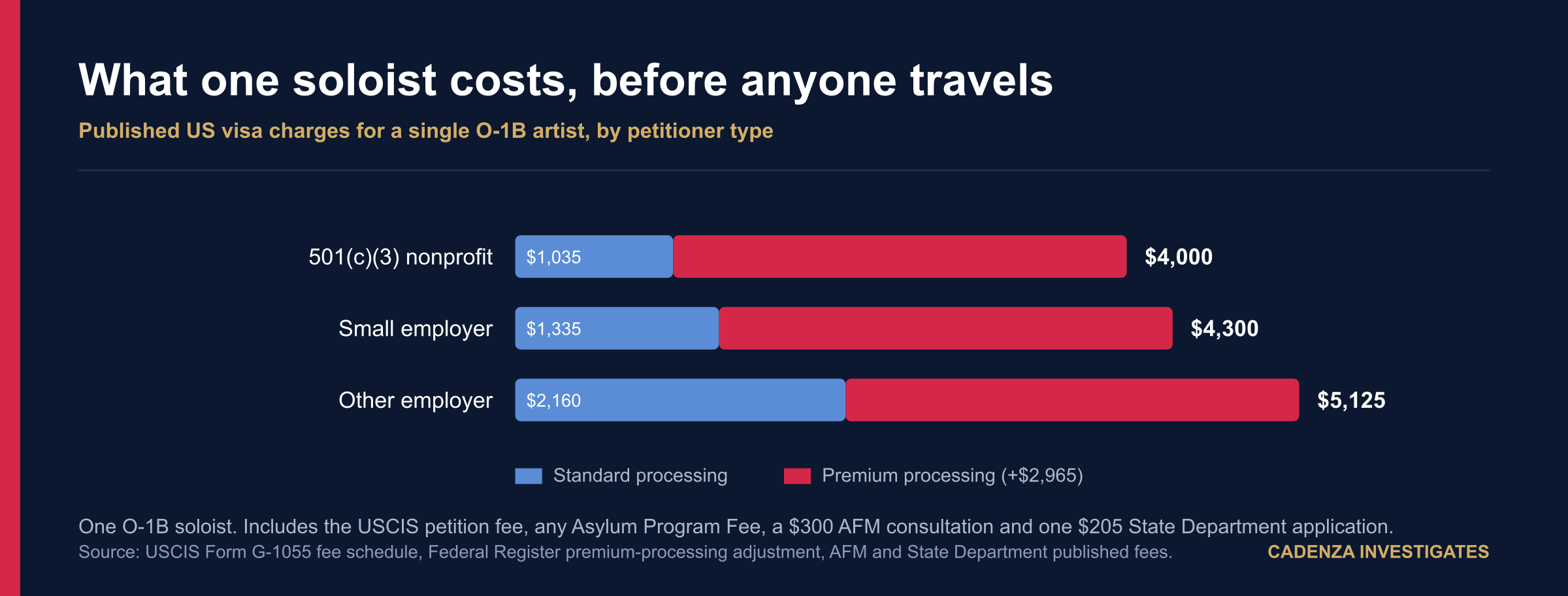
Includes the USCIS petition fee, any Asylum Program Fee, a $300 AFM consultation and one $205 State Department application.
The public fee schedule is unusually clear. Standard service costs $300 and is listed at five to ten business days. Expedited service costs $450 and is listed at two business days. Super-expedited service costs $550 and can be completed the same business day or by the following business day if the request reaches the AFM after its cutoff. The time stops when a submission is deficient or further information is required. [S01]
Speed has a price before the petition is filed
Published service targets apply only after a complete submission and payment have been received. P-2 fees are handled separately through the Canadian office.
The consultation is not a visa and not an employment authorization. It is evidence inside the petition. Yet the presenter cannot safely treat it as a minor formality. The AFM requests the completed I-129, contracts, wages or oral terms, itinerary, beneficiary lists and support materials. The file must therefore be substantially built before the union clock begins.
For a large instrumental group, USCIS may require several petitions while current reported AFM practice permits one consultation request for the whole group and copies of the resulting letter across related filings. That practice prevents the union fee from multiplying four times in Cadenza’s 90-player model. It does not prevent the USCIS fees or premium charges from multiplying. Because the AFM’s public page does not spell out the large-group rule, Cadenza identifies the assumption and provides a sensitivity range in the calculator notes. [S25]
5. How USCIS prices the petition
USCIS does not charge every petitioner the same Form I-129 fee. It divides filers into qualifying nonprofits, small employers with 25 or fewer full-time-equivalent employees and all other employers. It then applies a separate Asylum Program Fee to small and regular employers but exempts qualifying nonprofits.
The same soloist, three petitioner types
Nonprofit: $530 O petition + $300 AFM + $205 State. Small employer: $530 + $300 Asylum Program Fee + $300 AFM + $205 State. Other employer: $1,055 + $600 Asylum Program Fee + $300 AFM + $205 State.
The structure produces one of the system’s stranger labels. A commercial concert presenter filing an O petition can owe a $600 Asylum Program Fee even though the case is not an asylum application. The charge is attached to a broad set of employment petitions as a funding mechanism. A small employer owes $300. A qualifying nonprofit owes none. [S02] [S03]
For O classifications, the underlying fee is $530 for a nonprofit or small employer and $1,055 for other employers. For P classifications, it is $510 for a nonprofit or small employer and $1,015 for other employers. The difference between O and P is small. The difference between one petition and four is not.
Each petition must be paid correctly. A rejected fee does not merely produce an accounting adjustment. It can return or delay a time-sensitive filing. Since late 2025, USCIS has moved away from paper checks and money orders to specified electronic payment forms, adding another point at which a transaction failure can become a filing failure. [S28]
6. The $2,965 clock
Premium processing is the largest single published charge in the soloist model. On 1 March 2026, the Form I-129 premium fee used for O and P petitions rose from $2,805 to $2,965. USCIS describes the service as a commitment to take adjudicative action within 15 business days for most classifications. [S04] [S05]
The word action matters. Premium processing is not a purchased approval. USCIS can approve, deny, request evidence or issue another formal notice within the period. A request for evidence moves the burden back to the petitioner and can consume the concert’s remaining preparation window. Premium processing also stops at USCIS. It does not buy a consular appointment, shorten administrative processing or reserve admission at the airport.
What the premium fee does—and where it stops
The clock can pause if the package is incomplete.
The $2,965 service accelerates an action, not necessarily approval.
No general O/P premium appointment product appears on the current State fee table.
A valid visa permits travel to seek entry; it does not compel admission.
In March 2026, Artists From Abroad warned that some premium cases were running beyond the expected 15-business-day window. That notice is an industry alert rather than a comprehensive USCIS performance dataset. It nevertheless exposes the presenter’s dependence on a service marketed around time when the product being protected—the concert—has a fixed date. [S24]
The State Department demonstrated in July 2026 that it can sell a separate expedited appointment. Its pilot in Mission Mexico charges eligible B-visa applicants $750 for an appointment within ten business days, subject to availability. The pilot is limited to B visas. It does not create a corresponding paid appointment lane for O or P artists whose USCIS petition has already been premium-processed. [S22]
The system therefore sells speed in the middle of the journey. A presenter can pay $2,965 to shorten Gate 3 and then re-enter an unpriced queue at Gate 4.
7. Why one soloist becomes exactly $4,000
The soloist calculation is the clearest view of the fee architecture because no group cap is involved.
Nonprofit O-1B with premium processing
The nonprofit discount applies to the underlying petition, not to premium processing, the union consultation or the individual visa application.
Premium processing accounts for nearly three quarters of the published bill. This is why nonprofit status only partially protects cultural institutions. The government reduces the base petition and removes the Asylum Program Fee, but the largest optional charge remains identical for a small orchestra, a university presenter and a multinational corporation.
Calling premium processing optional is legally correct and operationally incomplete. A presenter with a year of lead time may avoid it. A replacement artist, late program decision, delayed contract or uncertain ordinary processing time can make the option functionally compulsory. The fee then behaves less like luxury service and more like insurance against the government’s own timetable.
The $4,000 model is still a floor. Many petitioners retain immigration counsel because the filing requires legal classification, evidence selection and deadline management. Some artists must travel to a different city or country for an interview. Some nationalities face reciprocity fees upon issuance. None of those amounts appears in the headline total because no single public price applies to every case.
8. From quartet to orchestra
Group costs grow through two mechanisms. The State Department charge grows with every person. The USCIS charge grows whenever the group crosses another 25-person threshold. The first creates a smooth line. The second creates steps.
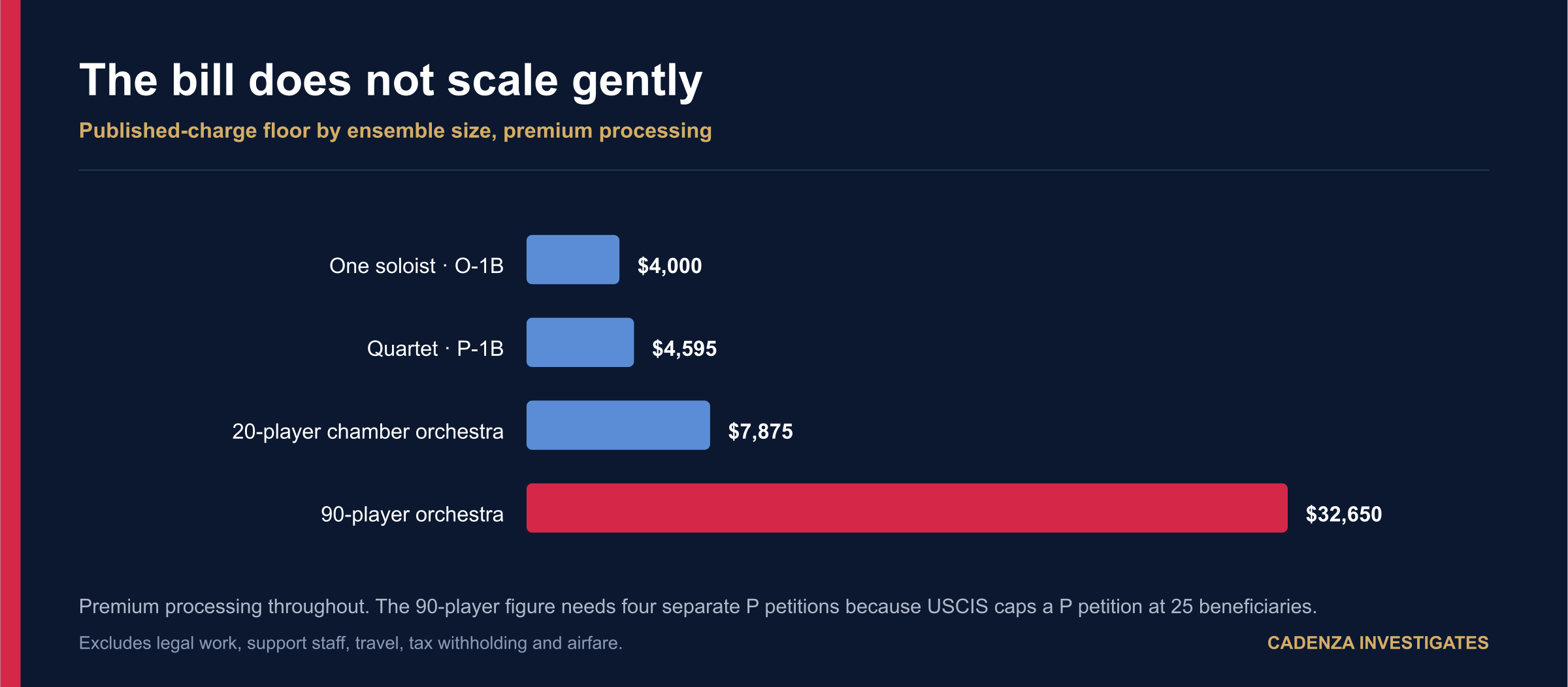
The 90-player figure requires four separate P petitions because USCIS caps a P petition at 25 beneficiaries.
Minimum published charges under the nonprofit model
| Ensemble | Standard processing | Premium processing |
|---|---|---|
| One soloist · O-1B | $1,035 | $4,000 |
| Quartet · P-1B | $1,630 | $4,595 |
| 20-player chamber orchestra | $4,910 | $7,875 |
| 90-player orchestra | $20,790 | $32,650 |
The largest scenario includes 90 visa application fees, four nonprofit P-petition fees, one $300 AFM consultation and, in the premium case, four $2,965 premium requests.
A quartet pays one P filing fee and four consular fees. A 20-player ensemble still fits inside one petition, so most of the increase comes from 16 additional $205 applications. The jump from 20 to 90 is different. Seventy additional applications add $14,350, and the beneficiary cap forces three additional petition fees. If premium processing is used, it also forces three additional $2,965 payments.
The model does not include a conductor travelling separately as an O-1B, guest soloists, dependants or the orchestra’s management and technical staff. Essential support can require separate P-support petitions and separate visa applications. A touring orchestra is therefore not one 90-person case. It may be a portfolio of principal, group and support cases whose deadlines must converge on the same first rehearsal.
Build a published-charge estimate
Assumptions: one $300 AFM consultation per instrumental artist/group; $205 State application per person; P groups split at 25. Excludes O-2/P-support cases, dependants, legal fees, travel, reciprocity fees, tax, translations and all production costs. AFM’s large-group practice has been reported as one consultation fee; if four separate fees were required for a 90-player group, add $900.
9. The 25-person fracture
Since April 2024, one O-2, P-1B, P-3 or P-support petition can contain no more than 25 named beneficiaries. USCIS’s current policy manual and filing instructions preserve that limit. A 90-player orchestra must therefore be split into at least four principal group petitions: 25, 25, 25 and 15. [S07] [S08]
How one orchestra becomes four immigration files
Each petition needs its own Form I-129, beneficiary grouping, fee and complete supporting package. Related petitions can travel together in one mailing, but USCIS adjudicates separate receipts.
The cap is not merely a billing multiplier. It divides an artistic unit into administrative units. The first violins can be approved while a brass petition is delayed. Two petitions can reach one adjudicator and another can reach a different one. An orchestra that performs collectively acquires several independent failure points.
Artists From Abroad instructs large groups to make every filing complete in itself, with its own cover letter, itinerary, evidence, contract and consultation copy. The duplication is rational from the agency’s file-based perspective. It is waste from the orchestra’s perspective: the same history, itinerary and institutional proof must be assembled repeatedly because the group exceeds an arbitrary document count. [S08]
Premium processing magnifies the fragmentation. Buying it for one of four petitions does not protect the full orchestra. To place all 90 players on the same USCIS timetable, the presenter must buy it four times: $11,860. A single policy choice therefore converts one $2,965 urgency fee into almost twelve thousand dollars.
10. Ninety applications, no group rate
USCIS can evaluate group recognition, but the State Department prices the next stage person by person. O and P classifications are petition-based nonimmigrant visas. The published application processing fee is $205 for each applicant and is nonrefundable. A 90-player orchestra therefore pays $18,450 before any nationality-specific reciprocity fee. [S06] [S26]
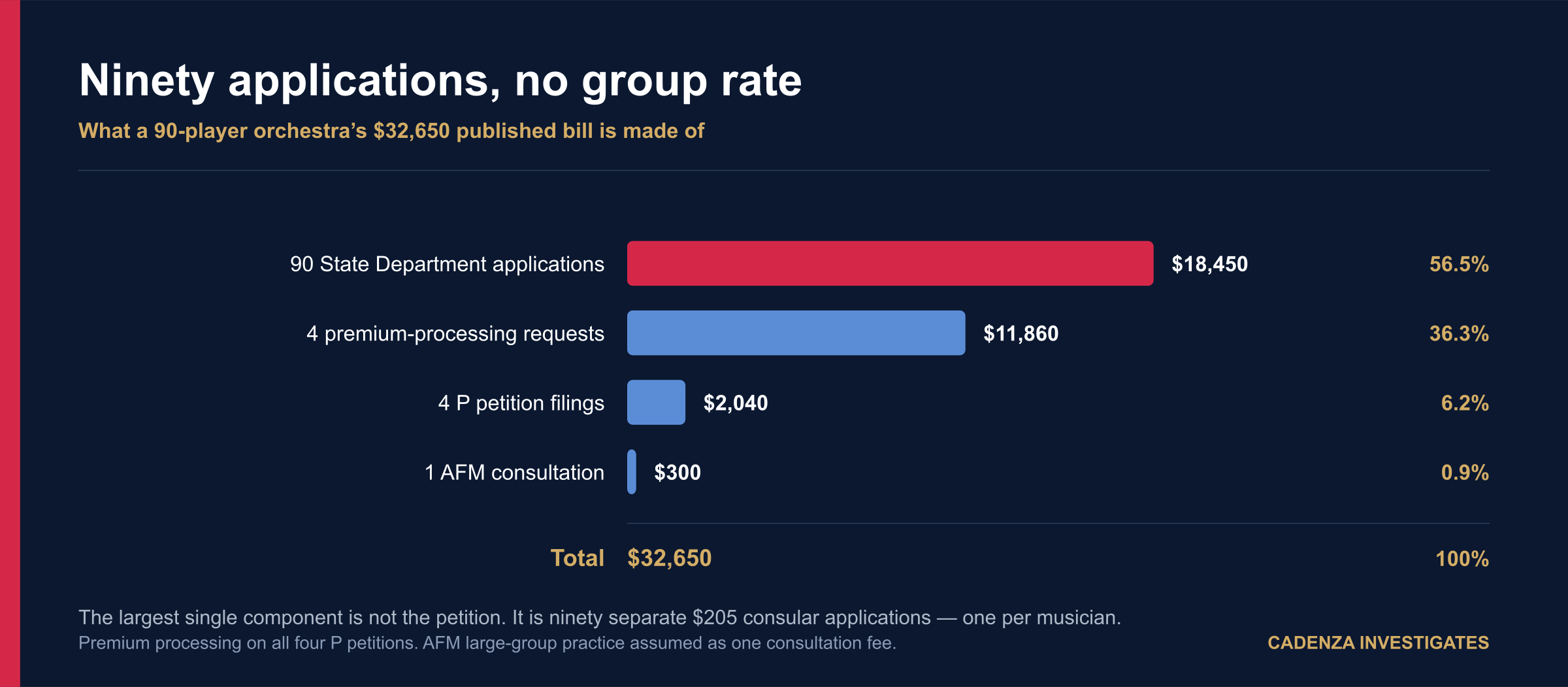
The largest single component is not the petition. It is ninety separate $205 consular applications — one per musician.
Where the $32,650 goes
The ensemble receives no published volume discount at the consular stage. Every principal applicant remains an individual visa case.
The per-person structure is understandable as security screening. It is economically indifferent to the nature of an orchestra. A 90-person cultural institution is charged like 90 separate temporary workers even when one American nonprofit, one contract, one itinerary and one group petition history bind them together.
The fee is only the visible component. Each applicant completes an individual application. Each passport must be available for processing and return. Each person must satisfy nationality- and post-specific procedures. One musician’s passport delay can become a seating problem; several can become a repertoire problem.
Reciprocity can add another layer. State Department tables impose issuance fees on some nationalities and classifications based on how the foreign country treats U.S. citizens. Cadenza excludes them because they vary. That exclusion makes the model comparable, not complete.
11. The interview is back
From 1 October 2025, the State Department’s general rule again requires in-person interviews for almost all nonimmigrant visa applicants. The narrow published waiver categories include certain diplomatic and official visas, some recent B renewals and some H-2A renewals. O and P artists are not on that list. Consular officers can also require an interview even where an exception exists. [S12]
For one soloist, the interview can mean a train ride and a morning away from work. For an orchestra, it can mean coordinating dozens of appointments, often across several countries because modern ensembles are multinational. The group petition does not create one group interview.
The return of the interview removes a pandemic-era flexibility that had sometimes allowed qualifying renewals to proceed by document submission. It also creates a queue that premium processing cannot reach. USCIS may approve the petition in 15 business days, but the artist still needs an appointment at a consular post with its own capacity, holidays, security posture and local demand.
The system provides no universal number for that stage because wait times vary by location and can change. That variability is itself the risk. A presenter can budget a $205 fee. It cannot purchase a guaranteed O/P appointment date from the current general fee schedule.
12. The country-of-residence rule
On 15 July 2026, the State Department updated its instructions for all nonimmigrant applicants. Applicants should schedule interviews in their country of nationality or residence. Someone relying on residence must be able to demonstrate it. Applicants who try another country may find it more difficult to qualify and should expect significantly longer waits; fees paid outside the proper post are not refundable or transferable. [S13]
This closes a common pressure valve. When one consulate had no useful appointment, internationally mobile artists sometimes searched for another post willing to accept a third-country national. The new instruction does not create an absolute statutory prohibition on every third-country case, but it makes the alternative less reliable and explicitly warns of longer waits and lost fees.
The rule interacts badly with touring life. Musicians often live in one country, hold citizenship in another, teach in a third and spend much of the season elsewhere. “Country of residence” sounds simple in a government notice. It can be a factual issue for an itinerant performer whose lease, tax residence, orchestra contract and physical location do not align.
The State Department says existing appointments will generally not be cancelled, while rare exceptions may be made for humanitarian, medical or foreign-policy reasons. A concert is not listed as a general exception. The artistic urgency that justified premium processing at USCIS therefore has no parallel entitlement at the consular stage.
13. Africa’s regionalized border
The country-of-residence instruction arrived on the same day as a major geographic reorganization. Effective 1 August 2026, the State Department moved routine visa services from 26 African locations to designated regional hubs. The policy expressly includes petition-based nonimmigrant visas—the category containing O and P musicians. [S14]
Applicants formerly served in Antananarivo, Abuja, Asmara, Bamako, Banjul, Brazzaville, Bujumbura, Conakry, Cotonou, Durban, Freetown, Gaborone, Harare, Juba, Libreville, Lilongwe, Lusaka, Maputo, Maseru, Mbabane, N’Djamena, Niamey, Nouakchott, Ouagadougou and Windhoek are directed toward a smaller group of hubs. The department lists Abidjan, Accra, Addis Ababa, Cape Town, Dakar, Dar es Salaam, Djibouti, Johannesburg, Kampala, Kigali, Kinshasa, Lagos, Lomé, Luanda, Malabo, Monrovia, Nairobi, Port Louis, Praia and Yaoundé among the processing locations. [S14]
The change may standardize adjudication and allocate staff more efficiently, as the government argues. It also transfers part of the visa infrastructure onto the applicant. A musician may need an additional international journey, entry permission for the hub country, ground transport, accommodation and time away from paid work merely to ask for permission to take the American engagement.
Cadenza does not assign a universal price to that journey because the routes differ. The absence of a universal price does not make it free. It makes the cost geographically unequal and harder for a U.S. presenter to budget.
The wall changed while presenters were booking
Full or partial visa restrictions take effect under Proclamation 10998.
Two-day consultation increases to $450.
O/P I-129 expedite rises by $160.
AFM begins requiring the 02/27/2026 form edition.
Interview geography tightens; hub policy announced.
USCIS restores broad discretion to deny incomplete cases immediately.
14. When nationality overrides the contract
Presidential Proclamation 10998 took effect on 1 January 2026. State Department guidance describes full or partial suspensions covering 39 countries, plus travel documents issued or endorsed by the Palestinian Authority. The full suspension applies to all nonimmigrant and immigrant categories for nationals of 19 countries, subject to limited exceptions. O and P visas are therefore blocked for affected applicants who fall within the proclamation’s scope and do not qualify for an exception or discretionary relief. [S15]
The fully suspended list is Afghanistan, Burma, Burkina Faso, Chad, the Republic of the Congo, Equatorial Guinea, Eritrea, Haiti, Iran, Laos, Libya, Mali, Niger, Sierra Leone, Somalia, South Sudan, Sudan, Syria and Yemen. The partial suspension applied to another 19 countries focuses on B, F, M and J nonimmigrant categories and immigrant visas; it does not generally list O and P among the suspended nonimmigrant categories. Turkmenistan is subject to an immigrant-only restriction. Precision matters: a headline count of 39 does not mean every national of all 39 countries is barred from an O or P visa. [S15]
The exceptions reveal a policy choice. The proclamation protects certain diplomatic travel, lawful permanent residents, specified U.S.-government-related cases, dual nationals using a nonrestricted passport and participants in certain major sporting events. It does not establish a comparable general exception for major cultural events. A football tournament can have an express category. An orchestra tour does not.
The guidance states that the proclamation applies to people outside the United States on the effective date who did not hold a valid visa then. Visas valid on 1 January were not revoked under the proclamation. That grandfathering can separate two musicians of the same nationality in the same ensemble: one with an existing valid visa may travel; another seeking a new visa may not.
An approved USCIS petition does not neutralize the proclamation. This is the clearest example of the five-gate structure. Gate 3 can say yes to the artistic and employment petition while Gate 4 is instructed not to issue the visa.
15. The pending $250 switch
Public Law 119-21 created a Visa Integrity Fee of at least $250 for a person issued a nonimmigrant visa. In July 2025, DHS said the fee required cross-agency coordination and would be implemented through a future publication. As of 6 August 2026, the State Department’s live fee page still lists $205 for O and P applications and does not display the additional $250 charge. Cadenza therefore excludes it from every headline total. [S16] [S17]
The unresolved implementation creates a budget switch. If the fee becomes collectible at issuance without a different exemption or amount, it would add $250 to one soloist, $1,000 to a quartet, $5,000 to a 20-player ensemble and $22,500 to a 90-player orchestra.
The statutory fee could more than double the consular bill
The combined bar is not drawn to the same maximum as the first two components; the labels carry the exact amounts. The analysis assumes $250 per issued visa and no exemption.
For presenters, the problem is not only the amount. It is the absence of an implementation date visible in the ordinary planning materials. International tours are contracted months or years ahead. A fee that attaches at issuance can move the economics after the artistic commitment has been made.
The correct response is not to pretend the fee is already collected. It is to show the exposure and date the evidence. Cadenza’s calculator lets readers switch it on as a scenario, while the published totals keep it off.
16. The separate 30-percent wall
Immigration charges are not the only federal claim on the engagement. IRS guidance states that payments to nonresident alien artists performing independent services in the United States are generally subject to 30% withholding on gross income unless a treaty position, Central Withholding Agreement or other applicable rule changes the result. The withholding agent can include the American presenter or another person controlling the payment. [S18] [S19]
Withholding is not necessarily the artist’s final tax liability. It is money held back. A Central Withholding Agreement can allow the IRS to calculate withholding from expected net income rather than gross receipts, but the request generally must arrive at least 45 days before the first covered event. The artist still has filing obligations. [S19]
Thirty percent withheld from illustrative gross fees
Illustrative independent-contractor cash flow at the default 30% withholding rate. A CWA can reduce withholding toward anticipated tax on net income; treaties and employment status can change treatment.
This is a different wall from the visa wall, but the two interact. A presenter may pay thousands to secure the legal right to perform and then withhold a large share of the gross fee. The touring artist may have already paid flights, hotels, management commission and local musicians from the same contract. Gross withholding can therefore create a severe cash-flow mismatch even when a later tax return produces a refund.
The 45-day CWA lead time also punishes replacements. A substitute soloist called into a concert three weeks ahead may have enough time for an expedited consultation and premium petition but not enough time for the ordinary CWA window. Immigration offers a purchasable fast lane. Tax withholding does not necessarily follow it.
17. The itinerary trap
O and P petitions are built around specific work. The AFM asks for contracts, wage terms and an itinerary before it will issue its consultation. USCIS likewise expects the petitioner to establish the events and period requested. That is sensible evidence of real employment. It is also an awkward fit for live performance, where programs, personnel, venues and dates change.
A tour is not one contract. It is a chain of conditional obligations. A hall moves an available date; a festival changes the order; a soloist becomes ill; one state adds a performance; a sponsor withdraws. Immigration law distinguishes minor adjustments from material changes, but the presenter must decide whether a revised itinerary remains within the approved case or requires new action. That judgment carries legal and financial risk.
The 25-person cap makes substitution harder to visualize. The orchestra is divided into named groups for filing. A replacement must be mapped into the correct petition history. Support personnel may be in a separate case. A change that is musically trivial—a different second oboe—can be administratively important because the beneficiary is named.
The result is a bias toward fixed, long-planned tours and against spontaneity. American presenters can invite a domestic artist at short notice with a contract and ticket page. Inviting a foreign replacement means rebuilding part of the legal architecture under a clock.
18. The safety net removed
On 5 August 2026, one day before this investigation’s publication date, USCIS changed the evidentiary risk. The agency announced that officers may deny benefit requests without first issuing a Request for Evidence or Notice of Intent to Deny when required initial evidence is missing or the record does not establish eligibility. The policy applies to pending requests and new filings unless another rule controls. [S20] [S21]
USCIS can still issue requests. The change is that petitioners can no longer treat a request as the expected opportunity to repair the file. Officers also have discretion to set shorter response windows than the maximum in cases where they do request more evidence.
For an O or P filing, this raises the value of front-loaded legal preparation and the cost of error. A missing translation, incomplete review, weak explanation of group recognition or absent consultation can now lead more directly to denial. The government retains the filing fees. The petitioner may need to file again, if the concert date still permits it.
The policy therefore sharpens the inequality already present in the system. Institutions with experienced counsel, established artist files and repeat-petitioner knowledge can adapt. A small festival bringing its first foreign ensemble is more likely to discover the hidden standard through failure.
This article reflects the USCIS evidentiary guidance announced on 5 August 2026. The practical denial pattern was not yet measurable when Cadenza closed the article on 6 August.
19. Who quietly stops coming
There is no authoritative public dataset showing how many American engagements are abandoned before a petition is filed. Visa statistics capture applications, approvals and refusals. They do not capture the quartet a presenter never invited after seeing the cost, the emerging conductor replaced by a domestic option, or the regional orchestra tour that ended in a spreadsheet before reaching USCIS.
That missing denominator matters. A system can report a high approval rate among filed petitions while exerting a strong deterrent effect on everyone who does not file. The most excluded artist may leave no immigration record.
The economics point toward who is filtered first. Fixed charges weigh most heavily on low-fee engagements. Under the premium nonprofit soloist model, the same $4,000 published cost equals 200% of a hypothetical $2,000 artistic fee, 40% of a $10,000 fee and 8% of a $50,000 fee. These are not claims about standard market rates. They are illustrations of how a fixed administrative charge selects for higher-value contracts.
The same $4,000 buys radically different access
Bar lengths are normalized to the 200% case. The exercise isolates published visa charges and does not imply any typical fee level.
The filter is also geographic. An artist living near a high-capacity consulate experiences a different system from an artist required to reach a regional hub. An artist from a visa-waiver country still needs the proper work classification but may have stronger travel infrastructure and more consular options than an artist from a fully suspended country. The law uses categories; the market experiences distance, cash and uncertainty.
The likely result is not the end of famous international artists in America. Major institutions can pay, plan early and retain counsel. The likely result is narrower discovery: fewer small ensembles, fewer artists from administratively difficult places, fewer late substitutions and fewer presenters willing to take a first risk on someone without a reusable file.
20. Why nonprofit status only partly helps
USCIS does recognize nonprofit status. It reduces the O fee to $530, the P fee to $510 and removes the Asylum Program Fee. That is meaningful. A regular commercial petitioner pays $1,655 at the USCIS base stage for one O petition, compared with $530 for a nonprofit.
But the protection shrinks once the full pipeline is priced. The $2,965 premium fee does not fall. The AFM fee does not fall. The $205 application does not fall. For one premium soloist, the nonprofit saves $1,125 against the regular-employer published model, but still pays $4,000. For a 90-player premium group, most of the cost lies in consular applications and four premium requests, neither of which receives the nonprofit base discount.
Premium soloist total by organization type
Premium processing compresses the difference among petitioner types because its $2,965 price is identical in all three cases.
The system’s implicit theory is that nonprofit cultural work deserves relief on the petition but not necessarily on urgency or individual visa processing. That division might be defensible if ordinary processing and consular scheduling were reliably compatible with performance calendars. When they are not, nonprofit presenters pay the same urgency price as everyone else.
21. Approval is still not admission
A visa is permission to travel to a U.S. port of entry and ask to be admitted in the classification. Customs and Border Protection makes the final decision. Most properly documented artists enter without a public incident. The legal distinction remains consequential because the entire concert budget has usually been committed by the time the musician reaches the officer.
At that point, the presenter has paid petition charges, legal preparation, flights, hotel deposits, marketing and perhaps orchestra services. The artist may be carrying a valuable instrument subject to separate customs, CITES or carnet questions. An immigration concern and an instrument concern can therefore meet at the same border even though they arise under different rules.
The risk is not captured by counting visa issuances. A visa issued on Tuesday and a concert scheduled on Thursday leave little tolerance for a missed connection, delayed passport return or extended inspection. The final gate is operationally closest to the performance and financially furthest from the refundable stage.
This is why the language used by government agencies is technically precise but culturally misleading. USCIS “approves” a petition. State “issues” a visa. The artist is “admitted.” The audience experiences only one binary result: the musician appears or does not.
22. A workable cultural-mobility system
The United States can screen foreign workers and still distinguish a time-bound cultural tour from 90 unrelated employment cases. Reform does not require eliminating security review or granting orchestras automatic entry. It requires aligning the administrative unit with the artistic unit and making time commitments follow the engagement through the whole pipeline.
Restore a true large-ensemble petition
Allow accredited cultural nonprofits to file one P petition for a bona fide group above 25 while retaining individual beneficiary screening inside the case. Charge one base fee and one premium fee, not four.
Create group consular scheduling
Keep individual adjudication but permit linked O/P applicants to reserve coordinated interview capacity under one approved itinerary, with a transparent service standard.
Make premium processing end-to-end
A premium petition for a performance occurring on a fixed date should trigger access to a time-bound consular appointment channel. Faster USCIS action without Gate 4 capacity is an incomplete product.
Publish a cultural-mobility dashboard
Report O/P petition times, consular appointment waits, administrative-processing duration and nationality-based outcomes without exposing personal data. Measure the engagements that miss their dates.
Clarify the Visa Integrity Fee before collection
Publish the effective date, exemptions, refund mechanism and interaction with existing fees far enough in advance for contracted tours to budget accurately.
Modernize artist tax withholding
Create a faster CWA process for short-notice engagements and a standardized digital route for presenters, while preserving collection of actual tax due.
Protect curable cultural filings
For established nonprofits and nonfrivolous O/P cases, require notice of a curable documentary defect before denial unless law makes approval impossible.
Create a cultural exception process
Where nationality restrictions allow discretionary exceptions, publish a review route for major cultural events comparable in clarity—not necessarily outcome—to stated sporting-event exceptions.
These reforms would not make every petition approvable. They would make the price and timetable correspond more closely to the work. A symphony orchestra would remain 90 screened people, but it would stop being treated as four unrelated premium products and 90 uncoordinated calendar problems.
23. The border inside the program
The United States continues to host many of the world’s most important orchestras, festivals, conservatories and presenters. International musicians still come. Major tours still happen. The existence of successful engagements does not prove that the system is proportionate. It proves that institutions with enough money, lead time and administrative skill can cross it.
The published numbers show what the system rewards. One premium-processed nonprofit soloist costs $4,000 before private expenses. Ninety musicians cost at least $32,650 under the same urgency assumption, and more when support staff, separate consultations, reciprocity fees or the unimplemented Integrity Fee apply. The tax system can hold back 30% of gross performance income. The consular system generally requires interviews. The July 2026 residence and Africa-hub policies add geographic friction. The January 2026 proclamation can make nationality dispositive. The August 2026 evidence rule makes an incomplete first filing easier to deny.
None of those measures alone is the visa wall. The wall is their accumulation.
It is built from fees that multiply differently, clocks that do not connect, decisions that do not bind the next agency and costs that become nonrefundable long before the artist reaches the hall. It filters not only by artistic distinction, but by contract value, institutional sophistication, passport, residence and tolerance for uncertainty.
The first musicians displaced by this system are unlikely to be the celebrities whose cancellations make headlines. They are the artists never invited, the ensembles never filed, the replacement not attempted and the tour removed from a regional presenter’s budget. Their absence leaves no refusal notice and no empty chair visible to the audience. The program is changed before it is printed.
By the time a foreign musician reaches the American border, the most consequential border may already have been crossed: the one inside the presenter’s budget.
Methodology and limitations
Cadenza reviewed public fee schedules, agency guidance and policy updates available on 6 August 2026. The numerical models are arithmetic, not estimates of total legal cost. They use a U.S. 501(c)(3) nonprofit petitioner unless otherwise stated; one O-1B petition for the soloist; P-1B petitions divided at the current 25-beneficiary limit; one ordinary $300 AFM consultation for each instrumental principal artist or group; one $205 State Department petition-based visa application per person; and $2,965 premium processing per required petition when the premium scenario is shown.
The 90-player model uses one AFM consultation fee for the entire instrumental group based on reported AFM large-group practice. If four separate $300 fees were required, the standard total would be $21,690 and the premium total $33,550. The model excludes conductors or soloists filed separately, O-2 and P-support personnel, dependants, lawyers, translations, couriers, travel, hotel, passport return, reciprocity charges, instrument customs documentation, payroll administration, insurance and production costs.
The statutory $250 Visa Integrity Fee is excluded because DHS previously said implementation required a future action and the live State Department fee page reviewed on 6 August 2026 still lists $205 for O and P applications without that additional charge. The what-if visualization is not a claim that the fee is currently collected.
Tax examples show cash withheld at 30% of illustrative gross independent-contractor payments. They are not calculations of final tax. Treaties, Central Withholding Agreements, employment status, expenses, residence and individual facts can change withholding and liability.
This article is journalism, not legal or tax advice. Immigration rules, fee tables, consular operations and litigation can change without synchronizing across every public page. Any live engagement requires current case-specific review.
Source register
- American Federation of Musicians — Need a Visa?Current consultation requirements, classification descriptions, 2026 fees and service times.
- Artists From Abroad — Filing FeesCurrent O and P filing-fee summary for nonprofits, small employers and other filers.
- USCIS — Frequently Asked Questions on the Fee RuleOfficial explanation of O/P fees, the Asylum Program Fee and reduced/exempt filers.
- Federal Register — Adjustment to Premium Processing FeesFinal rule raising the relevant premium-processing fee to $2,965 from 1 March 2026.
- USCIS — How Do I Request Premium Processing?Official description of premium-processing service and 15-business-day action period for most classifications.
- U.S. Department of State — Fees for Visa ServicesCurrent $205 nonrefundable application fee for H, L, O, P, Q and R petition-based visas.
- USCIS Policy Manual — Volume 2, Part N, Chapter 3Official policy stating that up to 25 named beneficiaries may be included per relevant petition and support requires a separate petition.
- Artists From Abroad — Required Evidence and P-1B Filing SpecificsOperational guidance for large groups, duplicate complete petitions and the 25-beneficiary cap.
- USCIS — O-1 Visa: Individuals with Extraordinary Ability or AchievementOfficial O classification overview.
- USCIS — P-1B Member of an Internationally Recognized Entertainment GroupOfficial P-1B eligibility overview.
- USCIS — P-3 Culturally Unique Artist or EntertainerOfficial P-3 eligibility overview.
- U.S. Department of State — Interview Waiver Update, 18 September 2025Policy generally requiring in-person interviews from 1 October 2025, with narrow listed exceptions.
- U.S. Department of State — Adjudicating NIV Applicants in Their Country of Residence15 July 2026 instruction on nationality/residence posts, nontransferable fees and longer third-country waits.
- U.S. Department of State — Realignment of U.S. Visa Services in Africa to Regional Hubs26 locations affected from 1 August 2026 and designated regional hubs, including petition-based visa processing.
- U.S. Department of State — Suspension of Visa Issuance under Proclamation 10998Current full and partial country restrictions, exceptions and effective-date rules.
- Federal Register — USCIS Immigration Fees Required by HR-1DHS statement that the Visa Integrity Fee required cross-agency coordination and future implementation.
- U.S. Department of State — Live Visa Fee TableFee table reviewed 6 August 2026; O/P application charge shown as $205 without a listed Integrity Fee.
- IRS Publication 515 (2026) — Artists and AthletesCurrent official guidance on 30% withholding for many independent nonresident artist payments and CWA treatment.
- IRS — Overview of the Central Withholding Agreement ProgramCurrent CWA overview, gross withholding rule and net-income approach.
- USCIS — Reinforcing Evidence Standards5 August 2026 announcement permitting denial without an RFE or NOID in specified circumstances.
- Artists From Abroad — RFEs and NOIDs Not Required6 August 2026 performing-arts summary of the new USCIS evidence policy and O/P implications.
- U.S. Department of State — Nonimmigrant Visa Expedited Appointment PilotJuly 2026 $750 B-visa appointment pilot in Mission Mexico; not an O/P service.
- League of American Orchestras — Visa and Tax for Foreign Guest ArtistsPerforming-arts sector guidance and policy context.
- Artists From Abroad — Current AlertsMarch 2026 alert concerning premium-processing delays and current O/P procedural updates.
- GG Arts Law — Multiple Petitions and AFM Consultation PracticeIndustry legal guidance reporting one AFM letter for an entire instrumental group split across multiple petitions.
- U.S. Department of State — Fees and Reciprocity TablesNationality-specific issuance fees that may apply in addition to the application fee.
- USCIS — Form I-129Current form page and 2026 edition information.
- Artists From Abroad — Changes to USCIS Fee Payment OptionsOperational guidance on ACH/credit-card payment forms and separate payments for related filings.
Methodology. Charges are those published by USCIS, the Department of State and the American Federation of Musicians in August 2026, recorded as they stood; fee schedules change, and one change dated in this article takes effect after publication. Totals are Cadenza's arithmetic on those published charges under a stated model — nonprofit petitioner, reduced fee where available, one union consultation per group — and are floors rather than estimates of any real invoice. Withholding illustrations use the statutory 30 per cent rate and are not statements of final tax; central withholding agreements and treaty outcomes vary.
What this investigation does not claim. It does not claim that any individual fee is unjustified, that any agency acts improperly, that any named ensemble has cancelled a tour, or that the published charge is what any particular presenter paid. Where a policy change is pending rather than in force, it is labelled as pending.
Right of reply. Any agency, union or institution named here may respond at any time and this article will be updated to carry the response in full. Corrections and responses are welcomed at hello@cadenza.work.
Images. All charts are original Cadenza analysis built from the published charges cited in the section they accompany; each states its own source and limitation. The cover is original Cadenza artwork and depicts no person or place.
Related Cadenza coverage.
- The Competition Machine — what it costs to enter, and who gets discovered
- The Summer Gate — a summer programme's real price, and who it filters out
- Who Really Pays the Musicians? — how public money reaches musicians worldwide
- The Bow at the Border — the other thing stopped at the border: the bow itself
Comments
Sign in to join the discussion.