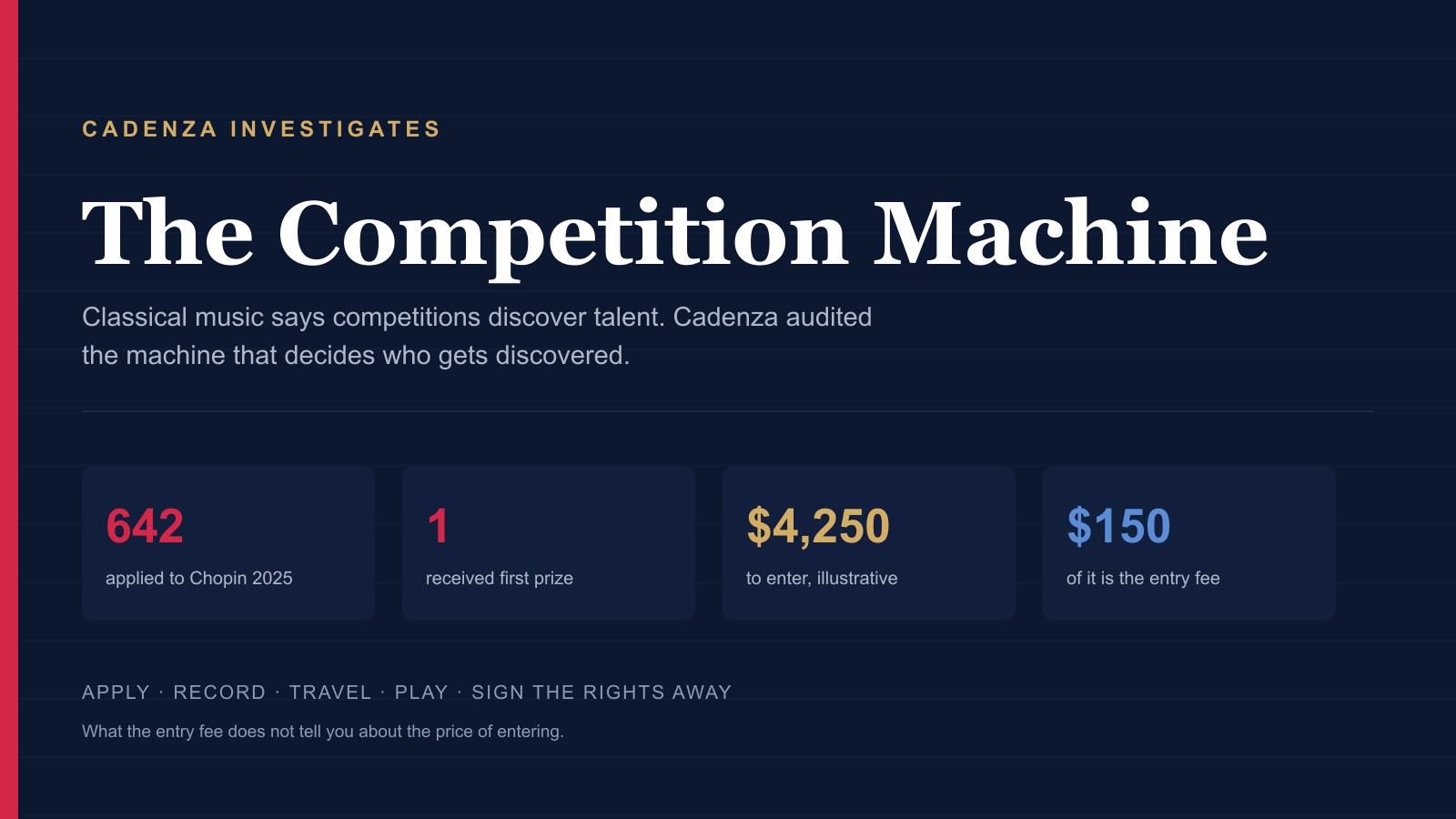
This investigation examines how international music competitions select, finance and monetise the musicians who enter them. It rests on published rules, entry conditions, prize terms and each competition's own reporting of its stages, recorded as they stood when checked. Three cautions travel with it. Application-fee totals are upper-bound arithmetic — reported applications multiplied by the published fee — not audited income, and waivers and unpaid applications are invisible in public reporting. Prize amounts are quoted in their own currencies and are not converted or compared. And where this article reads a competition's rules, it says so: a reading of published terms is analysis, not an allegation of misconduct against any competition, juror or contestant.
Contents
- The funnel
- What Cadenza audited
- The application bill
- Applicants as revenue
- The travel divide
- The prize pyramid
- The competition passport
- Who counts as a student?
- Recusal is not neutral
- Scores, secrecy and correction
- The order problem
- The public hears differently
- The winner becomes content
- The prize that requires free work
- Cash is not the real jackpot
- The pool is already unequal
- What the best competitions get right
- The Cadenza standard
- What the result actually measures
- Methodology
- Sources
Standalone investigation with interactive cost and scoring models.
Six hundred and forty-two pianists applied to the 2025 Chopin Competition. Eighty-four reached the main event. Eleven reached the final. One received first prize. The arithmetic is severe, but the numbers alone conceal the more consequential selection: who could finance the recordings, satisfy the repertoire, travel when summoned, absorb weeks without ordinary work and sign the legal terms required to enter the room.
The competition is one of classical music’s central myths and one of its most efficient institutions. It promises that a jury can gather young musicians from many countries, hear them under common conditions and identify the artists the profession should notice next. At its best, it does exactly that. A competition can move a performer from obscurity to global bookings in a week. It can produce a recording archive, place a new work into circulation, pay meaningful cash, lend an instrument and create a public event around concentrated listening.
It is also a tournament economy. Hundreds of applicants provide fees, recordings, biographical data and free promotional material. A smaller group assumes travel and opportunity costs. Jurors bring artistic knowledge and professional relationships that cannot be separated cleanly from the teaching networks through which contestants were trained. Organizers need broadcast rights broad enough to distribute the event. Winners may be required to perform again, sometimes without a separate fee. The competition does not merely measure careers. It produces, packages and owns part of them.
Cadenza reviewed the public rules, application requirements, jury procedures, prize schedules and candidate support offered by ten prominent competitions: the 2025 Chopin and Van Cliburn piano competitions; the 2024 Leeds; the 2026 Queen Elisabeth cello competition; the 2025 Sibelius violin competition; the 2025–26 Geneva conducting competition; Operalia 2026; the 2026–27 Busoni; the 2026 International Violin Competition of Indianapolis; and the 2026 Michael Hill International Violin Competition.
The result is not a ranking of which competition is “best.” The disciplines, currencies, histories and operating models differ. The audit asks a narrower question: what must an artist give the institution before the institution decides whether to give anything back?
What Cadenza found
Only 22 of 1,348 applicants reached the finals at Chopin, Cliburn and Leeds: a combined rate of 1.63%. Three first prizes emerged from the original pool.
The fee is often the smallest expense. Some applications demand recent, unedited, high-quality recordings of large programs; one conducting competition requires footage with an ensemble of at least 16 musicians.
Operalia, Cliburn and Michael Hill absorb major travel and lodging costs for selected artists. Leeds places international-round and Leeds travel on contestants. Queen Elisabeth partly reimburses only semifinalists.
A relationship that triggers recusal at one competition may not at another. Chopin, Queen Elisabeth and Leeds use different time and lesson thresholds, while masterclasses are commonly excluded.
Chopin publishes individual original and corrected juror scores. Leeds explicitly keeps individual votes confidential. Several other public rulebooks disclose outcomes but not the numerical path to them.
Several competitions claim extensive recording, broadcast and streaming rights without additional payment. Some also require winners or finalists to provide future appearances free of charge.
1. The funnel is the product
The Chopin Competition’s 2025 funnel began with a record 642 applicants. The institute invited 171 to Warsaw for preliminary auditions; 162 actually performed. Sixty-six qualified through those preliminaries, while 19 laureates of selected competitions received direct entry. Eighty-four pianists ultimately began the main competition. Twenty reached Stage III. Eleven reached the final. Eric Lu received first prize. 36
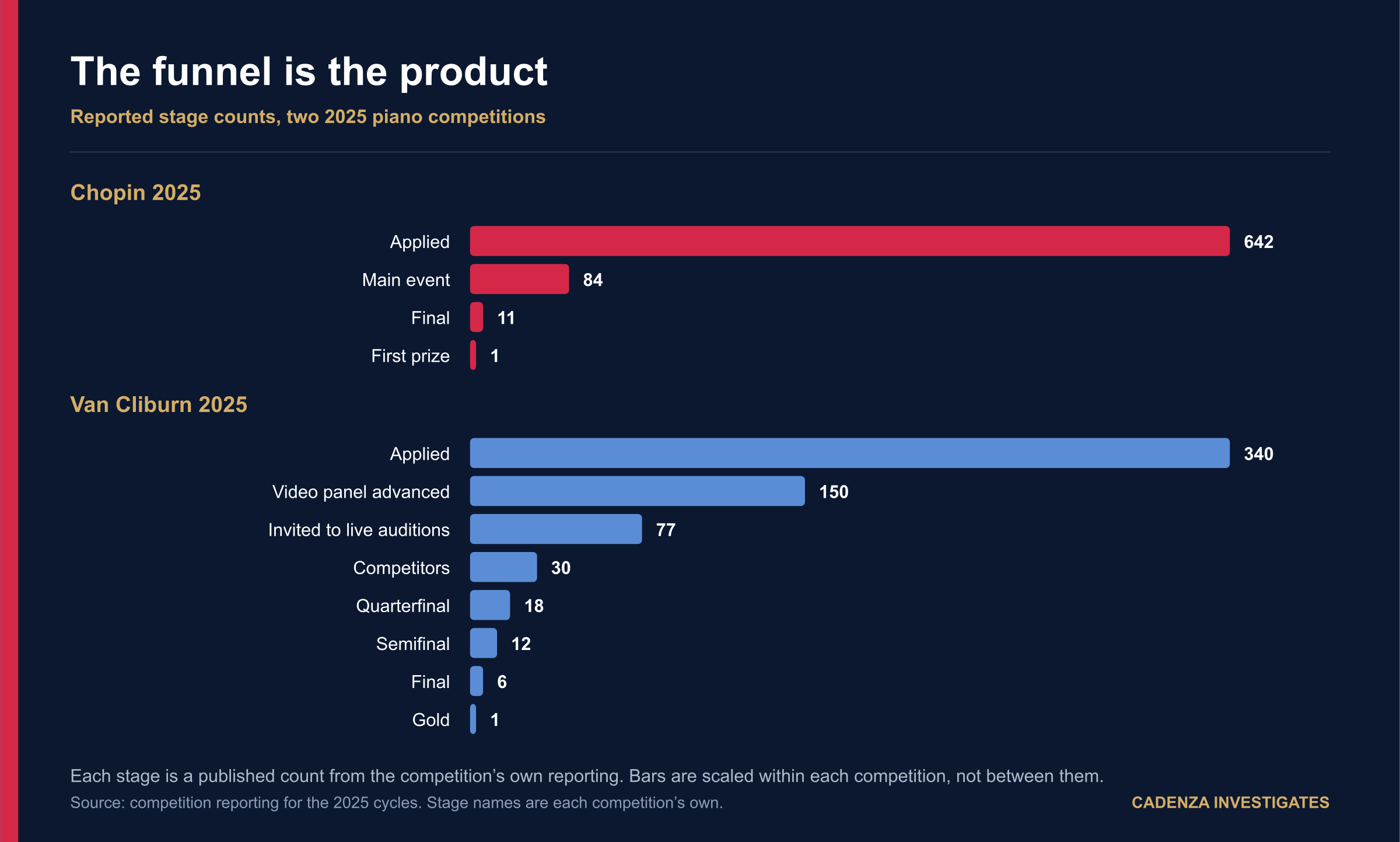
Each stage is a published count from the competition's own reporting. Bars are scaled within each competition, not between them.
The 2025 Van Cliburn Competition began with 340 applications from 45 countries and regions. A video panel advanced 150. A screening jury invited 77 to live auditions. Thirty became competitors, 18 reached the quarterfinal, 12 the semifinal and six the final. One, Aristo Sham, received gold. 8910
Leeds received 366 applications from pianists in 40 countries. Sixty-five advanced to the international first round, 24 to the rounds in Leeds, 10 to the semifinal and five to the final. Jaeden Izik-Dzurko won. 14
Three routes from application to first prize
Chopin 2025 642 applicants
Cliburn 2025 340 applicants
Leeds 2024 366 applicants
These funnels are not accidental overhead. They are the public drama. A competition needs scarcity because the title derives value from the number excluded. The audience watches a narrowing field. Press coverage gains a sequence of announcements. Streams accumulate across rounds. The institution generates more content from the selection process than from the final result.
The funnel also gives organizers a defence against any single judgment. No one juror usually “chooses the winner” alone. The winner survives repeated panels, repertoire changes and escalating performance conditions. That structure can reveal consistency and range. It can also make the final verdict look more objective than the underlying choices are. Every stage contains discretionary thresholds, different panels, withdrawals, direct entries and rules about who may vote for whom.
2. What Cadenza audited—and what the public cannot see
The public face of a competition is a prize amount, a prestigious jury and a photograph of the winner. The applicant sees a different institution: file specifications, age cutoffs, repertoire lists, references, deadlines, payment portals, travel terms, instrument insurance, pianist arrangements, rights waivers and conduct rules.
Cadenza coded five categories across the ten competitions:
Entry burden: the application fee, recording specifications and unusual production requirements. Participation support: who pays for flights, lodging, meals, local transport and accompanists. Adjudication: juror conflicts, recusal definitions, secrecy, numerical scoring and published results. Rights: what the organizer may record, distribute and exploit, and whether the artist receives additional payment. Post-prize obligations: free appearances, exclusivity, management commitments and required outreach.
The audit uses public documents. That limitation is substantive. When an application page does not describe a teacher-student conflict rule, it does not prove the competition lacks one; it proves the applicant cannot evaluate it from that page. When a competition says jury deliberations are governed by internal rules, the issue is not necessarily misconduct. It is informational asymmetry. The institution knows the rule under which the artist will be judged. The artist may not.
The World Federation of International Music Competitions recommends internationally recognized jurors, a majority of experts in the discipline, remuneration for jurors and manageable working days. Its guidance helps define institutional quality. It does not create a single global standard for fees, score publication, lesson thresholds, media rights or contestant support. 24
That is why the same word—competition—describes radically different bargains.
3. The application fee is the cheapest line
Published organizer entry fees in the audited group range from zero at Operalia—whose guidance separately notes a small third-party Embark platform charge—to CHF250 for the Geneva conducting competition. Chopin and Queen Elisabeth charge €100. Cliburn charges $150. Leeds charges £150. Indianapolis charges $125. Busoni charges €40 to apply, plus a €130 participation fee for candidates selected for its Glocal Piano Festival. Michael Hill requires a fee but leaves the amount on its external application form rather than the public rule page. Sibelius’s public rules reviewed by Cadenza did not state an application fee. 171112151617202123
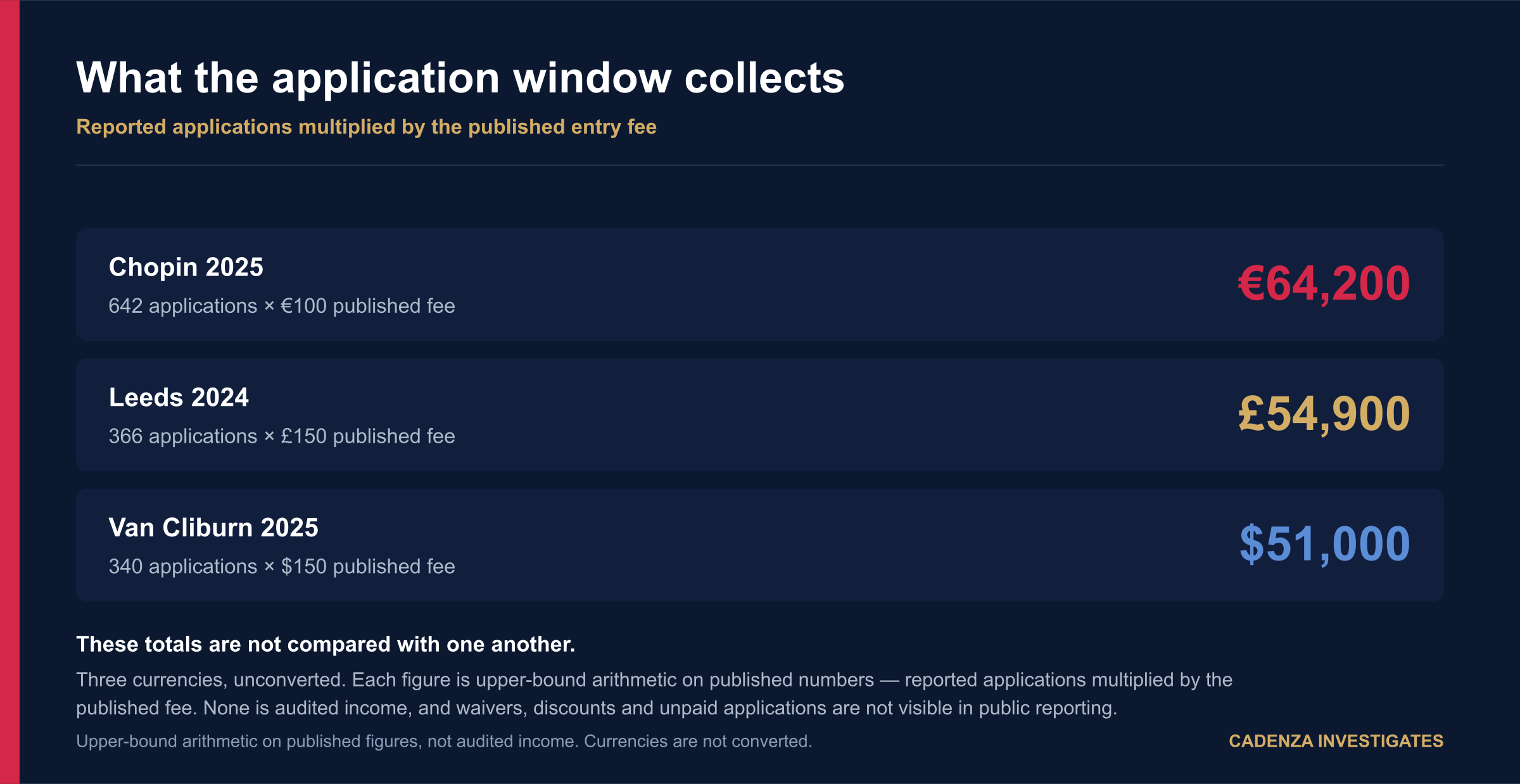
Upper-bound arithmetic on published figures, not audited income. The three totals are in different currencies and are not compared with one another.
Those numbers are visible, finite and easy to compare. The recording is not.
Leeds required professionally recorded application performances, with each piece recorded in one session, completed within six months of submission and accompanied by engineer certification. A serious applicant may need a tuned concert grand, a hall or studio, an engineer, editing limited to whatever the rules permit, and repeated sessions because a technically valid take is not necessarily competitive. 12
Indianapolis required a full concerto, a Mozart or Haydn concerto movement, a Paganini caprice and two contrasting Bach movements or the Chaconne. The videos had to be recent, high-quality, unedited — though a piece need not be captured in a single take — and supported by a producer statement. The applicant could self-produce, but the artistic comparison is not blind to sound quality. A musician recording on a phone in a teaching room competes against one with institutional access to a hall, engineer and pianist. 21
The Geneva conducting application exposes the economic problem most clearly. One video must show the applicant conducting an orchestra or ensemble of at least 16 musicians. A second must show work with an orchestra, ensemble or two pianos. The fee is CHF250, but the scarce asset is not the payment portal. It is access to people, rehearsal time, a venue and credible footage. 16
A €100 fee is not an equal barrier when one applicant records at a conservatory for free and another must rent the evidence that they deserve to be heard.
What one application actually costs
The interactive version let readers set every line. Held at the default scenario used in this investigation — a single application with a self-funded recording — the exposure assembles like this:
| Line | Amount |
|---|---|
| Application fee | $150 |
| Hall or studio rental | $450 |
| Engineer and recording | $550 |
| Accompanist and rehearsals | $700 |
| Selection-round travel | $900 |
| Lodging and meals | $650 |
| Visa, insurance and documents | $250 |
| Lost teaching or gig income | $600 |
| Illustrative all-in exposure | $4,250 |
These are illustrative assumptions, not a claim about any specific contestant, and they exclude the years of training required to prepare the repertoire. The point is the ratio: a $150 entry fee is under four per cent of what it costs to enter.
The hidden cost changes who applies. A musician can be artistically ready and financially unable to assemble the application. Another may have a conservatory that supplies recording space, faculty references, institutional pianists and travel grants. The competition then evaluates performances produced by unequal support systems and presents the result as an individual ranking.
This does not make recording requirements illegitimate. A jury needs comparable evidence, and unedited rules protect against fraudulent assembly. The reform is not to accept unusable files. It is to publish a realistic application budget, accept qualifying live footage where possible, offer recording grants, and separate audiovisual polish from musical assessment during preliminary review.
4. Applicants are also a revenue line
Multiplying published fees by reported application totals produces three striking figures: up to €64,200 at Chopin, $51,000 at Cliburn and £54,900 at Leeds. These are simple arithmetic upper bounds, not audited revenue. They may overstate receipts if waivers, refunds, exemptions or payment failures applied. They do not account for platform charges or administrative costs. They also do not establish that fees fund prizes directly.
Gross fee intake implied by published applications
Chopin 2025
642 reported applications × €100 published fee. Upper-bound arithmetic, not audited income.
Cliburn 2025
340 reported applications × $150 published fee. Upper-bound arithmetic, not audited income.
Leeds 2024
366 reported applications × £150 published fee. Upper-bound arithmetic, not audited income.
For a major competition, those totals are unlikely to cover the cost of halls, orchestras, staffing, juries, broadcasting, instruments, hospitality and prizes. The fee is not evidence of profiteering. It serves at least three rational functions: deterring unserious applications, recovering part of the selection cost and creating a commitment device before staff review hundreds of files.
But the fee also changes the relationship. The rejected applicant is not merely an artist the institution declined to invite. The applicant is a paying customer who purchased consideration under rules drafted entirely by the seller. That does not create an entitlement to advancement. It creates an entitlement to know how the selection is governed, how many applications were received, what conflicts were declared, whether numerical scores exist and what portion of the process is auditable.
A competition should therefore disclose application-fee receipts and the direct cost of preliminary selection in its post-event report. The figure would answer a basic question: whether applicants substantially finance the process that excludes them.
5. The travel divide
Once selected, candidates encounter the sharpest difference in institutional design.
The Cliburn covered round-trip economy travel, host accommodation, meals, practice facilities and local transport for competitors. It also supported invited live-screening candidates with flights, accommodation and ground transportation, though some incidental costs remained theirs. Operalia charges no organizer application fee, though its guidance notes a small third-party platform charge, and covers travel and accommodation in the host city for selected singers. Michael Hill provides economy airfare from a major hub, private-host accommodation and official collaborating artists for its 16 quarterfinalists. Geneva provides or reimburses travel, supplies host accommodation, a meal allowance and local transit. 717181623
Leeds places the cost of the international first round and travel to Leeds on contestants, then provides full board during the rounds in England and makes bursaries available. Sibelius provides hotel accommodation during a contestant’s active period but leaves travel to the artist, with discretionary assistance for some candidates outside Europe. Queen Elisabeth reimburses 50% of travel for its 24 semifinalists, capped at €500, and offers host accommodation subject to availability. Those eliminated before the semifinal do not receive that travel reimbursement under the published rule. 111215
Who absorbs the participation risk?
Cliburn 2025
- Economy travel for live screeners and competitors
- Host accommodation
- Competitor meals and local transport
- Practice support
Operalia 2026
- No organizer application fee; small platform charge
- Air transportation for selected singers
- Hotel
- Accommodation in host city
Michael Hill 2026
- Return economy airfare from major hub
- Private-host accommodation
- Official accompanists
- Visas, meals, incidentals and insurance remain contestant costs
Geneva Conducting
- Travel reimbursed or arranged under published terms
- Host accommodation
- Meal allowance and transit
- Application itself requires expensive ensemble footage
Leeds 2024
- International first-round costs borne by contestant
- Travel to Leeds borne by contestant
- Full board in Leeds
- Bursaries available
Queen Elisabeth Cello
- 50% travel reimbursement only for semifinalists
- €500 maximum
- Host accommodation subject to availability
- Official accompanying support
Sibelius Violin
- Contestants and pianists pay travel
- Hotel during active competition period
- Discretionary aid outside Europe
- Official pianist available
Busoni 2026–27
- Finalists offered €800 lump-sum travel reimbursement
- Multi-city “Glocal” selection distributes access
- Support before finals varies by phase
- €40 application fee, plus €130 on selection
Indianapolis 2026
- No travel support stated in the application rules reviewed
- No universal travel guarantee in application page reviewed
- Extensive audition recording burden
- Four-year career and instrument support for laureates
The support model changes the artistic field before the jury hears a note. Full travel support lets a selected musician treat qualification as an opportunity. Partial support turns qualification into a financial decision. No support can make advancement unaffordable after the artist has already succeeded.
The most defensible model is not necessarily to pay every original applicant. It is to ensure that once the institution selects an artist for an in-person round, lack of money does not reverse the artistic decision. Otherwise the jury chooses a musician and the travel market chooses whether that musician appears.
6. The prize pyramid
Headline prizes are designed to be remembered: €60,000 at Chopin, $100,000 at Cliburn, £30,000 at Leeds, €25,000 at Queen Elisabeth cello, €30,000 at Sibelius violin, CHF20,000 at Geneva conducting, $30,000 for each first-prize voice category at Operalia, €30,000 at Busoni, $75,000 at Indianapolis and NZ$40,000 at Michael Hill. Comparing those numbers directly would require exchange rates and would still ignore taxes, local costs and career services. More revealing is how deeply the prize money descends into the field.
Cliburn paid every competitor who played: $100,000, $50,000 and $25,000 to the medalists; $10,000 to each of the other three finalists; $5,000 to six semifinalists; $2,500 to six quarterfinalists; and $1,000 to 11 preliminary competitors. The base awards total $261,000 before special prizes. 10
Queen Elisabeth’s published cello schedule distributes at least €128,500 across 24 semifinalists: six ranked prizes from €25,000 to €8,000; €4,000 for each of six other finalists; and €1,000 for each of 12 semifinalists who do not reach the final. 11
This matters because reaching an in-person round creates real labour. The artist prepares compulsory repertoire, travels, rehearses, performs for the institution’s paying audience and broadcast, participates in publicity and may remain on site after elimination. Deep prize structures recognize that value. A winner-take-all design treats everyone else as raw material for the winner’s narrative.
How far does the cash descend?
Cliburn 2025 · every competitor who played was paid
Queen Elisabeth Cello 2026 · 24 semifinalists paid
The expected-value calculation is mathematically tempting and practically deceptive. Dividing Cliburn’s $261,000 base pool by 340 applicants gives approximately $768 per applicant. The median applicant receives zero. The expected figure ignores unequal probabilities, recording costs, travel support, taxes and the career value of advancement. It is useful only because it exposes the tournament structure: a high average created by a small number of large outcomes.
A competition should publish the entire distribution, not only the first prize. The meaningful number for most applicants is not the jackpot. It is what happens when they are good enough to be selected but not chosen to win.
7. The competition passport
Competitions do not operate as isolated tournaments. They form a credential network.
Nineteen pianists entered the 2025 Chopin main stage without playing its preliminary round because they were laureates of selected competitions in Leeds, Tel Aviv, Miami, Bolzano, Hamamatsu, Bydgoszcz and Warsaw. Busoni’s current rules similarly permit a limited number of first- or second-prize winners from World Federation competitions to enter its final phase directly. 320
This system has a rational purpose. A musician who has recently survived another serious international competition has already been screened. Direct entry reduces repetitive travel and lets institutions attract proven contestants. It also turns one jury’s decision into a portable asset.
The competition passport
The benefit compounds. A first important result can reduce the cost and risk of entering the next competition. It can also influence agents, presenters and jurors before the next note is played. The competition system therefore has path dependence: early recognition produces easier access to later recognition.
That does not make direct entry unfair by definition. It makes the feeder list a policy decision. Organizers should publish why particular competitions qualify, how often direct entrants advance, and whether a direct entrant’s prior title is visible to the main jury. A passport should be transparent about which borders it opens.
8. Who counts as a student?
Classical music is taught through concentrated personal relationships. The same internationally respected artists who sit on juries teach conservatory studios, festivals, academies and private lessons. Excluding every juror who has ever advised a contestant would make many elite panels impossible. Ignoring those relationships would make impartiality implausible.
The solution is a threshold. The thresholds differ.
Chopin required jurors to declare current students, regular students taught for more than six months since 2021 and other relationships that could compromise impartiality. Those jurors marked the candidate with an “S” and did not score them. Masterclasses were excluded from the student definition. Queen Elisabeth defined a pupil as someone who had received more than five lessons from the juror, again excluding masterclasses. Leeds used three or more private lessons within the previous six years, also excluding masterclasses, and required resignation for a broader compromising relationship. 21113
Three definitions of a disqualifying teaching relationship
Chopin
Regular teaching for more than six months within the defined recent period, plus current students and other relationships affecting impartiality.
Queen Elisabeth
A “pupil” threshold based on more than five lessons, alongside rules for close personal or professional connections.
Leeds
Three or more private lessons in the previous six years, with separate disclosure of relationships that may compromise fairness.
The same factual relationship can therefore produce three outcomes. Four private lessons may be disqualifying at Leeds but not meet Queen Elisabeth’s pupil threshold. Seven months of regular teaching can trigger Chopin’s rule even if the raw lesson count is low. A masterclass is excluded from all three automatic definitions, though a broader relationship may still require disclosure.
No threshold can convert a networked profession into a blind examination. The minimum reform is a public relationship register after the competition: teacher-student recusals, close professional collaborations, management links and significant recent masterclass contact. The audience does not need private correspondence. It needs to know which jurors did not vote and why.
9. Recusal is not neutral
Recusal is usually described as removing bias. It also changes the electorate.
Suppose 17 jurors hear a final. One candidate is a student of three jurors and receives 14 scores. Another receives 17. Even if the competition normalizes averages, the candidates have been evaluated by different panels. If the recused jurors are specialists in the repertoire, their absence changes the expertise mix. If a famous teacher has several students in the field, the teacher’s nonvotes can affect multiple comparisons.
This is unavoidable once jurors teach. It should not be invisible.
Chopin’s published score tables offer an unusually useful answer. They show the “S” where a juror did not evaluate a student or related candidate. A reader can see that the missing value exists. Most public result announcements provide no comparable map. 4
Competitions should publish, for every stage, the number of eligible jurors per contestant and the normalization method used when panel sizes differ. They should also set a minimum number of independent scores. If a candidate’s professional network removes too much of the panel, the solution may be an alternate juror or a separate vote—not an increasingly small sample disguised as the same jury.
10. Scores, secrecy and correction
Chopin publishes the individual scores of its jurors, both in their original form and after correction. Its 2025 rules limited an individual score’s distance from the jury mean: three points in the first stage and two in later stages. The institute explains the mechanism with a simple example. If the mean is 18.5 and one juror gives 23 in a later round, that score becomes 20.5 before a new mean is calculated. 24
The system limits a juror’s ability to destroy or propel a candidate with one extreme mark. It also encodes a philosophical choice: disagreement beyond a defined distance is treated as less trustworthy than consensus.
How an outlier rule changes a result
The interactive version let readers move one juror's score and watch the corrected mean follow. The mechanism is simple: a panel of nine scores, a cap of ±2 points around the mean, and a single recalculation once the outlying score is capped. A juror scoring 25 against a panel clustered near 90 does not pull the mean by the full distance; the cap absorbs most of it.
That is the trade the rule makes. It protects a result against sabotage and against favouritism, and in doing so it also suppresses sincere minority judgement. Actual competition algorithms can contain further stage rules and iterative details not modelled here.
The model recalculates the mean once after capping the movable score. Actual competition algorithms can contain additional stage rules and iterative details.
Leeds takes the opposite public position on visibility. Its jury voting and tallying are secret; individual votes remain confidential and are not revealed to other jurors or the public. Its rules emphasize independent judgment, prohibit jury consultation during the competition, retain data for statistical analysis and provide private feedback sessions to eliminated competitors. The process may be rigorous. The external audience cannot reconstruct it. 13
Secrecy has legitimate functions. It can protect jurors from lobbying, fan campaigns and professional retaliation. It can encourage candid judgment. Publication can produce score-table scandal, especially when audiences interpret every low mark as corruption rather than taste.
But secrecy also protects unexplained anomalies. A competition that claims objective authority while withholding every individual vote asks the public to trust a procedure it cannot inspect. The better model is delayed transparency: publish scores, recusals, algorithms and tie procedures after the final, when they can no longer affect live voting.
11. The order problem
Random order feels fair because no contestant chooses it. Randomness distributes positional risk; it does not remove that risk.
Research on sequential jury evaluation has repeatedly found order effects in judged contests, including a tendency in some settings for later performers to receive higher ratings. The mechanism may involve memory, adaptation of standards, comparison with recent performances, fatigue or the simple fact that judges learn how to use their scale as the field unfolds. 25
The Chopin Institute publicly acknowledged the issue in 2025. Its prior system drew one starting letter and reused that alphabetical starting point in later stages, repeatedly placing some advancing pianists near the beginning. The institute changed the procedure after research suggested early performers had a slightly lower chance of high scores. 5
Why a random draw does not erase order effects
A robust competition should pre-register its order procedure, rotate positions across rounds, limit jury sessions, test historical scores for time-of-day and position effects, and publish the analysis after the event. Fairness is not achieved by drawing a number and refusing to study what the number does.
12. The public hears differently
The jury and the audience are not solving the same problem.
At the 2025 Chopin Competition, the jury placed Piotr Alexewicz fifth. The public awarded him the audience prize with 19,961 votes. Eric Lu won the competition. The divergence does not prove the jury was wrong or the audience sentimental. It shows that two voting bodies can hear the same final and reward different qualities. 6
Jurors hear every candidate, often with scores and repertoire knowledge, and must apply stage-specific criteria. Audience voters may hear selectively, follow a nationality, respond to personality, prefer a particular work or vote after a single extraordinary performance. The jury is not merely a sample of the public. The public is not an incompetent jury.
Competitions should preserve both verdicts and prevent one from laundering the other. The audience prize should be reported as an audience result, not evidence that the jury secretly agreed. The jury prize should be described as a panel judgment under specific rules, not a scientific finding of who is “best.”
The word winner compresses too much. It can mean highest weighted score, most votes, strongest consensus, least polarizing finalist, preferred long-term career prospect or the musician who performed best during a particular week. A transparent competition tells the public which definition it used.
13. The contestant becomes content
A modern competition is also a broadcaster and archive. Cameras make the event globally relevant. Streams allow an eliminated performer to reach presenters who were never in the hall. A recording can be more valuable than a small cash prize.
To operate that system, competitions need rights. The question is how much.
Cliburn’s public rules grant broad authority to record, reproduce, broadcast and use competition performances in current and future media, with no liability for additional payments. Queen Elisabeth requires a broad cession covering formats, territories and the full term of copyright. Sibelius claims unrestricted rights to record, broadcast and stream competition performances without remuneration to contestants or pianists. Geneva requires candidates to waive audio, video and broadcast rights. Michael Hill states that intellectual property arising from the competition belongs to the organizer. 711151623
Public media-rights terms
| Competition | Recording / broadcast scope | Additional payment stated? | Term / ownership signal | Cadenza reading |
|---|---|---|---|---|
| Cliburn | Broad use across media and purposes | No liability for payment | Extensive release language | Organizer receives a durable global content asset |
| Queen Elisabeth | Audio-visual exploitation across formats and territories | No separate fee stated | Full copyright term | Exceptionally long cession |
| Sibelius | Recording, broadcast and streaming | Without remuneration | Unrestricted public rule language | Clear transfer of performance-media value |
| Geneva Conducting | Audio, video and broadcast rights waived | No payment stated | Broad waiver | Application becomes permission to distribute |
| Michael Hill | Competition-created intellectual property | Prize terms separate | Organizer ownership | Broad institutional control over competition output |
| Leeds | Public rules contain production and participation terms | Not coded here | Review complete agreement | No inference beyond documents coded for this audit |
The exchange can be fair. The contestant receives global exposure, professional footage and association with a major institution. The organizer pays for production and distribution. The problem is that “exposure” is not an accounting category. A stream may generate sponsorship value, subscriptions, advertising, donor reach, educational products and a permanent archive while the performer receives no direct share.
The clean standard is a nonexclusive, time-bounded license for competition, educational, archival and promotional uses; a separate agreement for commercial exploitation; free access for the artist to high-quality files; and revenue sharing when a performance is sold as a standalone commercial product. The institution should not need the artist’s entire future rights to show what happened on its stage.
14. The prize that requires free work
Winning can create obligations that resemble payment back to the institution.
Cliburn’s rules provide that the top three medalists may be required to give up to three appearances without charge as part of their winners’ commitments. Sibelius requires selected finalists to participate in a first concert with its partner orchestras without a separate performance fee; a second concert is paid. Queen Elisabeth’s cello rules restrict laureates from giving public performances or recordings for four months after the result without competition authorization, protecting the organizer’s immediate laureate cycle. Michael Hill requires all 16 quarterfinalists to remain through the final and participate in career-development and community activities, including after elimination unless permission is granted; fees for the winner’s later tour are negotiated separately. 7111523
When the prize creates new labour
Cliburn appearances
Top medalists may owe up to three appearances without a separate charge under the winner-engagement framework.
Sibelius concert
Selected finalists commit to an initial partner-orchestra concert without a separate performance fee; a subsequent concert is paid.
Queen Elisabeth months
Laureates face a four-month authorization period for public performing and recording activity after the result.
There is nothing inherently abusive about requiring laureates to appear at an awards concert or participate in publicity. The institution has invested in the result and needs a coherent tour. The problem is the rhetorical inversion. A “winner’s engagement” sounds like paid career advancement. A rule requiring free performance is a service obligation.
Every prize schedule should therefore state, next to the cash amount, the minimum unpaid hours, free appearances, exclusivity period, required travel, management commission and rights granted. The net prize is what remains after the winner fulfills the contract.
15. Cash is not the real jackpot
The strongest competitions increasingly argue that money is secondary. They may be right.
Cliburn’s three medalists receive three years of individualized career management, tours, live albums and promotional packages. Indianapolis offers four years of management and international engagements to its top three, access to important instruments, and a Carnegie Hall recital and recording contract for the gold medalist. Leeds’s first-prize package includes management, recording and major recital opportunities. Michael Hill combines NZ$40,000 with a recording, winner’s tour and personalized career development. Operalia’s jury is composed largely of opera administrators and casting figures who may hire singers directly. 10192223
The noncash prize
Management
Booking strategy, presenter relationships, fee negotiation, calendars and career triage can outlast the cash.
Recordings and media
A professional album and controlled video package can create a durable market asset if the artist retains usable rights.
Instrument access
Loans of fine violins or cellos can remove a capital barrier that no modest cash award could solve.
Presenter access
The decisive prize may be a room full of people able to cast, book or recommend the artist immediately.
The weakness is measurability. “Career management” can mean dozens of paid dates or a few introductions. An in-principle engagement can disappear. A recording can be released with minimal promotion. An instrument loan can be transformative but expensive to insure. The competition advertises the package at maximum symbolic value while the artist bears the outcome risk.
Competitions should publish a three- or four-year delivery report for each laureate cycle: number of engagements offered, number completed, total gross artist fees, countries reached, recordings released, management costs deducted and reasons for cancellations. That report would tell applicants whether the career prize is infrastructure or branding.
16. The pool is already unequal before the jury votes
Of the 340 applicants to the 2025 Cliburn, 89 were women and 251 were men. The imbalance existed before any competition jury made a selection. Leeds reported that only about one-third of its 2024 applications came from women and introduced blind audio selection for its initial shortlist as part of an explicit effort to address male dominance in the piano field. 814
Blind screening can remove names, photographs, nationality cues and institutional prestige from an early decision. It cannot remove differences in repertoire access, recording quality, teacher networks, instrument quality or who was encouraged to apply. It also cannot remain blind once a live competition begins.
Leeds’s jury rules go further. In certain ties for the final available place, jurors are asked to consider advancing a woman candidate. The rule is public, which allows applicants to assess it rather than discovering an internal policy after the result. Whether one supports that intervention or not, disclosure is preferable to hidden balancing. 13
Geography creates another pre-jury filter. The Cliburn’s largest applicant group came from China, with 102 submissions. A selected artist flying from Shanghai to Fort Worth faces a different cost, visa exposure and recovery schedule from one traveling within Texas. Competitions that cover travel reduce that inequality. Those that do not may end up measuring proximity and institutional subsidy alongside artistry.
A demographic result should therefore be reported at every stage: applications, video shortlist, live selection, semifinal, final, jury composition and recusals. Publishing only the final six makes it impossible to locate where the imbalance entered.
17. What the best competitions get right
A serious audit should not pretend the system has no value.
Chopin demonstrates that score transparency is possible. It publishes original and corrected marks, identifies student recusals and explains its outlier rule. It also changed its order procedure after acknowledging a structural disadvantage. Those choices expose the institution to criticism because the public can see more. That is evidence of accountability, not weakness. 45
Cliburn demonstrates deep participant support. It pays every live competitor, covers substantial travel and living costs, and attaches multi-year career infrastructure to the medals. Its media-rights and free-appearance terms deserve scrutiny, but the institution does not ask a selected pianist to finance the entire live process. 710
Operalia demonstrates that an elite competition can operate without an organizer application fee and support selected singers’ travel, hotel and meals. Its casting-centered jury makes the professional purpose explicit. 1718
Michael Hill demonstrates serious geographic support. Bringing 16 violinists to New Zealand is expensive; the organizer pays the principal airfare, housing and official collaborating artists. 23
Leeds demonstrates that selection design can change. Blind first-stage listening, anti-bias measures, independent voting and confidential feedback are attempts to address known problems rather than deny them. The tradeoff is that its individual votes remain unavailable to the public. 1314
Queen Elisabeth demonstrates deep semifinal compensation. Twenty-four cellists receive cash rather than only the final winner. Its rights and post-result control are broad, but the prize pyramid recognizes work beyond the podium. 11
The correct conclusion is not that competitions are fraudulent. It is that they are powerful enough to require the same transparency expected from any institution that collects money, adjudicates careers, captures intellectual property and sells public authority.
18. The Cadenza competition standard
Publish the real applicant budget
List the fee, required recording length, expected pianist hours, likely in-person duration, travel coverage, insurance, visas and uncompensated obligations in one document.
Report fee receipts and selection cost
Disclose application count, waivers, gross fee revenue and the direct cost of preliminary adjudication after each edition.
Fund every selected live participant
Once the institution chooses an artist for an in-person round, provide travel and accommodation or a need-blind grant sufficient to attend.
Create a recording-access route
Accept recent qualifying live footage, provide partner studios, or offer grants so production wealth does not become a silent preliminary jury.
Publish a juror relationship register
After the event, disclose recusals, significant teaching, management and close professional relationships, including relevant masterclass contact.
Show the denominator
Publish how many eligible jurors scored each candidate and how averages were normalized when recusals changed panel size.
Release scores and algorithms
Publish individual votes after the final, along with tie rules, outlier correction, weighting and any demographic intervention.
Audit order effects
Rotate positions across rounds, cap jury hours and test historical results for session, day and order bias.
Limit media licenses
Use nonexclusive, time-bounded rights for broadcast and archive; negotiate commercial exploitation separately and provide artists with usable files.
Pay prize engagements
Separate ceremonial awards appearances from professional concerts. Publish every free service and exclusivity period beside the advertised cash prize.
Audit career delivery
Report engagements completed, artist fees generated, recordings delivered, management deductions and cancellations over the full prize cycle.
Explain direct-entry passports
Publish feeder criteria, direct entrants, jury visibility and advancement rates so inherited prestige can be evaluated.
None of these reforms requires jurors to agree about music. They do not turn interpretation into a standardized test. They distinguish legitimate artistic subjectivity from avoidable institutional opacity.
19. What the result actually measures
A competition result is real. The winner performed, the jury voted, the rules produced an outcome and the title can change a life. The error is treating that outcome as a pure ranking of musical worth.
The process measures several things at once:
It measures artistry under a specific repertoire and timetable. It measures technical reliability under pressure. It measures the ability to satisfy an application’s production standards. It measures access to teachers, pianists, ensembles, halls and recording equipment. It measures whether the artist can travel, obtain documents and stop ordinary work. It measures how the artist’s professional relationships intersect with the jury. It measures performance position, panel taste and the scoring system. It measures willingness to grant rights and accept obligations.
Some of those variables are appropriate. A professional soloist needs preparation, stamina, reliability and the capacity to perform in public. Others are accidental filters that institutions can reduce.
The competition industry prefers the language of discovery because discovery sounds passive. The talent already exists; the jury merely finds it. The documents show something more active. The institution defines the evidence, selects the field, prices the route, constructs the jury, corrects or conceals the scores, owns the broadcast and packages the winner for the market.
It does not discover a career in the ground.
It manufactures a credential.
The honest result is not “the best young musician in the world.” It is: the artist this institution selected, from the people able to enter, under these costs, these relationships, these rules and this week’s performances.
That description is less magical. It is also more credible. Classical music does not need competitions to pretend they are neutral instruments. It needs them to show the machine.
Methodology and limitations
Cadenza reviewed public rules, application pages, jury procedures, prize schedules and organizer announcements available through 7 August 2026. The audit covers the 2025 International Fryderyk Chopin Piano Competition; 2025 Van Cliburn International Piano Competition; 2024 Leeds International Piano Competition; 2026 Queen Elisabeth Competition for Cello; 2025 International Jean Sibelius Violin Competition; 2025–26 Concours de Genève conducting competition; Operalia 2026; 2026–27 Ferruccio Busoni International Piano Competition; 2026 International Violin Competition of Indianapolis; and 2026 Michael Hill International Violin Competition.
Application and prize amounts remain in their published currencies. No exchange-rate comparison is made. The implied fee totals for Chopin, Cliburn and Leeds are the published fee multiplied by the reported application count. They are upper-bound arithmetic, not audited revenue, and may differ from receipts because of waivers, exemptions, refunds, failed payments or platform fees.
“Not stated,” “not coded” or “no universal guarantee found” means Cadenza did not find the item in the public documents reviewed. It does not prove the organization lacks an internal policy or discretionary practice. Cadenza did not review private jury manuals, individual contracts, financial ledgers, visa files or artist-management agreements.
The cost calculator contains user-controlled assumptions and is not an estimate of any named contestant’s expenses. The order-effect chart is conceptual. The score laboratory demonstrates a simplified single-pass cap around a mean and is not a reproduction of every detail in the Chopin calculation.
Competition rules change between editions. This article evaluates the named editions and documents, not the permanent character of any institution. It does not assess the artistic merit of individual contestants or jurors.
Principal sources
- Fryderyk Chopin Institute — 19th Competition RegulationsApplication requirements, €100 fee, eligibility and competition structure.
- Fryderyk Chopin Institute — Jury RulesStudent recusals, scoring scale and outlier-correction rules.
- Chopin Competition — 84 Participants Announced642 applications, preliminary-round counts, direct entrants and first-prize amount.
- Chopin Competition — Judges’ ScoresPublished original and corrected scores, student marks and correction explanation.
- Chopin Competition — Performance Order ReformOrganizer explanation of research on early-order disadvantage and changed draw procedure.
- Chopin Competition — Audience Award ResultPiotr Alexewicz’s audience victory and fifth-place jury result.
- The Cliburn — 2025 Application and RulesFee, travel and accommodation support, media rights and winner obligations.
- The Cliburn — 340 ApplicationsApplication volume, geography and gender counts.
- The Cliburn — 2025 Competitors Announced340-to-150-to-77-to-30 selection funnel.
- The Cliburn — Prizes and AwardsCash distribution, three-year management and winner packages.
- Queen Elisabeth Competition — Cello 2026 RulesFee, travel reimbursement, accommodation, prizes, conflict definitions, rights and post-result restrictions.
- Leeds International Piano Competition — 2024 Rules£150 fee, professional recording requirements, travel and board terms.
- Leeds — 2024 Jury Voting ProcessConflict thresholds, confidential voting, independence rules, feedback and tie provisions.
- Leeds — 2024 Selection Announcement366 applicants, blind initial selection and demographic context.
- International Jean Sibelius Violin Competition — RulesTravel, accommodation, prizes, accompanists, media rights and unpaid first concert.
- Concours de Genève — Conducting Competition RulesCHF250 fee, ensemble-video requirements, travel support, prizes and rights waiver.
- Operalia — Application GuidelinesNo organizer application fee, third-party platform charge, and selected-candidate framework.
- Operalia — Candidate SupportTravel, hotel and meal support stated in the application guidance.
- Operalia — Prizes and AboutPrize amounts; field size, rounds and casting-oriented jury role.
- Ferruccio Busoni International Piano Competition — 2026–27 Rules€40 fee, travel reimbursement, prizes and direct-entry provisions.
- International Violin Competition of Indianapolis — 2026 Application Rules$125 fee and extensive recent, unedited video requirements.
- Indianapolis — 2026 Competition Details$75,000 gold prize, four-year career support, instrument access, recording and Carnegie Hall package.
- Michael Hill International Violin Competition — 2026 RulesAirfare, host housing, accompanists, prizes, attendance obligations and intellectual-property terms.
- World Federation of International Music Competitions — RecommendationsJury composition, remuneration and working-condition guidance.
- Wändi Bruine de Bruin — “Save the Last Dance for Me”Acta Psychologica study of unwanted serial-position effects in jury evaluations.
- Journal of Cultural Economics — Outlier Scores and JurorsResearch on identifying anomalous scoring while distinguishing manipulation from genuine disagreement.
Methodology. Rules, fees and prize terms are those published by each competition, recorded when checked; competitions revise their rules. Application-fee totals multiply reported applications by the published fee and are upper bounds, not income. Stage counts are each competition's own reporting. The application-cost and outlier tables are illustrative models built on stated assumptions, not measurements of any contestant or any jury.
What this investigation does not claim. It does not claim that any competition is rigged, that any juror has acted improperly, that any result was wrongly decided, or that any named competition profits from entry fees. Where rights and recording terms are described, they are described as published, and a broad grant of rights is a contractual fact rather than evidence of bad faith.
Right of reply. Any competition, institution or individual named here may respond at any time and this article will be updated to carry the response in full. Corrections and responses are welcomed at hello@cadenza.work.
Images. All charts are original Cadenza analysis built from the published figures cited in the section they accompany; each states its own source and limitation. The cover is original Cadenza artwork and depicts no person or place.
Related Cadenza coverage.
- The Summer Gate — what a summer programme costs, and who is filtered out by the price
- The Ghost Catalog — half of Deezer's new music is AI
- Who Really Pays the Musicians? — how public money reaches musicians
- The Visa Wall — what it costs to cross a border and play
- The Baton for Sale — when the conductor pays the orchestra
Comments
Sign in to join the discussion.