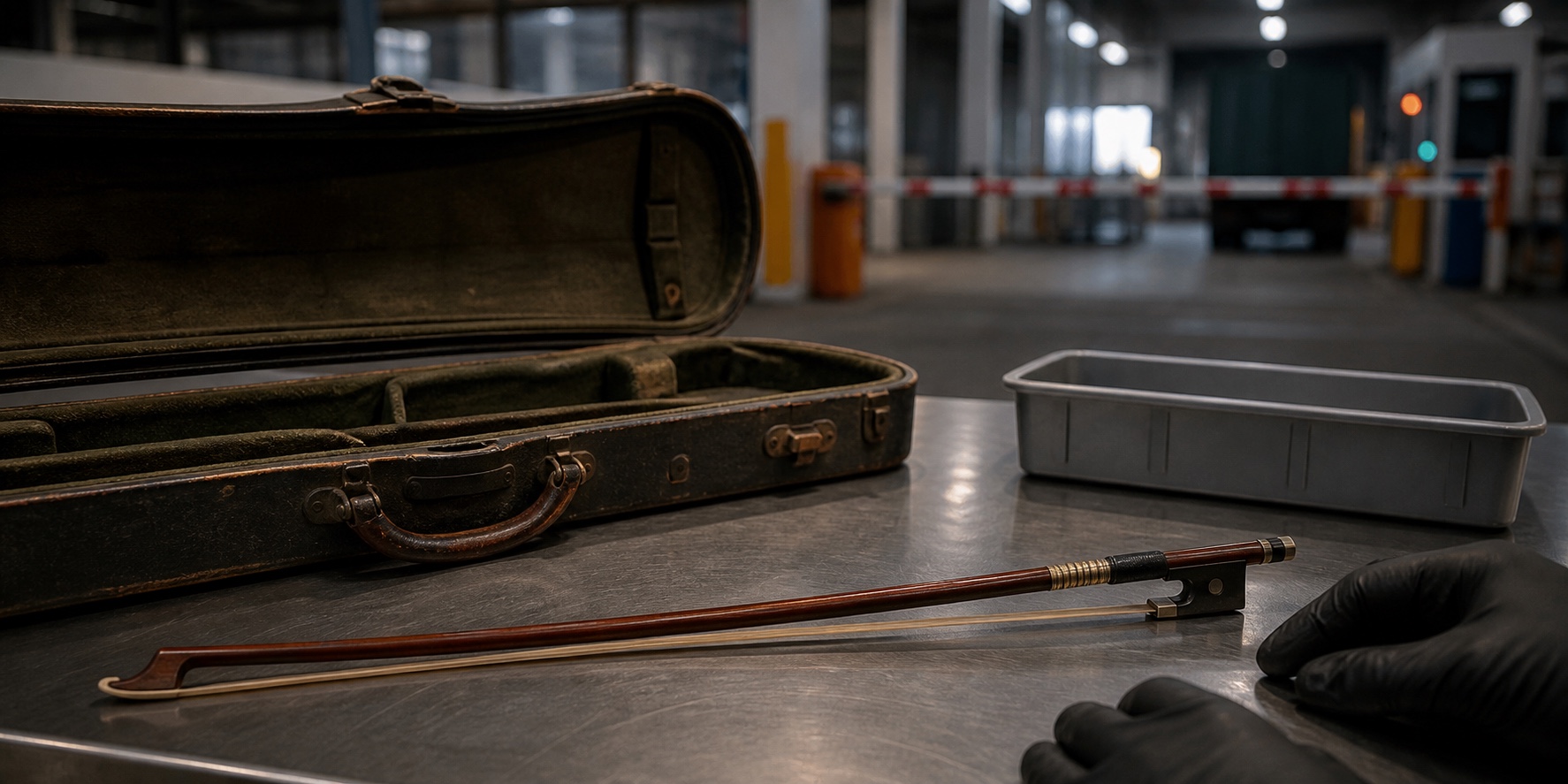
This investigation examines whether the classical music trade can prove where its pernambuco came from, after a revised CITES rule took effect on 5 March 2026. It is a desk analysis of public records available to 6 August 2026: the treaty text and annotation, official implementation guidance, Brazil's CITES proposal, peer-reviewed research and twenty public dealer pages. Three cautions travel with it. Trade figures come from the invoices Brazil could recover for its own proposal — 346 cases, incomplete records — and are a documented floor, not the size of the trade. The dealer audit records what twenty pages displayed on one date; it is not a finding that any seller trades unlawfully, and a page that does not publish provenance is not evidence that provenance does not exist. And nothing here is legal advice: compliance turns on the specific object, the specific route and the authorities involved.
How to read this investigation
A player may fly from New York to Berlin with a finished pernambuco bow for a paid performance and, under the CITES rule that took effect on 5 March 2026, need no permit—provided the bow is not sold, transferred or left abroad and returns to the player’s country of usual residence. The same player who leaves that bow with a Berlin dealer on consignment has changed the purpose of the journey. The movement is now commercial. The exemption disappears. [S01] [S04]
For an international sale, the decisive question is whether the wood came from a tree harvested before 13 September 2007, the date Paubrasilia echinata entered the CITES Appendices, or from a lawful non-wild source such as a qualifying plantation. A pre-2007 bow can move through international commerce only with evidence and the required CITES documentation. A wild-sourced post-2007 bow cannot. A bow whose owner cannot establish either route may remain legal to possess and play while becoming effectively immobile in the international market. [S01] [S03]
The new scarcity is not only pernambuco. It is credible evidence about pernambuco.
What Cadenza found
A bow without provenance is not automatically proof of illegal logging. It may be old, lawful and poorly documented. Under the 2026 system, however, missing evidence can still prevent international commercial movement.
1. The legal switch hidden in intent
The new regime is easiest to understand as a switch. The bow itself does not change when a musician walks from the concert hall to a dealer. The legal category changes because the purpose changes.
One bow, two journeys
The owner travels with a finished bow for a paid concert. Ownership does not change. The bow is not offered for sale and returns home.
The owner leaves the same bow on consignment or completes a sale. The movement now serves a commercial transfer.
This diagram states the treaty-level distinction, not every national procedure. Import, export, wildlife-component and customs rules differ by country.
CITES deliberately treats paid performance as non-commercial for this purpose. That wording protects ordinary musical life. An orchestra tour is paid work, but the bow is not merchandise during the tour. Repairs, teaching, competitions, display, loans and appraisals can also fall within the permit-free exemption when ownership does not change and the object returns home. [S01]
The line is narrower than many musicians assume. A gift is a transfer. A donation is a transfer. A consignment is an arrangement made with the intent to sell. A bow carried abroad so that an auction house can inspect and offer it is not simply travelling for personal use. The UK guidance issued after CoP20 says consignments require CITES documentation even when the bow ultimately fails to sell. [S04]
This creates a peculiar class of asset. The bow can remain musically functional, insurable and valuable within a domestic market while losing access to foreign buyers. Its sound does not deteriorate. Its chain of title does.
2. What changed on 5 March 2026
Pernambuco had been in CITES Appendix II since 13 September 2007. Appendix II does not mean an object is prohibited. It means international trade must be controlled so that commerce does not threaten the species’ survival. The practical scope depends on the annotation attached to the listing.
For years, finished bows occupied an unusually permissive space. Earlier versions of Annotation #10 focused control on logs, sawn wood, veneer and unfinished bow material. A bow blank could be regulated while a completed bow made from the same wood could pass through commerce with less scrutiny. CoP19 broadened control in 2022, but finished musical products remained exempt in important circumstances. [S05] [S06]
CoP20 replaced that arrangement with a sharper divide. Finished instruments, accessories and parts may move without CITES permits for specified non-commercial purposes. Commercial trade in wild-harvested specimens is subject to a zero quota. The principal route left open for wild-source bows is pre-Convention status: proof that the wood was harvested before the 2007 listing date. Lawful plantation-origin material can also qualify under a non-wild source code, but the source must be established. [S01] [S02]
From dye tree to documented bow
Brazilwood extraction for red dye
Colonial trade makes the tree a commodity centuries before bow making becomes its defining modern use.
The modern concave bow emerges
French makers associated with François-Xavier Tourte establish a model in which pernambuco becomes the reference material.
National and international threat recognition
Brazil lists the species as threatened; the IUCN assessment categorizes it as Endangered.
CITES Appendix II
The date later becomes the legal dividing line for pre-Convention commercial trade.
Operation Dó-Ré-Mi
Brazil says IBAMA uncovers laundering and seizes more than 292,000 bow blanks and bows deemed illegal.
CoP20 rejects Appendix I transfer, adopts compromise
The species stays in Appendix II, but commercial wild-source trade receives a zero quota and traceability work expands.
Revised Annotation #10 takes effect
Performance travel remains broadly permit-free; international commercial trade in finished bows becomes documentation-driven.
Technical system still unfinished
CITES committees continue work on marking, stockpiles, conversion factors and harmonized traceability.
For American owners, a one-use pre-Convention certificate costs $75 as of June 2026. A Musical Instrument Certificate, valid for up to three years for eligible material, also carries a $75 application fee. A master file for repeated commercial shipments costs $200, with individual permits at $5. These fees are not the principal burden. The hard part is producing evidence sufficient for the authority to decide that the wood qualifies. [S01]
That is why 5 March did not merely add paperwork. It changed the value hierarchy of the bow market. Maker, condition, playing quality and attribution still matter. Now a separate asset travels with the stick: a defensible account of when and how its wood entered commerce.
3. The tree behind the sound
Paubrasilia echinata is endemic to Brazil’s Atlantic Forest, a coastal biome that has been cut, fragmented, replanted and urbanized for centuries. The tree is known as pau-brasil or brazilwood; in the string-instrument trade, the high-grade material is generally called pernambuco. Market language can be confusing because “brazilwood” is also used for lower-cost bows made from other tropical woods. Customs law follows species, not marketing vocabulary.
The tree’s modern cultural importance comes from a rare mechanical combination. A bow stick must be dense enough to carry mass, stiff enough to resist the pull of tightened hair, elastic enough to be cambered with heat, responsive enough to articulate rapid strokes and internally quiet enough not to dissipate vibration indiscriminately. Recent measurements place pernambuco in the medium-to-upper range among selected tropical hardwoods for density and stiffness, while finding exceptionally low damping and substantial variation from one sample to another. [S13]
That last point matters. “Pernambuco” is not a guarantee of bow quality. Trees vary. Logs vary. Different parts of one trunk vary. Makers evaluate straightness, grain, density, resilience, colour, defects and the way a stick responds under the plane and flame. The legendary material is not every piece of the species. It is a narrow fraction of a threatened species.
A 2024 global assessment of Atlantic Forest trees classified Paubrasilia echinata as Critically Endangered because of an estimated 84 percent population decline over three generations. The older IUCN listing still commonly cited by regulators is Endangered. The difference reflects the age and method of the assessments, not a recovery. [S07] [S08]
The species is not one interchangeable genetic block. Phylogenomic work has identified five groups, and recent field research on the arruda-RJ lineage in Rio de Janeiro found it surviving in 43 forest fragments, 30 newly documented. Most fragments were small and displayed uneven population structure. Urbanization was identified as the principal threat in that study area. [S08]
A plantation that grows trees but represents only a narrow subset of genetic lineages may supply timber without conserving the species’ evolutionary range. A conservation program that preserves scattered adults but no viable regeneration may preserve a photograph of a population rather than a future one. The bow crisis is therefore not simply a shortage of red hardwood. It is a collision among material performance, legal origin and biological diversity.
4. The tree that named a country
Brazil’s relationship with the tree predates the modern nation. Portuguese extraction focused on the red dye in its heartwood. European merchants valued brazilin, the pigment that could produce rich reds in textiles. The commodity became so closely associated with the territory that pau-brasil is widely understood to have supplied the country’s name. [S07] [S12]
The first extraction economy was not built for bows. It was built for colour. Colonial monopoly, coastal cutting and trade reduced accessible stands long before a French bow maker selected the wood for a new musical technology. When synthetic aniline dyes appeared in the nineteenth century, dye demand weakened. By then, a second international use was emerging.
This history matters because the bow trade often describes itself as a tiny cultural user compared with agriculture, urbanization and broad deforestation. In total volume that is plausible. Bow making does not clear landscapes on the scale of cattle or infrastructure. But selective logging can target the precise mature, straight, high-quality trees most valuable for reproduction and genetic continuity. A small luxury trade can exert disproportionate pressure when it searches for exceptional specimens inside already fragmented habitat.
The Brazilian CoP20 proposal cited continuing selective extraction in and outside protected areas, including Pau-Brasil National Park. It reported 102 recently cut logs found in 2019 on a property linked to a bow maker, 175 illegal logs seized in Bahia in 2022 and repeated detection of standard-sized material intended for bow production. Those are government allegations and enforcement findings summarized for an international policy campaign, not a verdict on every maker or every bow. They nevertheless demonstrate that the bow supply chain remained an active destination for newly cut wood after wild harvest had been prohibited. [S05]
5. How Tourte made it indispensable
The modern bow is usually traced to late-eighteenth-century Paris and the work of François-Xavier Tourte and his circle. Earlier bows existed in many shapes, but the Tourte model established the inward curve, standardized proportions and balance that supported the expanding technical and dynamic demands of violin-family repertoire. Pernambuco proved unusually compatible with that design. [S06]
The result was a feedback loop lasting more than two centuries. Great makers learned the material. Players learned the response of the best examples. Conservatories taught technique on the assumption that the bow would behave within familiar parameters. Dealers priced historic French bows as both musical tools and collectible objects. Orchestras, competitions and recordings reinforced a shared idea of professional sound.
Tradition then began to look like material inevitability. The best pernambuco bows genuinely possess qualities players value, but the market also rewards familiarity. A dark red-brown stick reads as serious before it touches the string. An alternative material must not only match stiffness, damping, balance and workmanship. It must overcome two centuries of visual and professional signalling.
This is why replacing pernambuco is not equivalent to changing a chair leg from one hardwood to another. The bow is part spring, lever, resonator, control surface and expressive interface. Tiny changes affect the player’s hand before they become measurable in the hall. Yet this sensitivity can also make anecdote dominate evidence. A player may reject a carbon or alternative-wood bow because of a real response difference, because of a poor individual example or because the object violates an inherited expectation. The industry rarely separates those effects systematically.
Pernambuco has exceptional and useful properties, especially low damping, but it is not uniform and science does not prove that every professional bow must be made from it. The stronger claim—no other material can work at the highest level—is cultural and commercial as much as scientific.
6. The ninety-percent problem
Brazil’s CoP20 submission estimated that more than 90 percent of harvested brazilwood is discarded during production because it does not meet professional bow standards. The figure is not an audited international conversion factor; CITES has explicitly asked Parties to develop better factors connecting logs, sawn volume, blanks and finished bows. It is still a revealing description of the trade’s selection pressure. [S05] [S10]
The forest supplies a tree. The market wants a tiny fraction.
Illustrative funnel based on Brazil’s “more than 90 percent” estimate. It is not a standardized conversion factor and should not be used to calculate legal stock.
A low yield magnifies the conservation cost of every successful stick. It also creates incentives for laundering. If a company holds documented old stock that contains mostly cracked, twisted or weak material, new illegal wood of better quality can be mixed into the inventory and sold under the old paper. The documentation describes a volume; the market selects particular sticks. Unless the control system connects each finished bow to a traceable stock lot, the legal volume can become a cover rather than a constraint.
The waste figure also complicates plantation policy. Planting a thousand trees does not promise a thousand bows. Growth rate, site, genetics, silviculture, trunk form and decades of environmental conditions determine whether any future wood meets makers’ requirements. A plantation may be excellent conservation work and a poor commercial bow source. It may also be commercially productive while conserving only a narrow genetic sample.
Any serious supply forecast therefore needs more than hectares planted. It needs survival rates, lineage, diameter, straight usable length, mechanical testing, time to harvest and a verified conversion from log to finished bow. CITES is asking for precisely those figures because the market has operated for decades without a shared accounting language.
7. The documented scale of the trade
Brazil’s 2025 CoP20 proposal drew on 346 administrative cases and available invoices covering roughly 25 years. The records were incomplete. Hundreds of invoices were missing, and the submission said declared values were often five to ten times below comparable market prices. The figures therefore do not represent a complete census. They are a floor built from the paperwork authorities could find. [S05]
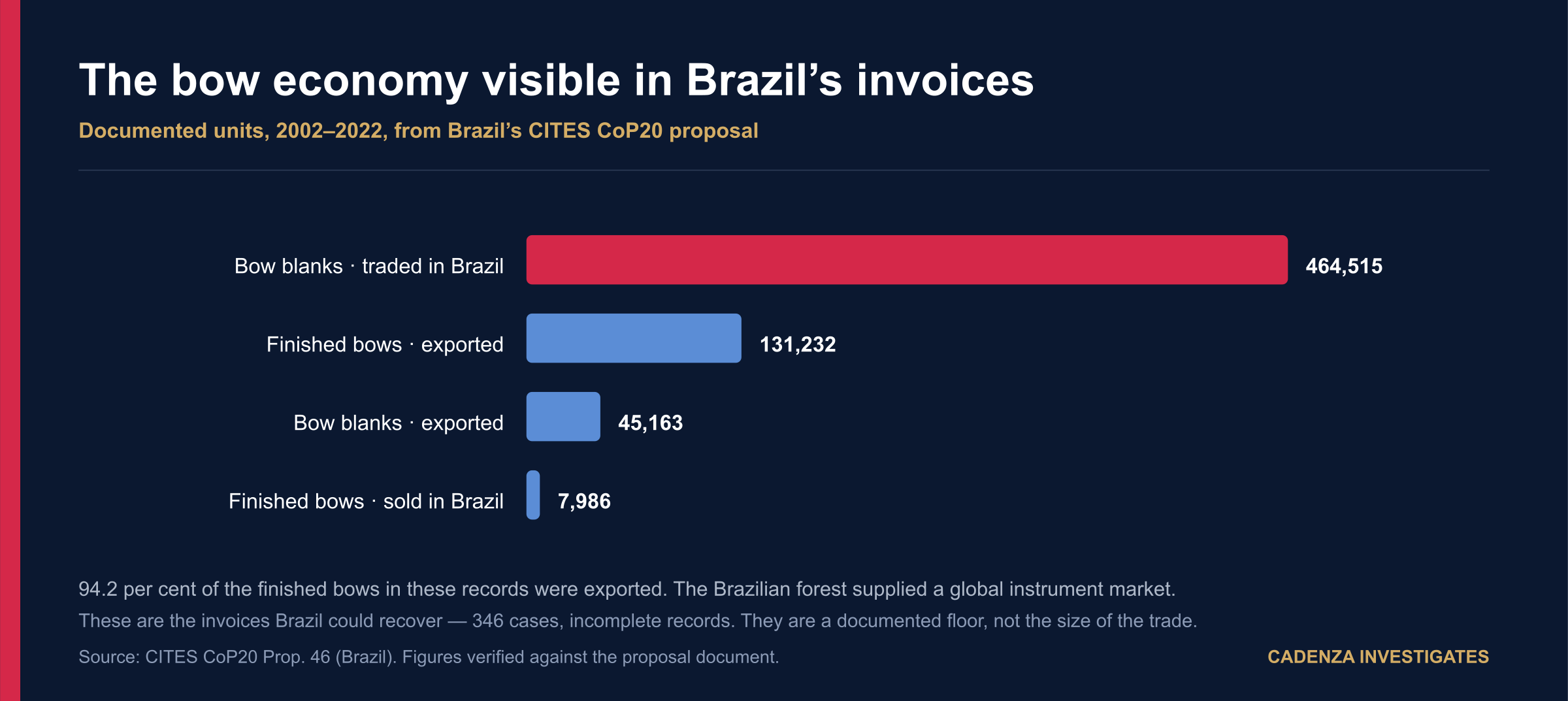
From the invoices Brazil could recover for its CoP20 proposal — 346 cases, incomplete records. A documented floor, not the size of the trade.
Even that partial floor is substantial. From the available 2002–2022 records, 464,515 bow blanks were traded within Brazil and 45,163 were exported. Brazilian companies sold 7,986 finished bows domestically and 131,232 abroad. The proposal estimated 70.87 cubic metres in bows and blanks traded within Brazil and 26.46 cubic metres exported, plus 8.4 cubic metres of boards and planks. [S05]
The bow economy visible in Brazil’s available invoices
Bars use a linear scale against the largest category. The dataset excludes missing invoices and cannot establish the legality of each unit.
The mismatch between domestic and foreign sales is striking. Of the finished bows represented by those invoice records, 94.2 percent were exported. The Brazilian forest supplied a global musical market. The musicians, dealers and collectors who benefited from that market were mainly outside Brazil. [S05]
The declared invoice total—about R$86.8 million, stated in the proposal as roughly €13.54 million—does not resolve the market’s value. If the reported under-declaration was widespread, customs records substantially understate it. If some comparisons involved retail prices while invoices recorded wholesale or unfinished goods, the five-to-ten-times claim may overstate the gap for certain transactions. The proposal does not provide enough raw data for Cadenza to reproduce every valuation comparison.
That limitation is itself part of the story. A species can be globally important, nationally protected and internationally listed while the market still lacks a reliable count of how many bows its stock has produced.
8. Where Brazil’s bows went
The available invoices identify the United States as the dominant destination for finished bows. Of the 131,232 exported units, 72,040 went to the United States—54.9 percent. Belgium received 20,732 and Japan 13,305. Germany, the Netherlands, Italy, Portugal, England, Taiwan and Canada followed. [S05]
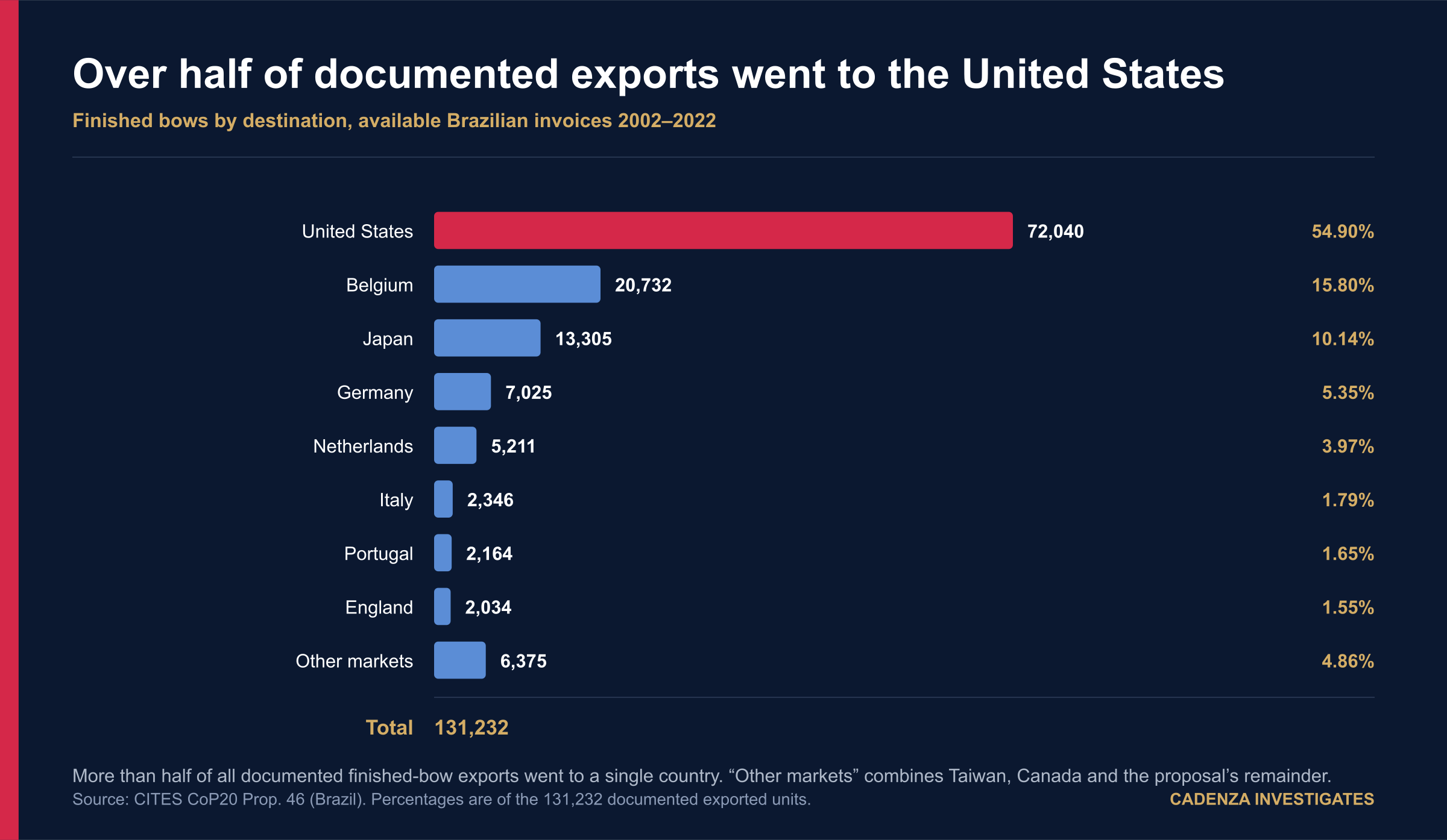
Percentages are of the 131,232 documented exported units in Brazil's available invoices.
More than half of documented exports went to the United States
“Other markets” combines Taiwan, Canada and the proposal’s remaining destinations. Percentages are those reported or derived from the invoice totals.
Bow blanks followed a different map. Japan received 26,000 of the 45,163 exported blanks, or 57.57 percent. The United States received 11,052, Germany 2,774, Italy 2,538 and Portugal 1,950. A later section of Brazil’s proposal said 27,274 blanks were exported under judicial decisions recognizing the material as pre-Convention, including one transaction of 26,000 blanks to a Japanese trading company. [S05]
The concentration matters for enforcement. A small number of destination countries became the clearing centres where Brazilian wood entered workshops, dealer inventories and global resale. Once a blank became a bow and changed hands repeatedly, the original import record could become separated from the object. A maker’s stamp identified authorship, not necessarily the tree, stock lot or permit.
The route is therefore longer than Brazil to musician. It can run from forest to extractor, intermediary, Brazilian company, blank exporter, foreign workshop, wholesaler, dealer, auction house, collector and player. Every handoff can add value. Every handoff can also remove context.
The bow’s journey is global. Its paper trail often is not.
Tree, plantation or illegal extraction site in Brazil.
Log cut, assessed, discarded, registered or merged with inventory.
Stick selected, cambered, mounted and stamped—or left anonymous.
Attribution, appraisal, consignment, export and resale.
Ownership may outlast receipts, permits, maker records and memory.
9. The laundering machine
The strongest case for the 2026 restrictions is not that paperwork was occasionally incomplete. It is that Brazilian authorities described a system in which paperwork could be used to disguise new illegal wood as old legal stock.
In October 2018, Brazil launched Operation Dó-Ré-Mi against environmental offences involving CITES timber, particularly pau-brasil. According to the country’s CoP20 submission, approximately 45 bow makers, companies and contracted professionals were fined for offences including possession of illegally sourced wood, false or misleading information, illegal transport, receipt and sale. IBAMA agents seized more than 292,000 bow blanks and bows deemed illegal. [S05]
The alleged laundering method exploited a structural weakness. Companies possessed documents for pre-Convention stock. Fresh logs, planks or blanks obtained in southern Bahia were incorporated into those inventories. Existing paperwork then gave later sales the appearance of legality. The proposal also described the use of virtual credits in Brazil’s forest-origin control system to mask wood transported from Bahia. [S05]
How old paperwork can cover new wood
Mature wild tree is removed despite national protection.
Log becomes planks and selected blanks; poor material is discarded.
New material enters a company yard holding documented old stock.
Pre-2007 documents or system credits are used to mask source.
A bow acquires market legitimacy without object-level traceability.
This is a diagram of the scheme alleged in Brazil’s official CITES proposal. It is not a finding about every company, stockpile or pre-2007 bow.
Later Federal Police operations in 2021 and 2022 searched nearly 60 locations, the proposal said. Much of the wood was thought to have come from Pau-Brasil National Park and other sites in southern Bahia. Brazil estimated more than US$46 million in profits from illegal exports. Again, those figures are the state’s enforcement account. Cadenza has not reviewed the complete case files, charges or final judgments for each target.
The distinction between seizure and conviction is essential. Administrative seizure means authorities judged material unlawful or insufficiently documented at that stage. It does not mean every object was later confirmed illegal by a final court. Nor does a large count translate directly into that many finished professional bows: the seized category included blanks and bows of different stages and quality.
But the mechanism does not depend on every case surviving appeal. If old stock documents can be detached from individual sticks, then paper volume and physical identity can diverge. The system has no reliable answer to the question that now governs international trade: which exact tree history belongs to this exact bow?
10. Why 13 September 2007 rules the market
CITES does not retroactively prohibit all objects made from a newly listed species. Pre-Convention treatment allows specimens acquired before the listing took effect to continue in trade under certificates. For pernambuco, the relevant date is 13 September 2007.
The date is legally clear and physically difficult. Wood does not arrive with a timestamp. A bow made in 2015 may have been cut from stock harvested in 1995. A bow made in 1995 is almost certainly made from pre-Convention wood, but an undated anonymous bow may not disclose its manufacture year. A receipt proves purchase date, not necessarily harvest date. A maker’s statement can connect a bow to stock, but only if the maker retained records that identify the stock.
U.S. guidance allows applicants to assemble different forms of evidence: receipts, invoices, appraisals, serial numbers linked to a date, photographs, catalogues, advertisements, inventories and notarized statements. No single document is always mandatory. The authority asks whether the total evidence is sufficient. [S01]
Not all provenance files carry the same weight
Direct, linked records
Dated maker stock ledger, original invoice, validated import document, serial or mark tied to the specific bow, continuous ownership record.
Corroborated expert evidence
Independent appraisal, dated photographs or catalogue, maker chronology, signed prior-owner statements and consistent physical identification.
Unsupported assertion
“Old bow,” family memory, generic dealer label or undocumented claim that all workshop wood was pre-2007.
The grades are Cadenza’s analytical shorthand, not official CITES categories. Authorities decide sufficiency case by case.
The market’s problem is temporal asymmetry. The bow industry had little incentive before 2007 to preserve harvest-date evidence for each stick. Owners bought tools, not regulated specimens. Receipts were lost. Workshops closed. Estates dispersed. Dealer labels faded. The legal system now asks for evidence that the market was not designed to create.
This is not an argument against the rule. It is an argument for an orderly transition. A traceability regime cannot recover the past by pretending that every undocumented bow is criminal. It also cannot protect the species by accepting self-declaration from anyone who writes “pre-2007” on an appraisal.
11. Provenance after the fact
Provenance usually means the history of ownership and attribution. Under the new system it must do more. It must support biological and legal origin.
A traditional bow certificate may identify a maker, school, approximate date, condition and authenticity. That can establish that a Tourte bow predates 2007 by two centuries. It may say nothing about an anonymous modern bow. A modern maker’s invoice may establish manufacture in 2004, which strongly supports pre-Convention wood. A 2018 invoice does not answer whether the maker used old stock or post-listing material.
High-resolution photographs can help establish identity. Grain patterns, head shape, frog, winding, button, repairs and stamps create a visual fingerprint. U.S. guidance specifically recognizes photographs and catalogues as possible evidence. But identity is not origin. A photograph can prove that the bow at the border is the bow in a 2001 catalogue. It cannot alone prove where a 2018 bow’s wood was harvested. [S01]
Scientific testing has limits. Wood anatomy can help identify species. Mechanical measurements can characterize a stick. Neither ordinarily gives a precise harvest date. Radiocarbon methods may distinguish broad periods in some circumstances, but a valuable bow offers little material for destructive sampling and the legal system has not adopted a routine global protocol for dating individual pernambuco sticks.
The practical answer is cumulative evidence. Date the bow. Identify it uniquely. Trace the maker or workshop. Link the maker to registered stock or an import record. Record every later transfer. The system grows stronger forward in time even when the first link is imperfect.
The absence of a mandatory bow registry makes that process voluntary. U.S. authorities currently do not require registration of existing bows or stockpiles. An internationally harmonized marking system remains under discussion. That means the market is living under a strict origin rule before it has a common identity system. [S01] [S11]
12. The anonymous antique problem
The easiest cases are old and famous. A bow reliably attributed to Tourte, Peccatte, Sartory or another historic maker necessarily predates 2007. Its manufacture date can establish pre-Convention status even when the original wood invoice has vanished.
The hardest cases are neither obviously new nor securely attributable. Many bows carry workshop brands rather than individual authorship. Some stamps are copied. Some heads and frogs have been replaced. Some bows were made from old sticks remounted later. Some owners know only that a teacher sold the bow decades ago. A family may possess a lawful object with no commercial paper because nobody imagined that a future border officer would need a harvest chronology.
These objects expose a tension between conservation law and cultural heritage. A nineteenth-century anonymous bow cannot threaten a living tree by existing. Preventing its undocumented international sale may still reduce market incentives for laundering because enforcement cannot always distinguish the genuinely old object from a newly made imitation supported by a weak story.
The law therefore accepts some false negatives: lawful bows that fail to qualify for international trade. A looser system would accept more false positives: illegal wood admitted as old stock. The policy question is not whether error can be eliminated. It is which error the market and the species can bear.
A fair transition should not erase value without a route to evidence. Expert panels, time-limited registration windows, standardized photo files and reviewable decisions could help establish old objects. But any grandfathering process must resist the exact vulnerability Brazilian investigators described: old documents becoming reusable covers for new material.
The more generous the system is toward undocumented old bows, the easier it becomes to launder new bows. The stricter it is, the more lawful heritage objects become trapped in domestic markets.
13. Auctions, consignments and stranded value
International bow commerce depends on movement before sale. A dealer may take a bow to a fair. An auction house may receive consignments from several countries. A player may trial a bow at home before deciding. A maker may send examples to an overseas shop. The revised annotation treats many of these movements as commercial even when ownership has not yet changed, because the purpose is sale.
The UK guidance is explicit: a bow entering or leaving the country on consignment requires the relevant import and export or re-export documents. APHA aims to issue permits within 30 days after payment but warns that processing can take longer. Multiple bows can share one permit only when shipment details align. Eurostar St Pancras is not a designated CITES point of entry or exit, and the UK says there are currently no plans to make it one. [S04]
That detail changes real commerce. A London dealer sending bows to Paris cannot assume the fastest passenger rail route can process the paperwork. A musician buying in continental Europe cannot treat the return journey as ordinary baggage under UK guidance. The transaction may require a permit from the exporting country and a UK import permit. A delayed permit can outlast an auction deadline or trial period.
For lower-value bows, compliance costs can consume the margin. The permit fee is only one part. The seller may need an appraisal, photography, staff time, customs brokerage, designated-port routing, insurance extensions and storage while waiting. A bow worth $800 can face a paperwork burden designed around the same protected species as a bow worth $80,000.
The likely result is market segmentation. Documented bows retain international liquidity. Undocumented bows trade domestically at a discount. Dealers become more selective about consignments. Auction houses reject objects that once would have been routine. Makers using old stock must prove the stock before converting it into finished inventory.
This does not necessarily destroy value. It redistributes it toward evidence-rich objects and domestic buyers. A certificate that once supported attribution now supports mobility. The strongest provenance file becomes part of the bow’s price.
14. The market names the wood and hides the proof
The new system assumes that evidence can follow the bow. The public market shows how far the trade remains from that standard.
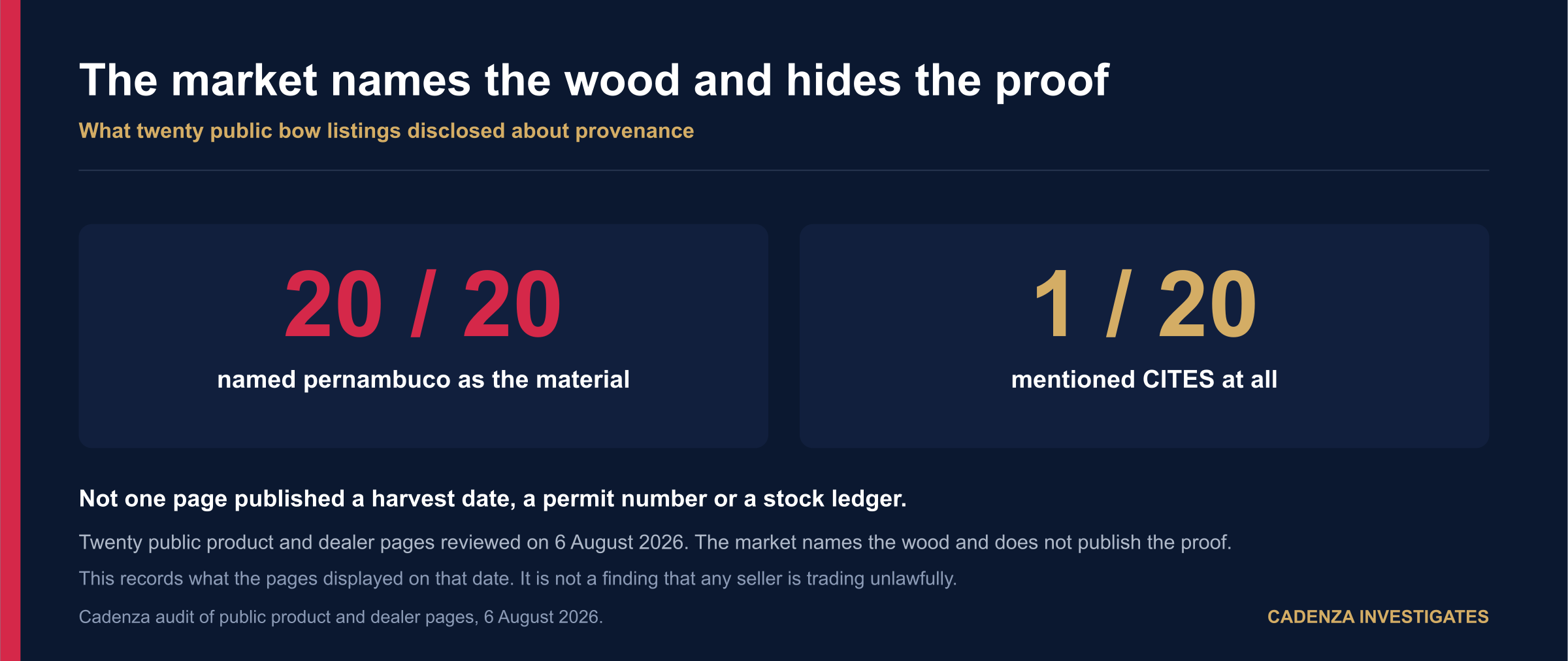
Twenty public product and dealer pages reviewed on 6 August 2026. This records what those pages displayed on that date.
Cadenza reviewed 20 English-language retail, dealer and recently sold product pages available in August 2026. The sample covered specialist string shops in the United States and Europe, lower-priced workshop bows, contemporary maker bows and objects presented as aged-stock or modern production. It was not designed to estimate the entire global market. It was designed to test a narrower question: what can a buyer learn from the page on which a pernambuco bow is offered?
Every audited page named pernambuco. Only one page mentioned CITES. None published a precise wood-harvest date, a linked pre-Convention certificate, a plantation source code, a permit number or another public record that would allow the buyer to test the bow’s eligibility for international commercial movement. Three pages made partial age or stock claims—wood aged 35 to 80 years, aged European stock, or wood aged at least 30 years—but did not connect the claim to a dated inventory record or an individual stick. [S20]–[S39]
The species is a selling point. The evidence is not.
The pages are optimized to sell material, maker, mountings and playing characteristics. They are not yet optimized to sell verifiable legal mobility. The audit does not show that the sellers lack documents. It shows that buyers cannot assess the documentation from the public listing.
The sample is non-random and limited to public English-language pages accessible during the review. “No” means the information was not published on the audited page, not that it does not exist in a dealer’s private file.
The mismatch is commercially important. A product page can support a five-figure valuation with detailed claims about maker, nationality, silver or gold mountings, weight, balance, condition and tonal response. Yet the information that may determine whether the bow can be sold to a foreign buyer is often absent. The market describes what the bow is. It rarely describes why the protected wood may lawfully cross a border for sale.
Corilon’s B41 listing was the only audited page to make the regulatory problem explicit. It stated that the bow could not be shipped outside the European Union because of new CITES regulations. That is useful consumer disclosure: the page identifies a practical limit before a buyer attempts the transaction. It still does not publish the harvest date or documentary basis that would establish whether a future permit route exists. [S36]
Several age claims illustrate another problem. “Aged for at least 30 years” can describe seasoning, storage or commercial stock. It does not necessarily establish when a tree was harvested, who held the stock on 13 September 2007, whether fresh wood was later mixed into the inventory, or whether the specific bow came from that stock. A bow dated 2017 proves when the object was made, not when the tree was cut. Under the revised system, those dates perform different legal functions.
A missing field on a product page is not evidence of illegal wood, false advertising or an unlawful sale. Dealers may hold invoices, stock declarations, expert opinions or permits that they provide only when an international transaction is proposed. Some pages concern domestic sales for which CITES export documentation is not immediately required. The finding is a disclosure gap: the buyer is asked to value the protected material before being shown the evidence that governs its international liquidity.
What 20 listings disclosed
| # | Seller | Listing | Pernambuco named | CITES mentioned | Harvest / permit basis published | Public-page observation |
|---|---|---|---|---|---|---|
| 1 | Shar Music | Klaus Becker Pernambuco Violin Bow [S20] | Yes | No | No | Species/material named; no public harvest date, certificate number or permit basis. |
| 2 | Shar Music | Markus Fischer Pernambuco Violin Bow [S21] | Yes | No | No | Species/material named; no public origin documentation. |
| 3 | Shar Music | W. Seifert Octagonal Violin Bow [S22] | Yes | No | No | Pernambuco named; no public trade-eligibility evidence. |
| 4 | Shar Music | Guy Laurent One-Star Violin Bow [S23] | Yes | No | No | Pernambuco named; no public harvest or permit basis. |
| 5 | Fiddlershop | Holstein Pernambuco Violin Bow [S24] | Yes | No | No | Advertised as genuine pernambuco; no public provenance basis. |
| 6 | Fiddlershop | Archet SLC Atelier Prier Violin Bow [S25] | Yes | No | Partial | Wood described as 35–80 years old, but no harvest date, certificate number or stock linkage is published. |
| 7 | Fiddlershop | Arcos Lusitânia Silver Plus Violin Bow [S26] | Yes | No | Partial | Aged European stock is claimed, but the page does not publish a dated chain of custody or permit basis. |
| 8 | Carriage House Violins | Christopher Dickson Violin Bow [S27] | Yes | No | No | Pernambuco named; no public harvest date or CITES basis. |
| 9 | Johnson String Instrument | Christopher Dickson Violin Bow [S28] | Yes | No | No | Pernambuco named; no public trade documentation. |
| 10 | Carriage House Violins | I-Strings Pernambuco Cello Bow [S29] | Yes | No | No | Pernambuco named; no public harvest or permit basis. |
| 11 | Southwest Strings | Egidius Dörfler Pernambuco Violin Bow [S30] | Yes | No | No | Pernambuco named; no public origin documentation. |
| 12 | Southwest Strings | L’Archet Brasil Pernambuco Cello Bow [S31] | Yes | No | No | Pernambuco named; no public CITES or harvest basis. |
| 13 | Southwest Strings | Höfner Round Pernambuco Violin Bow [S32] | Yes | No | No | Pernambuco named; no public eligibility evidence. |
| 14 | StringWorks | Dörfler Pernambuco Violin Bow [S33] | Yes | No | Partial | Wood described as aged at least 30 years; that is not the same as a published harvest date or linked stock record. |
| 15 | StringWorks | Horst John / D. Silveira Violin Bow [S34] | Yes | No | No | Pernambuco named; no public harvest or permit basis. |
| 16 | StringWorks | Charles Allard Violin Bow [S35] | Yes | No | No | Pernambuco named; no public provenance basis. |
| 17 | Corilon Violins | CV Selectio Modern Violin Bow B41 [S36] | Yes | Yes | No | The page explicitly cites new CITES restrictions and limits shipping outside the EU; it does not publish the bow’s harvest or permit basis. |
| 18 | Corilon Violins | CV Selectio Cello Bow [S37] | Yes | No | No | Pernambuco named; no public harvest or permit basis. |
| 19 | Benning Violins | Georges Tepho Violin Bow [S38] | Yes | No | No | Pernambuco named; no public eligibility evidence. |
| 20 | Benning Violins | Alysio de Mattos Violin Bow [S39] | Yes | No | No | The bow is dated circa 2017, but the page does not state when its wood was harvested or identify a plantation/permit route. |
“Partial” marks a general age or old-stock claim that was not linked on the page to an exact harvest date, certificate, permit, stock ledger or individual-bow source record.
The audit also reveals why the 2026 transition will be uneven. Retail systems were built around cataloguing physical attributes and maker attribution, not regulated-material provenance. Most e-commerce templates do not contain fields for CITES source code, pre-Convention status, certificate jurisdiction, permit number, wood-stock batch, object identifier or international-sale eligibility. Adding those fields requires more than a disclaimer. It requires the dealer to connect inventory data to a document that can survive transfer.
The strongest market response would not be to place a generic “CITES applies” banner on every pernambuco page. That would warn without informing. A useful listing would distinguish among at least four conditions:
Domestic sale only
The bow is offered only inside the seller’s jurisdiction because no international commercial basis has been established.
Pre-Convention eligible
The seller holds evidence that the wood was harvested before 13 September 2007 and can identify the certificate or application route.
Lawful non-wild source
The seller can link the bow to qualifying plantation or artificially propagated material and the required source code.
International documents issued
The listing identifies the issuing authority, document type, validity and whether a new permit is required for the buyer’s destination.
This would alter how bows are priced. Two outwardly similar sticks could carry different values because one has internationally usable evidence and the other does not. Dealers already price attribution, condition and playing quality. Provenance must become a fourth axis rather than an after-sale administrative problem.
Public disclosure also creates discipline upstream. A maker who knows the final listing will require a stock batch and source basis has an incentive to preserve supplier invoices and conversion records. A wholesaler knows that “old wood” will no longer be accepted as a complete commercial description. An auction house knows that vague catalogue language may strand a consignment at the border.
The market has spent decades teaching buyers to ask whether a bow is pernambuco. The next question is harder: what record makes that pernambuco tradable?
15. One treaty, different borders
CITES creates the shared framework. National authorities implement it. The result is not complete uniformity.
Common rule, different procedures
| Activity | United States | United Kingdom | European Union context |
|---|---|---|---|
| Travel for paid performance, no transfer | Permit-free under the finished-instrument exemption, subject to conditions. | Permit-free; carrying evidence of the performance is prudent. | Treaty exemption applies, but national customs practice should be checked. |
| International sale of a wild-source bow | Pre-2007 evidence + CITES certificate. | Pre-2007 evidence + import/export or re-export documents. | CITES permits and EU wildlife-trade rules; Member States administer them. |
| Domestic sale | CITES is international; other federal/state material rules may apply. | No Appendix-I Article 10 certificate for pernambuco alone; other bow materials can trigger rules. | Internal EU movement is distinct from third-country trade; national documentation rules still matter. |
| Buy abroad and carry home for personal use | U.S. personal-effects exemption may apply, but exporting country requirements remain. | UK guidance requires permits because the introduction follows a commercial transaction. | Check both export and destination authorities before purchase. |
| Consignment across border | Commercial purpose; documentation expected. | Not exempt; permits required even if no sale occurs. | Generally treated as commercial movement. |
This is a reporting summary, not legal advice. Bows can also contain ivory, tortoiseshell, lizard skin, whalebone or other regulated material requiring separate analysis.
The U.S. personal-effects position illustrates the mismatch. U.S. guidance says a traveller who buys a bow abroad from a resident seller and brings it home in personally accompanying baggage for personal use may qualify for the American personal-effects exemption. But the exporting country may still require a CITES document. The UK takes the opposite approach for an overseas purchase returning to Britain: because the movement follows a sale, permits are required. [S01] [S04]
A musician cannot solve this by reading only the destination country’s website. Every international transaction has at least two authorities: export and import. A certificate accepted by one country may not be the document another expects. The UK warns that pre-Convention certificates are not universally used or accepted in place of standard permits. [S04]
This friction is not accidental. CITES depends on sovereign implementation. But the lack of a standardized bow identity magnifies it. Authorities cannot quickly verify a global record because no global record exists.
16. Brazil’s failed Appendix I bid
Brazil entered CoP20 seeking a stronger result: transfer of Paubrasilia echinata from Appendix II to Appendix I. Appendix I generally reserves international commercial trade for exceptional circumstances and would have transformed the bow market more radically.
Brazil argued that continued illegal logging, laundering, weak control of finished bows and severe population decline justified the move. Several countries supported it. The European Union, United Kingdom, Canada and Japan pressed for a working group and a narrower solution that would protect the species without making ordinary musician travel unmanageable. Music-industry groups warned of damage to bow making and existing instruments. TRAFFIC emphasized illegal trade and the need for traceability. [S09]
The Appendix I proposal failed to reach the two-thirds majority required. The Earth Negotiations Bulletin recorded 69 votes in favour, 42 against and 17 abstentions at the first vote. Excluding abstentions, 74 affirmative votes would have been required; the proposal fell five short. [S09]
Appendix I had a majority—but not the required majority
CITES listing amendments require a two-thirds majority of Parties present and voting; abstentions are excluded from that calculation.
The vote should not be read as a finding that the species was safe enough for ordinary commerce. A majority supported Appendix I. The proposal failed because treaty procedure demanded more than a simple majority and because Parties believed a tailored annotation could address the trade with less collateral damage.
Nor should opposition be reduced to industry capture. A complete Appendix I transfer could have created serious problems for musicians carrying historic bows, orchestras touring with hundreds of instruments, museums, repairers and makers holding lawful old stock. The policy dispute concerned how to distinguish those uses from new exploitation when the market’s records were already weak.
17. The compromise that bought time
The working-group compromise kept the species in Appendix II and rewrote Annotation #10. It protected travel for performance and other non-commercial uses, imposed a zero quota on commercial wild-harvested specimens and preserved the pre-Convention route. It also adopted decisions requiring deeper work on traceability, stockpiles, conversion factors, non-wild production, enforcement and alternatives. [S02] [S10]
Decision 20.239 urges Parties to develop a harmonized approach for identifying individual bows, report the size and evidence base of blank and wood stockpiles, determine how many bows those stocks can produce, report plantation and other non-wild operations, and share information on seizures. It also calls for due diligence to prevent illegal material from being laundered into legal trade. [S10]
That list is an admission of how much the international system still does not know. It does not have a standard conversion from a cubic metre of wood to saleable bows. It does not have a complete inventory of stockpiles. It does not have a universal mark. It does not know whether plantations can supply professional-grade wood at sufficient scale. It does not have a harmonized way to connect an individual finished bow to the evidence for its source.
By July 2026, CITES technical documents showed implementation work continuing. The UK had produced stakeholder guidance, and committees were still considering marking and traceability. The 5 March commercial restriction was already in force while the permanent infrastructure remained under construction. [S11]
The compromise therefore bought time for the species and transferred risk to the market. Owners and businesses must comply now. The system that might make compliance predictable will arrive later.
18. A species divided into fragments
Trade controls address extraction. They cannot by themselves repair habitat.
The Atlantic Forest once extended across roughly 1.3 million square kilometres. Estimates of what remains vary with the definition used—old-growth remnants, total native vegetation, regenerated cover and minimum patch size produce different answers. Recent research cites recovery to around 27–28 percent when broader forest regeneration is counted, while Brazil’s CoP20 proposal used 12.4 percent for original cover under a narrower measure. The disagreement is methodological, not evidence that the biome is intact. [S06] [S08]
Annual loss continues. Brazil’s proposal reported 20,100 hectares of Atlantic Forest deforested in 2021–22, 14,700 in 2022–23 and 14,400 in 2023–24. The decline from the first year is positive, but 14,400 hectares is not zero. [S05]
Deforestation slowed from the 2021–22 spike—and remained extensive
These are biome-wide annual loss figures, not hectares of pernambuco habitat specifically destroyed.
Pernambuco’s problem is not only total area. Genetic groups are geographically structured. The 2026 Oryx study on the arruda-RJ lineage found 164 occurrence records across 43 forest fragments, with many small populations and uneven age structure. Thirty fragments were newly documented, a sign both of improved knowledge and how incomplete the map remained. [S08]
A tree planted in a city square may preserve the species’ public symbolism but not the ecology of a native population. A plantation from a limited seed pool may produce thousands of trees and still narrow genetic diversity. A protected fragment may contain old adults but too few seedlings. Conservation must operate at the lineage, habitat and demographic levels—not merely count trunks.
19. Why plantations are not an instant answer
The most attractive solution is simple: plant more pernambuco, wait, harvest legally and use the proceeds to conserve the species. The principle is sound. The timetable and evidence are harder.
Brazil’s CoP20 submission said there were no large-scale commercial plantations supplying the market and that most existing plantings were not registered in the national forest-origin system. It cited estimates of roughly 40 to 50 years for trees to reach a diameter of at least 30 centimetres, while noting that no consensus exists on the minimum age at which plantation wood can produce professional bows. Some studies report promising properties; others question whether planted wood matches high-quality native material. [S05]
Forty years is short for forest restoration and long for a workshop’s inventory. A bow maker cannot bridge the period by asserting that future plantations will replace present supply. The transition needs lawful old stock, alternative materials, efficient use and transparent planting programs operating simultaneously.
Plantation legality must also be designed against laundering. Brazil described cases in which plantation credits or authorizations were allegedly used to legitimize wild wood. A plantation registry that counts volume without marking logs and tracking conversion can recreate the old-stock problem under a new label.
A credible plantation route would need registered seed source, lineage data, mapped trees, harvest authorization, marked logs, stock-lot conversion, waste accounting and finished-bow linkage. It would also need an honest statement of purpose. A conservation grove and a commercial timber plantation can both be useful, but they are not the same project.
The long horizon is not a reason to abandon planting. It is a reason to stop using planting as a rhetorical substitute for present traceability.
20. Can another material replace it?
Carbon-fibre bows already serve students, professionals, outdoor players and touring musicians. They offer consistency, durability and freedom from endangered tropical wood. They also produce a different tactile and acoustic experience, and the category ranges from inexpensive moulded products to sophisticated handmade designs. “Carbon bow” is no more a single quality level than “wood bow.”
Researchers have examined alternative tropical woods with combinations of density, stiffness and acoustic properties similar to pernambuco. A 2014 study identified species with substantial potential for bow making. A 2025 study selected ipê wood, made five violin bows and reported favourable evaluations by professional players, with mean scores above the midpoint of its six-point scale. These studies show possibility, not universal equivalence. Sample sizes are small, maker skill matters and player preference is not settled by one trial. [S14] [S15]
Replacement is not one question
Pernambuco
Low damping, familiar response, historic prestige, high variability, endangered wild source and strict border rules.
Carbon fibre
Consistent and durable, scalable, no threatened wood, but different feel and weak acceptance in the historic-bow market.
Ipê
Promising mechanical and player-test results; requires careful selection and its own sustainability controls.
Other tropical species
Several candidates show suitable properties, but availability, machining, legality and long-term supply vary.
Hybrid designs
Engineered laminates and mixed materials could tune mass and stiffness while reducing dependence on rare stock.
Alternative woods also carry environmental risk. Replacing one endangered species with an opaque supply of another tropical hardwood would repeat the failure under a new name. Every substitute requires species identification, legal harvest, chain of custody and life-cycle analysis.
The professional acceptance problem is real. A principal player choosing a bow for an audition does not want to become a materials experiment. Dealers know that a fine pernambuco bow can appreciate; an alternative bow may not. Conservatories teach within established equipment norms. Competition juries cannot see the supply chain but they can see an unfamiliar stick. The market therefore underinvests in alternatives because the current prestige system discounts them before performance begins.
That can change only through high-quality making, blind playing tests, commissions by major players, acquisition by institutions and transparent research. Conservation does not require declaring every alternative equal. It requires creating conditions in which alternatives can become excellent.
21. The bow passport classical music needs
The treaty has created a documentation requirement without a universal document architecture. Cadenza’s proposed answer is a bow passport: a portable, verifiable record tied to the individual object and its stock history.
A record that follows the bow—not the dealer’s filing cabinet
Minimum fields
A passport would not legalize an unlawful bow. It would make identity and future chain of custody harder to detach from the object.
The system should have two layers. A public layer would allow a buyer, customs officer or auction house to verify that the record exists, matches the bow and has not been revoked. A protected layer would contain personal ownership details and sensitive commercial documents accessible to authorities and authorized parties.
Existing bows require a registration window. Owners would submit standardized photographs, dimensions, weight, marks, appraisals, purchase records and statements. Independent reviewers would assign an evidence status rather than pretend certainty:
Verified pre-Convention
Direct evidence connects the specific bow or its maker’s stock to a date before 13 September 2007.
Corroborated pre-Convention
Multiple independent facts make pre-2007 origin highly credible even without a single definitive document.
Lawful non-wild source
Plantation or other qualifying source is documented through the complete conversion chain.
Unresolved
The bow may be possessed and used subject to domestic law but lacks enough evidence for international commercial movement.
Inconsistent or high-risk
Records conflict, stock volume is implausible, or documents appear reused; referral for deeper review.
Future production
Every new bow receives an object ID at manufacture and is linked to registered raw stock before sale.
For stockpiles, the unit of control cannot remain only cubic metres. Each lot should be photographed, measured, sealed or marked, sampled where appropriate and assigned a realistic conversion range. Waste should be recorded. When a blank leaves the lot, the digital balance decreases. When a bow is completed, the blank ID is closed into an object record.
The passport is not technologically difficult. The hard part is governance. Who verifies makers? Who pays? Who can correct errors? Which evidence standard applies across countries? How are privacy and theft risk controlled? How are historic bows handled without forcing every owner into an expensive appraisal?
Those are solvable institutional questions. Continuing without object-level identity is not a neutral option. It preserves the condition that allowed paper to travel independently from wood.
22. Who must act now
Musicians
Photograph every bow now. Preserve receipts, appraisals, prior-owner statements, insurance schedules, repair records and dated performance images. Record identifying details beyond the maker stamp. Do not assume a dealer’s verbal statement that a bow is “old stock” will satisfy an authority years later.
Dealers and auction houses
Separate attribution from trade eligibility. A catalogue should state whether international commercial movement is supported, which documents exist and which jurisdictions have accepted them. “Pernambuco bow, circa 2000” is not a complete compliance description. A domestic sale should not be marketed to foreign bidders without a plan for lawful export.
Bow makers
Inventory every stick and blank. Link finished bows to stock lots. Preserve purchase and import records. Mark new bows uniquely even before a harmonized system becomes mandatory. Publishing conservation donations does not replace source evidence.
Orchestras and conservatories
Create equipment-record programs before tours, not at the airport. Help musicians digitize provenance. Commission high-level alternative-material bows and run structured blind evaluations. A school that trains the next generation on endangered wood while treating supply-chain literacy as optional is transmitting technique without responsibility.
Governments and CITES bodies
Publish consistent forms, timelines and evidence standards. Create a low-cost route for musicians and small makers. Develop interoperable object IDs. Release anonymized permit and seizure data. Do not use administrative opacity as conservation policy.
Brazil
Protect habitat and lineages, prosecute illegal extraction, register legitimate plantations and make stock data auditable. Brazil carries the enforcement burden because the tree is endemic there, while most documented finished bows were exported. Destination countries must fund and participate in that burden rather than treat conservation as a source-country expense.
The minimum file every serious bow should have
Preserve
- Full-resolution object photographs
- Maker, workshop and approximate date
- Bill of sale and previous ownership
- Appraisals and insurance schedules
- Import, export and CITES documents
- Repairs that altered identifiable parts
Do not rely on
- “Everyone knows it is old”
- A generic species label
- A dealer sticker with no supporting file
- A workshop’s total stock declaration
- An undated photograph
- A document that cannot be tied to the bow
23. The price of proof
The 2026 rule is often described as a restriction on bows. More precisely, it is a restriction on undocumented international commerce in a threatened tree.
Musicians can still perform with qualifying finished bows across borders without a CITES permit under the treaty exemption. Owners can still possess old bows. Domestic markets continue under national law. What has narrowed is the ability to move a bow across a border for sale while asking authorities to trust an unsupported account of the wood.
That burden did not appear from nowhere. Brazil documented illegal cutting inside a depleted biome, gaps in invoice records, low declared values, huge seizures and alleged schemes in which pre-Convention paperwork covered fresh material. The industry’s defence—that bows are culturally important and their total timber volume is small—does not answer the evidence. A small trade can still be destructive when it selects rare mature trees and converts weak records into high-value objects.
Conservation advocates also carry a burden. They must distinguish a living threat from a historic tool. An anonymous lawful bow made in 1900 does not become ecologically dangerous because its owner lost a receipt. A system that traps heritage objects without offering a credible review process will lose legitimacy and encourage avoidance.
The solution is not a return to the old exemption. Finished bows were the endpoint at which regulated wood became difficult to trace. The solution is to make the endpoint visible: object identity, stock linkage, transfer history and permits that can be checked across jurisdictions.
Pernambuco gave the modern bow its physical language. Classical music then spent two centuries extracting value from that language while leaving the tree’s origin outside the concert programme. The new border rule forces the missing history back into the object.
A great bow will still be judged by what it does on the string.
But the international market will increasingly judge it by a second performance: whether its documents can survive contact with the truth.
Methodology and limits
This investigation is a desk analysis of public records available through 6 August 2026. It reviewed the revised CITES Annotation #10, implementation guidance from the U.S. Fish and Wildlife Service, UK authorities and industry bodies, CITES committee and decision documents, Brazil’s CoP20 Appendix I proposal, peer-reviewed conservation and wood-science research, and international meeting reports.
Brazil’s CoP20 proposal is an official government submission advocating a policy outcome. Its trade and enforcement figures derive from administrative cases, available invoices and cited investigations. The proposal itself says records are incomplete. Cadenza did not obtain the underlying 346 case files, full invoice dataset, evidentiary records for every seizure or final judgments for every investigated party. Statements about laundering, illegal origin and profits are attributed accordingly.
Counts of seized blanks and bows should not be read as counts of finished professional bows, convictions or trees. The “more than 90 percent” discard figure is an estimate, not a standardized CITES conversion factor. Forest-cover percentages differ among studies because definitions and mapping thresholds differ.
Cadenza did not inspect or authenticate any individual bow. The article does not determine whether a particular object is legal, pre-Convention or eligible for a permit. Regulations and national practice can change. Owners should obtain current advice from the relevant CITES management authorities before moving a bow for sale, consignment, gift or other transfer.
The retail-page audit reviewed 20 public English-language listings accessible on 6 August 2026. The sample was purposive rather than statistically representative and included current, sold-out and recently sold pages from specialist dealers in the United States and Europe. Review fields were limited to whether the page named pernambuco, mentioned CITES, and published an exact harvest date, certificate or permit number, explicit pre-Convention basis, plantation/non-wild source code or comparable object-linked evidence. General statements such as “aged wood,” “old European stock” or a bow-making year were recorded as partial context, not proof of harvest date. No conclusion was drawn about documents that a dealer may hold privately or provide later in a transaction.
Source register
- U.S. Fish & Wildlife Service — Pernambuco CITES Annotation #10 implementation FAQsOfficial U.S. guidance on the 5 March 2026 rule, performance travel, international sales, evidence, fees, stockpiles and marking.
- CITES — Appendices valid from 5 March 2026Current treaty listing and Annotation #10 for Paubrasilia echinata.
- NAMM — New requirements for pernambuco trade now in effectIndustry compliance summary of CoP20 implementation in the United States.
- Musicians’ Union / UK APHA guidance — Musicians with pernambuco bowsUK implementation guidance on sales, consignment, permits, processing and ports.
- Federative Republic of Brazil — CITES CoP20 Proposal 46Official proposal to transfer Paubrasilia echinata to Appendix I, including trade, enforcement, habitat and plantation data.
- Lichtenberg et al. — “Pau-brasil and string instrument bows telecouple nature, art, and heritage”Ecology and Society, 2022. History, bow making, conservation and transnational supply-chain analysis.
- de Lima et al. — “Comprehensive conservation assessments reveal high extinction risks across Atlantic Forest trees”Science, 2024. Includes the 84 percent estimated decline and Critically Endangered assessment.
- Dantas et al. — Conservation of Atlantic Forest fragments and brazilwood in south-east BrazilOryx, 2026. Field records, genetic lineage, fragment priorities and threats.
- Earth Negotiations Bulletin — CITES CoP20 reporting and summaryIndependent meeting record of Brazil’s Appendix I proposal, vote and compromise.
- CITES Decision 20.239 — Paubrasilia echinataDecision text via ECOLEX/InforMEA on traceability, stockpiles, conversion factors, due diligence and alternatives.
- CITES Plants Committee 28 — implementation update, July 2026Committee document describing continuing work on the CoP20 decisions and national guidance.
- Oxford University Herbaria — Paubrasilia echinataBotanical profile covering brazilin, distribution, form and historic use.
- Brémaud et al. — Physical, vibro-mechanical and optical properties of pernambucoHolzforschung, 2024. Measurements of 61 specimens, variability and low damping.
- Longui et al. — Woods with properties similar to pernambucoCerne, 2014. Candidate alternative woods based on physical, mechanical and acoustic properties.
- Fomin et al. — Acoustic and performance-based ipê selection for violin bowsWood Research, 2025. Material selection, five test bows and professional-player evaluation.
- European Commission — Wildlife trade and CITES implementationEU framework for CITES and stricter European wildlife-trade regulation.
- CITES Secretariat — “Paubrasilia echinata bows: Fine Tuning Traceability Solutions”CoP20 technical report reviewing marking, certification and traceability options.
- CITES — Decisions 20.239 to 20.243Official decision index assigning work to Parties, the Secretariat and CITES committees.
- CITES — Current species checklistTreaty species database for current listing and nomenclature checks.
- Shar Music — Klaus Becker Pernambuco Violin BowPublic product or dealer page reviewed 6 August 2026. Species/material named; no public harvest date, certificate number or permit basis.
- Shar Music — Markus Fischer Pernambuco Violin BowPublic product or dealer page reviewed 6 August 2026. Species/material named; no public origin documentation.
- Shar Music — W. Seifert Octagonal Violin BowPublic product or dealer page reviewed 6 August 2026. Pernambuco named; no public trade-eligibility evidence.
- Shar Music — Guy Laurent One-Star Violin BowPublic product or dealer page reviewed 6 August 2026. Pernambuco named; no public harvest or permit basis.
- Fiddlershop — Holstein Pernambuco Violin BowPublic product or dealer page reviewed 6 August 2026. Advertised as genuine pernambuco; no public provenance basis.
- Fiddlershop — Archet SLC Atelier Prier Violin BowPublic product or dealer page reviewed 6 August 2026. Wood described as 35–80 years old, but no harvest date, certificate number or stock linkage is published.
- Fiddlershop — Arcos Lusitânia Silver Plus Violin BowPublic product or dealer page reviewed 6 August 2026. Aged European stock is claimed, but the page does not publish a dated chain of custody or permit basis.
- Carriage House Violins — Christopher Dickson Violin BowPublic product or dealer page reviewed 6 August 2026. Pernambuco named; no public harvest date or CITES basis.
- Johnson String Instrument — Christopher Dickson Violin BowPublic product or dealer page reviewed 6 August 2026. Pernambuco named; no public trade documentation.
- Carriage House Violins — I-Strings Pernambuco Cello BowPublic product or dealer page reviewed 6 August 2026. Pernambuco named; no public harvest or permit basis.
- Southwest Strings — Egidius Dörfler Pernambuco Violin BowPublic product or dealer page reviewed 6 August 2026. Pernambuco named; no public origin documentation.
- Southwest Strings — L’Archet Brasil Pernambuco Cello BowPublic product or dealer page reviewed 6 August 2026. Pernambuco named; no public CITES or harvest basis.
- Southwest Strings — Höfner Round Pernambuco Violin BowPublic product or dealer page reviewed 6 August 2026. Pernambuco named; no public eligibility evidence.
- StringWorks — Dörfler Pernambuco Violin BowPublic product or dealer page reviewed 6 August 2026. Wood described as aged at least 30 years; that is not the same as a published harvest date or linked stock record.
- StringWorks — Horst John / D. Silveira Violin BowPublic product or dealer page reviewed 6 August 2026. Pernambuco named; no public harvest or permit basis.
- StringWorks — Charles Allard Violin BowPublic product or dealer page reviewed 6 August 2026. Pernambuco named; no public provenance basis.
- Corilon Violins — CV Selectio Modern Violin Bow B41Public product or dealer page reviewed 6 August 2026. The page explicitly cites new CITES restrictions and limits shipping outside the EU; it does not publish the bow’s harvest or permit basis.
- Corilon Violins — CV Selectio Cello BowPublic product or dealer page reviewed 6 August 2026. Pernambuco named; no public harvest or permit basis.
- Benning Violins — Georges Tepho Violin BowPublic product or dealer page reviewed 6 August 2026. Pernambuco named; no public eligibility evidence.
- Benning Violins — Alysio de Mattos Violin BowPublic product or dealer page reviewed 6 August 2026. The bow is dated circa 2017, but the page does not state when its wood was harvested or identify a plantation/permit route.
Methodology. Trade figures are those published in Brazil's CITES CoP20 proposal and were verified against that document. They derive from 346 recovered invoice cases with incomplete records and are a documented floor. The dealer audit reviewed twenty public product and dealer pages on 6 August 2026 and records only what those pages displayed. Legal descriptions summarise published treaty text and official guidance as they stood; rules and implementation are still developing.
What this investigation does not claim. It does not claim that any named seller, maker or dealer is trading unlawfully, that any specific bow is illegal, that any stock is undocumented, or that a page which omits provenance proves provenance is absent. It does not claim pernambuco bows cannot be traded. Nothing here is legal advice.
Right of reply. Any organisation, dealer or maker named here may respond at any time and this article will be updated to carry the response in full. Corrections and responses are welcomed at hello@cadenza.work.
Images. All charts are original Cadenza analysis built from the published figures cited in the section they accompany; each states its own source and limitation. The cover is original Cadenza artwork and depicts no person or place.
Related Cadenza coverage.
- The Visa Wall — what America charges musicians to cross its border
- The Ghost Catalog — provenance failure in the streaming catalogue
- The Competition Machine — what it costs to be discovered
Comments
Sign in to join the discussion.