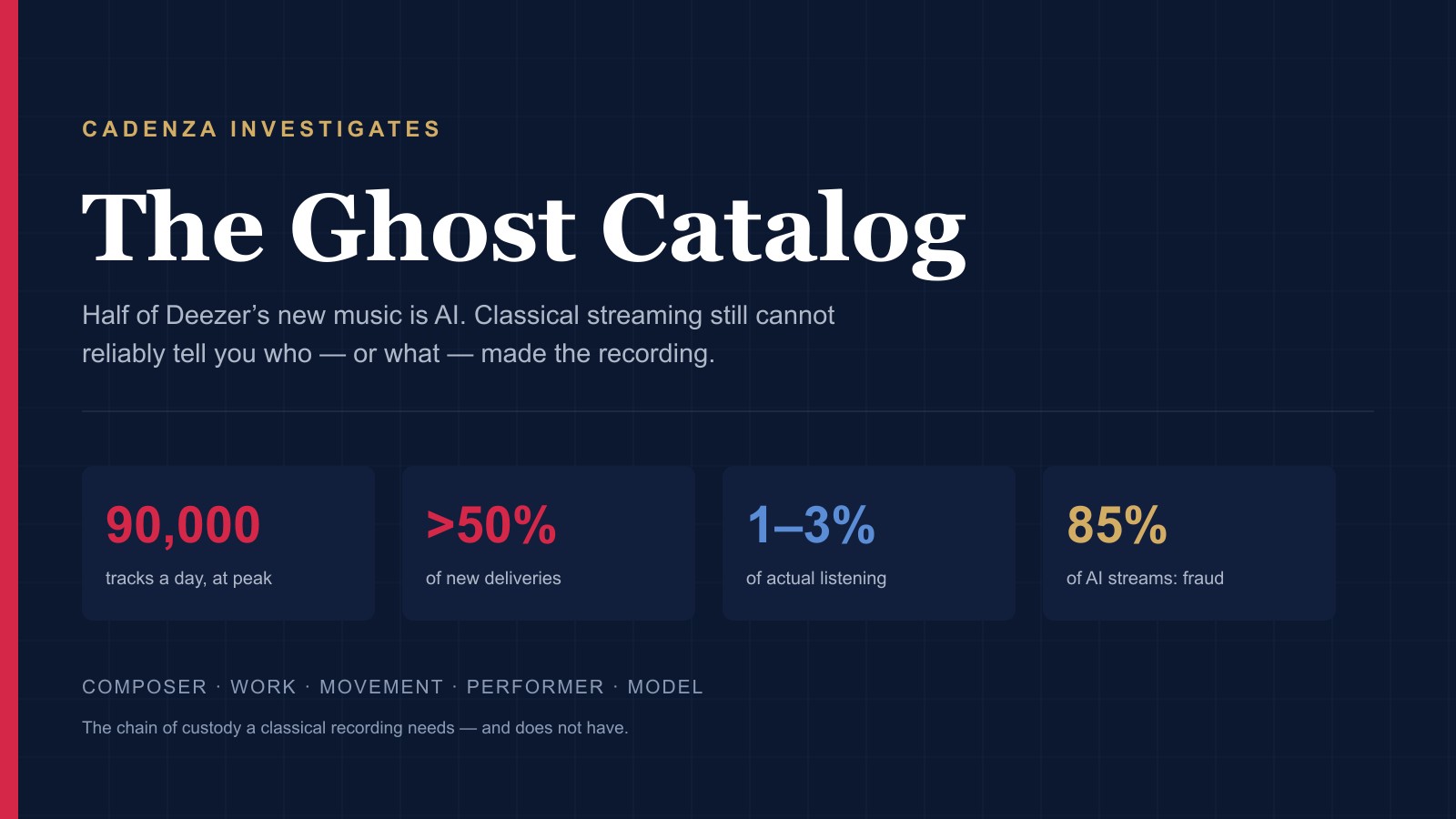
This investigation examines how much of the music arriving at streaming services is now machine-generated, and why classical listeners in particular cannot tell. It rests on platform disclosures and on public catalogue pages observed up to 7 August 2026. Three cautions travel with it. Detection figures are each platform's own and Cadenza cannot independently audit them. “AI-generated” does not mean no human was involved: lyrics, prompts, editing, production and financing can all sit behind a synthetic performance. And the profiles sampled here prove that catalogue volume is achievable — they do not measure how much of any platform's catalogue is synthetic.
What Cadenza found
Deezer’s reported AI intake rose ninefold in seventeen months, from roughly 10,000 tracks per day in January 2025 to 90,000 at the June 2026 peak.12
More than half of new deliveries produced only 1–3 percent of streams. Upload share and listening share describe different systems.
Six public Qobuz profiles explicitly associated with AI displayed 2,919 release entries when checked. The sample proves throughput, not market prevalence.
A public Qobuz profile called “AI Music Channel” placed “Chiptune,” “Pizza Party,” “City Pop” and other titles inside the Classical category.22
Bandcamp prohibits substantially AI-generated music; Tidal labels and demonetizes wholly synthetic recordings; Deezer quarantines them from recommendations; Apple supports delivery metadata; Spotify emphasizes spam, impersonation and credits.
“AI-generated” does not mean “no human made a decision.” Human lyrics, prompts, editing, production and financing can sit behind a synthetic performance. Provenance must identify roles, not declare metaphysical authenticity.
1. The morning the intake pipe flipped
For most of the streaming era, abundance meant digitized history. Record companies delivered back catalogs. Independent musicians gained access to global distribution. Live tapes, archival broadcasts, forgotten regional labels and obscure twentieth-century recordings returned to circulation. The catalog expanded because the cost of storing another file approached zero.
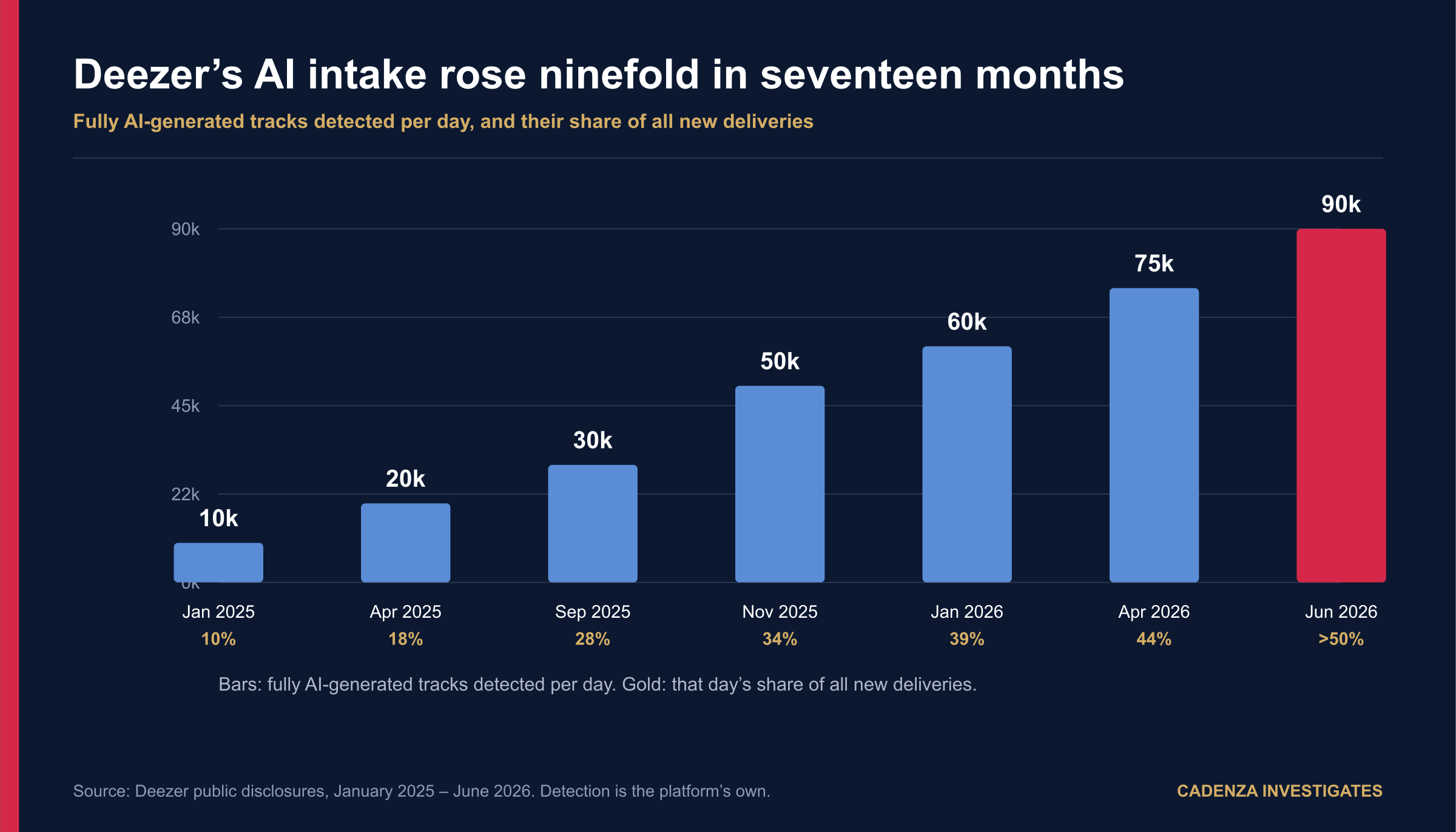
Bars show fully AI-generated tracks detected per day; gold shows that month's share of all new deliveries. Detection is Deezer's own.
Generative music changed the limiting factor. The producer no longer needed a room, musicians, microphones, editing time or even a complete composition before creating a deliverable recording. A prompt could produce a track. Automation could produce many. Distribution services could place them in the same intake queue used by orchestras, labels and working artists.
Deezer’s disclosures provide the clearest public sequence. In January 2025, it detected roughly 10,000 fully AI-generated tracks per day, approximately 10 percent of its daily intake. By April the figure was above 20,000 and 18 percent. September brought more than 30,000 and 28 percent. In November, Deezer reported 50,000 and 34 percent. January 2026 reached 60,000 and 39 percent. April reached almost 75,000 and 44 percent. At the June 2026 peak, the company received approximately 90,000 tracks in a day—more than half of all deliveries.1234567
No known human recording economy expanded ninefold in seventeen months. The number does not describe a musical movement. It describes an industrial capability.
The synthetic intake curve
The dates represent company disclosure points, not a continuous audited time series. “90k” is the reported peak-day level in June 2026; earlier figures were described as daily averages or approximate daily intake.
2. What “half of new music” means—and what it does not
The phrase is explosive because it collapses three different quantities into one.
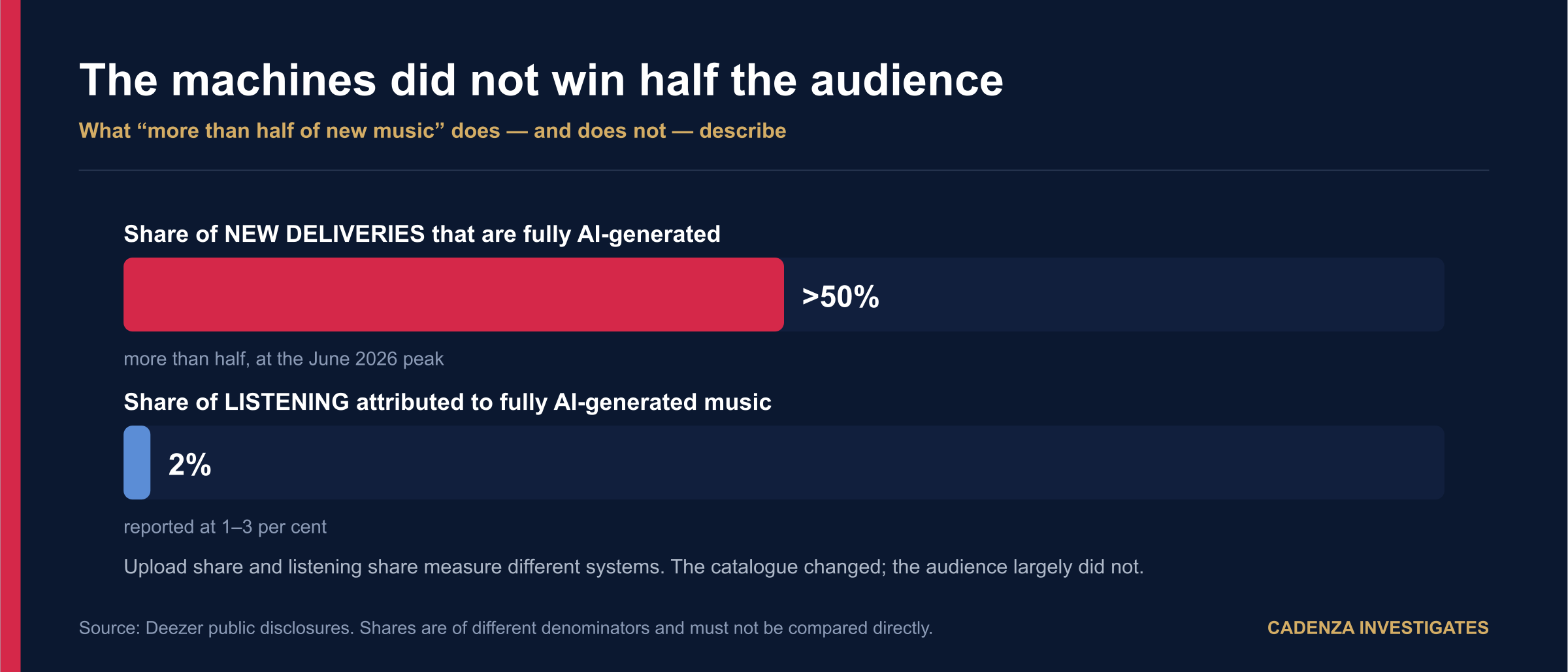
Upload share and listening share are different denominators and must not be read against each other.
Upload share measures what enters the database. It gives one ten-second track the same unit weight as an eighty-minute opera recording. It does not measure duration, audience, cultural importance, revenue or the amount of human labor displaced.
Listening share measures consumption. Deezer places fully AI-generated tracks outside algorithmic recommendations and editorial playlists, which sharply limits exposure. Its reported 1–3 percent therefore describes both listener demand and a platform intervention.1
Revenue share is harder. Deezer removes detected fraudulent streams from royalty calculations. The remaining legitimate AI listening may still receive money depending on rights ownership and the applicable payment system. Public disclosures do not reveal a complete platform-wide sum. The correct conclusion is not that AI has already taken half of music revenue. It is that the infrastructure is processing a synthetic supply shock whose economic effect depends on detection, recommendation and payment rules.
The machines have captured the intake queue, not the audience. That is still consequential: every low-value delivery creates storage, matching, moderation, rights, identity and fraud work that must be performed before a listener hears anything.
3. The human supply did not collapse. The machine supply multiplied.
Deezer publishes both the approximate number of AI tracks and their share of daily delivery. Dividing one by the other produces an implied total intake. Subtracting AI tracks produces an implied non-AI intake. Because every input is rounded, the result is not an audited company metric. It is nevertheless revealing.
Across the first six disclosure points, implied non-AI delivery remained in a broad band of roughly 77,000 to 97,000 tracks per day. The extraordinary increase came almost entirely from the synthetic side. Human and conventional production did not need to shrink for AI to become the majority of new files. The denominator expanded around it.
Derived daily supply: AI versus all other deliveries
Example: 75,000 divided by 44 percent implies about 170,455 total daily deliveries; subtracting 75,000 leaves about 95,455 non-AI deliveries. Figures are rounded to the nearest thousand. The June 2026 peak is excluded because “more than 50 percent” does not provide a precise denominator.
This is the economics of near-zero marginal production. The conventional recording economy can continue at something close to its previous volume while becoming a minority of new database objects. The result resembles email after spam: legitimate communication did not stop, but the receiving system had to assume that most incoming units might be disposable, deceptive or machine-produced.
What that daily flow becomes
The interactive version of this table let readers set their own rate. Held at the June 2026 peak of 90,000 fully AI-generated tracks a day, the arithmetic runs:
| Period | New recordings delivered |
|---|---|
| Every hour | 3,750 |
| Average month | 2,737,500 |
| One year | 32,850,000 |
This is not a forecast. It converts a daily flow into catalogue scale at a constant rate, and assumes nothing about how long that rate holds.
4. The fraud layer
The supply shock alone does not explain why Deezer has taken stronger action than most competitors. The second layer is artificial listening.
In 2025, the company says up to 85 percent of streams on fully AI-generated tracks were fraudulent, compared with 8 percent across its total catalog. Deezer's disclosed fraud rate rose across the period, from up to 70 per cent in September 2025 to up to 85 per cent for 2025 as a whole. Deezer removes detected fraudulent streams from the royalty pool. It also keeps detected AI recordings out of recommendations and editorial playlists.16
AI does not create streaming fraud. Bot networks, account farms, short-track manipulation, identity hijacking and repetitive uploads existed before modern generative music. AI changes the unit economics. A fraudster no longer needs a back catalog, musicians or rights to existing recordings. The production cost of a new asset approaches the price of computation, and the number of identities under which it can be delivered is limited primarily by distributor and platform controls.
This is why the public argument about whether a synthetic song sounds good is secondary. A platform facing 90,000 daily AI tracks is not reviewing 90,000 artistic propositions. It is operating a hostile intake system in which legitimate experiments, industrial filler and fraud can arrive in the same format.
5. What Cadenza audited
Cadenza conducted two related reviews.
The first compared the public AI policies and delivery rules of six services: Deezer, Spotify, Qobuz, Tidal, Bandcamp and Apple Music. We recorded whether each service publicly describes detection, listener-facing disclosure, recommendation controls, blocking, demonetization and treatment of AI-assisted rather than wholly generated recordings.
The second was a catalog stress test, not a prevalence study. We searched public Qobuz pages for profiles whose names, biographies or release labels explicitly identified AI involvement. We did not classify music by listening, artwork, productivity, genre, vocal quality or suspicion. Six profiles with unambiguous public signals displayed 2,919 release entries on August 7, 2026.
A small number of explicit AI-associated suppliers can generate catalog volume at a scale normally associated with decades of human recording activity. It does not prove that 2,919 unique recordings were wholly AI-generated, that the profiles are fraudulent, or that the sample represents Qobuz’s overall catalog.
6. Six profiles, 2,919 release entries
The largest profile, “Jason’s AI Generated Songs,” displayed 927 entries. Its public page sold many in 24-bit/48 kHz format and identified a human composer, Jason Nutter. “SuntyAion” displayed 614 entries; at least one release label explicitly included “#Suno V5” and “#AI Music.” “AI Music Channel” displayed 599. “Thompsxn Therapy,” whose Qobuz biography called it a contemporary AI music artist, displayed 458. “SOULBAND AI” displayed 303. “Eddie Dalton,” described in its biography as a fictional AI-generated singer created by producer Dallas Ray Little, displayed 18.202122232425
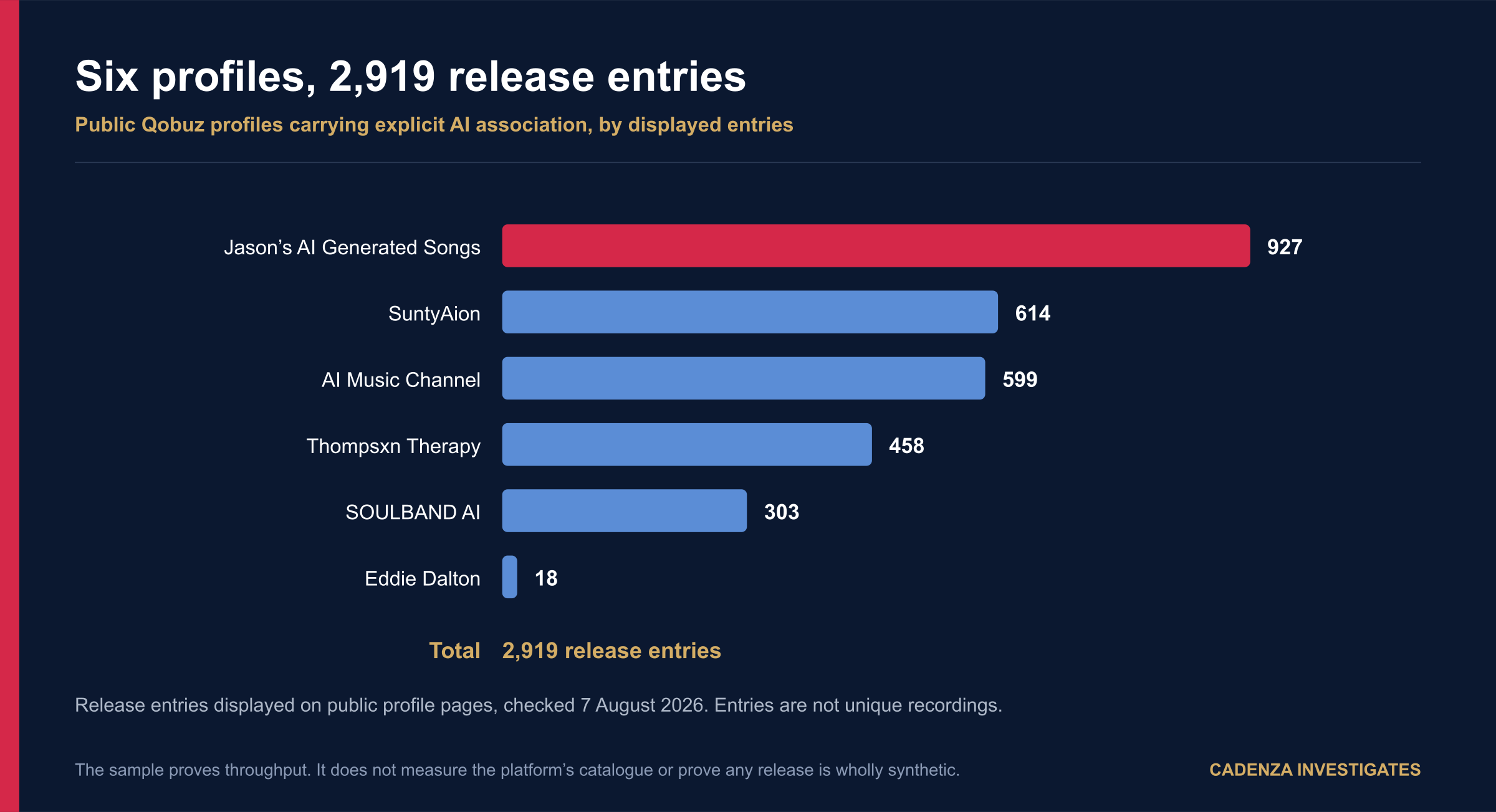
Release entries displayed on public profile pages, checked 7 August 2026. Entries are not unique recordings.
Release entries displayed by six explicit AI-associated profiles
Qobuz labels the metric “album(s),” although the displayed catalogs include singles, albums and other release objects. Cadenza therefore uses “release entries.” Counts are dynamic and may change with new deliveries, merges or removals.
Quantity alone does not establish abuse. A prolific producer can lawfully release large volumes. A synthetic project may be transparent and artistically intentional. The relevant fact is operational: one profile can now deliver in a year what a historical label might have taken generations to record, document and market.
The catalog database treats both histories as a sequence of release objects. Without stronger provenance, scale erases the distinction.
7. Classical music’s metadata fault
Popular music services were built around the assumption that a track has a primary artist and a title. Classical music breaks that model before AI arrives.
A listener searching for Beethoven’s Fifth is not searching for one recording. The relevant identity may include the composer, work number, movement, edition, arranger, orchestra, conductor, soloist, chorus, venue, recording year and label. The same work can have thousands of commercial recordings. One performance may be historically informed; another may use a modern orchestra. A new recording can be valuable precisely because a different human ensemble made different decisions.
Apple built a separate Classical app because ordinary streaming metadata was insufficient. Its interface places the work, orchestra, conductor, contributing artists and recording year in view, while supporting search and libraries organized by composers, works and recordings. At launch, Apple described a catalog of more than five million classical tracks.19
AI adds a new identity axis: the performance itself may not have happened.
A classical recording is not one artist field
Title, catalog number, key, movement, edition and arranger.
Soloist, ensemble, conductor, chorus and instrumental forces.
Date, venue, producer, engineer, label, source and live/studio status.
Which audible performances were generated, transformed or played.
Generator, voice model, stem replacement, restoration and mastering tools.
Sound-recording owner, composition rights, licenses and distributor.
In a pop song, a generated lead vocal may be the obvious provenance issue. In classical music, a synthetic orchestra can perform a public-domain work under a plausible ensemble name. The composer is real. The score is real. The acoustic image may be convincing. The orchestra, conductor and recording session may be fictional.
That combination is unusually difficult for a generic music service. A platform can correctly identify “Mozart” and still fail the basic question: who made this sound?
8. “Classical” is a category, not provenance
The AI Music Channel page provides a blunt example of what happens when delivery metadata enters a storefront without adequate semantic control.
On the page observed by Cadenza, 599 release entries were displayed. Many were classified as Classical. Titles included “Italian pop-2,” “Pops trumpet-1,” “Japanese-style Jazz-1,” “Beer time-14,” “City pop-8,” “Chiptune-19,” “Pizza party-16,” “Autumn song techno-3” and “Motor city disco-3.” Releases from the same profile carried the Classical genre on their own public product pages when checked on 7 August 2026. Qobuz's Classical new-release listings are generated dynamically and cannot be re-checked for a past date.2226
What the Classical category contained
Chiptune-19
Released June 11, 2026; classified as Classical on the public page.
Pizza party-16
Released May 14, 2026; category metadata did not establish musical form or provenance.
Autumn song techno-3
Released March 13, 2026; a genre phrase and a storefront category directly conflicted.
Motor city disco-3
Released April 7, 2026; surfaced inside a field used by listeners to find classical recordings.
Japanese-style Jazz-1
Released April 17, 2026; another title whose declared style diverged from the assigned category.
Italian pop-2
Released March 16, 2026; evidence of intake metadata, not an editorial determination.
The issue is not that a synthetic work cannot be classical. Computer-generated composition has a long history. Human composers can use generative tools within serious work. A genre category should describe music, not police the biology of its maker.
The issue is that category placement can be mistaken for validation. A listener entering a Classical new-releases page reasonably expects a minimum level of catalog coherence. When an industrial feed can assign “Classical” to obvious pop, techno, chiptune and party labels, the category ceases to certify even its own subject matter. It certainly cannot certify provenance.
9. Hi-res is not human
The same public pages repeatedly offered explicit AI-associated releases in 24-bit/48 kHz format. Qobuz’s download store correctly describes the technical container it sells. A 24-bit file can carry a synthetic recording just as accurately as it carries a live orchestra.
The danger is conceptual. Audio quality branding answers: how is the file encoded and delivered? It does not answer: what event produced the sound?
A generated waveform can be exported at high resolution. An old low-resolution source can be upsampled. A genuine orchestra can be poorly documented. Technical fidelity and documentary fidelity are separate axes.
Classical services have spent years persuading listeners that resolution, mastering and recording format matter. They do. The next step is to give provenance the same visual status. A “Hi-Res” badge should never be the most prominent information attached to a recording whose performers are unknown or synthetic.
10. The human inside the machine
A binary article would be easier: real musicians on one side, fake music on the other. The public catalog contradicts it.
Qobuz describes Xania Monet as an AI-generated project created by poet and designer Telisha “Nikki” Jones, who uses Suno to turn original poetry into produced songs. Eddie Dalton is described as a fictional AI-generated singer created by producer Dallas Ray Little. SOULBAND AI’s public credits identify Robert Dignard in composer and related roles. Jason’s AI Generated Songs identifies Jason Nutter as composer.27252420
These examples contain human intent. Someone wrote words, chose prompts, selected outputs, edited material, constructed identities, paid for distribution and decided what to release. The recorded performance may be synthetic while the project remains the product of human decisions.
That does not make the result equivalent to a singer performing a song or an orchestra recording a score. It means the label must describe roles.
The audible performance is substantially synthetic
- Human lyrics or score
- Human prompting and selection
- Generated lead voice or instruments
- Human editing, mixing or mastering
Humans performed the primary expressive elements
- Restoration or noise reduction
- Idea generation or orchestration aid
- Stem repair or limited transformation
- Mastering, translation or workflow support
The distinction announced by IFPI, RIAA and other music organizations in July 2026 follows this logic. Their voluntary system separates “AI-Generated,” where generative AI produced the entirety or primary creative elements of a recording, from “AI-Assisted,” where humans performed the lead vocal and primary instruments but generative AI contributed some expressive elements.15
That is more useful than “real” versus “fake.” It is still incomplete for classical music because it covers sound recordings, not composition, lyrics, video or cover art. A generated orchestral performance of a human composition and a human performance of a generated composition require different labels. One icon cannot explain both.
11. Six platforms, six answers
The industry has not converged on a single rule. The services reviewed by Cadenza occupy distinct positions: quarantine, disclosure, demonetization, prohibition, metadata support or general anti-spam enforcement.
Public platform policy matrix
| Service | Detects / receives disclosure | Listener-facing AI label | Recommendation control | Blocks / removes | Payment restriction | AI-assisted distinction |
|---|---|---|---|---|---|---|
| Deezer | ✓ | ✓ | ✓ | Fraud / inactive | Fraud | No public binary beyond fully AI |
| Spotify | Credits + spam systems | Credit-based | No blanket exclusion stated | Spam / impersonation | No blanket AI rule stated | ✓ spectrum acknowledged |
| Qobuz | ✓ | Rollout announced | ✓ | Fraud / 100% AI policy | Fraud excluded | ✓ charter distinction |
| Tidal | ✓ wholly AI | ✓ | User can block | Fraud / deception | No royalties for wholly AI | Partial AI may remain unlabeled |
| Bandcamp | Reports / review | Not applicable to prohibited content | — | Wholly or substantially AI | Content prohibited | Substantial-use threshold |
| Apple Music | Delivery metadata field | Public display not established by spec | No public blanket rule found | No public blanket rule found | No public blanket rule found | Metadata can carry transparency |
12. Deezer’s controlled quarantine
Deezer has built the most measurable public system in the market reviewed here. It detects fully AI-generated audio, applies an album-level tag, excludes identified material from algorithmic recommendations and editorial playlists, removes fraudulent streams from payments and licenses its detection technology to other organizations. In July 2026 it claimed 99.8 percent detection accuracy, missing approximately two in every thousand AI tracks, with fewer than one false positive per 10,000 human-made tracks.1
The model is neither a ban nor neutrality. It allows listeners to search for synthetic music while preventing the recommendation engine from turning industrial volume into automatic exposure. That distinction explains why more than half of deliveries became only 1–3 percent of listening.
Deezer’s system also reveals a limitation. The tag is applied at album level rather than track level. Deezer does not publish a rationale for that choice; a coarser unit limits false positives, but it also means a mixed album can carry the tag on the strength of some of its tracks. A mixed album can therefore receive a broad label, while a partially AI-assisted recording may fall outside a tool optimized for fully generated output. Detection is strongest when the platform knows the generator’s acoustic fingerprints. Transformation, human overdubs and new models can narrow that advantage.
The company’s numbers are self-reported. Cadenza did not independently test the detector. The disclosure remains valuable because it converts an invisible infrastructure problem into a time series. Most competitors do not provide an equivalent denominator.
13. Spotify’s spam war
Spotify frames the problem less as a category of music than as a set of abusive behaviors: impersonation, profile mismatch, spam and deception.
In September 2025, the company said it had removed more than 75 million spammy tracks during the previous twelve months, a period it described as marked by the explosion of generative AI tools. The figure is not an AI count. It includes spam regardless of production method. Spotify announced stronger rules against unauthorized vocal impersonation, a new spam-filtering system and AI disclosure through industry-standard credits supplied by labels and distributors.9
This behavior-based approach has a rational basis. A human can commit fraud. An AI-assisted recording can be legitimate. A blanket detector can misclassify experimental production or restoration. Removing spam without defining a forbidden aesthetic avoids treating the tool itself as misconduct.
The weakness is listener certainty. Credits depend on upstream disclosure. A service can remove millions of tracks while leaving the surviving listener unable to distinguish a generated performance from a human one. Spam control protects the system; provenance explains the object.
Spotify explicitly acknowledges that AI use is a spectrum. That principle is correct. The unresolved question is whether the resulting credits will be visible, standardized and complete enough for a listener comparing recordings of the same classical work.
14. Qobuz’s implementation gap
Qobuz has adopted some of the industry’s strongest language. Its May 2026 AI Charter says it opposes industrial production designed to saturate catalogs, applies contractual clauses prohibiting delivery of 100 percent AI-generated content and operates a zero-tolerance policy toward AI-generated content and AI-driven streaming activity. In February, it announced a proprietary detector that would analyze new and existing releases, place visible tags across its applications and remove AI-generated content upon detection.1011
On August 7, public Qobuz pages still displayed the six profiles in Cadenza’s sample, totaling 2,919 release entries. Some names and biographies explicitly declared AI. Some entries were available for paid high-resolution download. AI Music Channel releases appeared inside Classical catalog pages.
This is not proof that Qobuz ignored its policy. The company described a staged rollout. Catalog pages can lag internal decisions. Distributors may dispute classifications. A profile can contain a mixture of fully generated and human-assisted material. Detection technology is imperfect, a limitation the charter itself acknowledges.
It is proof of an implementation gap visible to the public: the policy’s stated endpoint and the catalog’s observable state were not aligned on the audit date.
Qobuz’s position is especially important because it sells downloads, not only access. A streaming service can later relabel or remove a file. A purchased download leaves the platform. The store therefore has a stronger reason to provide durable provenance at the point of sale.
15. Tidal, Bandcamp and Apple choose different edges
Tidal: permit, label, block and demonetize
Tidal’s policy, updated July 20, 2026, allows AI-generated recordings but labels those it identifies as wholly generated. Listeners can turn off labeled recordings, removing them from playback and refreshed recommendations. Wholly AI-generated tracks are ineligible for royalties. Fraudulent, deceptive or impersonating material can be blocked or removed. Tidal acknowledges that partially AI-generated recordings may remain unlabeled because its current enforcement threshold is 100 percent generation.12
This is the clearest listener-control model in the audit. It also creates a cliff: a track judged 100 percent generated receives no royalties, while a 99 percent generated track may remain unlabeled. Tidal openly identifies the limitation rather than pretending the boundary is technically clean.
Bandcamp: preserve a human marketplace
Bandcamp prohibits music and audio generated wholly or substantially by AI and prohibits AI impersonation. It invites users to report suspected material and reserves the right to remove music on suspicion of AI generation.13
The policy fits Bandcamp’s direct artist-to-fan identity. A marketplace can choose a narrower product category than a universal streaming utility. Its risk is enforcement fairness. “Substantially” is not self-defining, and suspicion-based removal requires an appeal process capable of protecting electronic, algorithmic and heavily processed human work.
Apple: build the metadata pipe
Apple’s March 2026 music-delivery specification added an <ai_transparencies> tag for disclosure of AI-generated content; an April revision extended the mechanism to music-video singles.14
The specification establishes that suppliers can transmit AI information. It does not, by itself, prove how consistently the field is required, verified or displayed to listeners. A metadata field becomes public accountability only when the platform validates it, surfaces it and penalizes false omission.
16. The missing label is not one icon. It is a chain of custody.
The voluntary industry labels announced in July 2026 are a necessary minimum. “AI-Generated” identifies recordings whose primary creative elements were generated. “AI-Assisted” identifies recordings substantially created by humans with generative AI used for some expressive elements.15
Primary audible creative elements generated
Examples include a generated lead vocal, generated key instrumental performance or an entirely prompt-produced recording.
Primary performance remains human
Humans perform the lead vocal and primary instruments; generative AI contributes limited expressive elements.
Classical music needs more. Consider four recordings sold under the same work title:
A human orchestra plays a human composition, with AI used only for noise reduction. A human orchestra plays a human composition, but one missing instrumental line is generated. A synthetic orchestra performs a human score. A human pianist performs a composition generated by a model trained on historical repertoire.
One binary badge cannot explain those differences. The label must attach to roles: composition, arrangement, voice, instrumental performance, editing, restoration and mastering. The platform must preserve the chain from distributor declaration to storefront display.
17. The royalty-pool question
Streaming represented 69.6 percent of global recorded-music revenue in 2025, more than $22 billion, according to IFPI. Paid subscriptions alone represented 52.4 percent of the market.18
In a conventional pro-rata model, money is divided according to eligible streams after platform deductions and contractual allocations. A fraudulent stream that remains undetected can dilute the value of every legitimate stream. A legitimate synthetic stream creates a different dispute: whether the recording should compete equally, receive a reduced rate, or receive nothing if the audible performance contains no protected human authorship.
There is no universal answer. Deezer removes detected fraud. Tidal denies royalty attribution to wholly AI-generated recordings. Bandcamp prohibits the content category. Other services rely on general rights and fraud rules. These choices alter the market before a court or legislature settles every authorship question.
An illustrative royalty pool
The interactive version let readers vary both inputs. Held at the figures reported in this investigation — fully AI-generated music at 3 per cent of streams, and 85 per cent of those streams identified as fraudulent — a simplified pool divides like this:
| Component | Share of pool |
|---|---|
| Human and non-AI listening | 97.00% |
| AI streams identified as fraudulent | 2.55% |
| AI streams surviving as legitimate | 0.45% |
The figures are illustrative arithmetic on reported shares, not an audited royalty statement.
The calculator exposes the policy leverage. At 3 percent of streams and 85 percent fraud, only 0.45 percent of a simplified pool remains attached to legitimate AI listening before any special payout rule. If a service fails to detect fraud, the gross 3 percent competes with all other recordings. If it demonetizes every wholly generated track, the remaining amount returns to other eligible uses. The technical definition of “wholly generated” therefore becomes a financial boundary.
18. Listeners want disclosure because they cannot reliably infer it
Deezer commissioned Ipsos to survey 9,000 people across eight countries in 2025. Participants heard three tracks—two fully AI-generated and one human-made. Ninety-seven percent failed to identify all three correctly. Eighty percent supported clear labels. Among streaming users, 73 percent wanted to know when a service recommended fully AI-generated music and 45 percent wanted the ability to filter it out. Fifty-two percent opposed placing fully AI songs in main charts alongside human-made music; 69 percent believed payouts should be lower.5
What listeners said
A label is not needed because synthetic music is always inferior. It is needed because audible inference is unreliable and listeners assign meaning to origin. They may care about musicians’ labor, training rights, a fictional persona, live performance, stylistic lineage or the simple truth of the product description.
Disclosure does not dictate the listener’s judgment. It makes judgment possible.
19. The substitution risk is larger than today’s listening share
CISAC’s economic study projects that generative-AI music outputs could reach €16 billion in annual market value by 2028, represent about 20 percent of traditional streaming-platform revenue and 60 percent of music-library revenue. Under the study’s assumptions, 24 percent of music creators’ revenue would be at risk, equal to €4 billion annually and €10 billion cumulatively over five years.17
A market-value forecast, not a prediction of creator income.
Driven by substitution as well as new consumption.
Equivalent to a projected €4 billion annual loss in 2028 under unchanged conditions.
Forecasts are not facts. The model depends on adoption, licensing, regulation, consumer behavior and platform intervention. Deezer’s present data show why intervention matters: synthetic files can dominate intake while remaining a small share of listening when recommendation and fraud controls restrict them.
The most immediate substitution pressure may not fall on celebrity performers. It falls where clients buy functional sound: production libraries, background music, low-budget advertising, meditation catalogs, stock cues, personalized tracks and anonymous mood playlists. Classical music overlaps that market through study music, sleep playlists, “relaxing piano,” cinematic orchestration and generic public-domain repertoire.
The performer displaced first may not be the violinist in a named orchestra. It may be the session musician whose credit was already difficult to see.
20. A provenance standard for classical streaming
The industry’s new AI-generated and AI-assisted labels should become mandatory track-level fields. Classical services should add a richer provenance panel.
The interface should expose the summary without forcing listeners into legal metadata. A badge could open a panel reading: “Synthetic orchestral performance; human composition; prompt and production by [name]; model [name/version]; no live ensemble credited.” A restored historical recording might read: “Human performance; AI-assisted noise reduction only.”
This standard would also protect honest AI artists. A creator using synthetic instruments would no longer need to choose between concealment and a vague warning symbol. Human contributions would receive explicit credit. Listeners could search for generated work, exclude it or evaluate it on its declared terms.
21. What platforms must do now
Distributors must submit generated and assisted status at track level. An empty field cannot mean “human.”
Use detection, upload-pattern analysis, identity checks and audits. Disclosure without enforcement rewards concealment.
Distinguish composition, lead voice, instrumental performance, editing, restoration, mixing and artwork.
Provide visible badges and a filter that affects search, autoplay, radio, recommendations and charts.
Verify new profiles, detect catalog mismatch and require authorization for cloned voices or names.
Rate-limit suppliers, impose quality and identity thresholds, and charge for extreme catalog volume where necessary.
Report daily AI deliveries, catalog stock, stream share, fraud share, removals, appeals and false-positive rates.
Do not allow supplier genre tags alone to place releases in Classical discovery or new-release pages.
Embed declarations in download metadata and receipts so the information survives outside the platform.
Human creators need rapid correction when detectors misclassify experimental, electronic or restored recordings.
22. The catalog cannot remain neutral about its own contents
The first phase of streaming treated every delivered recording as another unit of abundance. That assumption is over.
At 90,000 fully synthetic tracks per day, a platform is not merely hosting more music. It is receiving an adversarial volume capable of overwhelming metadata, discovery, identity verification and payment systems. The fact that listeners consume only a small fraction does not make the intake harmless. It proves that the primary pressure is infrastructural.
Classical music exposes the weakness because its identity was already distributed across many people and many fields. A composer name does not identify a performance. A genre tag does not identify a tradition. A 24-bit badge does not identify a recording event. A plausible orchestra name does not prove an orchestra existed.
The answer is not to prohibit every generative tool. Human artists use AI in materially different ways. Some synthetic projects disclose their methods and contain substantial human writing, editing and production. A platform that erases those distinctions will punish honesty and misdescribe the work.
The answer is provenance backed by enforcement.
Every service should be able to tell a listener whether the lead voice or primary instruments were generated, which humans contributed, which model was used, whether the platform verified the declaration, and whether the recording is eligible for recommendation and payment. Classical services should also identify the relationship between the synthetic performance and the underlying composition.
The industry has spent decades perfecting the delivery of sound. It now has to document the origin of sound with the same precision.
Half of Deezer’s new files may be AI. The more serious fact is that, across much of streaming, the listener still cannot reliably know which half.
Methodology and limitations
- Audit date: Public platform policies and catalog pages were reviewed through August 7, 2026.
- Deezer time series: Figures come from company newsroom releases. The disclosures use rounded counts, approximate shares and different time descriptions, including averages and a June 2026 peak. They are not independently audited by Cadenza.
- Derived non-AI intake: Cadenza divided the disclosed AI count by the disclosed share, then subtracted the AI count. Results are approximations and should not be interpreted as precise company totals.
- Catalog stress test: Profiles were selected only where a public name, biography or release label explicitly indicated AI involvement. Cadenza did not use auditory guessing or visual suspicion. The six-profile sample is purposive and cannot estimate platform-wide AI prevalence.
- Release counts: Qobuz displayed the metric as “album(s),” although pages included singles and other releases. Cadenza calls these “release entries.” Counts are dynamic and may change.
- No fraud allegation: High output, AI use or unusual genre metadata does not establish fraud. This article does not allege that any named profile manipulated streams or violated law.
- Policy matrix: Entries reflect public statements, not confidential systems. “No public rule found” is not evidence that a service performs no internal detection or enforcement.
- Royalty calculator: The interactive model is illustrative. Actual streaming payments vary by territory, contract, service, subscription type, publishing allocation, fraud treatment and payment architecture.
- Terminology: “Fully AI-generated” follows the relevant platform’s stated category. “Synthetic performance” describes generated audible performance and does not deny human prompting, writing, editing or production.
Principal sources
- Deezer, “AI Music Tops 50% of Daily Uploads on Deezer,” July 21, 2026.90,000 daily tracks, peak share, listening share, fraud rate and detector claims.
- Deezer, “Deezer deploys cutting-edge AI detection tool,” January 24, 2025.10,000 tracks per day and 10 percent of delivery.
- Deezer, “18% of all new music … is fully AI-generated,” April 16, 2025.20,000 tracks per day and 18 percent.
- Deezer, “28% of all music delivered … is now fully AI-generated,” September 11, 2025.30,000 tracks, recommendation exclusion and early fraud figures.
- Deezer / Ipsos, AI music survey, November 12, 2025.50,000 tracks, 34 percent and international listener survey.
- Deezer, commercial AI detection announcement, January 29, 2026.60,000 tracks, 39 percent, 13.4 million detected in 2025 and 85 percent fraud.
- Deezer, “AI-generated tracks now represent 44%,” April 20, 2026.75,000 tracks per day, 44 percent and 1–3 percent listening share.
- Deezer, first AI tagging system, June 20, 2025.Album-level labels and recommendation exclusion.
- Spotify, “Spotify Strengthens AI Protections,” September 25, 2025.75 million spam removals, impersonation rules, spam filtering and AI credits.
- Qobuz, “Moves to Protect Artists and Listeners from AI Content,” February 26, 2026.Detection, tagging, recommendation and removal plans.
- Qobuz AI Charter, version dated May 2026.Contractual, editorial, anti-fraud and transparency commitments.
- Tidal AI Policy, updated July 20, 2026.Labels, listener blocking, demonetization, removal and appeals.
- Bandcamp, “Keeping Bandcamp Human,” January 13, 2026.Prohibition of wholly or substantially AI-generated music.
- Apple Music Specification 5.3.26.AI transparency metadata added in March and April 2026 revisions.
- IFPI and partners, generative-AI labeling program, July 10, 2026.Definitions of AI-Generated and AI-Assisted sound recordings.
- IFPI, global chart principles for AI recordings, July 30, 2026.Chart eligibility framework and label distinction.
- CISAC / PMP Strategy AI economic study.2028 market and creator-revenue projections.
- IFPI Global Music Report 2026.2025 global recorded-music and streaming revenue shares.
- Apple, “Apple Music Classical is here,” March 28, 2023.Classical metadata architecture and catalog description.
- Qobuz, Jason’s AI Generated Songs public discography.927 displayed release entries and high-resolution formats.
- Qobuz, SuntyAion public discography.614 displayed entries and explicit Suno / AI release labeling.
- Qobuz, AI Music Channel public discography.599 displayed entries and examples categorized as Classical.
- Qobuz, Thompsxn Therapy public discography.AI-artist biography and 458 displayed entries.
- Qobuz, SOULBAND AI public discography.303 displayed entries and public composer fields.
- Qobuz, Eddie Dalton public discography.Biography identifying a fictional AI-generated singer and 18 displayed entries.
- Qobuz, public Classical new-release pages.AI Music Channel releases surfaced in Classical catalog browsing.
- Qobuz, Xania Monet public biography.Description of a human poet using Suno to produce an AI-generated project.
Methodology. Platform intake and fraud figures are each service's own published disclosures; Cadenza cannot independently audit a platform's detection system and does not claim to. Catalogue observations were made on public pages on 7 August 2026 and record what those pages displayed on that date; pages can change. Release entries are entries as displayed, not verified unique recordings. The royalty and catalogue-scale tables are illustrative arithmetic on reported shares, not audited accounts.
What this investigation does not claim. It does not claim that any named profile is fraudulent, that any specific recording is wholly machine-generated, that the sampled profiles represent any platform's catalogue, or that AI-associated music is displacing human listening at the scale of its upload share. Where a platform's policy is described, it is described as published.
Right of reply. Every platform named here may respond at any time and this article will be updated to carry the response in full. Corrections are welcomed at hello@cadenza.work.
Images. All charts are original Cadenza analysis built from the figures cited in the section they accompany; each states its own source and limitation. The cover is original Cadenza artwork and depicts no person or place.
Related Cadenza coverage.
- Who Really Pays the Musicians? — how public money reaches musicians across Europe and beyond
- Do Not Destroy What Orbán Built — a cultural inheritance after sixteen years
- The Most Dangerous Conductor in the World — state power and the classical institution
- The Composer Did Not Exist — the credit line a 2018 recording cannot explain
- The Bow at the Border — provenance and the chain of title that breaks
Comments
Sign in to join the discussion.