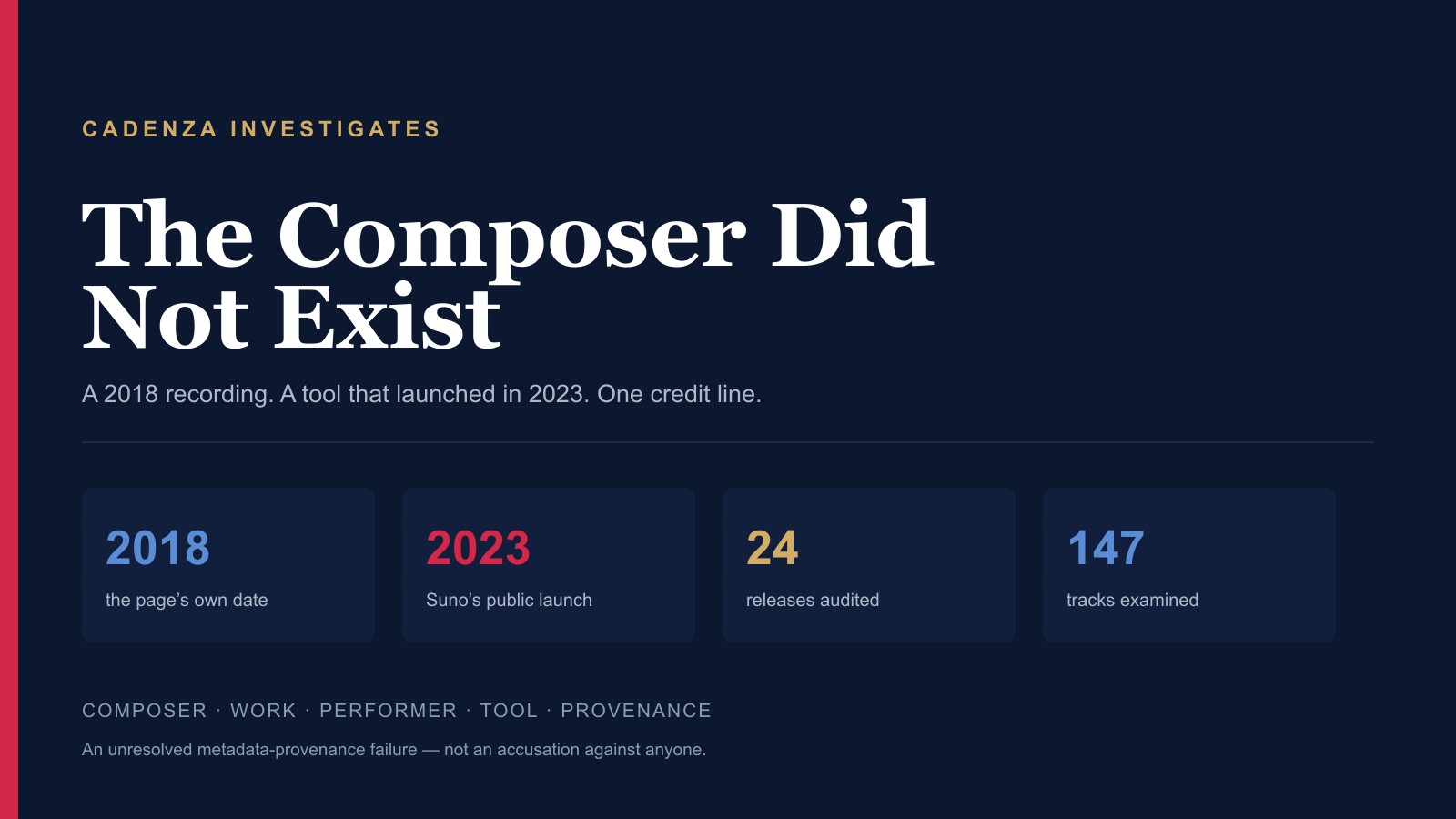
This investigation examines a metadata-provenance failure in classical streaming. Apple Music Classical currently places “AI Generated Content (Suno)” in a composer-line position on Vox Sacra's Ave, a recording the same page dates to 2018; Suno says public music creation launched in 2023. The display therefore cannot describe Suno's participation in the original creation history. Cadenza captured that page on 8 August 2026 and recorded what it showed. Four cautions travel with it, and they are not decoration. This article does not claim that Vox Sacra used AI, that any audio was replaced, that Apple originated the field, that any release is fraudulent, or that the discovery sample measures how much of Apple Music Classical is synthetic. What is established is that a field was displayed as described, on that date, at that URL — and that no public record explains it.
Apple Music Classical credits “AI Generated Content (Suno)” in the composer position of a choral recording released in 2018—five years before Suno says it launched music creation. Cadenza audited 24 search-indexed releases and found a disclosure system capable of naming the machine while failing to tell listeners what it did, when it did it, who supplied the claim or whether the platform verified it.
Cadenza Investigation | 6 August 2026
On 19 October 2018, the American choir Vox Sacra released an album called Ave.
It contained Josquin. Bruckner. Britten. Gesualdo. Górecki.
And, according to the page now displayed by Apple Music Classical, something else.
Immediately above the track Regina Caeli, in the position the service uses to identify a composer, Apple currently displays the words:
AI Generated Content (Suno)
The album page also says the recording was released in 2018 and belongs to Vox Sacra. [S01]
Suno’s own product history says music creation launched through Discord in 2023, before moving to its website later that year. [S02]
The chronology is impossible.
A system launched in 2023 cannot have participated in the original creation of a recording released in 2018.
That sentence is the beginning of this investigation. It is not its conclusion.
The page does not prove that Vox Sacra used artificial intelligence. It does not establish that the audio was replaced, altered or remastered. It does not prove that Apple created the credit. It does not identify the label, distributor, metadata vendor or account that supplied it. It does not show whether a later catalogue update concerned artwork, a derivative version, remastering, restoration, a music video, a contributor record or something else. It does not reveal whether a legitimate attempt at AI disclosure was attached to the wrong recording, wrong track, wrong field or wrong role.
It proves something narrower and more serious.
Apple Music Classical currently displays a composer-line credit that cannot describe the original creation history of the recording beside it.
For an ordinary streaming service, that would be an embarrassing metadata error.
For Apple Music Classical, it strikes at the purpose of the product.
Apple launched the service by declaring that classical music required richer, more exact metadata than ordinary streaming could provide. Its interface was built to distinguish a composer from a conductor, a work from a recording, a movement from a composition, and an orchestra from a soloist. Apple said its extensive metadata would ensure that composers, arrangers, conductors, musicians, producers, publishers and others received the credit they deserved. [S03]
In classical music, metadata is not decoration.
It is the identity of the work.
A recording called Symphony No. 5 becomes intelligible through the composer, orchestra, conductor, soloists, edition, movement order and recording date. Remove or corrupt those fields and the catalogue ceases to describe music. It becomes a warehouse of sound files whose labels cannot be trusted.
That is why the Ave page matters.
It shows that a service built around attribution can display an impossible author.
It can name the machine while misplacing the human.
It can display an act of apparent transparency without revealing the chain of custody behind the claim.
And the problem does not stop with one choir page.
Cadenza’s audit found public Apple Music Classical pages where model names such as Suno, AIVA, Riffusion and Soundraw appear as contributor credits; where multiple models and human names coexist without an explanation of their respective roles; where functional piano catalogues, a medieval-knight rap and other material appear within the classical domain; and where two displayed label strings account for two-thirds of the 24-release discovery sample.
Across those 24 releases, Cadenza recorded 147 tracks and approximately 633.7 minutes of audio—10 hours and 34 minutes. Suno appeared on 19 releases, AIVA on four, Riffusion on four and Soundraw on two. Those counts overlap because one release may name several systems.
This is not a prevalence estimate. It is not a claim that 24 releases represent Apple’s classical catalogue. It is not proof that any named account committed fraud.
It is a provenance audit.
The first finding is an impossible date.
The larger finding is a system without a visible chain of custody.
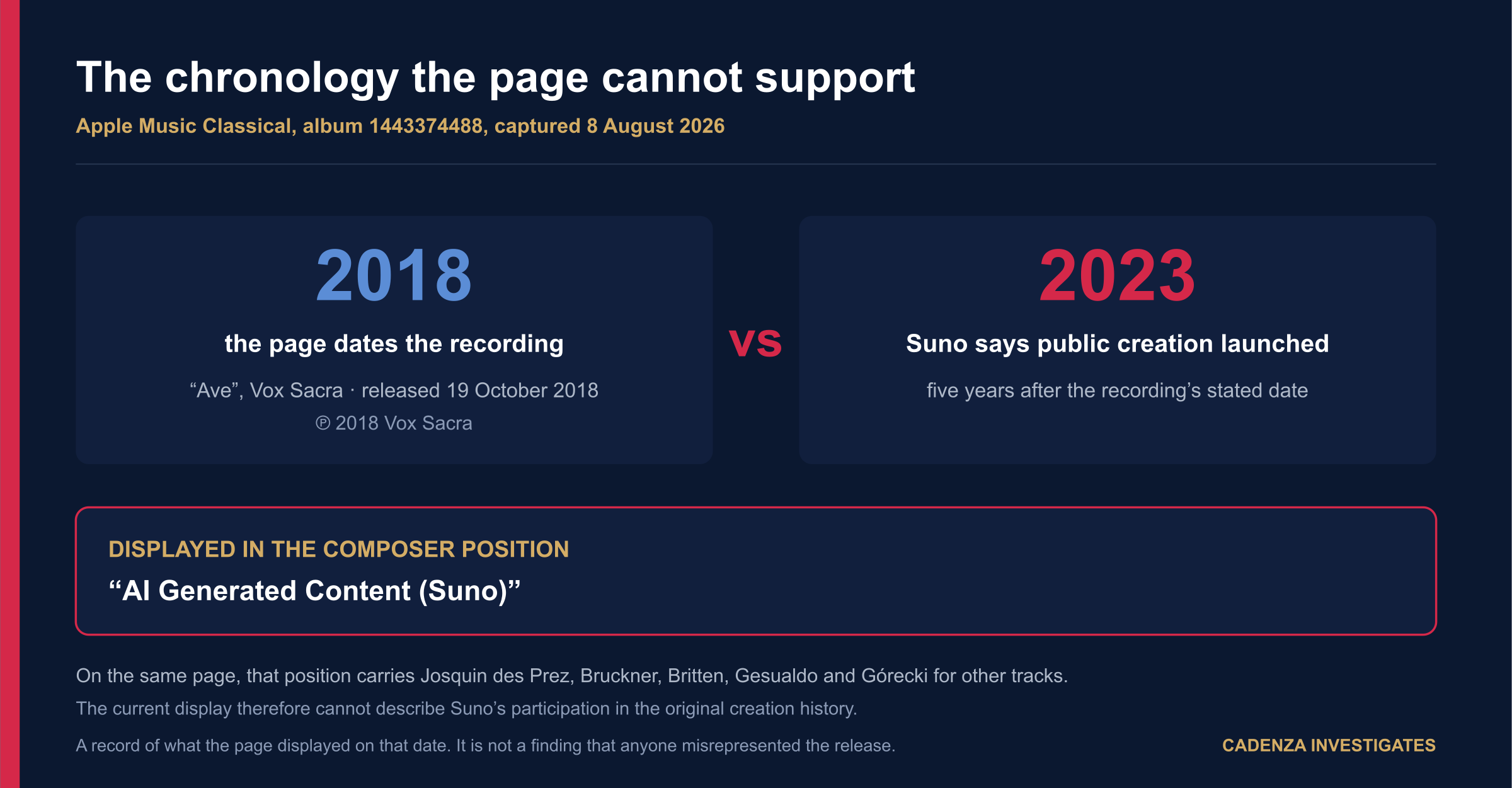
Figure 1. A current composer credit cannot describe the original creation history of a 2018 recording. The chronology establishes a metadata contradiction, not AI use by the choir.
I. THE MACHINE ARRIVED FIVE YEARS LATE
The Ave page gives us unusually valuable evidence because its contradiction does not require an audio detector, an anonymous source or a judgment about whether a choir sounds human.
It requires a calendar.
Apple Music Classical lists:
- Album: Ave
- Artist: Vox Sacra
- Release year: 2018
- Release date: 19 October 2018
- Tracks: 14
- Runtime: 57 minutes
- Copyright line: ℗ 2018 Vox Sacra
- Current display above “Regina Caeli”: “AI Generated Content (Suno)” [S01]
Suno says its music-creation service began in 2023. [S02]
No technical debate can close that five-year gap.
The contradiction has several possible explanations.
A supplier could have attached a new AI-disclosure field to the wrong track identifier. A distributor could have delivered the phrase as an artist or composer name instead of a dedicated transparency field. Apple could have mapped a valid disclosure into an invalid role. A metadata update could have confused a later derivative, replacement, restoration or remaster with the original 2018 master. A catalogue correction could have introduced a new error. An automated normalisation system could have treated a disclosure string as a contributor. Someone could have used Suno in a later version that was then associated with the original album page.
Any of those explanations would be materially different.
None is visible to the listener.
The page does not say:
- who supplied the claim;
- when it was supplied;
- whether it was self-declared by a creator, label or distributor;
- whether Apple detected anything independently;
- whether the phrase refers to the composition, sound recording, artwork, video or another asset;
- whether Apple checked the date conflict;
- whether the field has been corrected or disputed;
- whether it concerns the original 2018 release or a later event.
The listener receives an answer without provenance.
That is worse than no answer because it carries the authority of a platform designed around exact attribution.
A false negative hides AI involvement.
A false or incoherent positive rewrites authorship.
What this page proves
It proves that Apple’s current public metadata is internally inconsistent with the release chronology.
It proves that a named model can occupy the visual space of a classical composer credit.
It proves that the listener-facing page does not provide enough information to reconstruct what that credit arrived to describe.
What this page does not prove
It does not prove that Regina Caeli contains AI-generated audio.
It does not prove that the recording was produced by Vox Sacra with Suno.
It does not prove that Apple originated the field.
It does not prove that Vox Sacra, its conductor, its label or its distributor supplied it.
It does not prove that no legitimate AI-assisted action occurred after 2018.
It does not prove fraud, deception or bad faith by any party.
Until Apple and the relevant supplier explain the field history, Cadenza will describe the anomaly as an unresolved metadata-provenance failure.
Not a synthetic choir.
Not a fake recording.
A public credit that cannot be true in the way it is currently presented.
II. APPLE BUILT CLASSICAL AROUND THE PROMISE OF EXACTNESS
Classical streaming has always exposed the limits of pop-oriented metadata.
A modern pop track may often be located through an artist name and title. A classical recording may involve a work translated into several languages, a catalogue number, a composer, an arranger, a conductor, an orchestra, a choir, multiple soloists, movements, recording dates, competing editions and a century of different interpretations.
Searching for Mahler 5 is not enough when hundreds of recordings exist.
The metadata tells the listener whether the performance is by one orchestra or another, whether the edition differs, whether the conductor is historically significant, whether the movement order is complete and whether the recording belongs to a particular cycle.
Apple understood this problem when it launched Apple Music Classical in March 2023. It presented the service as an answer to the structural failure of ordinary music metadata and emphasised specialised search, complete and accurate metadata, and extensive credits. Apple’s own launch material said that even a solo classical recording is collaborative and that its metadata should ensure everyone receives the credit they deserve. [S03]
That promise raises the standard by which the service must be judged.
A model name shown as a composer is not a cosmetic problem.
It can confuse at least four separate questions:
- Who wrote the underlying composition?
- Who created or performed the sound recording?
- What tool assisted any part of the process?
- Who supplied and verified the disclosure?
Those questions are not interchangeable.
A human composer may use AI to sketch material and then write the score.
A producer may use generative software to create an instrumental layer while the composition remains human-written.
A complete sound recording may be generated from a prompt based on a public-domain composition.
An image model may create the cover while the music is entirely human.
A distributor may attach a model-name disclosure but not explain what the model did.
A platform detector may flag a track even when the supplier did not disclose anything.
When all those possibilities collapse into a phrase placed where the composer belongs, transparency becomes theatre.
The platform appears candid because it says “AI.”
The listener remains unable to understand what happened.
III. APPLE’S NEW AI FIELDS ARE MORE PRECISE THAN THE PAGE WE FOUND
Apple’s music-delivery specification now contains dedicated artificial-intelligence transparency fields.
The specification describes an optional <ai_transparencies> structure. It permits a supplier to identify a material AI-generated portion of:
- Composition
- Track
- Artwork
- Music Video [S04]
Those categories matter.
A composition and a recording are not the same work. A supplier can report that AI affected a composition without saying that the sound recording itself was generated. It can disclose AI-generated artwork without implying anything about the audio. It can distinguish a music video from a track.
The field is optional and may be updated. Apple’s specification says that where the field is omitted, none is assumed. [S04]
That wording reveals both the promise and the weakness of the system.
The fields are more granular than a floating contributor name.
But the system still depends on delivery, mapping and interpretation.
Apple’s public specification tells suppliers what they can send. It does not publicly explain the evidentiary process through which Apple verifies the claim, records who supplied it, preserves a public correction history or reconciles it with dates already present in the catalogue.
Nor does the specification explain why a phrase resembling an AI-disclosure statement appears in a contributor position on the Ave page instead of as a clear, separate transparency label.
Cadenza asked the question that the page itself cannot answer:
What exact field produces the current display, when was it added or updated, and which supplier or internal system is responsible for it?
Until that is answered, no responsible publication should pretend to know which layer failed.
But a responsible platform should already know.
IV. HOW CADENZA CONDUCTED THE AUDIT
This was a discovery audit, not a random catalogue survey.
Cadenza used public search to locate Apple Music Classical pages associated with exact AI-related contributor strings, including:
- “AI Generated Content (Suno)”
- “AI Generated Content (AIVA)”
- “AI Generated Content (Riffusion)”
- “AI Generated Content (Soundraw)”
- generic AI roles or model-name combinations
Results were deduplicated by Apple album identifier. Each discovered page was manually reviewed for the displayed release title, artist, release date, track count, approximate runtime, displayed label, model or AI phrase, contributor position and public URL.
The final sample contains 24 releases.
It represents:
- 147 tracks
- approximately 633.7 minutes of audio
- 19 releases displaying Suno
- 4 displaying AIVA
- 4 displaying Riffusion
- 2 displaying Soundraw
- 1 displaying a generic AI role as recording engineer
The counts are non-mutually-exclusive.
The method has important limits.
Search engines do not index every page. Results can vary by language, country, date and the exact wording of a query. Apple’s catalogue is vastly larger than this sample. Search results reflect what the search engine can discover, not a random draw from the platform. Pages may change after publication. Several runtimes are approximate.
Cadenza did not use an AI detector to classify the 24 releases.
The audit cannot answer:
- how much AI music exists on Apple;
- what share of classical releases is fully generated, partly assisted or merely mislabelled;
- whether any named account committed streaming fraud;
- whether the audio on a sampled page was generated;
- whether the displayed model name came from the artist, label, distributor, metadata vendor or platform;
- whether the service’s public pages display every AI disclosure in its internal data.
The sample therefore answers only these questions:
- What public pages can be found using exact model-name disclosure strings?
- How are those strings displayed?
- What patterns appear among the discovered pages?
- What contradictions or ambiguities are visible without private access?
That is enough to test the integrity of the public record.
V. THE AUDIT: 24 RELEASES, 147 TRACKS, 10 HOURS AND 34 MINUTES
The sample includes single tracks, albums, functional piano releases, choral music, rap, background-music versions and projects whose public metadata names one or more generation systems.
The most frequent phrase was attached to Suno.
But frequency alone tells us very little about the creative process.
A tool name might represent the generator used for an entire track. It might identify one portion of a recording. It might be a supplier’s attempt to comply with a disclosure policy. It might have arrived through malformed metadata. It might be an automated translation or normalisation of a field. It might be a model name supplied as a composer because no better field existed in a delivery system.
The pages do not explain which.
Model names appear as credits, not explanations
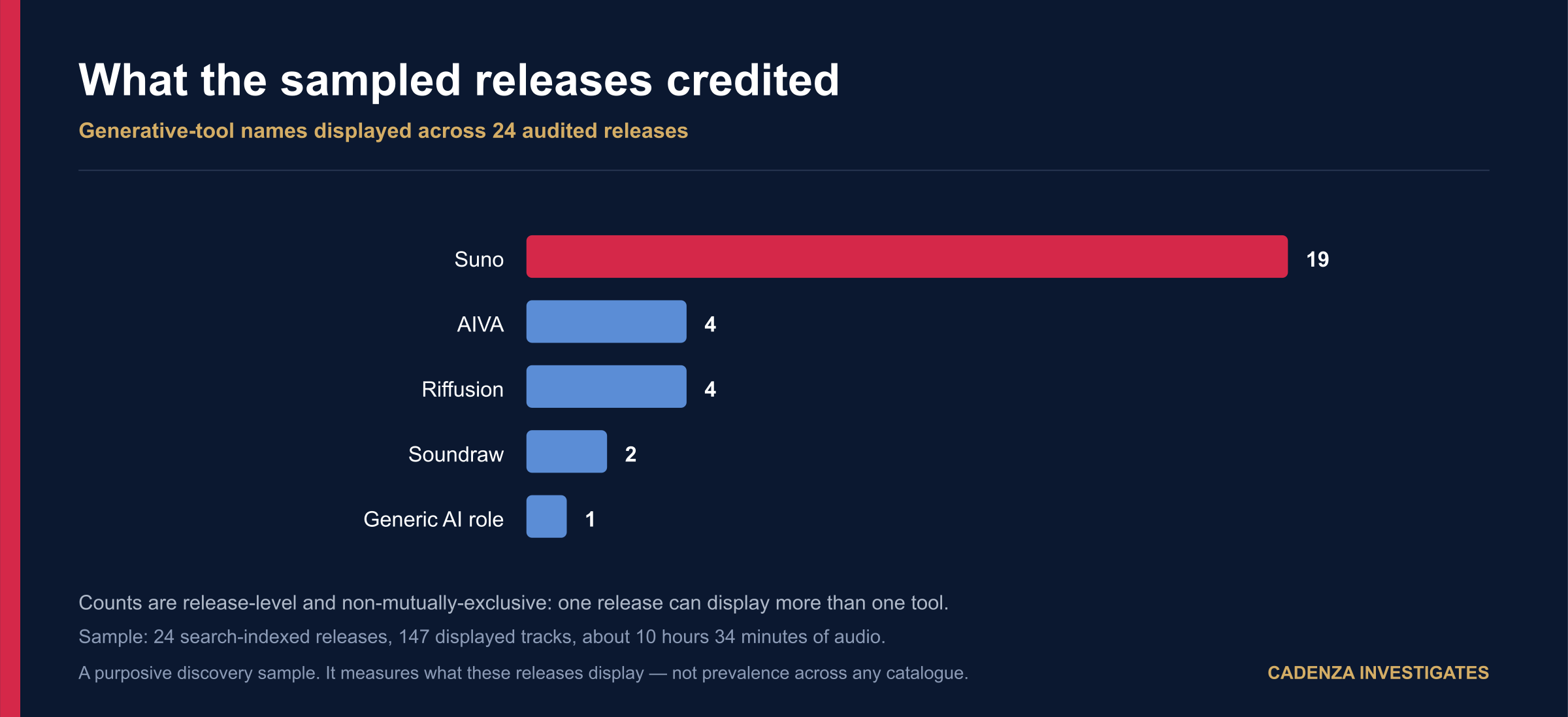
Figure 3. Model-name appearances in the 24-release sample. Counts are release-level and non-mutually-exclusive.
Several pages display more than one model name.
One release in the sample names Suno and Riffusion. Another names Suno and Soundraw. Another names Soundraw and AIVA. Other pages combine Suno, Riffusion and human names.
That is exactly the kind of hybrid production that a single binary badge cannot describe.
What did each system do?
Did one generate a composition and another generate audio?
Did a human rewrite the result?
Were models used at different stages?
Were the names supplied through separate contributor records?
Did a distributor map a disclosure into the role “composer” because the intended transparency field was not supported when the delivery occurred?
The public page does not say.
A model can be credited while the responsible human disappears
When “AI Generated Content (Suno)” occupies the composer position, the system may satisfy an abstract desire for disclosure while erasing the person accountable for the release.
Suno is not the label.
It is not the distributor.
It is not necessarily the rights holder.
It may not be the legal author.
It cannot answer a correction request about a specific metadata package unless it knows which user or distributor created it.
A listener needs the model name only after the catalogue can answer more basic questions:
- Who submitted this recording?
- Who claims the rights?
- Who wrote the composition?
- Who performed or generated the sound?
- Which parts were generated?
- Which humans selected, edited, mixed or approved the result?
- Who is responsible for correcting the record?
Without those answers, a model credit can become a shield.
The machine is named.
The accountable supplier remains invisible.
VI. TWO LABEL STRINGS ACCOUNT FOR TWO-THIRDS OF THE SAMPLE
Two displayed label strings—Kxrl00 and emuze.me—each appear on eight releases in Cadenza’s 24-release sample.
Together they account for 16 releases, or two-thirds of the sample.
They do not account for the same amount of music.
| Displayed label cluster | Releases | Tracks | Approx. minutes |
|---|---|---|---|
| Kxrl00 | 8 | 80 | 401.0 |
| emuze.me | 8 | 20 | 62.3 |
| All other displayed labels | 8 | 47 | 170.4 |
The Kxrl00 cluster contains eight releases issued between 5 November 2025 and 17 April 2026: 80 tracks and approximately 401 minutes over 164 calendar days.
The titles include Afterglow, Goodbye, Longing, Silence, Empty Frames, Fading Light, Silent Rooms and Stillness Within.
Several are attributed to names such as Narevi or Sad Piano Soundscapes. Their public credits name Suno alone or in combination with Riffusion, Soundraw and human contributors.
The emuze.me cluster is different. It contains eight releases but only 20 tracks, including several singles and shorter projects.
This concentration is noteworthy because industrial catalogue production often reveals itself not through one controversial track but through repeated release cadence, consistent metadata patterns and large amounts of functional material.
It is not proof of industrial abuse.
A legitimate human label can publish frequently. An ambient project can release long albums. A distributor can serve many unrelated clients. A company can encourage creators to disclose AI responsibly. A label string can represent a delivery service rather than an artist owner.
Cadenza therefore makes no allegation of fraud against Kxrl00, emuze.me or any named artist in the sample.
We report concentration because the platform’s public metadata provides no context for it and because platform policies increasingly treat volume, repetition and unusual streaming patterns as relevant risk signals.
TIDAL’s policy, for example, says high-volume uploads can be part of fraudulent activity, while Deezer says it removes fraudulent AI tracks and has developed dedicated detection and tagging. [S05][S08]
A risk signal is not a verdict.
It is a reason for platforms to know who is delivering the catalogue, how the credits were created and whether the declared provenance is coherent.
VII. WHY IS A MEDIEVAL RAP INSIDE THE CLASSICAL DOMAIN?
The public pages in the sample are not limited to recordings that a listener would ordinarily call classical music.
They include:
- functional “sad piano” releases;
- background-music versions;
- a track called Zbyszko z Bogdańca - Medieval Knight Rap;
- titles associated with motivational or ambient listening;
- projects with short catalogue-like names;
- releases whose metadata gives the impression of being optimised for mood, study or sleep categories.
This does not prove that Apple’s human editors selected them for a classical playlist.
It does not prove that Apple internally categorises every page as classical in the same way.
It does prove that public pages on the classical.music.apple.com domain can surface material whose genre relationship to classical music is not explained.
That matters because classical services depend on controlled work identities, composer authority files and genre-specific metadata. If supplier-declared genre fields can route mass-produced functional music into the classical domain, the service risks becoming a second ordinary catalogue wearing a specialist interface.
The key question is not whether one medieval rap is artistically legitimate.
The question is:
Who validates the metadata before it reaches the listener’s specialised classical service?
Cadenza has asked Apple how it distinguishes deliberate crossover pages from supplier genre errors, automated catalogue inclusion or search-indexed pages that do not reflect editorial classification.
VIII. THE METADATA IS NOT CONFINED TO ONE APP
Apple Music Classical is not the only public surface on which these credits appear.
Cadenza found Apple-owned Shazam pages where “AI Generated Content (Suno)” is displayed as a composer for material associated with the Kxrl00 label string.
We also found automatically generated video pages and public music metadata carrying model names through distribution chains.
That cross-platform appearance suggests that at least some of the strings may exist upstream in supplier metadata rather than having been invented uniquely by the Apple Music Classical interface.
It does not identify the first sender.
A distributor may have received the field from a creator. A platform may have normalised it. A metadata vendor may have reused a contributor record. A label account may have delivered one package to several services. One platform’s mapping can still differ from another’s.
The important point is that metadata propagates.
An error delivered once can become an apparent fact everywhere.
A release can acquire a machine “composer” across multiple services, search engines and public databases. Once indexed, the error may outlive the correction. Researchers, journalists, royalty systems and future machine-learning models can ingest it as evidence.
The industry is treating AI disclosure as a labelling challenge.
It is also an archival challenge.
A label without history can pollute the historical record.
IX. THE FLOOD IS REAL
The provenance failure matters because the volume has changed.
In January 2025, Deezer said it was receiving approximately 10,000 fully AI-generated tracks per day, around 10 per cent of daily deliveries.
By April 2025, the figure exceeded 20,000 and 18 per cent.
By November 2025, it exceeded 50,000 and 34 per cent.
In April 2026, Deezer reported approximately 75,000 per day and 44 per cent.
At the June 2026 peak, the company said fully AI-generated tracks exceeded half of all daily new deliveries, with a monthly average of approximately 90,000 per day. Deezer said it detected and tagged more than 13.4 million AI-generated tracks in 2025. [S05]
That is a ninefold increase in roughly seventeen months.
Deezer says fully AI-generated tracks still account for only 1 to 3 per cent of listening on its service. The upload problem is therefore not primarily a story of mass listener preference.
It is a story of catalogue pressure.
One person can generate, title, package and deliver far more recordings than a conventional studio workflow permits. Public-domain classical repertoire is especially exposed because composition rights may have expired while new sound recordings can still be generated at scale. Functional categories—sleep, focus, study, calm piano and background strings—require no visible performer and often receive passive listening.
The economics reward cheap abundance even when audience demand is thin.
Every upload creates work for ingestion systems, fraud systems, search systems, royalty systems and metadata systems.
When the volume reaches tens of thousands per day, optional disclosure alone cannot preserve trust.
The platform needs at least three layers:
- Supplier declaration — what the creator, label or distributor says happened.
- Independent detection and behavioural monitoring — what the platform observes in the audio, account and streaming pattern.
- Auditable provenance — who supplied the information, when it changed and how disputes were resolved.
Most current systems publish fragments of the first two.
Almost none show the third to listeners.
X. AI MUSIC IS NOT THE SAME AS FRAUD
The most dangerous shortcut in this debate is to treat “AI-generated” and “fraudulent” as synonyms.
They are not.
A musician may use a model as a compositional instrument. A disabled creator may use generative tools to perform ideas they could not physically execute. A filmmaker may commission functional music made with AI and disclose it honestly. A producer may generate texture, rewrite it, hire performers and release a hybrid work. A label may distribute fully generated music under a clear name without manipulating streams or impersonating anyone.
None of those acts is automatically fraud.
Fraud requires deception, manipulation or another prohibited act.
Likewise:
- high release volume does not prove automation;
- anonymity does not prove a false identity;
- a model credit does not prove full generation;
- a public-domain composition does not make a new recording unlawful;
- an AI detector’s output is not a legal judgment;
- the absence of a disclosure does not prove human production.
The industry needs those distinctions because overbroad enforcement can damage legitimate artists.
A platform that hides every disclosed AI-assisted track may punish the creators who were most honest.
A platform that treats a detector as infallible may remove human recordings.
A service that refuses royalties to any work involving AI may erase human contributions within hybrid production.
Transparency must therefore become more granular, not more punitive by default.
The question is not simply:
Was AI used?
It is:
What was generated, by which system, under whose direction, at what stage, with what human contribution, and who stands behind the release?
XI. THE PLATFORM POLICIES DO NOT YET DESCRIBE THE SAME THING
The major services are moving in different directions.
| Platform | Disclosure path | Listener-facing scope | Enforcement or consequence | Core limitation |
|---|---|---|---|---|
| Apple Music | Optional supplier-delivered metadata | Composition, Track, Artwork, Music Video | Public ranking or royalty policy not specified in the delivery document | Omission means none is assumed; observed model names can still appear as contributor strings |
| Deezer | Detection plus listener tag | Fully AI-generated tracks | Exclusion from algorithmic recommendations; fraudulent AI removal and demonetisation | Model coverage and detection limits are not a universal provenance record |
| Spotify | Artist, label or distributor disclosure through DDEX plus spam controls | Contribution-specific song credits | Spam and impersonation enforcement; no blanket penalty for honest AI disclosure | Spotify says absence of a credit does not mean AI was not used |
| Qobuz | Supplier fields plus detection and monitoring | AI-generated content and trusted metadata | Human editorial curation; seeks to exclude industrial AI and fraudulent catalogues | Qobuz acknowledges detection technologies are imperfect |
| TIDAL | Distributor disclosure plus platform identification | Wholly or substantially AI-generated | Wholly AI-generated music not monetizable; fraud or high-volume abuse may trigger removal | Platform identification and definitions may change as detection improves |
These policies reflect real philosophical differences.
Deezer pairs detection with labelling, recommendation exclusion and fraud controls. It says up to 85 per cent of streams on fully AI-generated tracks in 2025 were fraudulent and demonetised, compared with 8 per cent across its catalogue. [S05]
Spotify emphasises artist protections, spam removal and contribution-specific credits. It says it removed more than 75 million spammy tracks in the twelve months before September 2025. It also states plainly that because its disclosure approach depends on artists and distributors, the absence of a credit does not mean AI was not used. [S06]
Qobuz places human editorial authority at the centre and says it opposes industrial production of fully AI music. It is deploying supplier fields and detection while acknowledging that no reliable solution identifies all AI content with certainty. [S07]
TIDAL says it will tag music it identifies as AI-generated, expects distributors to disclose it and will not knowingly attribute royalties to music it identifies as wholly AI-generated. Its policy also says fraudulent activity can include high-volume uploads or unusual streaming. [S08]
Apple’s published specification is focused on metadata delivery rather than a broad public policy on ranking, monetisation, recommendations or correction.
The policies do not even use one stable definition.
“Fully AI-generated.”
“AI-Generated.”
“AI-Assisted.”
“Wholly AI-generated.”
“Substantially AI-generated.”
“Material portion.”
“Contribution-specific.”
A track can move from one service to another and receive a different label, different treatment or no label at all.
The industry has started to respond with standards.
In July 2026, IFPI, RIAA and partner organisations announced voluntary track-level labels distinguishing AI-Generated from AI-Assisted sound recordings. Their proposed system is deliberately limited to the sound recording and does not yet cover composition, lyrics, music videos or cover art. [S10]
That is a useful starting point.
It is not provenance.
A standard tells suppliers which box to tick.
Provenance tells the public who ticked it, what evidence supported the declaration and what changed later.
XII. SELF-REPORTING BREAKS AT THE HANDOFFS
The path from a prompt to a listener can include at least five actors:
- the creator or account operating the generator;
- the label or rights holder;
- the distributor or metadata service;
- the platform’s ingestion, mapping and detection systems;
- the listener-facing application.
A disclosure can fail at each handoff.
A creator may honestly write “made with Suno.”
A distributor form may ask for a composer but provide no dedicated AI field.
A label may convert a disclosure into an artist name.
A metadata package may place it inside an <artist> or contributor block with the role “Composer.”
A platform may faithfully display the malformed field.
A later specification may introduce a correct transparency tag without migrating older catalogue data.
A correction may be made on one service but not another.
Spotify states the weakness plainly: disclosure depends on artists and distributors, and the absence of a credit does not mean AI was not used. [S06]
Apple’s specification likewise treats AI transparency as optional supplier metadata. [S04]
TIDAL says distributors are responsible for identifying AI content before delivery, while also describing its own scanning and labelling as best-effort and potentially inaccurate. [S08]
Qobuz says it is deploying dedicated supplier fields and detection while acknowledging grey areas. [S07]
Every platform therefore depends on actors it does not fully control.
That is not an excuse for opaque display.
It is the reason an audit trail is necessary.
A trustworthy label should carry, internally and where appropriate publicly:
- the declaring party;
- the date of declaration;
- the relevant asset or contribution;
- the model or tool, where supplied;
- whether the label was self-declared or platform-detected;
- the confidence or review status;
- the correction history;
- the responsible rights holder or distributor.
Without those fields, platforms cannot reliably distinguish an honest disclosure from a malformed credit.
Listeners cannot distinguish either.
XIII. DETECTORS CAN FIND THE NOISE—SOMETIMES
The industry is not limited to self-reporting.
A July 2026 research paper, Finding the Noise: Zero-shot AI Music Detection, describes methods that identify generator-specific acoustic artefacts—patterns the researchers call “fakeprints.” [S09]
The results show both the promise and the danger of detection.
On the paper’s PopularAISet benchmark, one-class detection accuracy at a 1 per cent false-positive-rate threshold reached:
| Generator | Zero-shot accuracy at 1% FPR |
|---|---|
| Suno | 99.8% |
| Riffusion | 99.6% |
| Udio | 96.4% |
| ElevenLabs | 77.5% |
| Mureka | 14.9% |
| Mubert, in the tested Echoes subset | 0.0% |
The authors themselves caution against treating the method as universal.
Models evolve. A detector trained on one generation of a service may not recognise the next. Post-processing can alter artefacts. Hybrid works contain both human and generated material. A false-positive rate acceptable in a laboratory can become intolerable when applied to tens of millions of human recordings.
At catalogue scale, even one false positive in ten thousand can accuse thousands of legitimate tracks.
Detection should therefore complement provenance, not replace it.
A detection system might say:
This audio resembles outputs of a known model.
It cannot by itself say:
This rights holder intentionally deceived the platform, this person wrote no part of the work, this metadata field was supplied by this distributor, or this recording should lose royalties.
Those are different evidentiary questions.
The Ave anomaly demonstrates the inverse problem.
A page can carry an explicit AI claim even when the chronology makes that claim incoherent in its current position.
Detection finds hidden signals in audio.
Provenance tests whether the story attached to the audio makes sense.
The industry needs both.
Cadenza used neither detector output nor sonic judgment to classify the 24 sampled releases.
This audit resembles outputs of a known model.
It cannot by itself say what the audio is.
XIV. THE STRONGEST CASE FOR AI CREATORS
A fair investigation must present the strongest defence of the creators and distributors whose work appears in this new catalogue.
The defence is substantial.
Generative tools are instruments.
They can reduce production costs, permit experimentation and give non-performers access to sound. A person may write lyrics, design a prompt structure, select outputs, edit sections, arrange a form, add human vocals, mix stems and master the result. Treating that work as equivalent to pressing one button may itself be insulting.
High output can reflect genre convention rather than fraud. Ambient labels have long released frequent, long-form projects. Production libraries are built around scale. A distributor serving independent users may process many unrelated releases. Functional music often uses repetitive titles because the listener searches by mood rather than personality.
Creators may also have been forced into awkward metadata because platform and distributor fields were not designed for AI provenance.
Before Apple introduced its dedicated AI transparency structure, a distributor seeking to disclose the use of Suno may have placed the information in a contributor field. That would be clumsy but arguably more honest than concealing it.
A model name in the composer position may therefore be evidence of transparency attempted through an inadequate system.
That possibility strengthens Cadenza’s argument.
A system that forces an honest creator to impersonate a composer called “AI Generated Content (Suno)” is not transparent.
It is broken.
The correct structure should be able to say:
- A human wrote the lyrics.
- Suno generated the first audio draft.
- A human edited the arrangement.
- Riffusion generated one texture.
- Human performers replaced the main line.
- A named producer mixed and mastered the track.
- A named rights holder released it.
- A named distributor supplied the metadata on a specific date.
The listener should see that chain without having to infer it from a list of names.
Granularity protects human creativity inside AI-assisted work.
Opacity erases it.
XV. THE COPYRIGHT FIGHT IS ALREADY IN COURT
The metadata crisis is unfolding while the legal status of generative-music models remains contested.
On 31 July 2026, a Munich court ruled at first instance in favour of the German collecting society GEMA in its case against Suno. GEMA said the court found infringement concerning training, storage and reproduction involving works in its repertoire. Suno has disputed the ruling and the decision can be appealed. [S11]
That case concerns training and reproduction claims under applicable copyright law.
It does not determine the authorship or legality of every Suno-assisted release.
It does not decide whether the Ave page contains AI-generated audio.
It does not establish who supplied Apple’s composer-line credit.
But it shows why attribution cannot be improvised.
If courts, collecting societies, labels and creators are disputing what models learned from and what outputs reproduce, platforms need metadata capable of answering:
- who made the claim;
- what rights were asserted;
- what source material was used, where known;
- what human authorship is claimed;
- whether the work is fully generated or assisted;
- whether the recording contains an authorised voice or style imitation;
- which territory’s legal rules may apply.
A floating “AI Generated Content” composer credit cannot carry that weight.
XVI. WHAT APPLE AND THE INDUSTRY MUST NOW DO
The current system is not beyond repair.
But the repair requires more than an icon.
1. Separate authorship from tool use
A generator should never occupy the composer field unless the platform is prepared to defend that classification as an authorship claim.
AI participation should appear in a distinct, structured section.
At minimum, the interface should separate:
- composition;
- lyrics;
- performance or generated voice;
- instrumentation;
- sound recording;
- arrangement;
- production and post-production;
- artwork;
- music video.
2. Show the source of the disclosure
Listeners should be able to distinguish:
- self-declared by the creator or rights holder;
- delivered by a label or distributor;
- detected by the platform;
- confirmed after review;
- disputed or corrected.
A platform-detected label is not the same as a supplier declaration.
3. Preserve dates and correction history
The Ave anomaly would be far easier to resolve if the public record showed:
- the original metadata delivery date;
- the date the AI field was added;
- the supplier responsible for the update;
- whether the audio asset changed;
- whether a correction was made;
- whether the audio asset was reidentified or replaced.
A 2018 release with a 2026 disclosure may be legitimate if the disclosure concerns later replacement artwork, a derivative recording or a corrected historical record.
The dates must make that legible.
4. Keep a responsible human or legal entity visible
Every release should identify a rights holder, label or distributor capable of responding to a correction.
The model name cannot be the endpoint of accountability.
5. Build a classical-specific metadata audit
Apple should scan the Apple Music Classical catalogue for:
- model names used as composers;
- AI phrases attached to releases predating the named tool;
- genre mappings that place clearly non-classical material inside the specialist domain;
- duplicate contributor identities;
- inconsistent AI credits between Apple Music and Apple Music Classical;
- disclosures that do not distinguish composition from recording.
6. Give artists a fast correction route
A performer or composer who discovers an impossible AI credit should be able to report it before release and after publication.
The complaint should propagate to every Apple surface, not remain trapped in one app.
7. Require distributors to support structured disclosure
Optional fields are meaningless if distributor dashboards do not expose them.
Every distributor delivering to major services should support the same structured AI categories and preserve the declaring party’s identity.
8. Publish genre-level transparency reports
Platforms should disclose, by broad genre:
- the number and share of new uploads declared as fully generated;
- the number declared AI-assisted;
- the number removed for fraud;
- the number corrected after dispute;
- the number of false positives identified;
- the number of suppliers repeatedly delivering malformed or contradictory metadata.
Classical music should not be hidden inside a global aggregate dominated by pop and functional audio.
9. Do not punish honest disclosure
A platform should not automatically suppress every track that transparently reports AI assistance.
Enforcement should target deception, impersonation, rights violations, fraud and catalogue abuse—not candour.
10. Correct the impossible page
Apple should investigate the Regina Caeli credit, identify the field and supplier responsible, and correct the display if it cannot be substantiated.
Apple should also notify Vox Sacra and preserve a correction history.
XVII. WHAT THIS INVESTIGATION DOES NOT CLAIM
Cadenza’s findings must not be expanded beyond the evidence.
We do not claim that Vox Sacra used Suno in 2018.
We do not claim that the audio of Regina Caeli is AI-generated.
We do not claim that Apple knowingly created a false credit.
We do not claim that Apple’s dedicated AI transparency field caused the display.
We do not claim that every page in the 24-release sample accurately describes the underlying production.
We do not claim that every displayed model credit is wrong.
We do not claim that Kxrl00, emuze.me or any named artist committed fraud.
We do not claim that high release volume is unlawful.
We do not claim that AI-generated music is inherently fraudulent, artistically worthless or legally unprotected.
We do not claim that detector results are infallible.
We do not claim that the current German ruling determines the legal status of every Suno output in every jurisdiction.
We claim the following:
- Apple Music Classical currently places “AI Generated Content (Suno)” in the composer position above a track on a 2018 album.
- Suno says its public music-creation service launched in 2023.
- The displayed chronology therefore cannot describe Suno’s involvement in the original 2018 creation of that recording.
- Apple’s public page does not reveal who supplied the claim, when it was added, what part of the work it concerns or whether Apple verified it.
- Cadenza found 24 search-indexed Apple Music Classical releases in which model names or generic AI phrases appear as public contributor metadata.
- Two displayed label strings account for 16 of those releases, while one cluster represents 80 tracks and approximately 401 minutes in 164 days.
- Several public pages contain ambiguous combinations of voluntary disclosure, distributor metadata, model names and human contributors.
- The sample does not measure catalogue prevalence or prove fraud.
- A trustworthy system requires provenance, not merely a label.
Those findings are sufficient.
XVIII. THE CREDIT IS THE RECORD
There is a comforting version of the AI-music story.
In that version, platforms will add a badge.
Listeners will know what is synthetic.
Human musicians will be protected.
Fraud will be removed.
The catalogue will remain intelligible.
The Ave page destroys that comfort.
It shows what happens when a label arrives without a history.
The platform can say “Suno” and still tell the listener almost nothing.
It can name the machine while misplacing the author.
It can display an act of apparent transparency that chronology renders impossible.
Classical music is unusually equipped to expose this failure because its catalogue depends on dates, works and attribution. A composer who died in 1896 cannot have written a work with a model released in 2023. A recording made in 2018 cannot contain a system’s original participation five years before the system existed. Metadata is where those impossibilities should be caught.
Instead, the metadata created one.
The industry is preparing for a world in which half of new uploads may be generated by machines.
Its first obligation is not to guess perfectly which sounds are synthetic.
It is to stop turning unverified strings into authorship.
A catalogue is a public record of what culture made.
On Apple Music Classical, beside Regina Caeli, that record currently names a composer that did not exist.
METHODOLOGY
Discovery sample
Cadenza used public search to locate Apple Music Classical pages containing exact AI-related contributor strings. Results were deduplicated by Apple album identifier. Each page was manually reviewed for title, artist, displayed date, track count, runtime, label, model or AI phrase, contributor position and URL.
The sample was frozen on 6 August 2026.
What the sample measures
The sample measures publicly discoverable metadata displays and patterns within those discovered pages.
It does not measure the prevalence of AI-generated music on Apple Music Classical because the sample is not random and public search does not index the whole catalogue.
Runtime and track totals
Track totals were taken from public release pages. Runtime totals are approximate, particularly where several singles displayed duration information rather than an album total. The aggregate is reported to one decimal minute and should not be treated as royalty-grade usage data.
Tool appearances
Tool counts are release-level and non-mutually-exclusive. A release naming Suno and Riffusion contributes one appearance to each total.
A tool appearance is not a determination that the release was fully generated by that tool.
Label clusters
Labels are reported exactly as displayed on public pages. A shared label string does not establish common ownership, a single uploader or wrongdoing.
Audio analysis
Cadenza did not use an AI detector to classify the 24 releases. The investigation concerns public provenance metadata, not a sonic verdict.
Cross-platform review
Where relevant, Cadenza reviewed public Shazam, YouTube, Spotify, Amazon, distributor and artist pages to test whether release and contributor information appeared elsewhere. Cross-platform consistency can suggest upstream metadata propagation but does not identify the originating sender.
Legal and editorial standard
Every named entity is invited to respond before publication. The draft distinguishes established public facts, Cadenza’s calculations, reasonable inferences and unanswered questions. No inference about fraud, rights ownership or the underlying audio is presented as fact.
SELECTED AUDIT TABLE
| Date | Release | Artist | Tracks | Displayed label | Public AI/tool credit | Cadenza classification |
|---|---|---|---|---|---|---|
| 19 Oct 2018 | Ave | Vox Sacra | 14 | Vox Sacra | Suno | Impossible chronology / unresolved provenance |
| 15 Oct 2024 | Demon | Corsi | 1 | emuze.me | Suno | Search-indexed discovery sample |
| 1 Aug 2025 | Lacrimosa (BGM Version) | Tim Brady | 13 | 2M Music | AIVA | Search-indexed discovery sample |
| 5 Nov 2025 | Afterglow | Narevi | 10 | Kxrl00 | Suno; Riffusion | Multiple model names |
| 28 Nov 2025 | Goodbye | Narevi | 10 | Kxrl00 | Suno; Soundraw | Multiple model names |
| 23 Jan 2026 | Empty Frames | Sad Piano Soundscapes | 10 | Kxrl00 | Suno | Functional piano cluster |
| 23 Jan 2026 | The 50 | xawery08 | 8 | emuze.me | Soundraw; AIVA | Multiple model names |
| 4 Feb 2026 | Zbyszko z Bogdańca - Medieval Knight Rap | Szopa Studio | 1 | Smutne Szczury | Suno | Classical-domain boundary example |
| 3 Apr 2026 | Silent Rooms | Sad Piano Soundscapes | 10 | Kxrl00 | Suno; Riffusion; human contributors | Hybrid / mixed-credit example |
| 28 May 2026 | Deep days (feat. AI Generated) | V.Universe | 5 | Not captured | Generic AI role | Recording-engineer display |
The complete 24-release audit is included in the accompanying evidence workbook and CSV.
SOURCE NOTES
[S01] — Apple Music Classical, Ave by Vox Sacra. Current public page displaying the 2018 release date and “AI Generated Content (Suno)” immediately above Regina Caeli. https://classical.music.apple.com/ca/album/1443374488
[S02] — Suno Help, “Suno Model Timeline & Information.” Suno states that music creation launched through Discord in 2023. https://help.suno.com/en/articles/5782721
[S03] — Apple Newsroom, “Apple Music Classical is here.” Apple’s statements on classical metadata, search and complete contributor credit. https://www.apple.com/newsroom/2023/03/apple-music-classical-is-here/
[S04] — Apple, Apple Music Specification. Optional AI transparency categories and update rules for Composition, Track, Artwork and Music Video. https://help.apple.com/itc/musicspec/en.lproj/static.html
[S05] — Deezer, “AI Music Tops 50% of Daily Uploads on Deezer.” June 2026 upload volume, detection, labelling, recommendation and streaming-fraud policy. https://newsroom-deezer.com/2026/07/ai-music-exceeds-50-percent-daily-uploads-deezer/
[S06] — Spotify, “Spotify Strengthens AI Protections for Artists, Songwriters, and Producers.” Spam removal, DDEX disclosure and the limitation that absence of a credit does not establish absence of AI use. https://newsroom.spotify.com/2025-09-25/spotify-strengthens-ai-protections/
[S07] — Qobuz, AI Charter. Human editorial policy, supplier fields, detection limits and position on industrial AI catalogue production. https://community.qobuz.com/ai-charter
[S08] — TIDAL, AI Policy. AI identification, distributor responsibility, integrity rules and non-monetisation of music identified as wholly AI-generated. https://tidal.com/ai-policy
[S09] — Martin, Sahi, Julian, Delbesse and Moussallam, “Finding the Noise: Zero-shot AI Music Detection.” arXiv:2607.25530, July 2026. https://arxiv.org/abs/2607.25530
[S10] — IFPI and partner organisations, generative-AI sound-recording labels. Voluntary AI-Generated and AI-Assisted track labels; sound-recording scope and exclusions. https://www.ifpi.org/music-community-introduces-new-labelling-program-to-distinguish-generative-ai-in-sound-recordings/
[S11] — GEMA, GEMA v. Suno first-instance ruling. 31 July 2026; copyright context distinct from the Apple metadata anomaly. https://www.gema.de/de/w/suno-entscheidung-2026
[S12] — Vox Sacra, recordings and contact material. The choir’s public information concerning Ave. https://www.voxsacra.com/recordings.html
RIGHT OF REPLY
Cadenza publishes a standing invitation rather than holding an investigation against a reply deadline. Apple, Vox Sacra, Suno, and any distributor, label or individual named or identifiable in this article may respond at any time. Any substantive response will be published in full, and any correction will be made and recorded, including a note if the Apple Music Classical page changes after publication.
Responses and corrections: hello@cadenza.work
Methodology. The central observation was captured in-browser on 8 August 2026 at classical.music.apple.com/ca/album/1443374488, and the capture record — timestamp, verbatim credit string, the album's own 2018 date and copyright line, and the composer names occupying the same position on other tracks — is held with this investigation. The 24-release audit is a purposive discovery sample built from search-indexed releases; it demonstrates that these releases display what they display, and measures nothing about any catalogue as a whole. Platform intake figures are each platform's own disclosures, which Cadenza cannot independently audit. Live pages change: a reader checking later may find a different display, which is itself why the capture was dated.
What this investigation does not claim. It does not claim that Vox Sacra used AI in this or any recording; that the audio was generated, replaced or altered; that Apple originated or authored the disputed field; that any distributor, label or artist acted improperly or fraudulently; or that the sample indicates prevalence. A metadata field is not a confession. The failure described here is that the chain of custody for a credit cannot presently be reconstructed by anyone outside the supply chain — including by the artists it names.
Right of reply. Apple, Vox Sacra, Suno, and any distributor, label or individual named or identifiable in this article may respond at any time. Any substantive response will be published in full, and any correction will be made and recorded — including a note if the Apple Music Classical page changes after publication. Responses and corrections are welcomed at hello@cadenza.work.
Images. All charts are original Cadenza analysis built from the figures cited in the section they accompany; each states its own source and limitation. The cover is original Cadenza artwork and depicts no person or place.
Related Cadenza coverage.
- The Ghost Catalog — half of Deezer's new uploads are AI
- The Bow at the Border — provenance, proof and a chain of title that breaks
- Who Really Pays the Musicians? — how public money reaches musicians worldwide
Comments
Sign in to join the discussion.