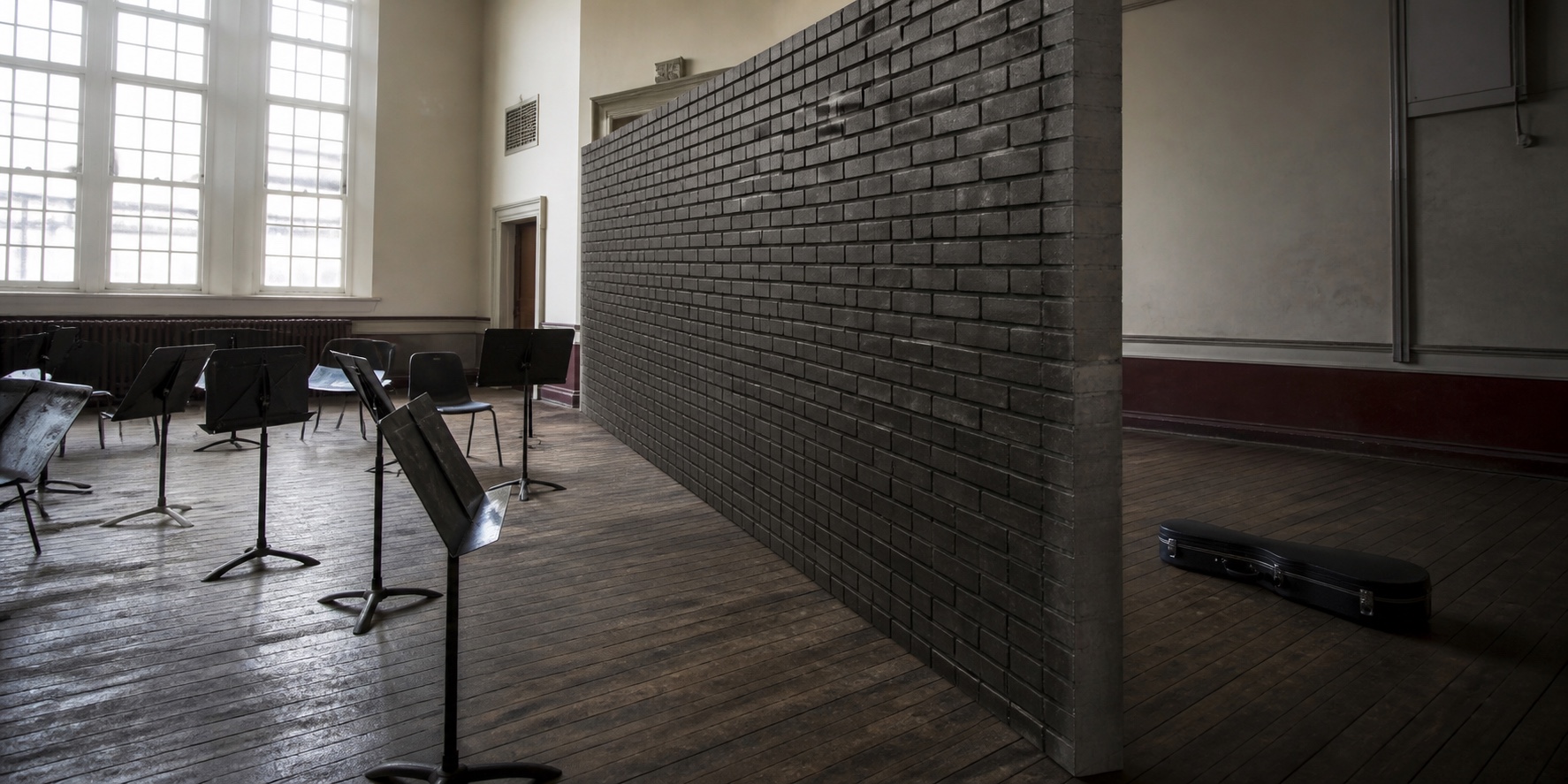
This investigation examines what England abolished when it ordered the high-cost subject grant for creative and performing arts to zero, and who is left outside the funding it chose to preserve. Every figure comes from official documents: the Department for Education's funding guidance, the Office for Students' allocation decisions and the HESES25 dataset. Four cautions travel with it. The £12.9 million was the creative-and-performing-arts line, not a music-only budget. The performing-arts category in the source data combines music, drama and dance, so no clean national music-only total exists. HESES values are countable years, not headcounts or final funding FTEs. And this analysis demonstrates exposure and institutional structure — it does not prove that any named provider will close a course or cut a post.
England’s two-tier higher-education music pipeline
Cadenza Investigation | Publication draft | 31 July 2026
Seven days before promising a national music pipeline, government ordered the university high-cost grant for creative and performing arts to zero. Cadenza’s analysis finds that 200 providers carrying 80 per cent of C1.2 activity — and nearly two-thirds of performing-arts activity — sit outside the specialist schemes it chose to protect.
On 6 July, England’s education department signed seven pages.
The decisive sentence was not delivered from a stage. It did not appear in a manifesto, a television interview or a national debate about the future of culture. It was placed inside the binding terms attached to the government’s annual funding guidance to the Office for Students.
The regulator “must no longer allocate” high-cost subject funding for Price Group C1.2: creative and performing arts. [1]
Twenty-four days later, the Office for Students placed the instruction into a table.
Last year: £12.9 million. This year: £0. The funding rate fell from £130.54 per eligible full-time-equivalent student to nothing. [2]
Seven days after issuing the instruction, government published Turn It Up: Our Plan for Music. It promised a national talent pipeline, regional opportunity and a curriculum that treats music as essential. [3]
These are not two unrelated stories. They meet in the same rehearsal room.
THE NUMBER IS ZERO
The 30 July table is the official conversion of a ministerial choice into a national allocation: £12.9 million becomes zero, and £130.54 per eligible FTE becomes zero. The published reduction is 100 per cent. [2]
The significance lies not only in the amount but in the principle. Creative and performing arts cease to receive any subject-wide recognition as high-cost provision, even though government continues to recognise exceptional cost through schemes attached to selected specialist institutions.
The grant was already too small to pay for a course or a department. It could still sit at the edge of a technician’s post, a visiting-teacher budget, an ensemble programme or an equipment cycle. Nationally modest does not mean institutionally meaningless.
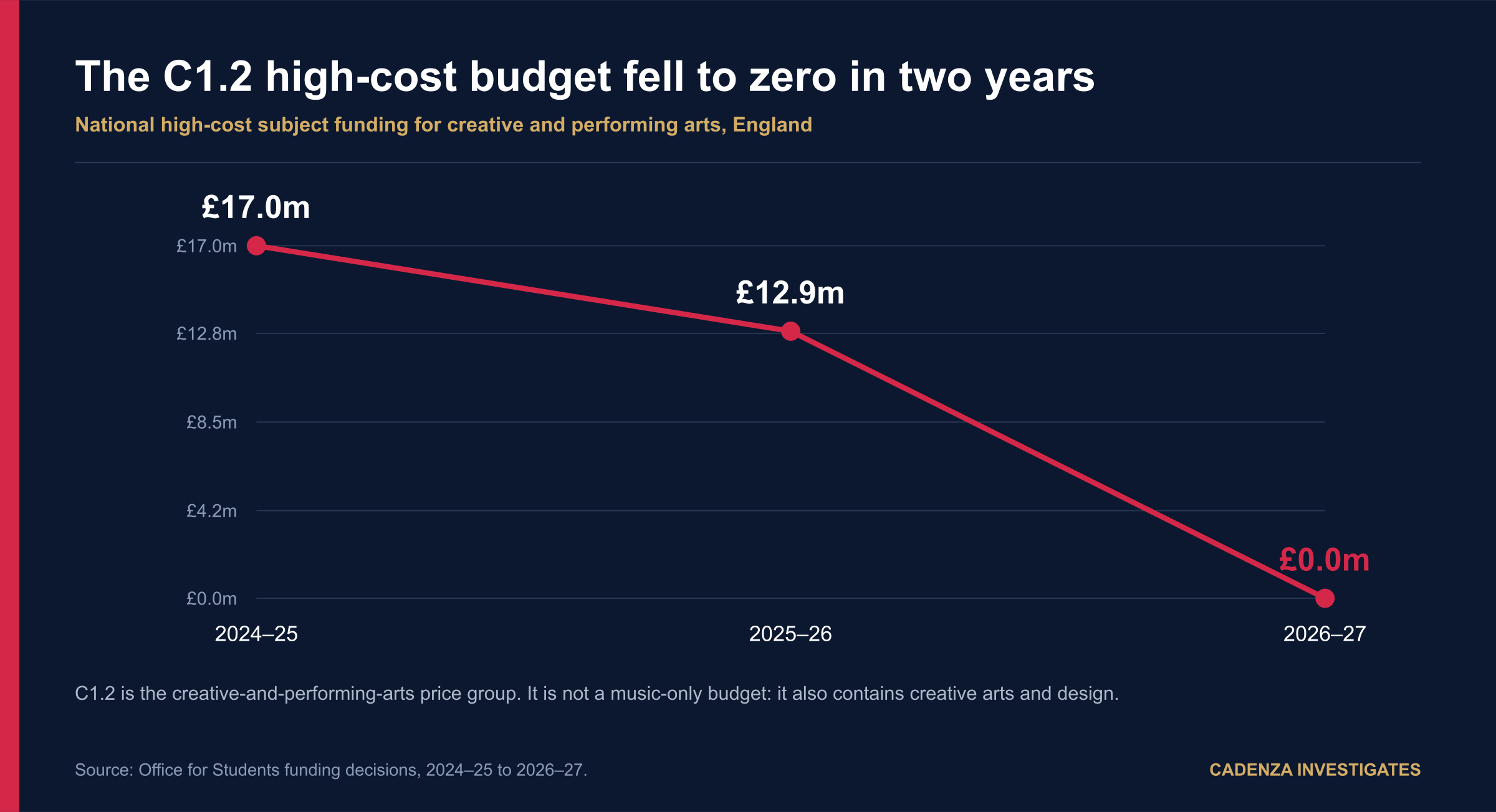
Figure 1. The national C1.2 high-cost budget fell from approximately £17 million in 2024-25 to £12.9 million in 2025-26 and to zero in 2026-27. C1.2 is not a music-only budget.
THE FINDING IN ONE SENTENCE
England has abolished the broad high-cost subject grant for C1.2 while preserving institution-specific specialist funding, even though 80.0 per cent of C1.2 activity and 65.5 per cent of performing-arts activity in the official HESES25 data sit outside the two preserved specialist schemes.
WHAT WAS ACTUALLY ABOLISHED
Precision matters because an imprecise version of this story is easy to rebut. England has not abolished all public support for university music. Universities still receive tuition-fee income. Some receive research funding, student-premium funding, capital support or other grants. Conservatoires and other designated specialists retain separate allocations. Institutions remain free to cross-subsidise music from other income.
Nor was the entire £12.9 million a music budget. C1.2 contains creative arts and design as well as performing arts. The performing-arts category in the underlying data combines music, drama and dance; it does not permit a clean national music-only total. [2][4]
What has been abolished is specific: the high-cost subject grant previously attached to eligible C1.2 provision at English higher-education providers. It was a modest grant — £130.54 per eligible FTE in 2025-26 — but it performed two functions. It transferred money, and it formally recognised that creative and performing arts carry costs beyond a standard classroom subject.
One further change belongs in this section, because it is the first thing a department would raise in reply. In the same data collection, the regulator introduced a new price group, C1.3, and recorded that the subjects within it “were previously recorded in C1.2”. Between the two years, C1.2 fell by 20,803 funded full-time equivalents while C1.3 appeared with 20,452. [2] Those subjects sit in the media, journalism and communications hierarchy; the design, creative and performing-arts hierarchy that contains music, drama and dance remained in C1.2. The reclassification therefore moved media provision out of the abolished group — it did not move performing arts to safety, and C1.3 carries no published high-cost rate of its own in the regulator’s rate table. This investigation measures C1.2 as it stands after that change, which is the group the instruction actually abolishes.
From 1 August, that recognition survives only through schemes attached to selected institutions. A rehearsal room does not become cheaper because it is housed in a multidisciplinary university. A studio does not stop needing technicians because the institution also teaches engineering. Yet the funding settlement now recognises structural cost at the protected provider and removes the subject-wide recognition everywhere else.
THIS WAS A GOVERNMENT ORDER, NOT A REGULATOR DISCOVERY
The Office for Students did not independently conclude that creative and performing arts had ceased to be expensive. The Department for Education directed the regulator to stop allocating the funding. The same guidance protected the cash budget for the highest-cost Price Groups A and B and instructed the regulator to maintain other targeted lines. [1]
That distinction matters because institutional language can make a political choice look like weather. “Fiscal constraints”, “strategic alignment” and “prioritisation” describe a climate. The guidance identifies an actor. Government selected the lines to preserve and the lines to erase.
The government’s rationale is visible in the letter: it wanted to focus limited grant on courses it considered most important to economic growth and skills, while the tuition-fee cap had also risen. Medicine, dentistry, veterinary science, laboratory-based science and engineering remain protected through Price Groups A and B. Creative and performing arts do not. [1][2]
That is a defensible policy position only if government can show that it assessed the consequences it accepted: the regional effect, the teacher-supply effect, the course-viability effect, the equality effect and the effect on the very music workforce celebrated in its own strategy. The public documents reviewed by Cadenza do not contain that provider-level analysis.
THE LETTER THAT REMOVED THE GRANT COULD NOT DESCRIBE IT CONSISTENTLY
The seven-page instrument contains a revealing drafting failure. In the narrative section, C1.1 is described as including nursing, computing and history, while C1.2 is described as including creative and performing arts, archaeology and geography. In the binding terms later in the same document, C1.2 is described as creative and performing arts, while archaeology and geographical systems appear under C1.1. History disappears. The formal clause also refers once to “Price Group 1.2” rather than C1.2. [1]
The binding clause is clear enough to implement, and the inconsistency does not invalidate the decision. It does show the quality of the public instrument through which a national subject category was removed. A decision capable of affecting courses, jobs, facilities and student choices was issued days before the academic-year allocation, in a document that could not keep its own category description consistent.
The Department for Education should say whether the narrative was erroneous, when the error was identified and whether a corrected letter will be issued. It should also publish the internal submission that recommended zero rather than a transition.
SEVEN DAYS LATER, MUSIC BECAME “ESSENTIAL”
On 13 July — seven days after the funding instruction — the government published Turn It Up: Our Plan for Music. It said the curriculum would recognise music as “essential — not a nice to have”. It described music teachers as central to good education, warned of sector skills shortages and promised pathways from education into employment. [3]
The plan committed up to £13 million over three years to a National Centre for Arts and Music Education, £76 million annually for 43 Music Hub partnerships through 2026-27, and an additional £25 million for instruments and music technology. It promised equitable access, a stronger talent pipeline and opportunity across the country. [3]
It also praised higher-education specialists. The plan highlighted approximately £48 million distributed among 12 world-leading institutions focused solely on creative and performing arts, naming Guildhall School of Music and Drama and the Royal Northern College of Music. [3]
The government therefore understands the chain. Music education requires teachers. Professional music requires trained performers, producers, composers, researchers and technicians. Specialist education requires costly infrastructure. Regional opportunity requires institutions that exist within reach of regional students.
The contradiction is not that the government funds nothing. It funds many worthwhile things. The contradiction is that it declared music essential while terminating the broad higher-education mechanism that recognised the cost of teaching creative and performing arts outside a protected group.
The music plan describes a pipeline. The higher-education settlement narrows the pipe.
CADENZA’S AUDIT: FOUR-FIFTHS OF C1.2 ACTIVITY IS OUTSIDE THE PROTECTED SYSTEM
Cadenza downloaded the Office for Students’ HESES25 underlying Tables 1 and 2 dataset. We selected Section A activity assigned to Price Group C1.2, restricted the analysis to home-fee, OfS-fundable provision, and aggregated the published HOMEF countable years by provider. We then compared provider UKPRNs with the two specialist systems maintained for 2026-27: the world-leading specialist-provider fund and the 15-provider specialist performing-arts initiative. [4][6][13]
The result is not marginal. It is the architecture of the system.
Table 1. Cadenza analysis of HESES25 Section A, C1.2, home-fee and OfS-fundable activity.
| Provider status | Providers | C1.2 countable years | Share | Performing-arts countable years | Share |
|---|---|---|---|---|---|
| Inside either preserved specialist scheme | 27 | 22,440 | 20.0% | 13,135 | 34.5% |
| Outside both preserved specialist schemes | 200 | 89,690 | 80.0% | 24,885 | 65.5% |
| Total | 227 | 112,130 | 100.0% | 38,020 | 100.0% |
Four-fifths of C1.2 activity in the dataset sits outside the schemes government preserved. Nearly two-thirds of performing-arts activity sits outside them. The protected system contains 27 providers reporting C1.2 activity. The unprotected side contains 200. [4]
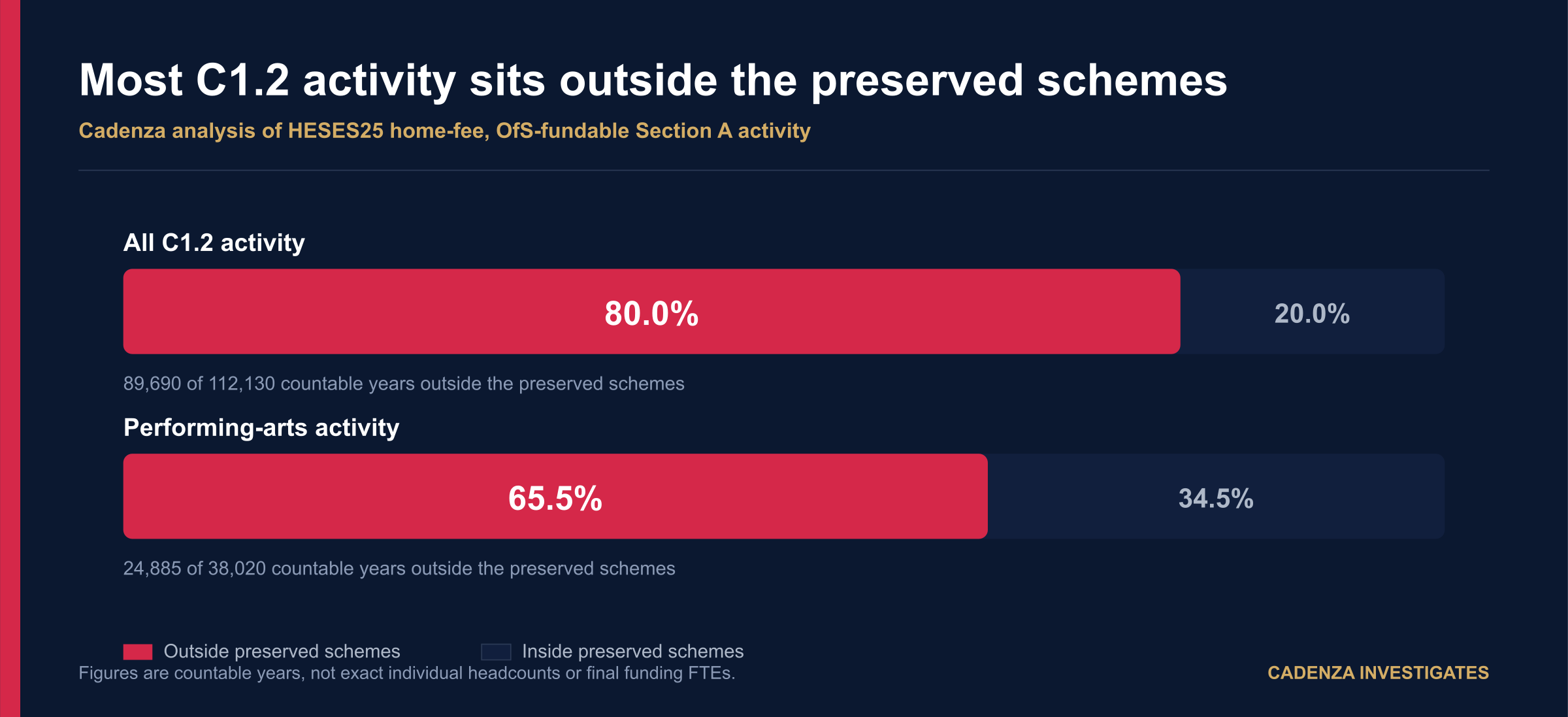
Figure 2. The majority of C1.2 and performing-arts activity sits outside the two preserved specialist schemes.
READ THE DENOMINATOR CAREFULLY
These are countable years from the HESES return, not an exact individual headcount and not the adjusted FTEs used directly in the final funding formula. Provider returns are rounded to the nearest five. The percentages describe the distribution of reported activity, not exact provider cash losses.
THE 200 PROVIDERS ON THE OTHER SIDE
The activity outside the protected system is not confined to a few marginal courses. The largest providers include major civic universities, regional universities and specialist creative institutions that do not fall within the particular schemes preserved for 2026-27.
The top 20 providers outside the schemes account for 48.2 per cent of all outside-scheme C1.2 activity. The concentration means the policy does not merely scatter tiny losses across hundreds of providers; it lands heavily on a recognisable group of institutions carrying large volumes of creative provision.
Table 2. Largest C1.2 providers outside both preserved specialist schemes. Counts are activity, not cash-loss estimates.
| Provider outside both schemes | Region | C1.2 countable years | Performing arts |
|---|---|---|---|
| Manchester Metropolitan University | North West | 4,415 | 325 |
| Nottingham Trent University | East Midlands | 4,110 | 595 |
| Falmouth University | South West | 3,520 | 370 |
| University of Salford | North West | 3,150 | 905 |
| Arts University Bournemouth | South West | 2,705 | 420 |
| University of the West of England, Bristol | South West | 2,535 | 370 |
| Birmingham City University | West Midlands | 2,050 | 190 |
| University for the Creative Arts | South East | 2,010 | 255 |
| Liverpool Media Academy | North West | 1,930 | 1,720 |
| Leeds Arts University | Yorkshire and the Humber | 1,915 | 115 |
The courses behind those totals are diverse. C1.2 includes creative arts and design alongside performance. Performing-arts provision may include music, dance and drama. The policy therefore reaches far beyond orchestral training: commercial music, production, songwriting, composition, sound, theatre, community practice, education and interdisciplinary work can all sit inside the exposed ecology.
The government’s plan repeatedly invokes a workforce broader than star performers. It wants producers, technicians, entrepreneurs and educators. Many are trained at precisely the institutions that the specialist-protection narrative renders invisible.
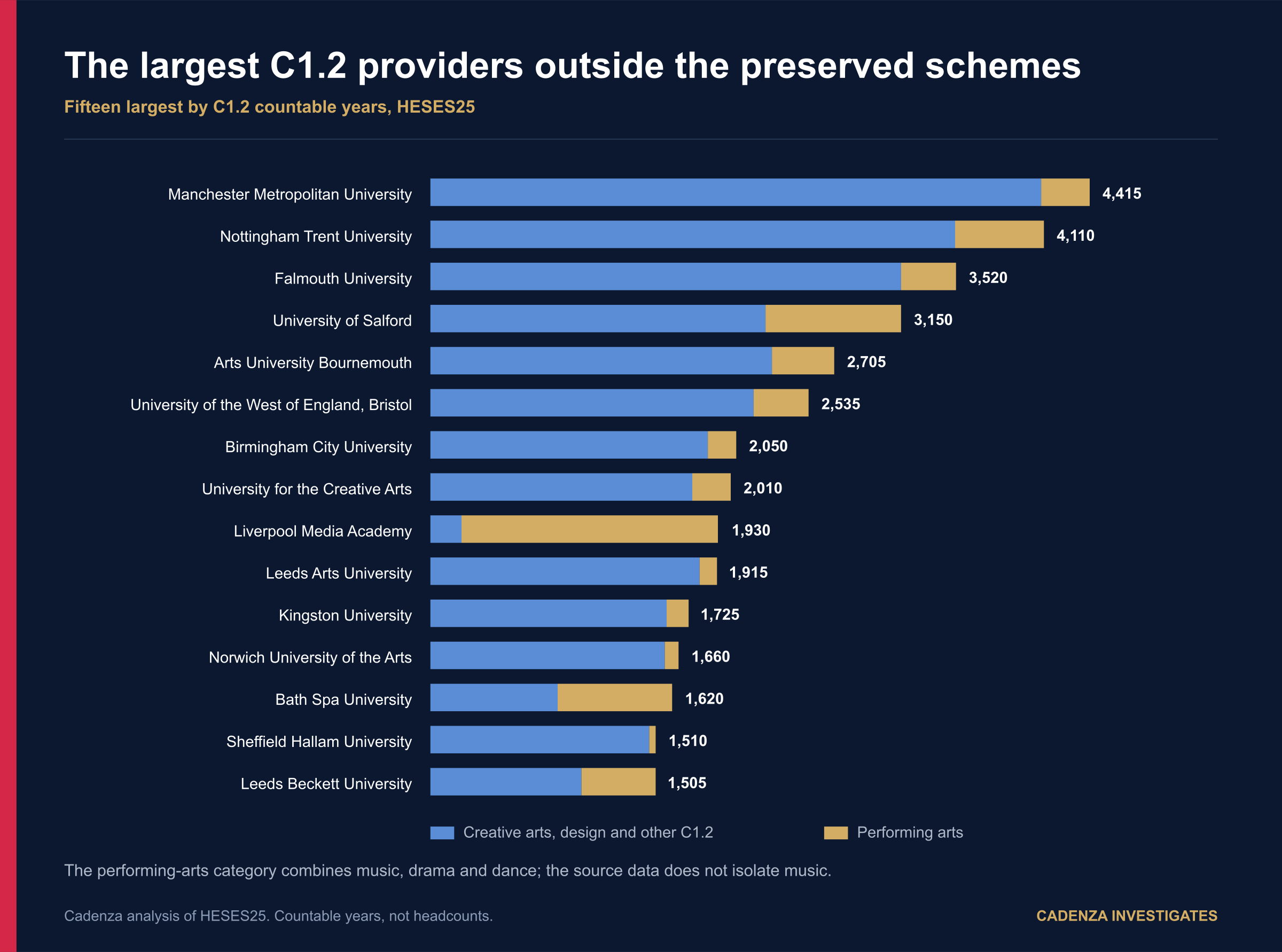
Figure 3. The 15 largest C1.2 providers outside the preserved specialist schemes, split between performing arts and other C1.2 activity.
FIVE REGIONS HAVE NO C1.2 ACTIVITY INSIDE THE PROTECTED SCHEMES
The government’s music plan promises nationwide access and a place-based approach. The funding geography does not match that language.
In five of England’s nine regions, every C1.2 countable year in HESES25 is recorded at a provider outside both preserved schemes: the East Midlands, East of England, North East, West Midlands and South West. The Open University’s 1,185 countable years also sit entirely outside them. [4]
In the North West, 16,215 of 17,995 C1.2 countable years — 90.1 per cent — are outside the protected providers. In Yorkshire and the Humber, 9,450 of 11,070 — 85.4 per cent — are outside. In the South East, the share is 67.1 per cent. Even London, where specialist institutions are concentrated, has 11,135 C1.2 countable years outside the two schemes.
The regional finding does not prove that a course will close. It proves that the institution-specific safety net does not reach most of the reported activity in much of England. When government says that a young person in Yorkshire should have the same structural opportunity as one in London, it must explain how an institutional protection system concentrated elsewhere delivers that promise.
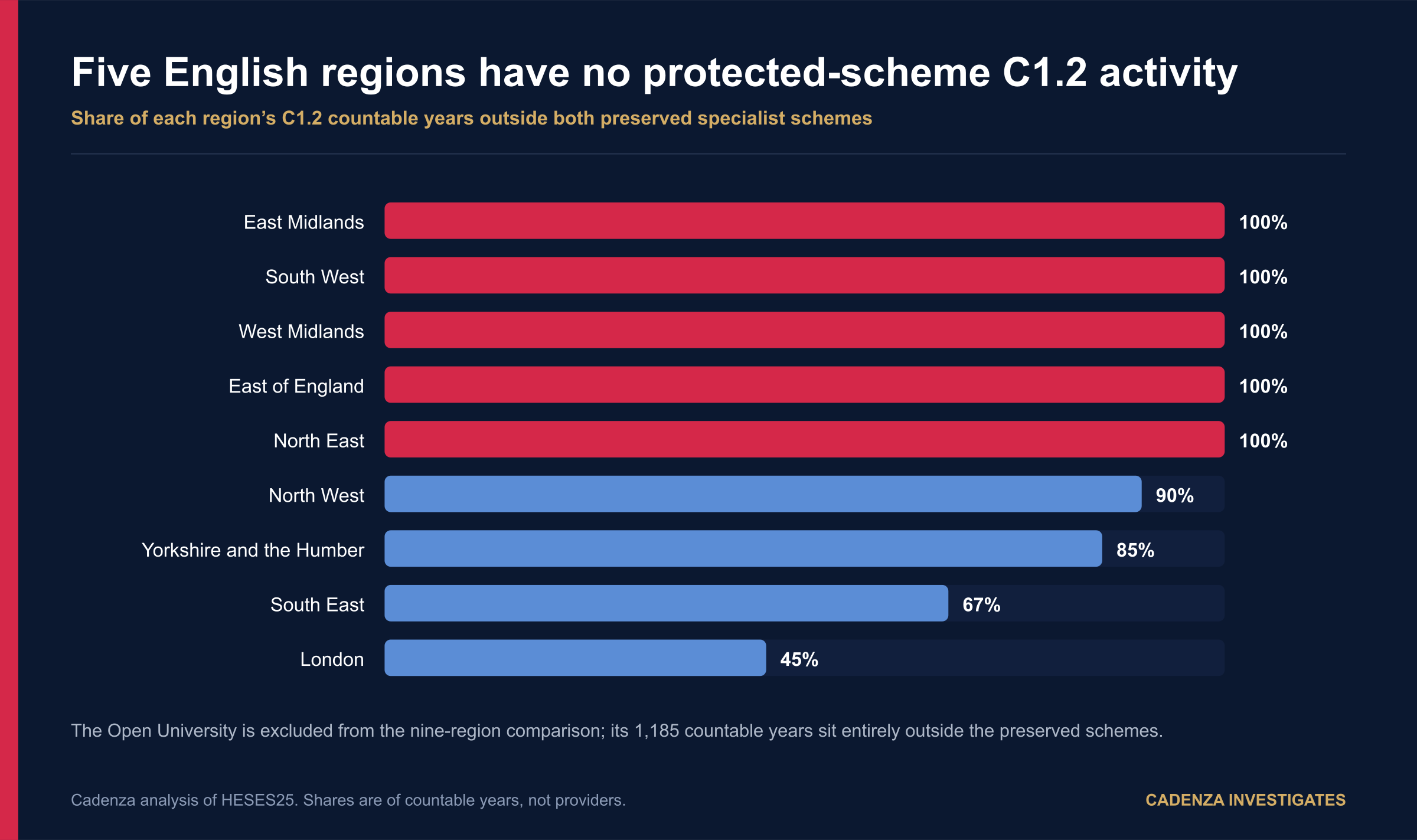
Figure 4. Share of C1.2 activity outside the preserved specialist schemes by English region.
THE LONDON GRAVITY WELL
The protected system is not exclusively London-based, and some of its most important institutions are elsewhere. But Cadenza’s audit finds that 13,390 of the 22,440 protected-scheme C1.2 countable years — 59.7 per cent — are in London. [4]
That concentration is not an argument that London institutions should lose support. It is evidence that a national access strategy cannot rely on a narrow protected tier alone. Living costs, travel, caring responsibilities, disability, local employment and family circumstances shape who can relocate. A pathway that exists only after a student can move to a small number of specialist centres is not an equal pathway.
Regional university departments also perform functions that are not substitutes for conservatoire training. They educate teachers and researchers. They support local ensembles and venues. They provide routes into music technology, community practice and interdisciplinary work. They anchor cultural life in places where a world-leading conservatoire will never be built.
THE PROTECTED SUMMIT
The specialist institutions are not the villains of this story. Their costs are real. They maintain intensive individual and small-group teaching, specialist facilities and professional training. Dismantling them would be catastrophic. The government is right to recognise their structural economics.
Five institutions with major specialist music provision — Guildhall School of Music and Drama, the Royal College of Music, the Royal Northern College of Music, the Royal Academy of Music and Trinity Laban Conservatoire of Music and Dance — each receive £4.875 million in world-leading specialist-provider funding. Together that is £24.375 million, about 1.9 times the entire former national C1.2 budget. [5][13]
The comparison requires care. The funding lines do different jobs. World-leading funding supports the structural cost of selected specialist institutions; C1.2 was a subject-rate supplement distributed more broadly. One is not a direct replacement for the other.
But the scale reveals the policy principle. Government accepts that arts education cannot always be sustained from ordinary fee income. It has chosen to recognise that truth at designated institutions and to stop recognising it through the subject formula elsewhere.
The answer is not to pull conservatoires down. It is to ask why the wider foundation has been removed.
TWO PROTECTED SYSTEMS, TWO DIFFERENT LOGICS
The world-leading fund supports 20 providers across several specialist disciplines. A separate performing-arts initiative supports 15 specialist providers that did not receive world-leading status, with a focus on contemporary music, drama and dance. The initiative was created for five academic years, from 2022-23 through 2026-27, and its published annual allocations total approximately £9.6 million. [6][13]
The second scheme is valuable. It supports teaching, access, partnerships and small items of specialist equipment, including musical instruments. It also exposes the dividing line in the new settlement.
The state will continue to recognise cost when the provider has entered a protected institutional list. It will no longer recognise cost merely because the subject requires specialist staff, space and equipment. Twenty-seven protected providers report C1.2 activity in HESES25. Two hundred other providers do too.
The new system therefore asks a status question before it asks a cost question.
THE PROVIDER-LEVEL NUMBER THE PUBLIC CANNOT SEE
A serious investigation should be able to answer a basic question: how much C1.2 grant did each provider receive last year, and how much will it lose this year? The current public allocation workbook does not make that calculation transparent.
Annex A for 2026-27 publishes a provider-level column called “High-cost subject funding”. It combines the surviving high-cost price groups. It does not provide a separate C1.2 column showing the exact amount removed from each institution. [5]
The HESES data cannot simply be multiplied by £130.54 to manufacture a loss figure. The OfS applies provider-specific multiplication factors and other adjustments. The regulator’s own funding decision distinguishes HESES counts from the FTEs used in allocations. [2]
This is not merely a technical inconvenience. It prevents students, staff, governors and local journalists from seeing the exact provider-level effect of a national policy. The Office for Students can publish the missing table. It should do so.
TRANSPARENCY REQUEST
For every provider, publish the 2025-26 C1.2 allocation, the 2026-27 C1.2 reduction, the fundable FTE calculation and any adjustment applied. Without that table, the national decision is visible but its local price is obscured.
THIS BEGAN IN 2021
The zero is not a sudden break. It is the final stage of a five-year dismantling.
In 2020-21, the rate that would become C1.2 was £243 per FTE. For 2021-22, the OfS split the category and reduced the new C1.2 rate to £121.50 — a 50 per cent cut. The regulator said the government’s terms obliged it to implement the change. [7]
The consultation attracted 8,072 submissions, an unprecedented response for the OfS. Respondents warned about course viability, staff, regional access, student choice and the future workforce. One submission warned that options would be curtailed and that some activity would need to be discontinued. The OfS recorded those warnings and implemented the required reduction. [7]
The rate later rose modestly in cash terms to £130.54. The national C1.2 budget was approximately £17 million in 2024-25, fell to £12.9 million in 2025-26 and is now abolished. [2][8]
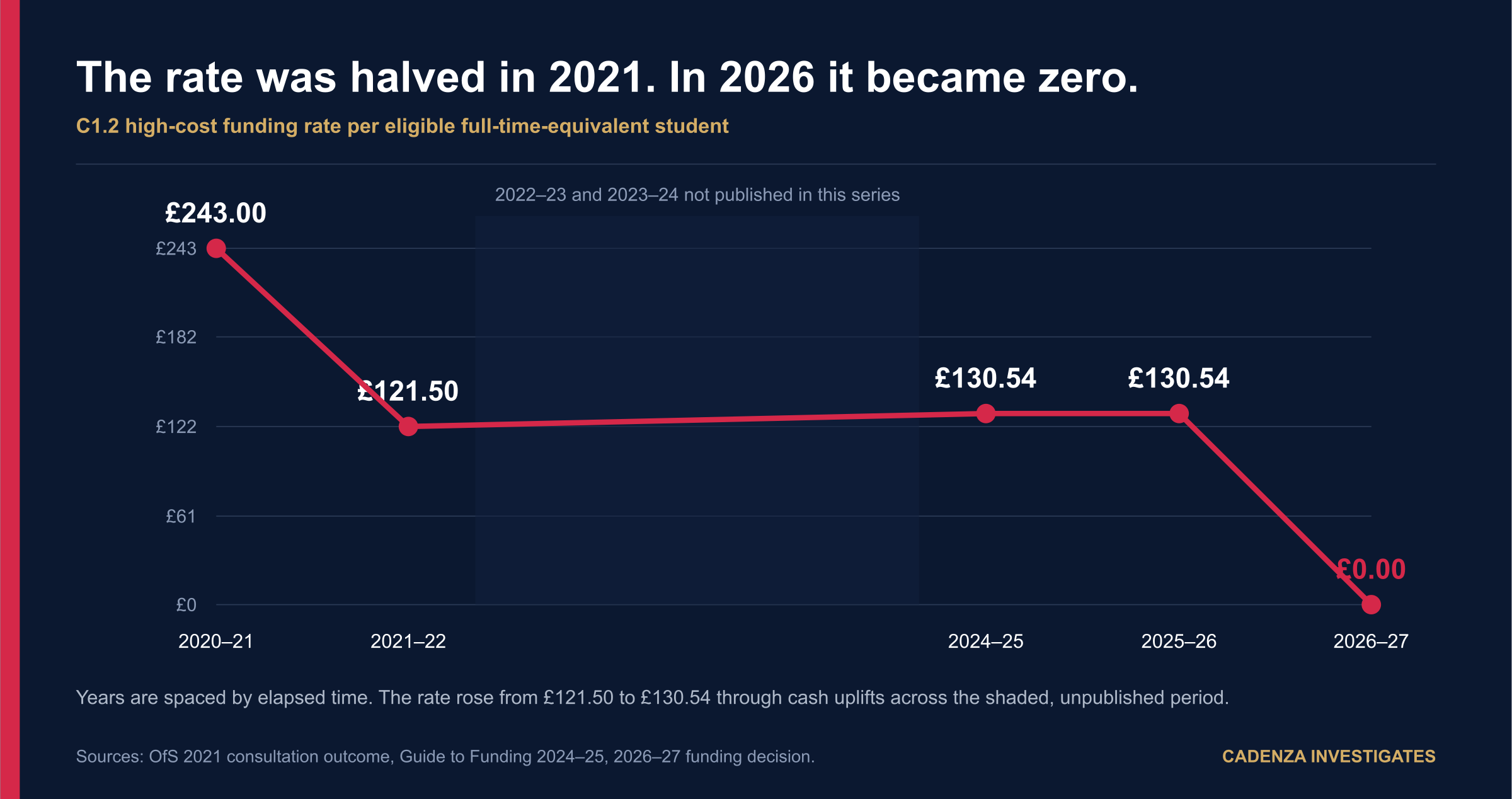
Figure 5. The C1.2 high-cost rate was halved in 2021 and abolished in 2026.
Half in 2021. Nothing in 2026. The sector was warned at the first stage that provision could contract. Before completing the removal, government should publish the work it did to test whether those warnings had materialised.
THE PIPELINE IS ALREADY UNDER PRESSURE
The cut lands in a higher-education system that the regulator itself describes as financially fragile. The Office for Students reports that 100 providers — 35.8 per cent of the sector — ran deficits in 2024-25. It forecasts 119 providers in deficit in 2025-26, with 57 expecting three consecutive deficit years. [9]
Those figures do not prove that music is uniquely endangered, and aggregate sector performance varies substantially. They do establish the decision environment. Departments are being assessed against recruitment, margin, staffing cost, space, maintenance and short-term cash needs. Creative subjects enter that contest with facilities and teaching models that cannot be compressed indefinitely.
Music provision has already retreated. Oxford Brookes confirmed the closure of its music programme in 2024, with compulsory redundancy processes, as part of wider cost-saving measures. The University of Kent decided to phase out Music and Audio Technology amid broader financial challenges. Both decisions predate the 2026 C1.2 abolition and must not be attributed to it. They show the condition of the ground onto which the new policy falls. [11][12]
Universities rarely issue a statement saying that one national grant line killed one department. The sequence is quieter: a vacancy is not filled; individual tuition is reduced; an ensemble budget disappears; specialist options are merged; a technician’s contract ends; a studio upgrade is deferred; recruitment is suspended; the course is taught out.
A modest grant can therefore matter without covering the full cost of a course. It may sit at the edge of the last staffing line or the decision to accept another cohort. Its removal also changes the institutional message: the subject no longer carries national high-cost status.
THE TEACHERS WHO ARE SUPPOSED TO DELIVER THE PLAN
The government’s music plan depends on people it does not currently have in sufficient number. Music Mark and the Royal Musical Association report a 51.3 per cent decline in music-teacher trainees between 2010-11 and 2024-25. Their joint letter argues that school-curriculum and enrichment ambitions cannot be delivered without supported higher-education departments. [10]
The government plan itself says high-quality music education is driven by teacher expertise. It promises a revised curriculum, stronger enrichment, continuing professional development and pathways into creative work. [3]
A national centre does not train a teacher by itself. A curriculum does not teach itself. A Music Hub cannot employ a workforce that has not been educated. The route from a child’s first instrument lesson to a qualified classroom teacher often runs through an ordinary university department, not solely through an elite performance institution.
Those departments also train private teachers, community musicians, youth-ensemble leaders, researchers and the practitioners who sustain local musical life. Government is increasing the work it wants that system to perform while removing the subject grant that acknowledged part of its cost.
WHAT £130.54 COULD — AND COULD NOT — BUY
The former rate was small. It did not pay for a year of instrumental tuition. It did not maintain a concert hall. It did not cover a lecturer’s salary or replace a studio. That is precisely why government may argue its removal should be absorbable.
But the relevant question is not whether £130.54 paid the full bill. It is whether institutions already operating under financial stress can replace the aggregate sum without reducing the activity it supported. Across tens, hundreds or thousands of eligible FTEs, a small rate becomes staffing, maintenance and contact time.
The national saving is also small in the context of the recurrent grant. The £12.9 million C1.2 line was around one per cent of the previous recurrent provider-grant budget. A saving of that scale does not repair the national higher-education settlement. It can still determine local choices.
Government cannot use smallness in both directions — too small to matter to a department, yet important enough to eliminate for fiscal necessity — without publishing the provider-level modelling.
THE GOVERNMENT’S STRONGEST CASE
The strongest defence of the policy is not that music lacks value. The government’s own plan rejects that proposition. The defence is triage.
The recurrent grant is constrained. The 2026-27 provider allocation is lower overall. Medicine, dentistry, veterinary science, laboratory science and engineering carry very high delivery costs and serve public-service or industrial priorities. The tuition-fee cap has risen. Universities are autonomous and may use fee income or cross-subsidy to preserve courses. Specialist music and performing-arts providers remain funded. School music, Music Hubs, instruments, grassroots venues and the wider industry receive support elsewhere. [2][3]
The arts were not alone. Government also removed C1.1 high-cost funding and several NHS-related targeted allocations. C1.2 represented a relatively small share of the total grant. A minister facing a fixed envelope can reasonably decide that some subjects have a stronger claim on scarce marginal funding.
That case deserves to be presented fairly. It does not answer the investigation.
WHY THE DEFENCE FAILS WITHOUT THE MISSING EVIDENCE
1. The policy changes the principle, not only the amount
Until now, the formula recognised that eligible creative and performing-arts provision carried additional teaching cost. The new settlement says that cost is nationally recognised when attached to protected institutional status, but not when substantially similar activity occurs elsewhere. That is institutional selection, not merely an across-the-board reduction.
2. The published impact analysis is too thin
The OfS decision explains budget changes and funding mechanics. It does not publish a provider-level regional assessment, an equality analysis focused on C1.2, a teacher-supply assessment or a list of departments at risk. Such work may exist internally. It is absent from the public evidence reviewed by Cadenza. [2]
3. Government was warned before
The 2021 consultation recorded warnings about course discontinuation, regional access and the talent pipeline. Five years later, government completed the removal. The relevant question is not whether the 2026 decision caused every earlier closure. It is whether government tested the warnings before choosing zero. [7]
4. The regional promise and regional structure conflict
Five regions have no C1.2 activity inside the two protected systems. Most activity in the North West and Yorkshire and the Humber is outside. A national plan based on regional opportunity needs a mechanism that reaches the regional institutions carrying the work.
5. Government chose zero rather than transition
The OfS settlement contains a £10 million reserve for emerging priorities and in-year adjustments. There is no evidence that the reserve was transferred from C1.2, and it should not be described that way. Its existence does show that the settlement can contain contingency. The government could have ordered a phase-out, a regional bridge, a teacher-training safeguard or a hardship mechanism. It chose none. [2]
6. Strategy cannot substitute for institutions
Plans are written in outputs: more access, more instruments, more teachers, more pathways, more skilled workers. Institutions operate through inputs: people, rooms, time, equipment, maintenance, salary and stable recruitment. A strategy can celebrate the desired result while weakening the machinery needed to produce it.
WHAT THIS INVESTIGATION DOES NOT CLAIM
Cadenza’s findings should not be stretched beyond the evidence. The discipline of the claim is part of its force.
- The £12.9 million was not exclusively music funding.
- C1.2 includes creative arts and design as well as performing arts.
- The performing-arts category cannot separate music from drama and dance.
- Government has not abolished all public support for university music.
- The 2026 decision did not cause closures announced in earlier years.
- HESES countable years are not exact student headcounts or final funding FTEs.
- The specialist schemes and C1.2 were designed for different purposes.
- The analysis does not prove every exposed provider will close courses or cut staff.
The precise finding is stronger than the exaggerated version: government abolished the broad C1.2 high-cost subject grant while preserving institution-specific specialist funding, although most C1.2 and performing-arts activity in the official dataset sits outside the preserved schemes.
WHAT GOVERNMENT AND THE REGULATOR MUST NOW PUBLISH
The Department for Education should release the evidence behind the decision. The Office for Students should make its local consequences visible. At minimum, the public needs:
- the exact 2025-26 C1.2 allocation for every provider and the exact amount removed for 2026-27;
- the provider-specific FTE calculation and multiplication factors used;
- the regional and equality impact assessments;
- the analysis of effects on music-teacher recruitment and the education workforce;
- the ministerial submission and options appraisal comparing zero with a phased transition;
- the assessment of whether protected specialists can absorb displaced demand;
- a monitoring plan for closures, recruitment suspensions, reduced contact time, staffing losses and facility withdrawal;
- a public report before the 2027-28 funding decision.
The regulator should also establish a student-protection trigger for providers that materially reduce C1.2 courses after accepting applicants. A national policy adopted days before the academic year should not leave individual students to discover the consequences through course-change emails months later.
A PLAN IS NOT A PIPELINE
A pipeline is not a policy document. It is a chain of institutions and people.
It is the primary-school teacher who lets a child hold an instrument for the first time. It is the Music Hub that finds the instrument. It is the secondary-school teacher who keeps the subject alive. It is the youth ensemble that gives the child somewhere to play. It is the university department that turns ability into knowledge. It is the technician who keeps the studio working. It is the lecturer, accompanist, composer, producer, researcher and community musician. It is a course close enough to reach and affordable enough to attend.
England has not abolished music. It has created a hierarchy of where the state will recognise that creative and performing-arts education is expensive.
At the summit, the cost remains visible. Across most of the activity below, it disappears from the formula.
Seven days after ordering that disappearance, government published a plan promising pathways in every corner of the country.
First, it built a wall.
METHODOLOGY
Cadenza analysed the Office for Students’ HESES25 underlying Tables 1 and 2 dataset, published in February 2026. The analysis selected records where POPULATION was A, PRICEGRP was C1.2, and activity was recorded as home-fee and OfS-fundable. We aggregated the HOMEF field by provider UKPRN. [4]
A provider was classified as inside the preserved specialist system when its UKPRN appeared either in the 20-provider world-leading specialist list or the 15-provider specialist performing-arts initiative. All other providers reporting C1.2 activity were classified as outside both schemes. [6][13]
The C1.2 total contains 73,975 countable years assigned to creative arts and design, 38,020 assigned to performing arts, and 135 assigned through a small subgroup or override. All calculations use the published data values. Provider submissions are rounded to the nearest five, and values below three are rounded to zero.
HESES countable years should not be read as an exact census of individuals. The dataset does not cover the whole of English higher education; it covers relevant providers in the Approved fee-cap category that completed the return. Final funding FTEs also incorporate provider-specific adjustments. [2][4]
The performing-arts category combines music, drama and dance. Cadenza has therefore not presented any derived music-only national count. The workbook accompanying this article exposes the formulas, regional table, provider ranking, source log and right-of-reply tracker.
RIGHT OF REPLY AND PUBLICATION STATUS
This file is a publication draft, not a representation that right-of-reply requests have already been sent. The editorial packet contains questions for the Department for Education and the Office for Students. Before publication, Cadenza should provide a clear deadline, preserve the correspondence and insert each substantive response fairly. If an organisation declines or does not respond by deadline, state that accurately. Do not imply refusal before it occurs.
No allegation of individual misconduct is made in this investigation. The criticism concerns a documented government instruction, a published funding settlement, the distribution of activity in an official dataset and the absence of provider-level impact information from the public record.
SOURCE NOTES
[1] Department for Education / Office for Students, Strategic Priorities Grant guidance and terms for 2026-27 (6 July 2026). Narrative p.3; binding term 3.3 on p.6.
[2] Office for Students, Funding for 2026-27: decisions and allocations (30 July 2026). Budget table p.9; rates p.10; student-number methodology p.14.
[3] Department for Culture, Media and Sport / Department for Education, Turn It Up: Our Plan for Music (13 July 2026). Music-plan objectives and education-and-skills section.
[4] Office for Students, HESES25 Tables 1 and 2 underlying data (16 February 2026 data release). Cadenza analysis of Section A, C1.2, HOMEF activity.
[5] Office for Students, Funding for 2026-27, Annex A: provider allocations (30 July 2026). Provider-level recurrent grant and specialist-provider allocations.
[6] Office for Students, Initiative funding for specialist performing-arts providers (9 March 2023). Purpose, eligibility and 15-provider allocation list; funding runs through 2026-27.
[7] Office for Students, Recurrent funding for 2021-22: consultation outcomes (2021). 8,072 responses; C1.2 rate cut from £243 to £121.50; warnings and government constraints.
[8] Office for Students, Recurrent funding for 2024-25 (2024). C1.2 budget of approximately £17 million.
[9] Office for Students, Financial sustainability of higher education providers in England (2026). Deficit data at paragraph 138, p.40 of the PDF.
[10] Music Mark / Royal Musical Association, A Call to Reverse Cuts to Higher Education Funding (10 July 2026). Sector advocacy letter; teacher-trainee decline and infrastructure argument.
[11] Oxford Brookes University, University statement on programme closures (2024). Music closure and redundancy context predating the 2026 decision.
[12] University of Kent, Future plans for Kent (2024). Phase-out of Music and Audio Technology predating the 2026 decision.
[13] Office for Students, World-leading specialist-provider funding: outcome (2022). Twenty-provider list and allocation methodology; Annex A.
Methodology. Funding figures are those published by the Office for Students for the years stated. Activity figures are Cadenza's analysis of the HESES25 home-fee, OfS-fundable Section A dataset, counted as countable years. The provider-level audit covers 227 providers and every headline figure in this article recomputes from that dataset. Where a source publishes components rather than a total, the arithmetic is Cadenza's and is stated as such. Oxford Brookes and Kent are included as historical context and predate the 2026 decision.
What this investigation does not claim. It does not claim that England has abolished all public support for university music, that the £12.9 million was a music budget, that any named provider will close a course, that the preserved specialist schemes and C1.2 were direct substitutes, or that any individual decision-maker acted improperly. The policy question raised here is about published evidence and its absence.
Right of reply. The Department for Education, the Office for Students and any institution named here may respond at any time and this article will be updated to carry the response in full. Corrections and responses are welcomed at hello@cadenza.work.
Images. All charts are original Cadenza analysis built directly from the published funding decisions and the HESES25 dataset; each states its own source and limitation. The cover is original Cadenza artwork and depicts no person or place.
Related Cadenza coverage.
- The Summer Gate — what a summer programme costs, and who it filters out
- The Competition Machine — the price of being discovered
- Who Really Pays the Musicians? — how public money reaches musicians worldwide
Comments
Sign in to join the discussion.