
This investigation examines what sixteen years of French policy transmitted, across demography, immigration, public order and culture. Every figure is traceable to the numbered source register at the foot of this article, and rests on official French publications — INSEE, SSMSI, the Ministry of Culture, DEPS and the CNSMDP. Eight distinctions govern it throughout. An immigrant is born abroad as a foreign national and remains one statistically after naturalisation; a foreign national may have been born in France. “Mis en cause” means identified as a suspect in a recorded and cleared case, not convicted. Recorded crime reflects reporting, police activity and classification as well as offending. First permits, apprehensions and removals are different populations and are never subtracted one from another. Central, broadcasting and local cultural budgets use different years and account boundaries and are never added. The CNSMDP's international standing is not proof of the national pipeline's health. Polls are snapshots, not forecasts. And the phrase “stopped reproducing itself” refers strictly to the negative natural balance — births minus deaths — and to nothing about ethnicity, religion or origin. The article criticises Macronism, immigration governance, integration policy and public-order outcomes. It does not assign collective guilt to immigrants, foreign nationals, Muslims, Africans or French people of immigrant origin, and chapter 14 states that the failure belongs to the state.
Macron’s Museum State: France preserved the monuments and surrendered the inheritance
By Cadenza Investigations · Expanded edition · August 2026
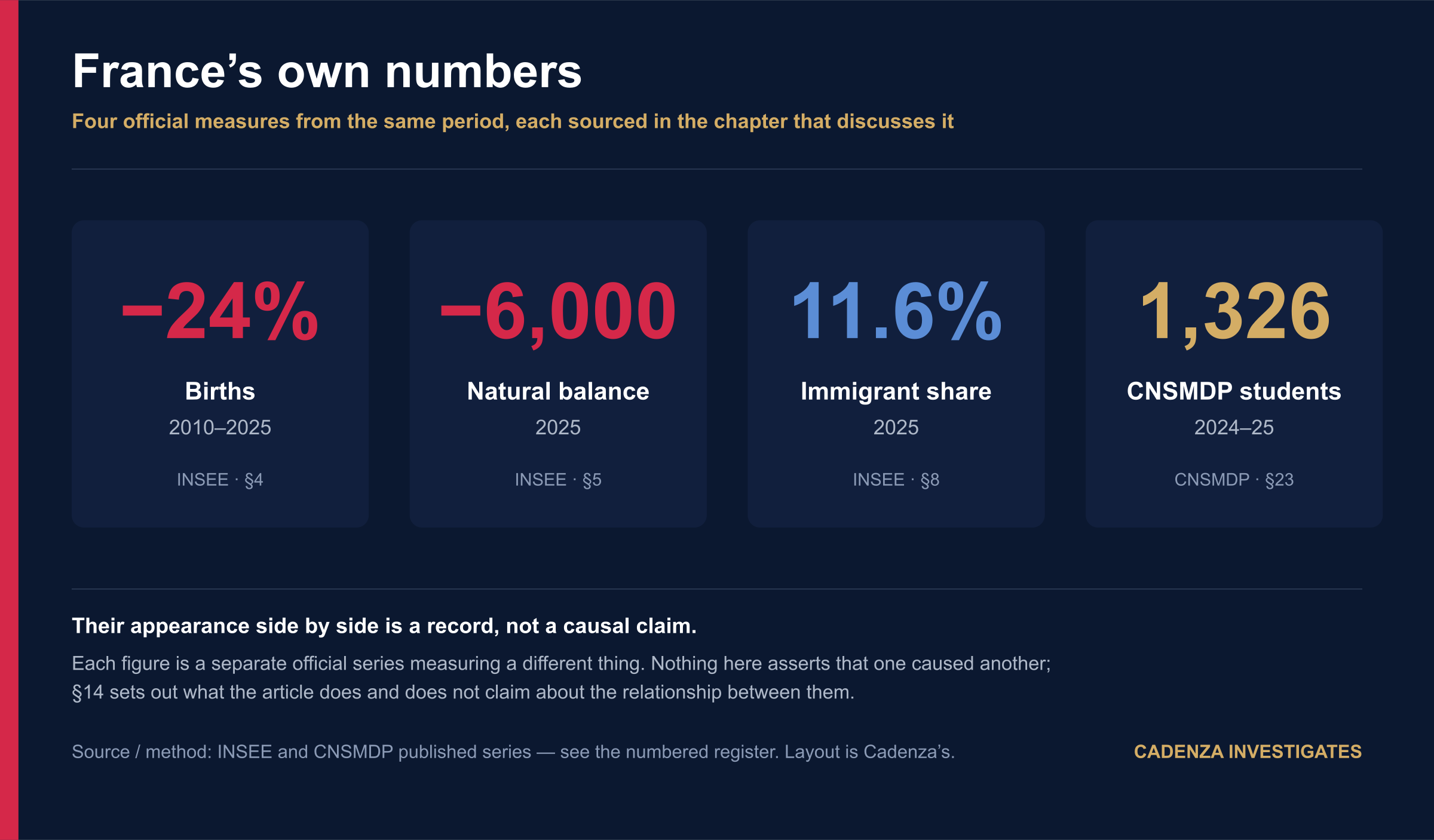
Four official measures from the same period, each sourced in the chapter that discusses it. Their appearance side by side is a record, not a causal claim — §14 sets out what this investigation does and does not argue about the relationship between them.
In the 1920s, musicians came to Paris to discover what music might become. They found Ravel, Stravinsky, Nadia Boulanger, Dukas, Les Six, the Ballets Russes, competing schools, publishers, salons, orchestras and a Conservatoire attached to a culture confident enough to judge, exclude, cultivate and lead.
A century later, musicians still come to Paris. They find an expensive, selective and internationally respected professional school. They find excellent individual players, state subsidy, European projects, administrative strategies, public events and impressive employment claims.
What they do not find is a country commanding the musical future of the world.
The institution survives. The authority is gone.
Around it, France recorded fewer births than deaths for the first time since the end of the Second World War. The immigrant share of the population reached an estimated 11.6%. Recorded physical violence, sexual violence, attempted homicide and narcotics offences rose. The government’s own security services continued warning about jihadism and organized political Islam. France kept spending billions on culture while failing to prove that the next France was being initiated into the inheritance those institutions were built to preserve. [S01] [S03] [S10] [S12] [S14] [S35]
Emmanuel Macron did not create every part of this decline. He became its perfect administrator.
He did not close the Paris Opera. He did not demolish the Conservatoire. He did not forbid Debussy, erase Ravel or empty the Louvre. He did something more characteristic of the managerial age: he preserved the monuments, expanded the programmes, digitized access and converted culture into a service—while the chain connecting family, school, public order, local conservatoire, elite training and national confidence weakened beneath him.
Macron inherited a civilization. He governed it like a platform.
This investigation uses French government statistics, public audits, security assessments and institutional records. It distinguishes immigrants from foreign nationals, suspects from convicts, Islam from Islamism, recorded crime from total victimization, institutional survival from artistic leadership, and state spending from cultural transmission.
It rejects collective guilt. It also rejects the governing class’s favorite evasion: using complexity to avoid judgment.
France’s own numbers are not a slogan. They are the prosecution.
THE SENTENCE THAT DEFINED AN ERA
1. “There is not one French culture”
In February 2017, candidate Emmanuel Macron told a rally that there was not one French culture, but rather a culture in France—diverse and multiple. [S26]
The sentence survives because it captured something larger than a campaign provocation. It expressed the operating philosophy of Macronism: the nation as an open platform, the state as manager, identity as a negotiated outcome rather than an inheritance, and cultural authority as something faintly suspicious unless distributed among many competing claims.
France has never been culturally sealed. The French language itself is an accumulation. Paris was shaped by Italians, Poles, Russians, Spaniards, Jews from across Europe, artists from the colonies and refugees from dictatorships. Debussy learned from Javanese gamelan at the 1889 Exposition. Ravel’s mother was Basque. Lully was born in Florence. The argument for French culture has never required ethnic purity.
But openness presupposes a centre strong enough to receive, transform and transmit. A river can take in tributaries because it has a course. A nation can absorb influences because it possesses institutions confident enough to decide what becomes part of the common inheritance.
Macron’s formulation inverted the burden. Rather than asking how diversity might enter French culture, it implied that France was primarily the venue in which multiple cultures happened to coexist. The political consequence was subtle but profound: the state became less willing to speak in the language of inheritance and more comfortable speaking in the language of access.
Access is necessary. It is not sufficient.
2. The clarification—and why it did not resolve the problem
Macron later corrected the impression. At a naturalization ceremony in Orléans, he affirmed that a French culture exists, described it as a river shaped by multiple tributaries and told new citizens that becoming French involved entry into a history, a language and a collective destiny. [S25]
That clarification matters. Fair criticism requires quoting both Macron’s most provocative sentence and his later, more traditional formulation.
But the contradiction remained. Which idea governed policy?
Was France a civilization whose inherited culture had to be learned, protected and extended? Or was it a neutral framework in which the state’s principal obligation was to fund participation among multiple identities? The Macron years repeatedly attempted to answer “both,” but avoided specifying what happened when the two objectives conflicted.
The result was a state willing to spend heavily on culture, yet reluctant to define cultural integration. A state willing to celebrate inclusion, yet unable to explain the duties of belonging with the same confidence it explained the rights. A state willing to tell every young person to consume culture, yet less willing to tell schools that mastery of a shared canon mattered.
This ambiguity did not create France’s demographic, security or educational problems. It made them harder to confront because it deprived the government of a clear language for explaining why cohesion mattered.
3. The platform presidency
Macron came to power as the political embodiment of administrative modernity. He distrusted inherited party structures, bypassed established institutions, elevated expertise, praised mobility and presented France as a start-up nation.
That approach could move quickly. It could launch a national cultural application, convene entrepreneurs, redesign an administrative process and place a new programme behind a polished interface. It was far less successful at answering questions that cannot be resolved by optimization:
- Why should French citizens have children?
- What level of immigration can schools, housing and public services absorb?
- What conduct must be required for belonging?
- What should happen when removal orders are not executed?
- Which cultural works and historical references should every child know?
- How should the state protect continuity without freezing culture into propaganda?
Macronism was strongest where France needed a manager. It was weakest where France needed a definition of itself.
By March 2026, 23% of respondents in an Ifop survey said they were satisfied with Macron’s performance — a rise of five points on February, from a very low base. That poll is a snapshot, not a verdict on every claim in this article. But it records the exhaustion surrounding a presidency that promised transcendence and came to symbolize detachment. [S27]
THE COUNTRY THAT STOPPED REPRODUCING ITSELF
4. The collapse in births
France recorded 645,000 births in 2025 — 24% fewer than in 2010, the year of the last peak in births, and 2.1% fewer than in 2024. Fertility fell to 1.56 children per woman in 2025, down from 1.61 the year before and the lowest level since the end of the First World War. [S01] [S02]
That collapse did not begin with Macron, and it cannot be assigned to one president. Fertility decline reflects housing, family formation, delayed childbirth, economic insecurity, changing values, education, work patterns and the cost of raising children. France remains less demographically fragile than some European neighbors.
Yet a president governs the trajectory he inherits. Macron entered office in 2017 when the trend was already visible. He leaves a France in which births are far below the level at the beginning of the century and family policy no longer carries the civilizational priority it once did.
The French social model was built on intergenerational confidence: workers funding pensions, families supplying future citizens, schools transmitting a common culture and the state promising continuity. A sustained birth decline weakens each link.
The scandal is not that government can command children into existence. It cannot. The scandal is that the political class discusses fertility as a technical variable while treating almost every competing social priority as a moral emergency.
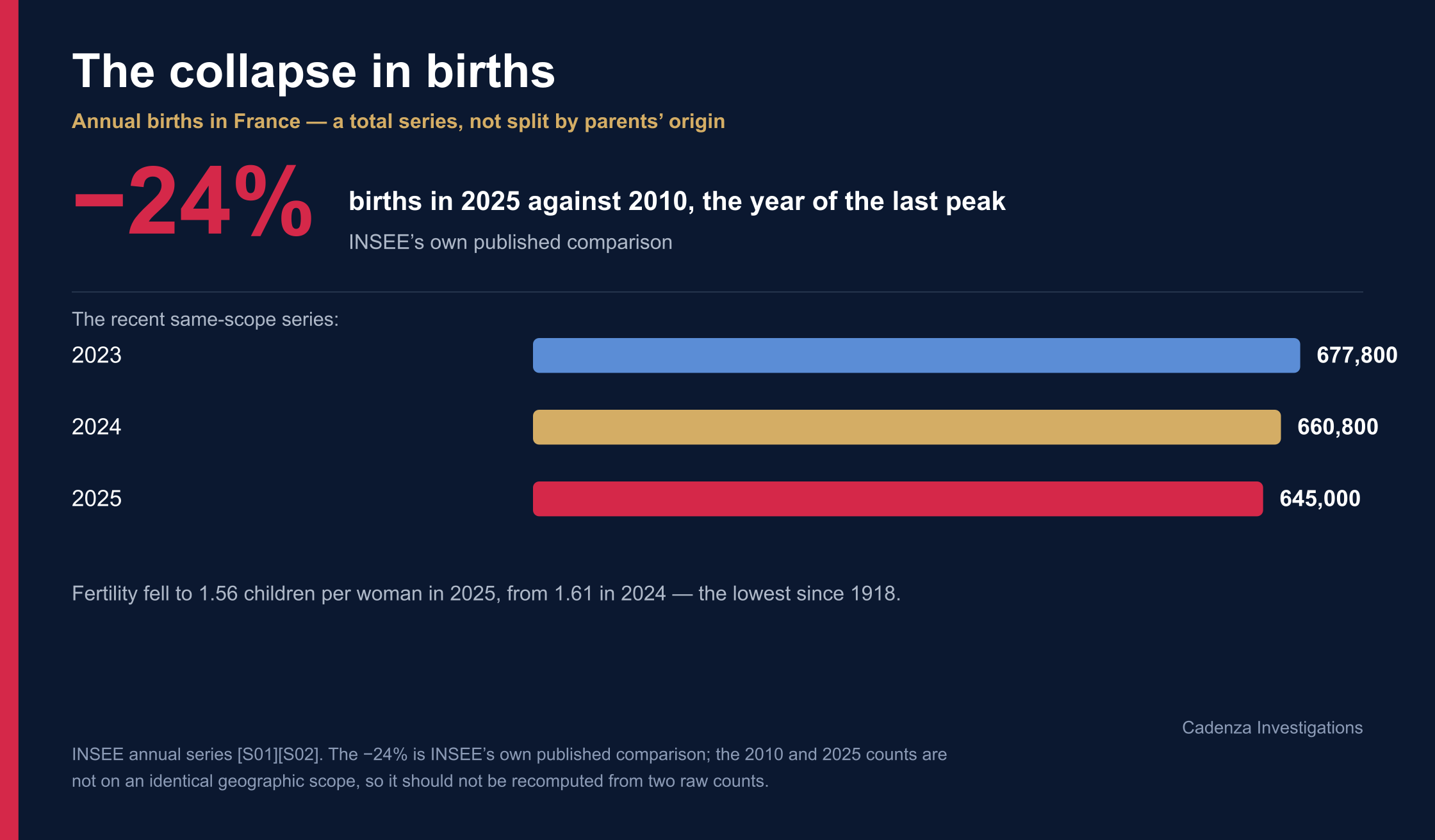
INSEE annual birth series. The line shows the scale of decline; it does not assign causation to immigration or to a single presidency.
5. More deaths than births
In 2025, France recorded 651,000 deaths and 645,000 births. The natural balance fell to minus 6,000. For the first time since the end of the Second World War, France had more deaths than births. [S01]
Six thousand is small against a population of 69.1 million. The significance is historical rather than apocalyptic. A threshold has been crossed.
France is aging. Twenty-two percent of the population was 65 or older at the start of 2026, roughly the same share as those under twenty. The postwar generations that financed and staffed the cultural state are moving into retirement and mortality at the same time as the number of children entering schools declines.
For classical music, the demographic equation is direct. Fewer children mean fewer potential instrumentalists, fewer families entering conservatories and a smaller base from which elite talent can emerge. An aging population also changes public budgets: pensions, health and care compete with artistic education, municipal theatres and regional orchestras.
The Paris Opera can remain full during this transition. The Conservatoire can maintain its ranking. Demographic decline often reveals itself first in the base, not the summit.
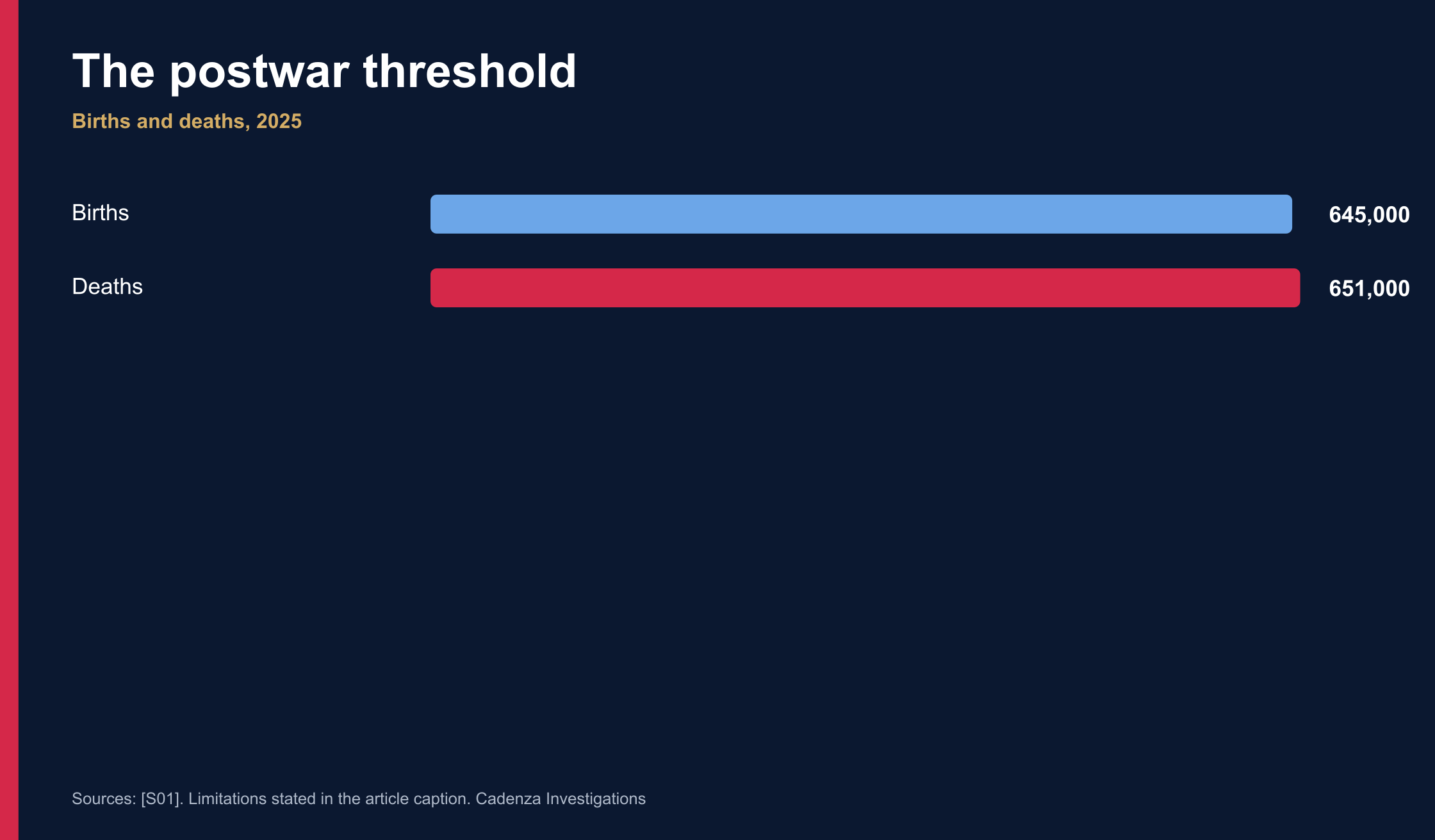
Births and deaths are provisional 2025 figures. A negative natural balance is a threshold, not proof that France will shrink every year.
6. Migration becomes the engine of population growth
France’s population still increased in 2025. It did so principally because estimated net migration added roughly 176,000 people, while a statistical adjustment added another 60,000 and the natural balance removed 6,000. [S01]
That does not mean every migrant is permanent, culturally distant or economically dependent. It means the mechanism of growth has changed.
For decades, France combined immigration with relatively strong fertility. The new situation is different: a falling birth count, negative natural growth and continued population increase through migration. That places far greater pressure on integration because new arrivals and their descendants are not a marginal demographic addition. They are part of the country’s future core.
The politically serious response is neither denial nor panic. It is to ask whether France possesses the institutions required to transform demographic change into national continuity.
Macron’s government expanded integration programmes, language training and administrative pathways. But the scale of the cultural task was larger than the state’s conception of integration. Employment and housing are essential. They do not alone produce a shared historical consciousness or attachment to French institutions.
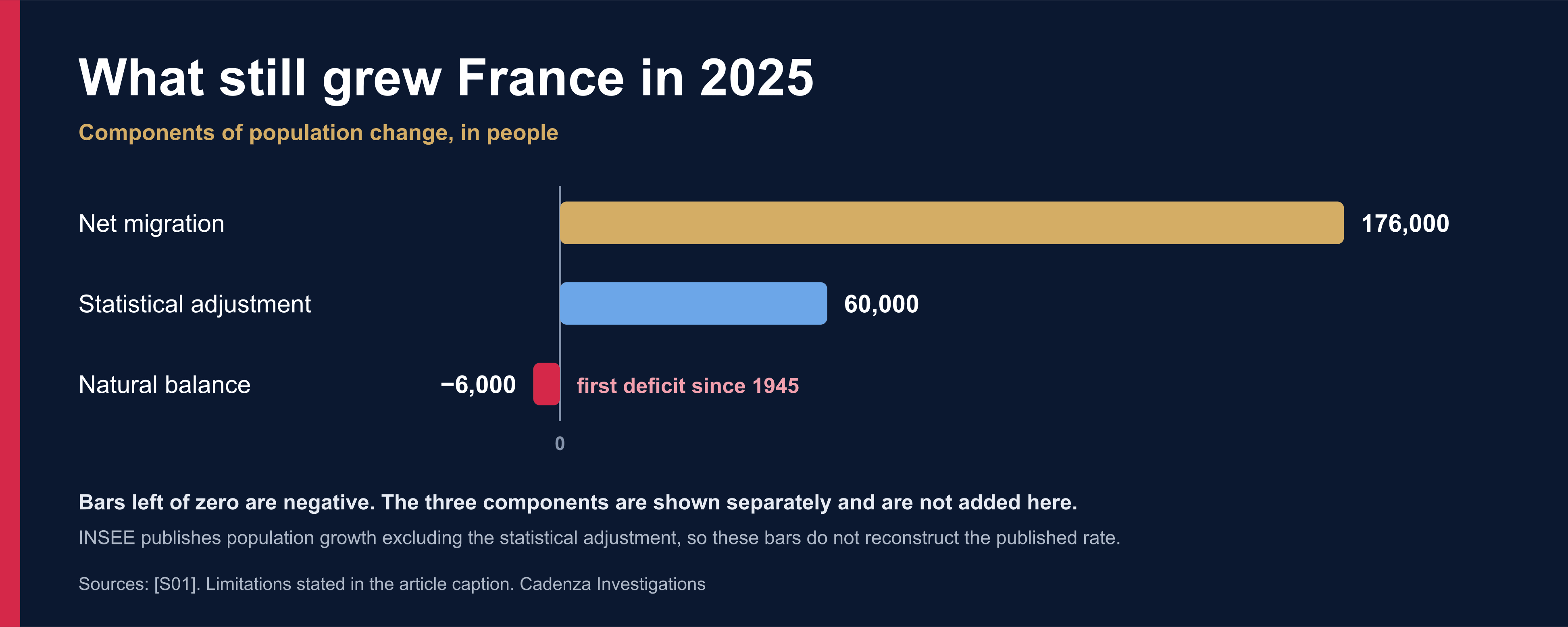
The components are shown separately. The statistical adjustment is not migration.
7. A fertility policy without a civilizational argument
France once possessed one of Europe’s most explicit family policies: allowances, tax treatment, childcare and a social prestige attached to the family as a national institution. That system has not disappeared. Its cultural meaning has weakened.
A state cannot ask people to form families merely to balance pension tables. Parenthood requires confidence that the future is worth entering. It depends on housing, stable work, time, safety and a belief that children will inherit more than debt and administrative decline.
Macron’s France offered individual emancipation and economic flexibility more convincingly than continuity. The government could announce a birth plan, expand reproductive medicine or adjust benefits. It struggled to articulate why the survival of French generations was itself a public good.
This matters because demographic policy and cultural policy are the same question viewed from different ends. Culture is the memory a population transmits. Demography is the existence of a population to receive it.
EIGHT MILLION IMMIGRANTS, ONE UNANSWERED QUESTION
8. Definitions before rhetoric
In 2025, 8.0 million immigrants lived in France, equal to 11.6% of the population. INSEE defines an immigrant as a person born abroad as a foreign national. Approximately 2.6 million had acquired French nationality. France also had 6.3 million foreign nationals, including people born in France who had not yet acquired citizenship. [S03]
These categories overlap but are not identical.
A naturalized Algerian-born citizen remains an immigrant in the statistical series and is French in law. A foreign-born child of French citizens may not be classified as an immigrant. A French citizen whose parents or grandparents immigrated is counted as French, not foreign.
Political debate repeatedly collapses these distinctions because imprecision is useful to both sides. Restrictionists sometimes inflate figures by combining categories. Defenders of current policy sometimes use definitional complexity to make public concern appear ignorant.
This investigation will do neither. Eight million is a real number. So is the fact that one-third of those immigrants had become French citizens. The question is not whether they exist. The question is what successful integration should mean beyond possession of documents.
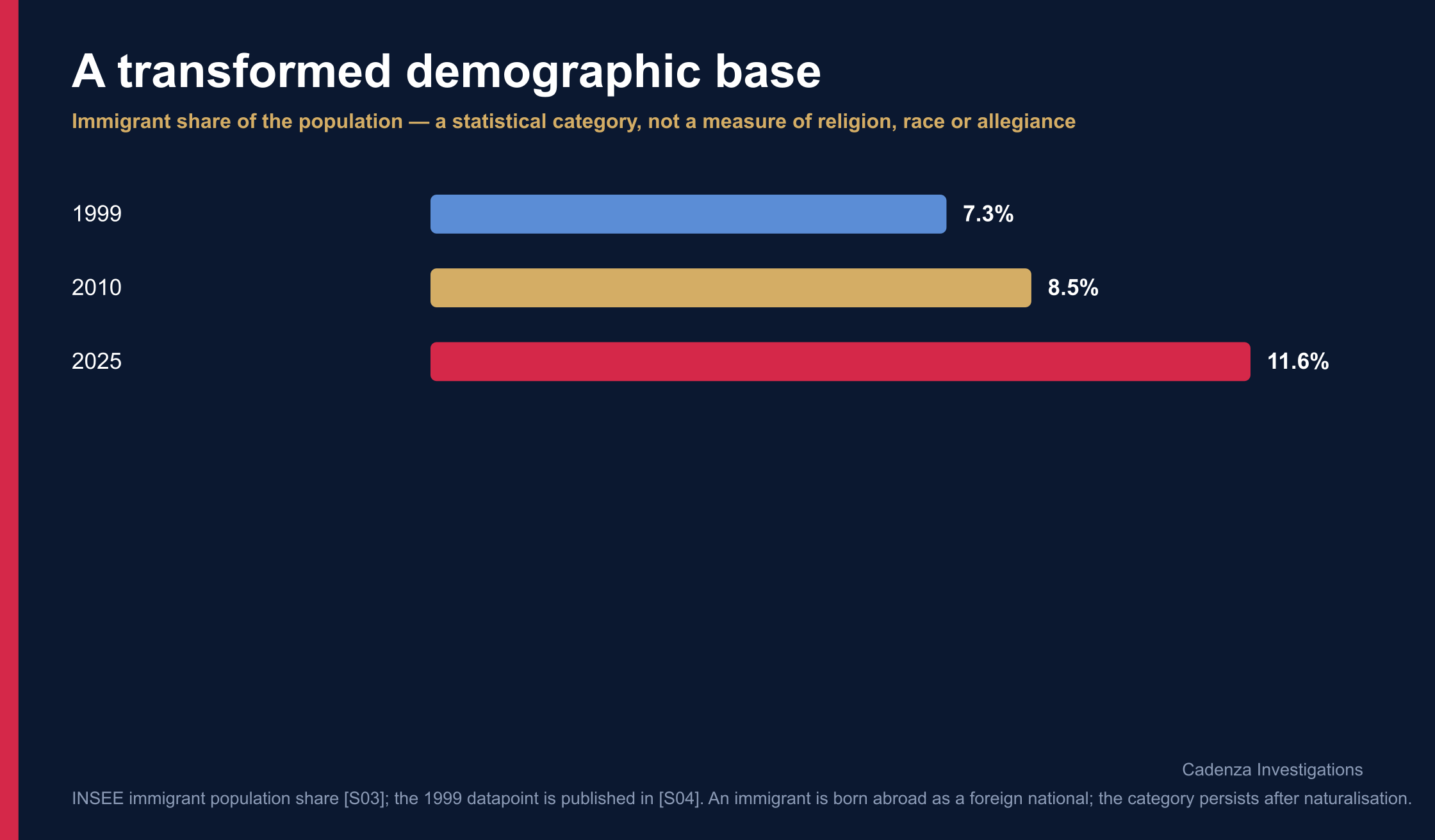
The statistical definition is preserved. This is not a measure of religion, race or allegiance.
9. Where immigrants came from
Nearly half of France’s immigrants in 2025 were born in Africa, 30% in Europe, 14% in Asia and 6% in the Americas or Oceania. [S03] [S04]
Those regional groups conceal enormous differences. A Portuguese engineer, an Algerian family-reunification migrant, a Ukrainian protected person, an Afghan refugee, an American executive and a Chinese conservatory student do not enter France through the same route or face the same integration problems.
But origins matter because language, educational background, religion, family networks and prior institutions affect how easily people navigate French society. It is not bigotry to observe cultural distance. It is irresponsible to assume distance closes automatically.
France’s relationship with Africa is especially complex. Colonial history created linguistic and familial ties, but also grievances, political tensions and transnational networks. The state cannot resolve these contradictions by alternating between guilt and denial.
A confident integration policy would make a clear offer: France does not ask newcomers to erase their ancestry. It does require acceptance of French law, public order, equality between men and women, freedom of expression, the secular state and a common civic and cultural inheritance.
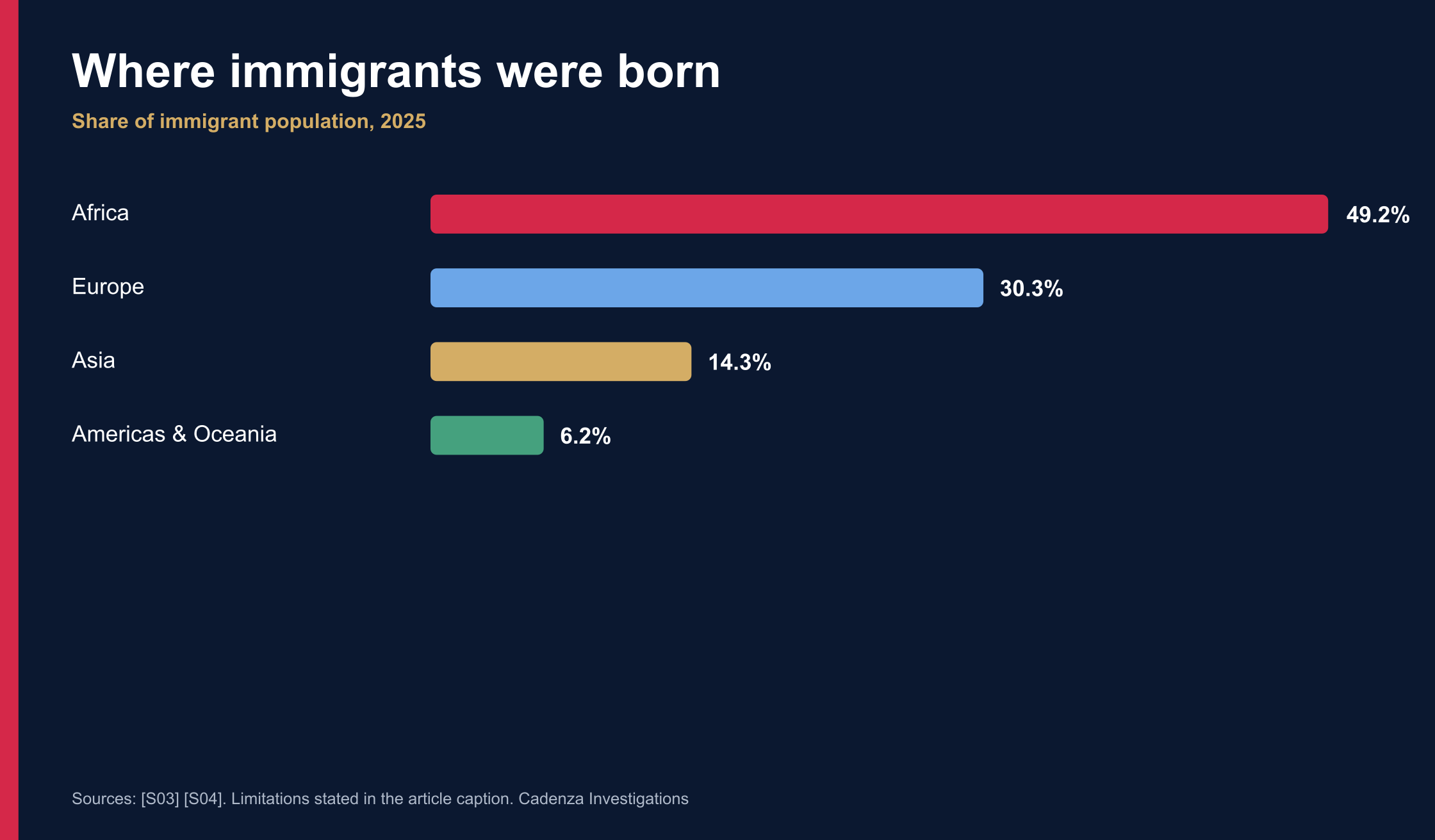
Broad regional categories should not be treated as uniform populations.
10. The France of 2050 is already in school
Among descendants of African-origin immigrants, 41% were under fifteen and another 22.8% were aged fifteen to twenty-four in the latest INSEE breakdown. In some African-origin subgroups, more than half were under fifteen. [S05]
These children are not “future immigrants.” Many are French by birth and law. They are the future French public.
The question “Who will inherit Debussy?” is therefore not a disguised demand for ethnic exclusion. It is a test of whether the Republic believes its inheritance belongs to these children strongly enough to teach it.
If France assumes that classical music, literature, secularism and national history are merely the private culture of an older native population, the country will create parallel inheritances. If it presents those traditions as national property open to every child, it can renew them.
The choice is political. Integration succeeds when the state expects belonging and supplies the institutions through which belonging becomes possible.
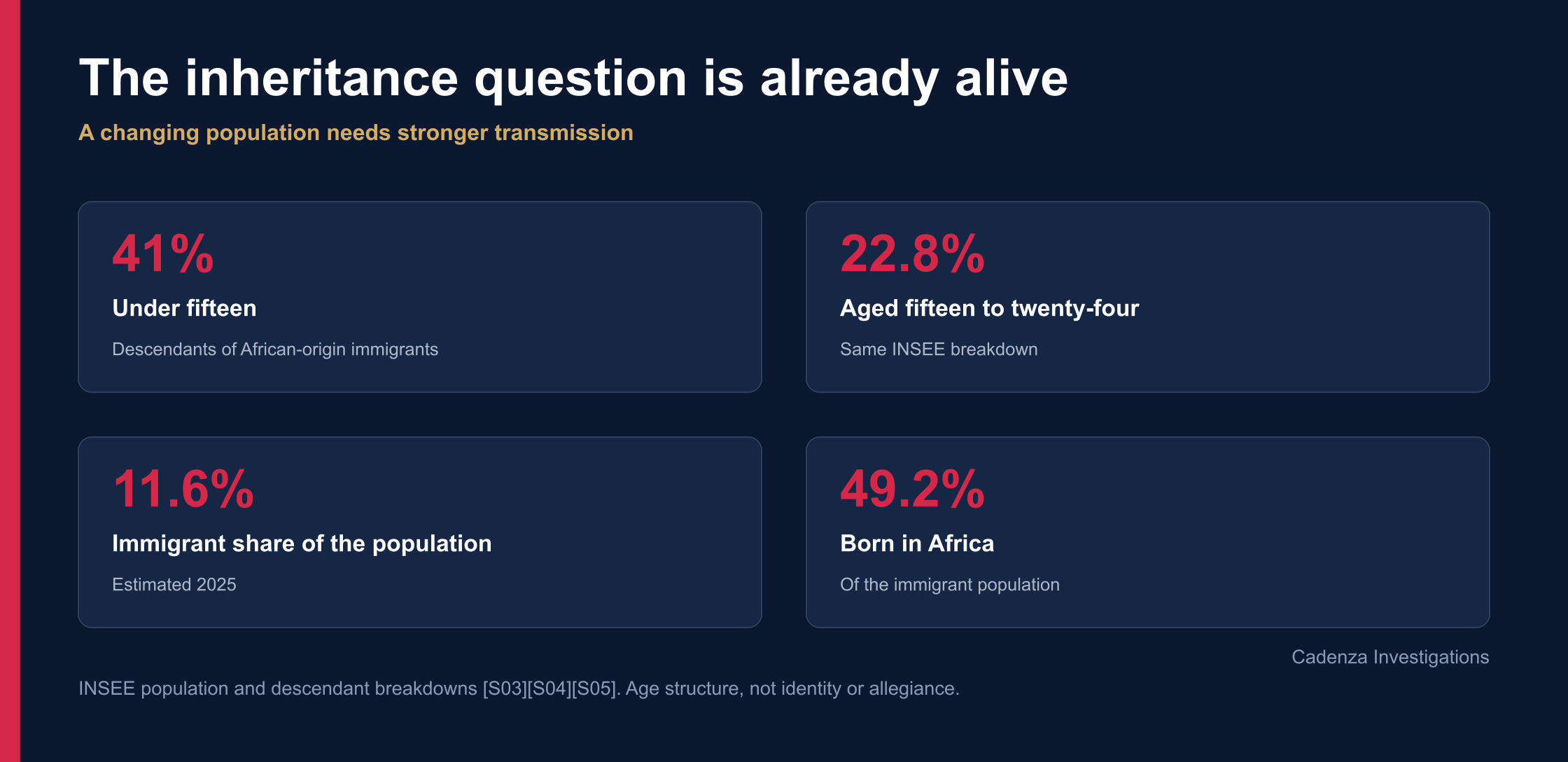
Age distributions show why cultural transmission is urgent. They say nothing about individual identity or loyalty.
11. 377,462 first residence permits
France issued 377,462 first residence permits to non-EU nationals in 2025, up 9.2% from 2024. Students accounted for 116,835, family grounds for 90,959, humanitarian grounds for 88,001, economic grounds for 50,848 and other grounds for 30,819. [S08]
Permits are not the same measure as arrivals. INSEE counts 438,000 people arriving in France in 2024, of whom 313,000 were immigrants — a different population, on a different definition, in a different year. The two must never be treated as one flow. [S36]
The distribution complicates every slogan.
Students were the largest category. Humanitarian permits rose sharply, driven by refugees, stateless persons and subsidiary protection. Economic permits declined. Family migration remained almost flat.
A government serious about immigration would publish not only totals but expected duration, transition rates, employment, language attainment, regional distribution and the long-term fiscal and integration outcomes of each route.
France’s problem is not that no data exist. It is that figures are distributed across bureaucratic reports and rarely assembled into a public strategy ordinary citizens can understand.
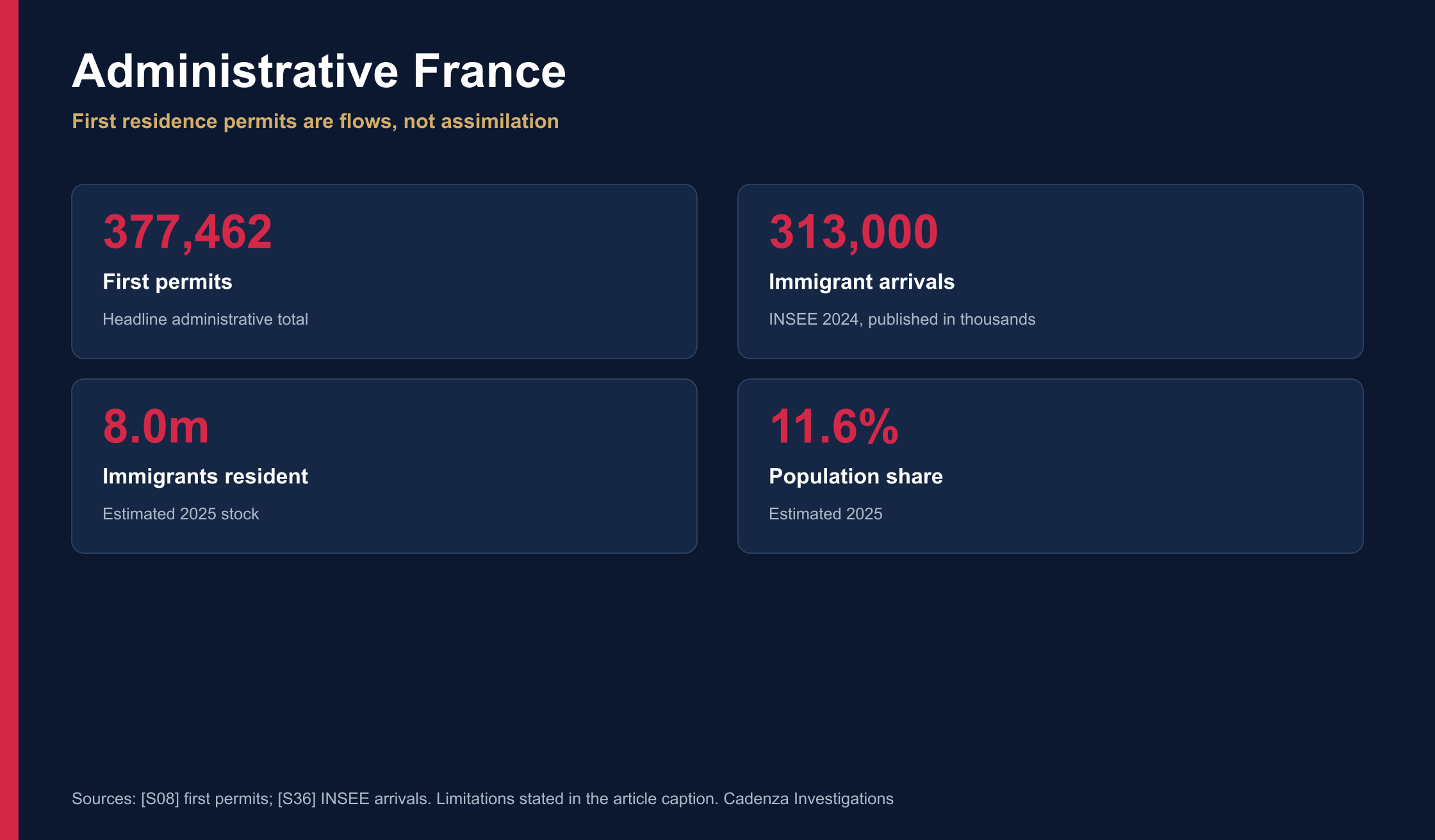
First permits are an administrative measure for non-EU adults, not a complete measure of all arrivals or net migration.
12. The enforcement gap
In 2025, the Interior Ministry reported 23,549 implemented removals of irregular foreign nationals, including 14,133 forced removals. It also recorded 175,051 apprehensions of people in irregular status and 7,394 spontaneous departures outside formal removal decisions. [S09]
These categories cannot be directly subtracted from first permits. Legal entrants and people subject to removal are different populations.
They nevertheless expose a capacity problem. France can identify large numbers of people in irregular status, issue removal decisions and devote substantial resources to enforcement while implementing relatively few physical removals.
The Cour des comptes estimated the direct annual cost of the anti-irregular-immigration policy at approximately €1.8 billion and the personnel commitment at around 16,000 full-time equivalents. It described a fragmented system without a coherent overall strategy. [S11]
A state that cannot make its legal decisions credible damages both restriction and integration. It teaches citizens that rules are optional and migrants that outcomes depend on procedural endurance.
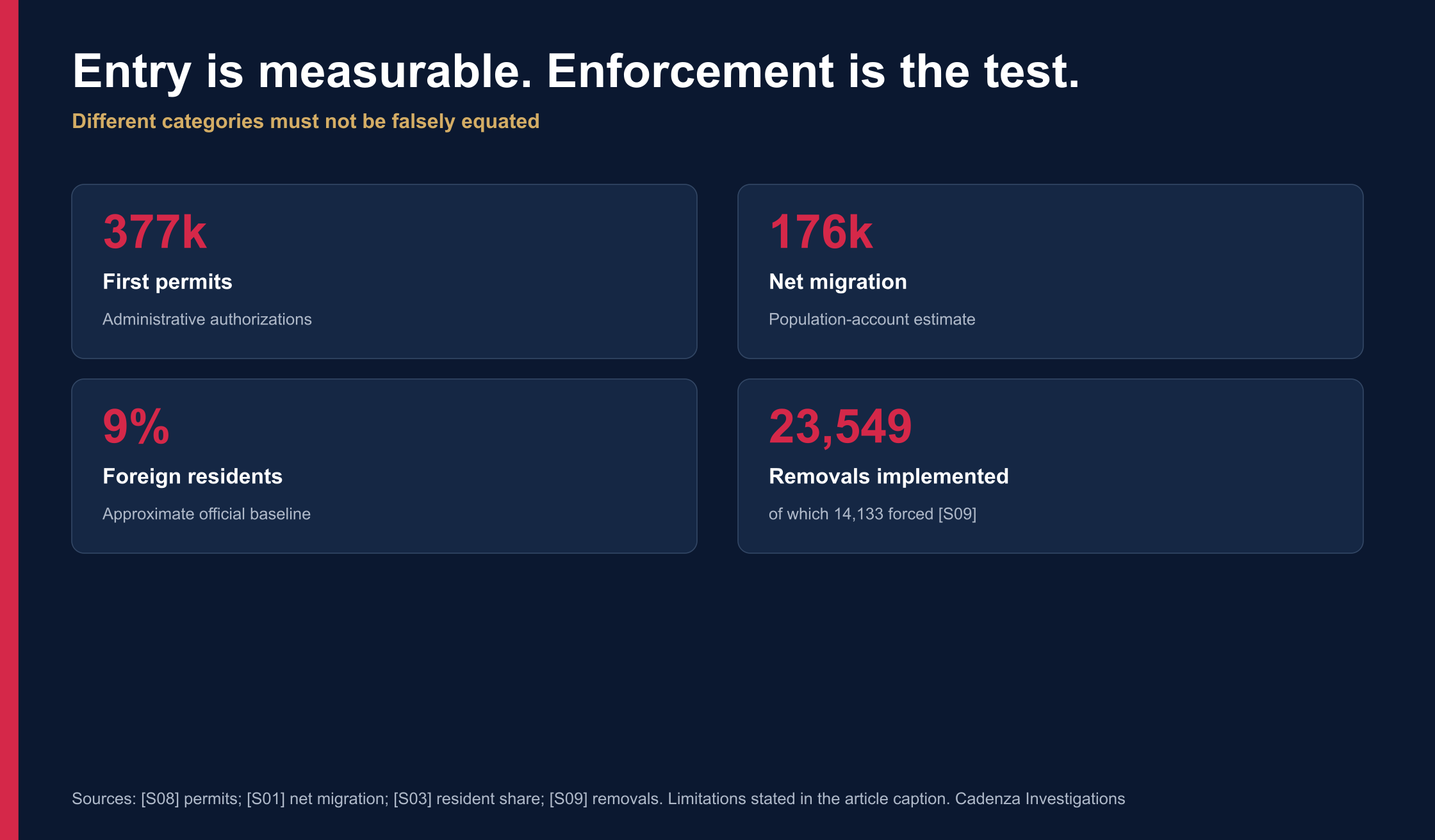
The side-by-side figures illuminate scale but should never be represented as a one-for-one migration balance.
13. Integration measured honestly
The AGIR programme offers one of the clearest windows into the practical work of integration for beneficiaries of international protection. By the end of 2025, 46,554 people had entered the programme. Nearly 79% were without employment or training at entry. Among those accompanied for six months or more, the overall positive-exit rate — counting employment and/or housing ending in a durable situation — was 37.2%. The ministry also publishes two narrower rates on their own denominators: of those who received housing support, 64.4% left with durable housing, and the positive-exit rate towards employment was 42.4%. Those two figures are not shares of the same group and must not be read as one. [S10]
These figures show both difficulty and progress. A serious article cannot cite only the 79% entering without employment while hiding the employment and housing outcomes. Nor can it quote the employment and housing rates without the overall figure beneath them: counting employment and housing together, fewer than four exits in ten ended in a durable situation.
Integration requires time, language, qualifications, employers, housing and local capacity. It also requires norms. Employment can integrate a person into an economy without integrating that person into a national culture.
Macronism concentrated on measurable administrative outcomes because they fit the machinery of government. The missing metric was inheritance: what new citizens knew about France, how strongly they identified with it and whether the common culture became stronger rather than merely more diverse.
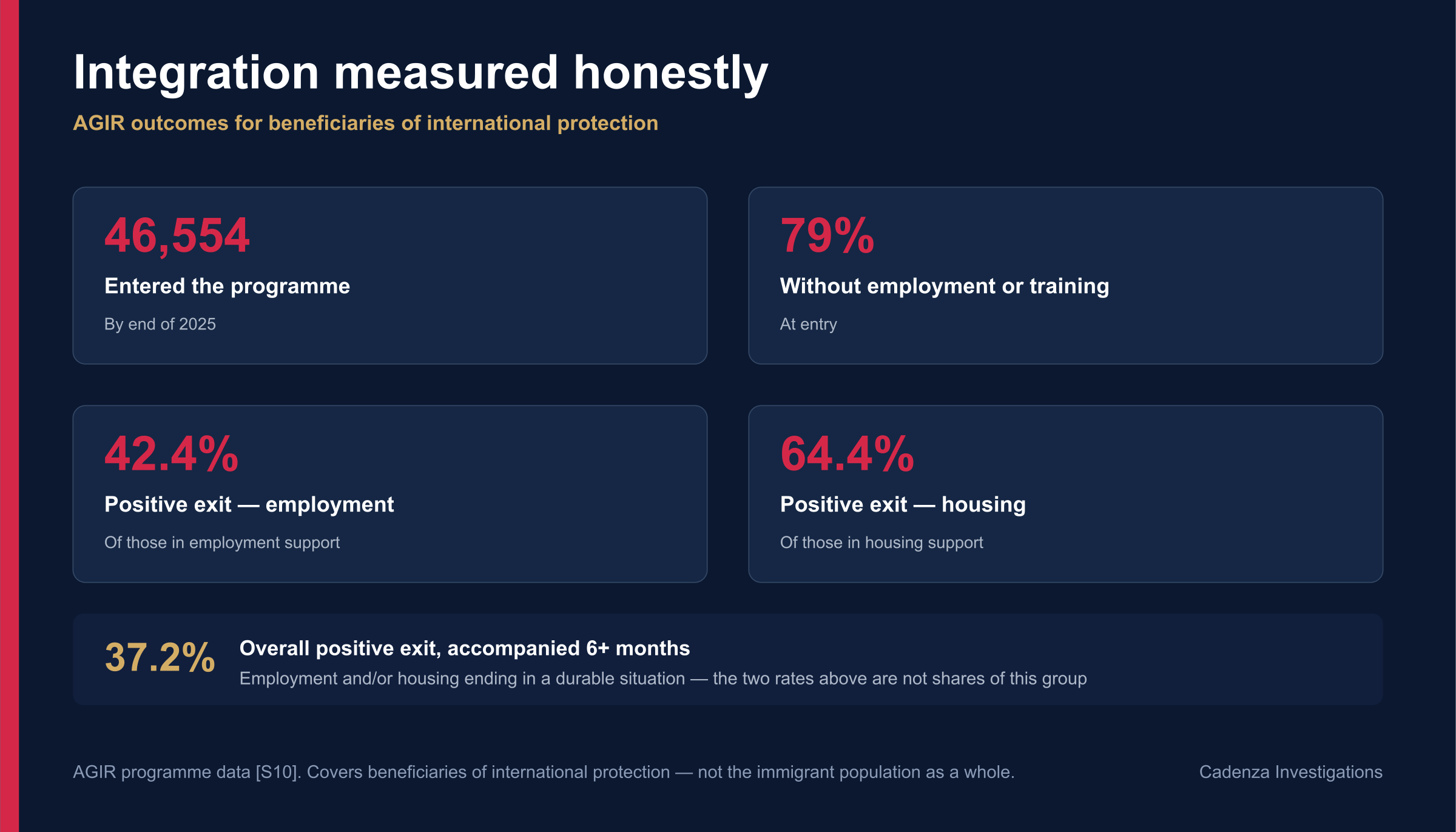
AGIR covers beneficiaries of international protection, not the immigrant population as a whole.
14. The failure belongs to the state, not to a category of people
It is intellectually lazy to treat eight million immigrants as a single political actor. It is equally lazy to insist that migration has no consequences because individuals differ.
Large-scale demographic change raises predictable demands: housing, schools, language instruction, policing, transport, medical care, labour-market entry and civic transmission. If the state accepts the change, it assumes responsibility for meeting those demands.
Macron’s defenders often describe concern about immigration as a moral defect among the French. That response protects the government from accountability. Citizens who live around failing schools, overloaded services or persistent disorder are told that the national averages are more authoritative than their experience.
The alternative is not collective blame. It is political responsibility: control the volume, select transparently, enforce decisions, distribute arrivals according to capacity, demand integration and publish outcomes.
Newcomers who want to become French are also failed by a system that leaves them in segregated neighbourhoods, low-employment conditions or schools too weak to transmit the language and culture of the country they entered.
THE CRIME LEDGER
15. “It has never been worse” is not a statistic
The claim that every crime category is at a record level is false. France’s 2025 data show a mixed picture.
Recorded physical violence rose 5%. Sexual violence rose 8%. Rape and attempted rape rose 9%. Attempted homicide rose 4%. Drug-use offences rose 7% and trafficking offences 9%. Homicides were stable at 975 victims. At the same time, residential burglary fell 3%, vehicle theft 9% and theft from vehicles 9%. [S12]
The honest indictment is therefore more precise and more disturbing: France made progress against several traditional property crimes while offences affecting bodily security and the narcotics economy continued to rise.
Recorded figures reflect more than offending. Victims may be more willing to report. Police may record complaints more accurately. Laws and classifications change. Drug offences are especially sensitive to enforcement activity.
None of those caveats makes the victims disappear.
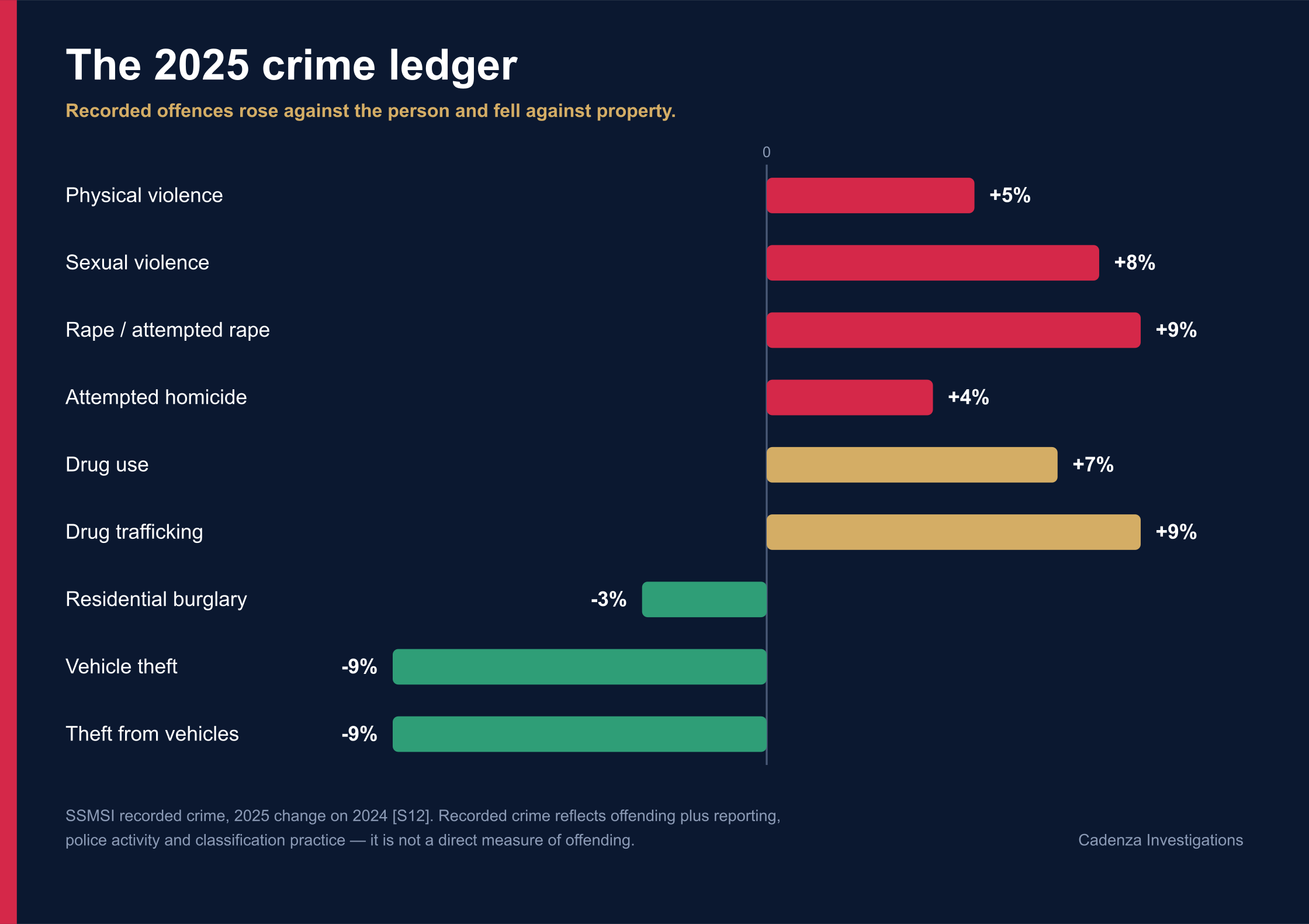
The chart includes both rising and falling indicators so the argument cannot be dismissed as selective panic.
16. The victims the abstractions conceal
Police and gendarmerie recorded 473,000 victims of physical violence in 2025, including 114,500 minors. They recorded 132,300 victims of sexual violence, including 76,200 minors. Physical-violence victims increased 5%; sexual-violence victims increased 8%. [S13]
More than half of recorded physical violence occurred within the family. Most sexual violence occurred outside it. This is not a simple street-crime narrative, and immigration cannot be used as a universal explanation.
But citizens do not experience violence as an econometric debate. They experience it as fear, injury, silence, failed prosecution and the decision not to let children travel alone.
A government that treats public concern as exaggeration loses legitimacy even when it can produce declining theft statistics. The state’s first cultural obligation is order. No conservatory, opera or museum can transmit confidence in a country whose citizens no longer believe basic rules will be enforced.
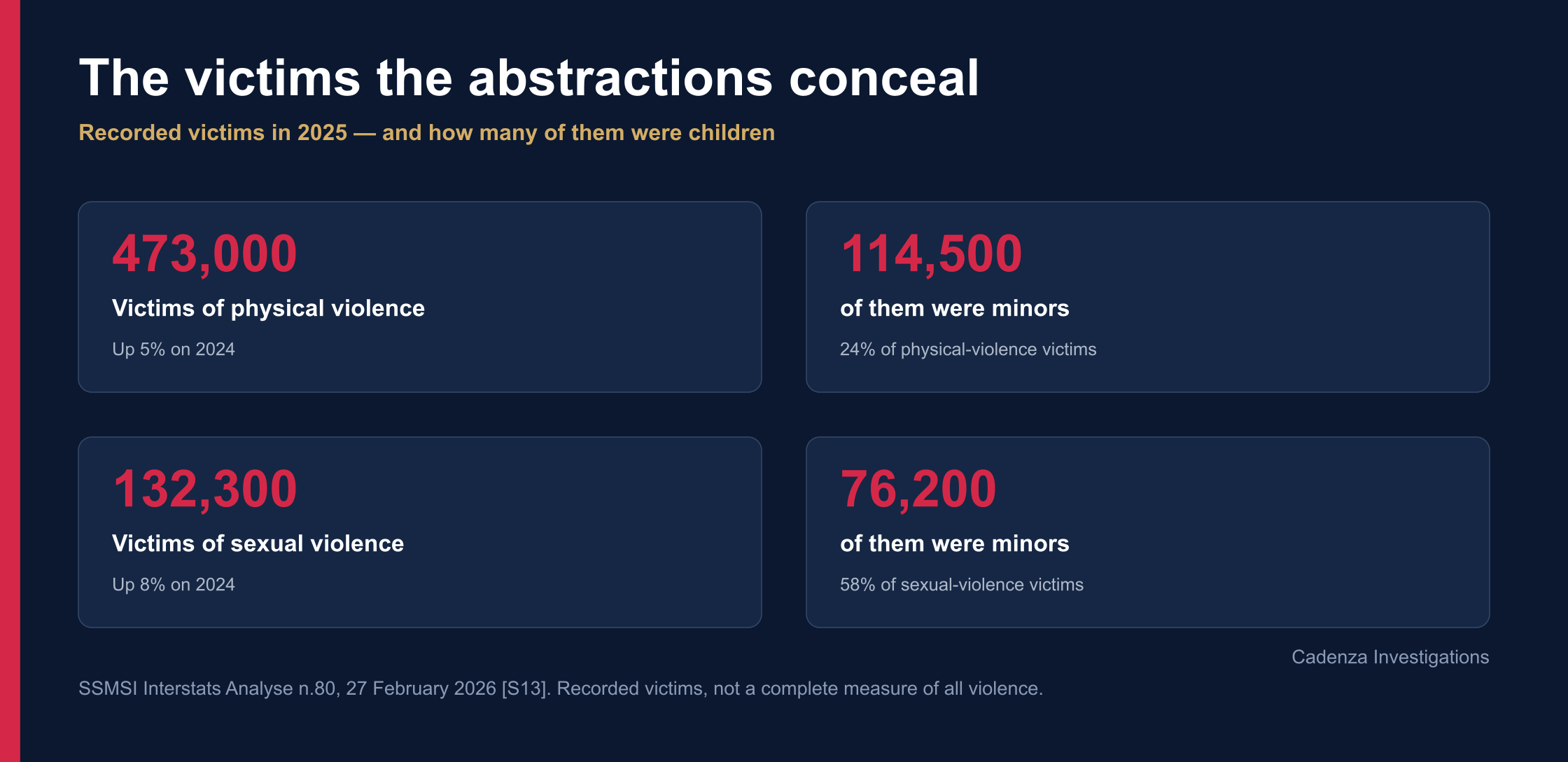
Recorded victim counts are not a complete measure of all violence, but they are too large to be dismissed as perception.
17. Foreign-national overrepresentation: the figures and the limits
Foreign nationals represented approximately 9% of residents in France. In the final 2025 statistical picture, they represented 37% of suspects identified in cleared cases involving thefts from vehicles, 36% in residential burglaries and 33% in violent robbery without a weapon. [S12]
These disparities are real. They should not be hidden.
They also require strict definitions. “Foreign” means current nationality, not immigrant origin. A naturalized citizen is counted as French. A tourist, transient offender or irregular resident may be counted as foreign. “Mis en cause” means identified as a suspect in a recorded and cleared case, not convicted by a court.
Age, sex, poverty, urban concentration, tourism, criminal networks and police exposure affect the comparison. The data do not prove that immigrants collectively are more criminal, and they say nothing about millions of law-abiding foreign nationals and citizens of immigrant background.
The responsible political conclusion is still unavoidable: some offence categories show severe foreign-national overrepresentation, and a state that refuses to investigate the mechanisms behind it is abandoning both public safety and honest integration.
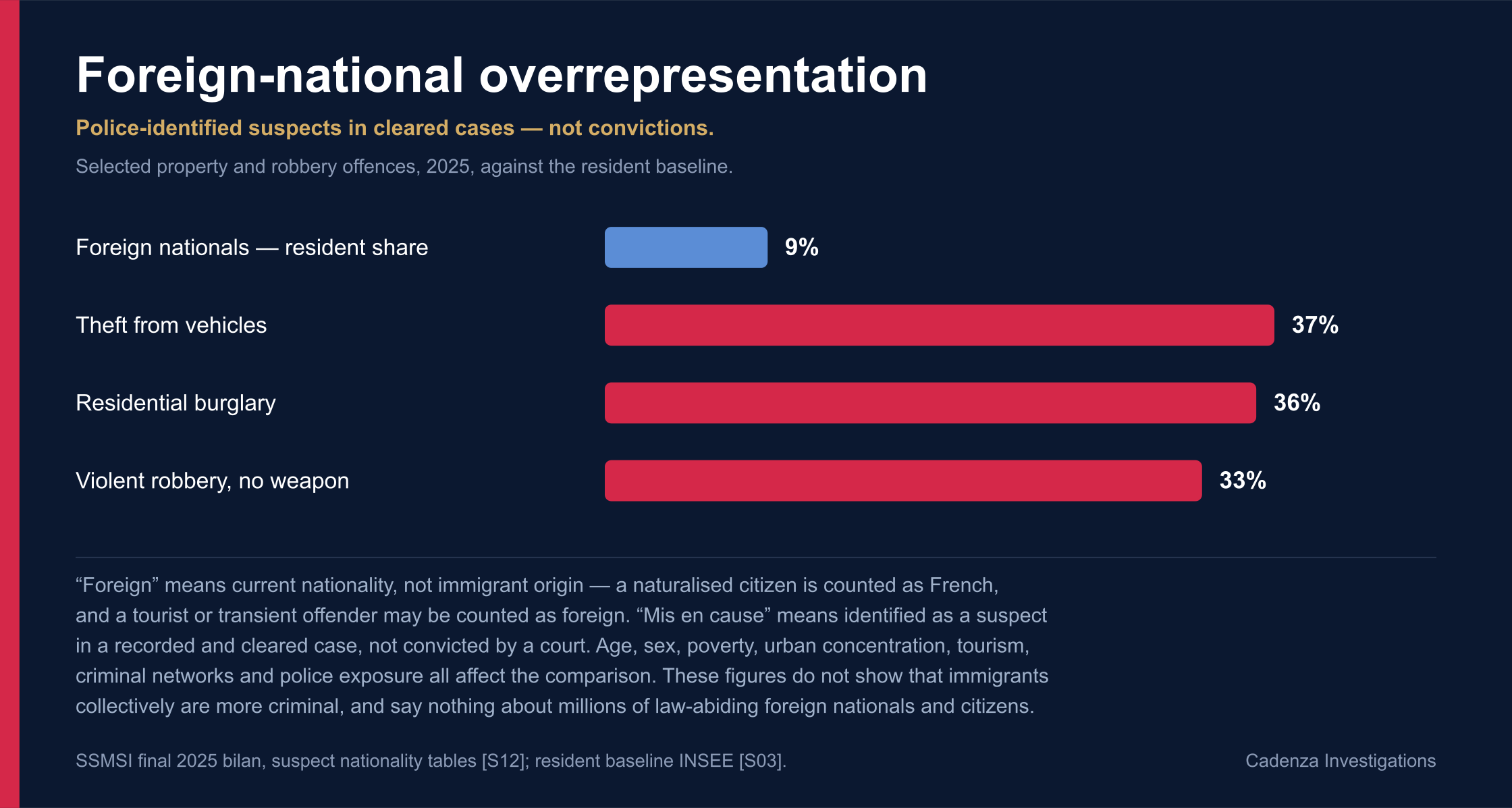
“Foreign” means current nationality, not immigrant origin: a naturalised citizen is counted as French, and a tourist or transient offender may be counted as foreign. “Mis en cause” means identified as a suspect in a recorded and cleared case, not convicted by a court. Age, sex, poverty, urban concentration, tourism, criminal networks and police exposure all affect the comparison. These figures do not show that immigrants collectively are more criminal, and say nothing about millions of law-abiding foreign nationals and citizens.
18. The two Frances
Recorded crime is highly concentrated. In 2025, the 1% of communes most affected—around 350 communes—accounted for between 38% of recorded home burglaries and 82% of violent robberies without a weapon. In contrast, 58% of communes recorded none of the fourteen monitored indicators on average. [S14]
National debate therefore contains two valid but incompatible experiences.
One France lives in towns and villages where serious crime is rare, social continuity remains visible and national alarm can sound exaggerated. Another lives in concentrated urban areas where theft, drug dealing, intimidation and violence shape daily decisions.
Macron’s politics often spoke from the first France to the second: aggregate statistics, reform language and moral reassurance. The resentment was not created by data. It was created by the gap between official tone and lived reality.
Any national restoration must be territorial. It must direct police, schools, housing enforcement, cultural institutions and employment policy toward the places carrying the greatest burden—not average the problem away.
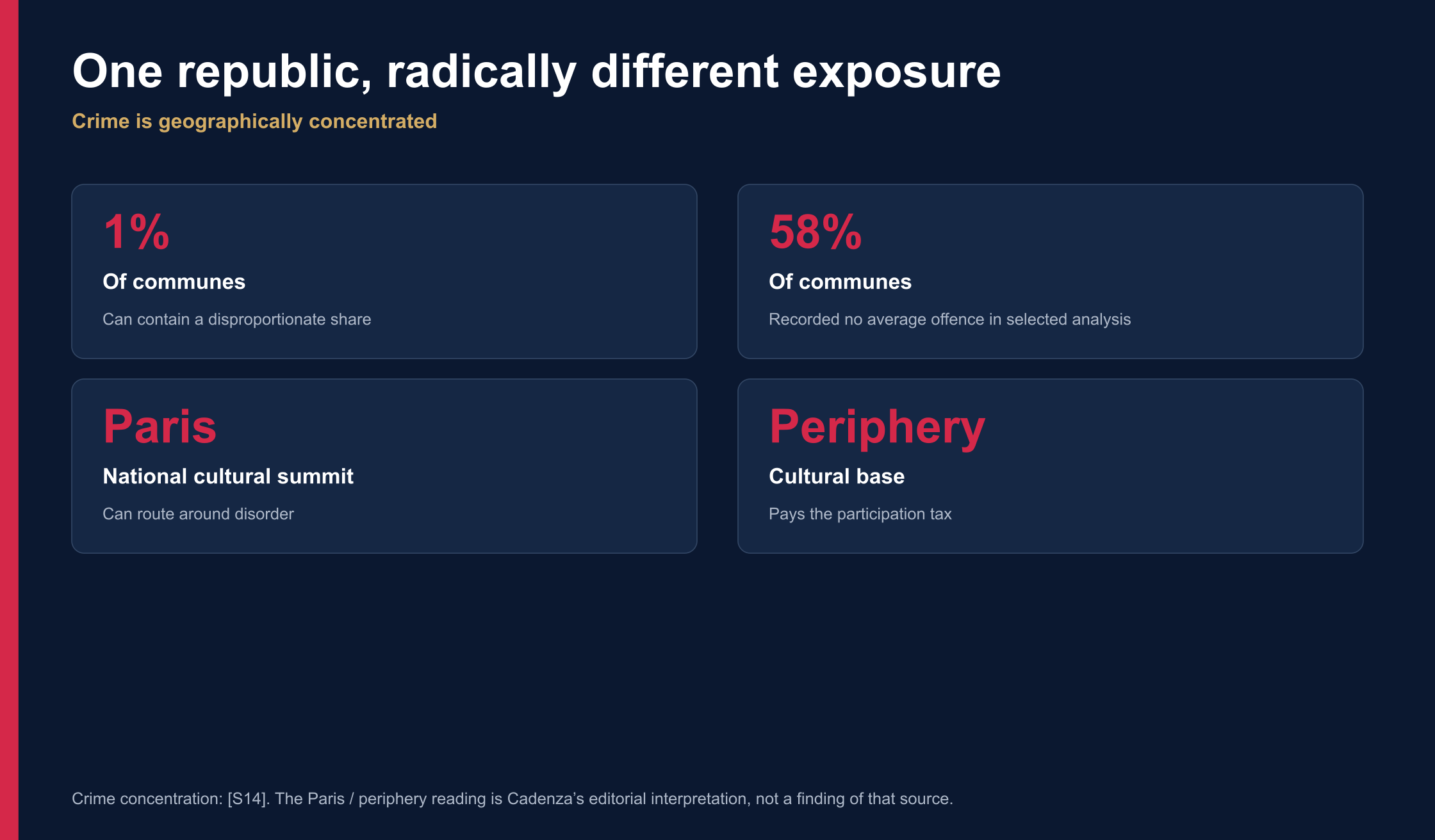
The concentration is an official statistical finding. It does not imply that every resident of the affected communes experiences the same risk.
19. The narcotics state within the state
Drug-use offences rose 7% and trafficking offences 9% in 2025. These figures partly reflect enforcement, but the long-run trafficking increase is not an accounting illusion. [S12]
Drug markets undermine more than safety. They create alternative authority. Dealers control stairwells, streets and informal economies. Families adapt their movements. Businesses close. Young people learn that the local state is slower and less certain than the network operating beneath it.
This is a cultural crisis in the most literal sense. Public space teaches values. When impunity becomes visible, it transmits a rival lesson about power.
Macron’s France frequently announced plans against trafficking. The continuing rise in recorded trafficking offences shows the scale of the enemy and the limits of episodic enforcement.
20. Trust is itself a public institution
Crime data can improve while trust declines, and trust can collapse while some offences fall. Citizens judge the state not only by annual percentages but by whether consequences feel predictable.
Can police intervene? Will prosecutors act? Will sentences be carried out? Will an irregular foreign offender be removed? Will a school protect teachers? Will political leaders describe what happened in ordinary language?
Macronism’s greatest public-order failure may have been rhetorical. It often treated disorder as a policy challenge and public anger as a communications challenge. The sequence should have been reversed: restore order, then explain.
CULTURE WITHOUT TRANSMISSION
21. France did not stop spending
The Ministry of Culture presented its 2025 budget as the highest in its history: €4.45 billion in budget credits, with another €4.03 billion for public broadcasting. Local authorities spent €10 billion on culture in 2024. The cultural sector generated €49.5 billion in value added in 2023. [S15] [S16] [S32]
These figures use different years and accounting scopes and must not be casually added. They do prove that France still operates an immense cultural state.
That makes the central accusation more severe. Macron did not preside over a simple withdrawal of money. He presided over a state that could increase spending while weakening the common story attached to it.
Buildings, grants and broadcasts preserve capacity. Transmission requires hierarchy, time and expectation: children learning instruments for years, teachers empowered to demand discipline, schools teaching history and language, families attending institutions and politicians willing to say that some inheritances are nationally important.
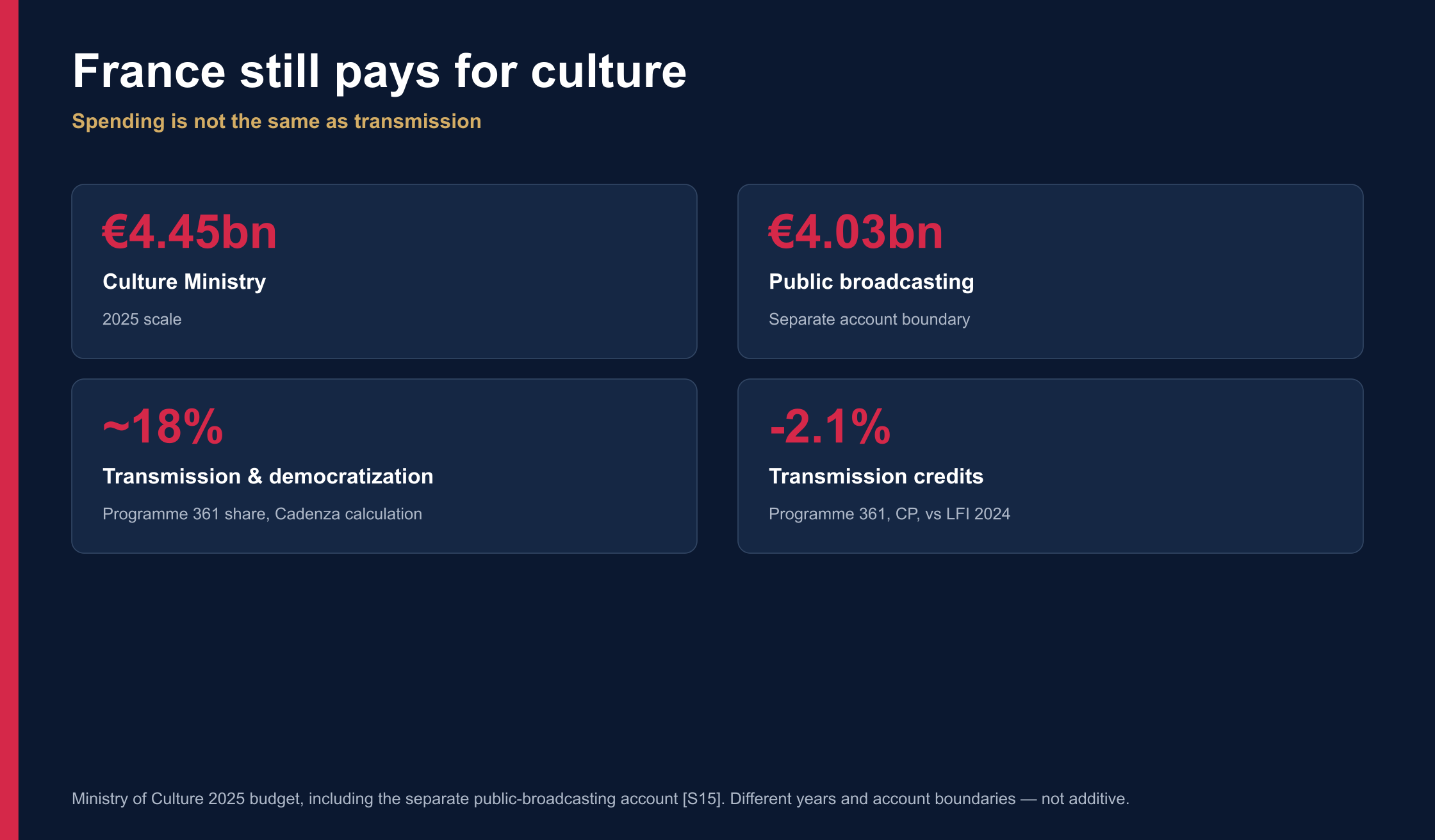
The three public-spending figures are displayed separately because they use different years and account boundaries.
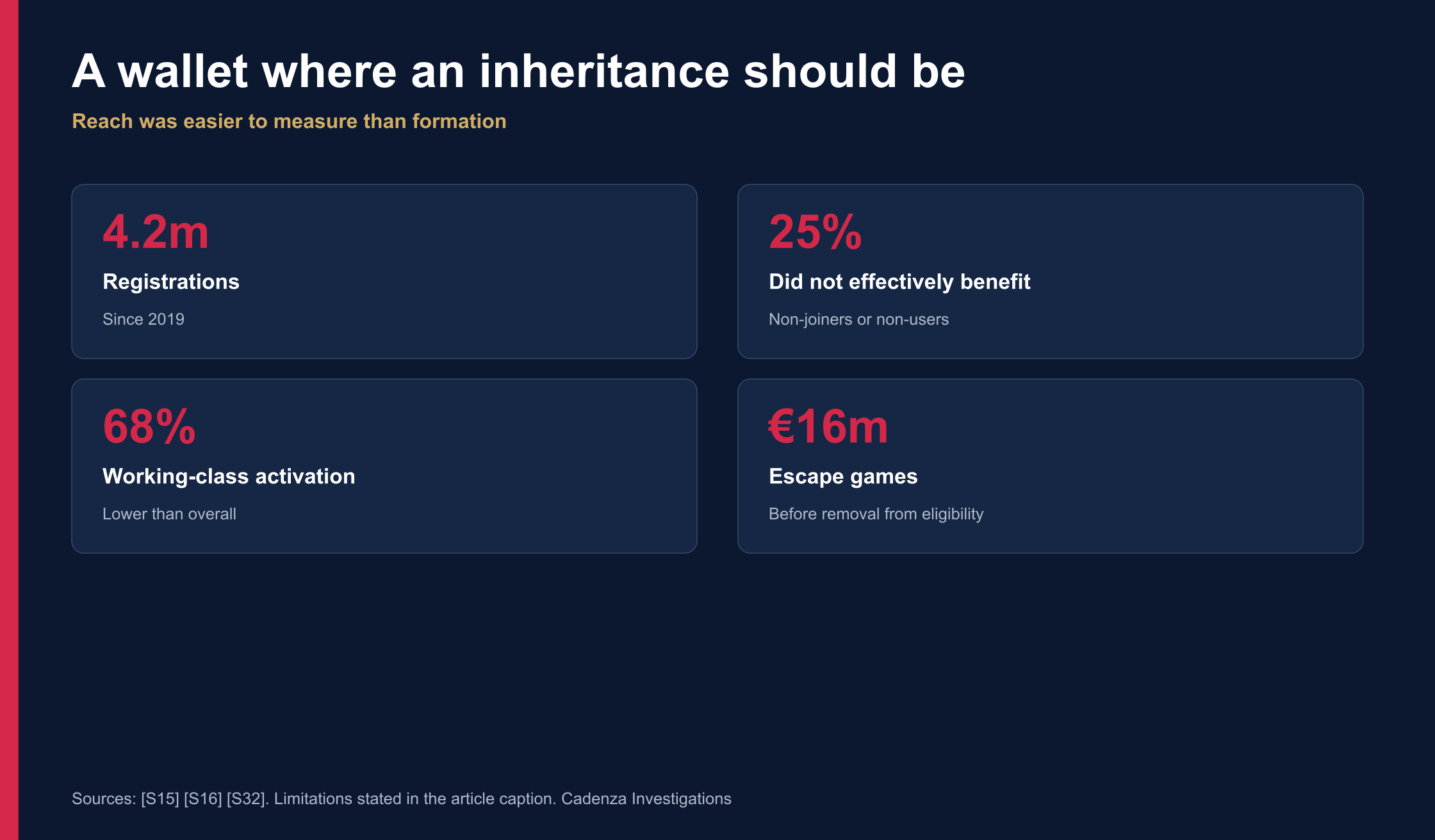
High take-up is not the same as diversification or long-term formation.
22. Pass Culture: a wallet where an inheritance should be
Macron’s signature cultural programme was the Pass Culture. By August 2024, 84% of eligible eighteen-year-olds had used it. That reach was real. So were the programme’s limitations. [S17]
The Cour des comptes found that 16% of eligible youth had not joined and another 9% downloaded the application but did not use it. Activation was lower among working-class youth. Users spent slightly more than €250 of the €300 envelope on average. Books absorbed between 42% and 55% of expenditure. Before the rules changed, the programme financed approximately €16 million in escape games.
None of this makes the Pass worthless. It bought books, tickets and experiences. It lowered barriers.
It also revealed the poverty of a policy that confuses consumer choice with formation.
A voucher can buy a ticket. It cannot produce an audience. It can buy a book. It cannot produce a reader.
Culture becomes inheritance through repetition, memory, instruction and belonging. An application can support that process. It cannot replace it.
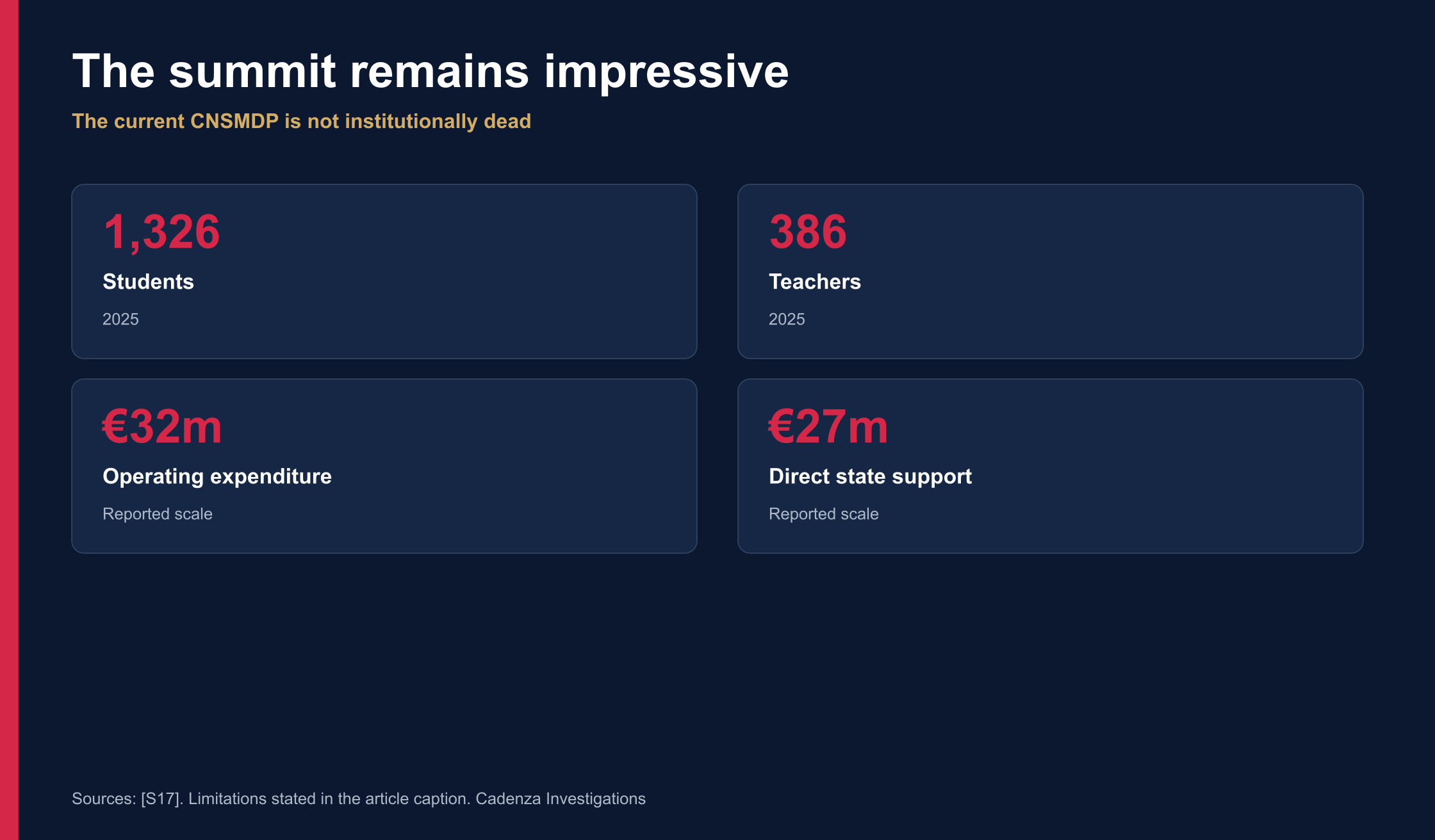
The CNSMDP data contradict easy claims of institutional collapse. The deeper question is what happens beneath it.
23. The summit remains magnificent
The Conservatoire national supérieur de musique et de danse de Paris is not a ruined institution. In its 2025 report it counted 1,326 students, 386 teachers, 227 public events, 30,000 spectators, €32 million in operating expenditure and €27 million in direct state operating subsidy. [S18]
The school reported a third-place global performing-arts ranking in 2025 and has remained in the top five for several years. Rankings are imperfect and partly reputational, but there is no serious evidence that the CNSMDP has ceased to be elite. [S20]
The mistake would be to treat the summit as proof of the mountain’s health.
France can maintain a world-class flagship while the regional pipeline becomes more unequal, teachers become more precarious and access depends increasingly on family knowledge, private preparation and residence near the strongest institutions.
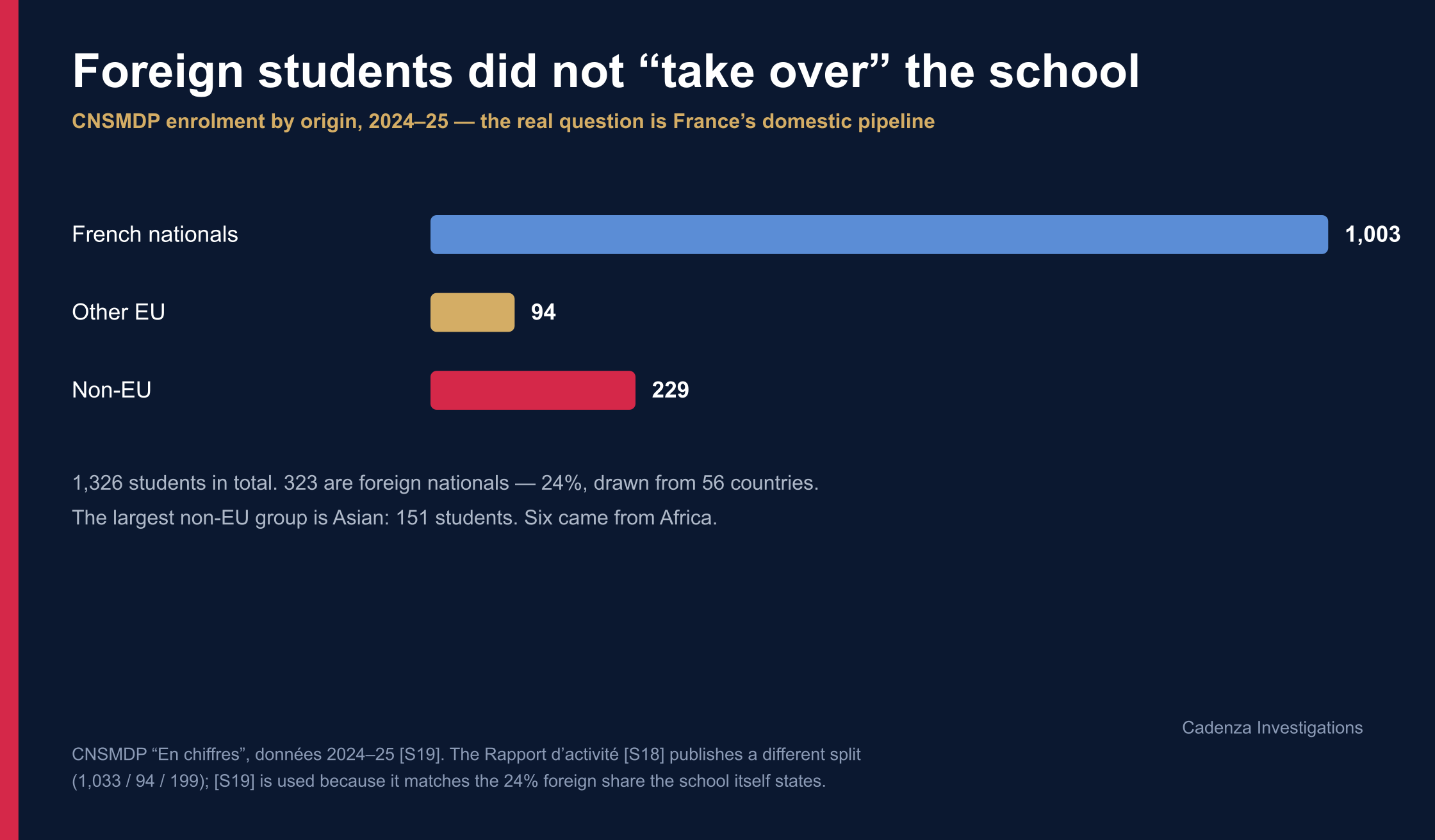
Student nationality data refute simplistic claims while preserving the question of domestic access and formation.
24. The foreign-student myth
Twenty-four percent of CNSMDP students were foreign nationals from 56 countries. The largest non-EU group was Asian: 151 students, led by Japan, South Korea, China and Taiwan. The published cohort included six students from Africa. [S19]
This does not support a claim that African immigration “took over” the Conservatoire.
International recruitment is one of the school’s strengths. An elite conservatory should attract the best musicians in the world.
The legitimate national question is different: is France producing a broad enough domestic pipeline to remain the intellectual and artistic centre of the institution it created? Among 2,044 candidates in the reported cohort, 75.4% were from France and 460 were admitted; 43% of candidates came through regional conservatories. [S33]
Foreign excellence is not French decline. Dependence on a narrow domestic elite would be.
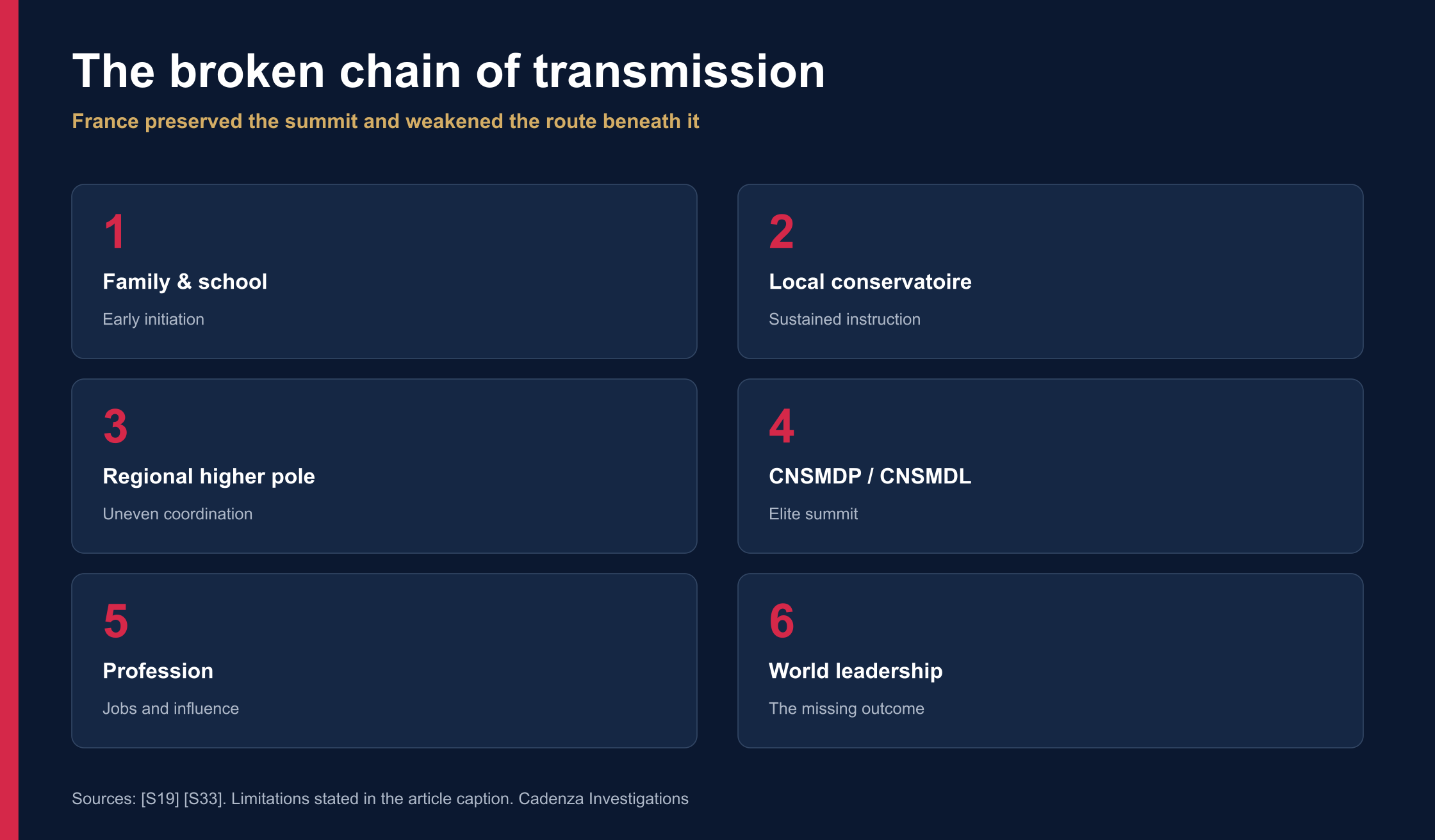
The pipeline graphic separates institutional levels; it does not imply that every student moves through every stage.
25. The people beneath the prestige
In 2025, strike action affected some CNSMDP entrance examinations, including situations in which candidates had to perform without the expected accompanist. [S21]
A prestigious institution can survive such disruption. The episode matters because it exposes the labour beneath the image: accompanists, teachers, administrators, technicians and temporary staff whose conditions determine educational quality.
France has often protected the symbolic apex while allowing the human infrastructure beneath it to absorb strain. Cultural glory becomes a demand placed on workers rather than a standard the state applies to their conditions.
26. Fifteen fragile higher-education poles
A 2025 public inspection described France’s fifteen higher music-and-dance poles as fragile and heterogeneous, with strong territorial disparities, fragmented national coordination and persistent budget constraints. [S22]
This is the structural story the CNSMDP ranking cannot tell.
If the pathway from local conservatory to higher training varies sharply by region, France is selecting talent partly through geography. If institutions depend on unstable partnerships between state and local authorities, long-term planning becomes vulnerable to budget cycles.
A country serious about musical continuity would publish a national pipeline audit: where children begin, who leaves, which instruments face shortages, how family income affects progression, which regions send students to higher education and what graduates earn.
27. Four hundred conservatories—and the problem between them
France has nearly 400 state-classified public conservatories serving approximately 300,000 students with 17,000 teachers. [S23]
This is extraordinary infrastructure. Few countries possess anything comparable.
But infrastructure is not a guarantee of coherence. Tuition levels, admissions, transport, instrument access, school partnerships and advanced opportunities vary by locality. Families with knowledge can navigate the system. Families without it may never discover that the path exists.
Macron’s cultural policy celebrated access while leaving the deeper inequalities of initiation intact. The child who receives a cultural credit at eighteen has already missed the years in which a violinist, pianist or singer is usually formed.
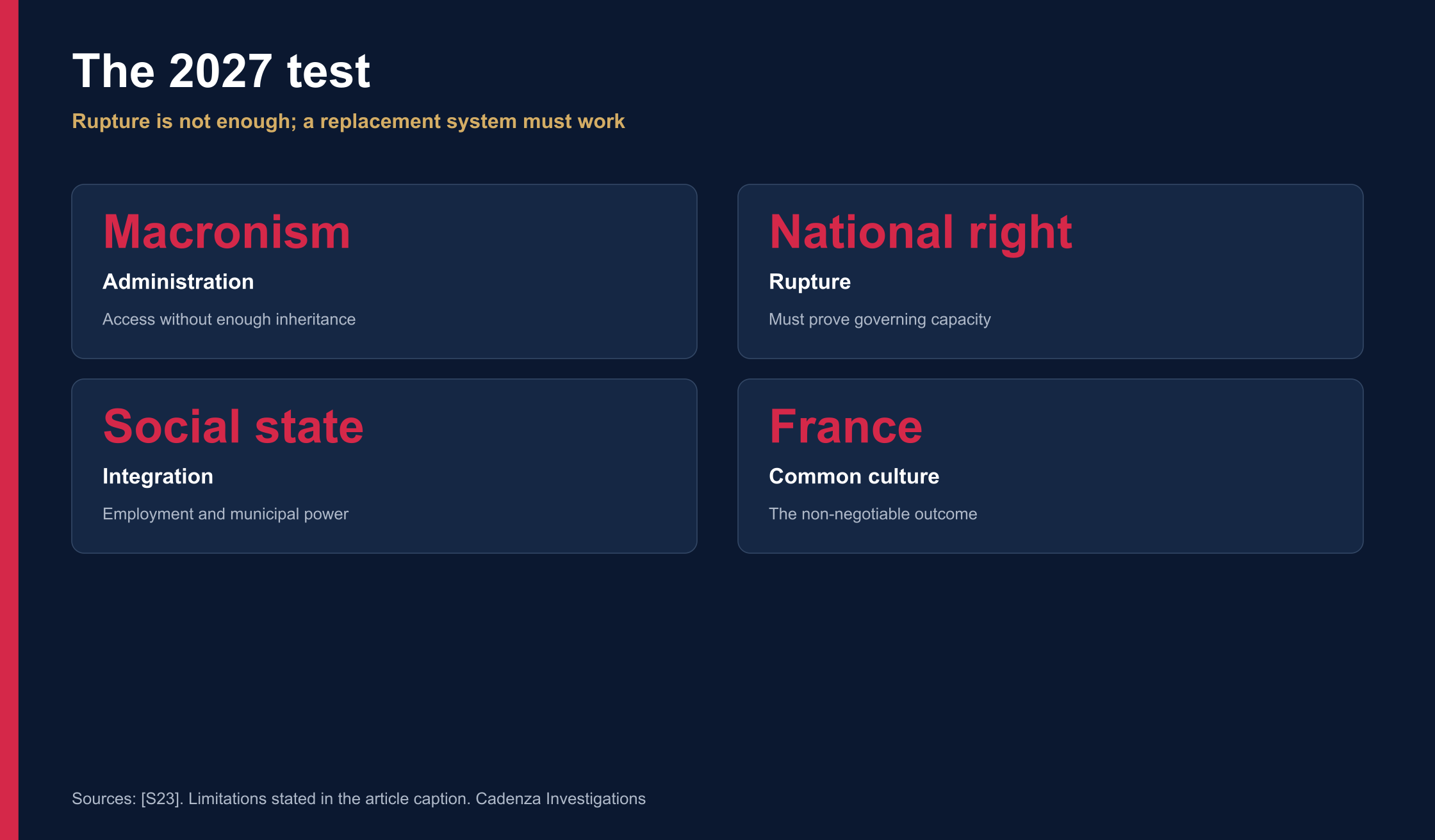
The graphic is analytical, not predictive. No candidate or party is endorsed.
28. The Opera is full. That is not the same as a civilization reproducing itself
The Paris Opera reported 394 performances and 850,000 spectators in 2023–24. The average audience age was 46, 180,000 spectators were under 28 and nearly 300,000 tickets were sold below €50. [S24]
Those figures contradict the easy story of an empty institution abandoned by the young.
They do not answer who attends repeatedly, who studies the repertory, whose families regard the Opera as their own and whether the audience will renew itself beyond subsidized access.
A full house measures demand today. A living civilization measures the desire to transmit tomorrow.
29. A museum nation
France risks becoming a museum nation not because its museums are empty but because its inheritance is increasingly treated as an attraction rather than an obligation.
Tourists can admire Garnier. International students can strengthen the Conservatoire. State subsidies can preserve orchestras. None of these outcomes guarantees that ordinary French families believe the institutions belong to them.
The danger is an exquisitely funded summit floating above a population divided by class, territory and cultural initiation.
That is the meaning of the end of a golden age. Not disappearance. Loss of creative centrality, social depth and confidence.
PARIS NO LONGER COMMANDS THE MUSIC
30. The difference between a school and a civilization
Calling the contemporary CNSMDP a “joke” would be easy—and inaccurate. The institution remains selective, internationally attractive and heavily subsidized. Its current scale contradicts any literal claim that it has ceased functioning.
But the flattering institutional statistics answer the wrong question.
A school can remain excellent by the standards of its competitors while the civilization that once gave it disproportionate global authority declines around it. Admissions, budgets and graduate employment measure professional capacity. They do not measure whether Paris still determines repertoire, aesthetics, pedagogy and the direction of world music.
The old Conservatoire belonged to an ecosystem that generated canonical composers, dominant instrumental schools, publishers, critics, salons, commissions, ballet, opera, orchestral innovation and international pilgrimage. The contemporary CNSMDP belongs to a globalized professional market. It trains musicians for that market. It does not command it.
The old Conservatoire helped govern a musical civilization. The modern CNSMDP administers a professional school.
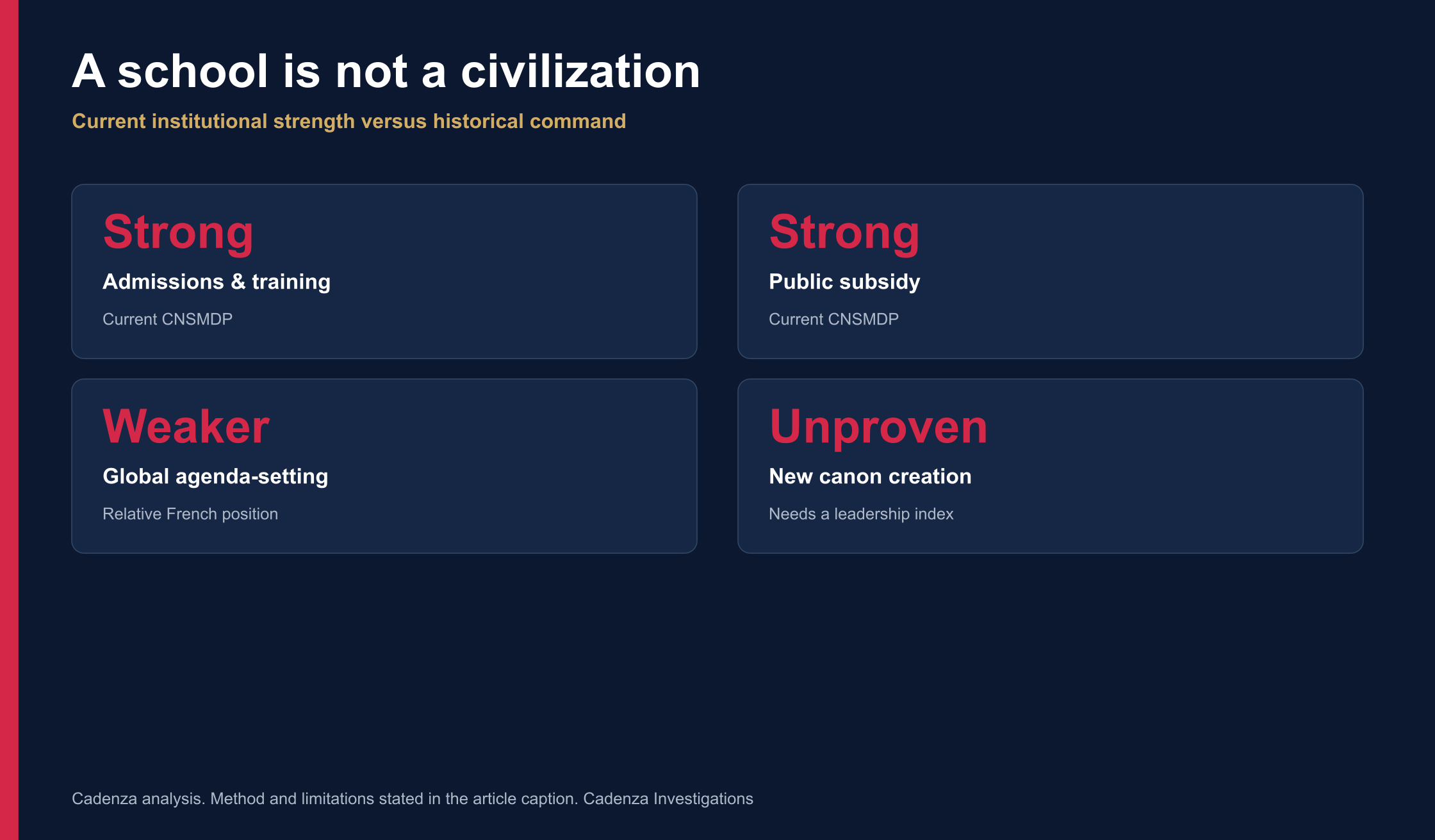
The comparison distinguishes current institutional strength from historical agenda-setting power.
31. Paris in the 1920s was not merely prestigious
The historical comparison must not become costume drama. Interwar Paris contained poverty, political instability, exclusion, antisemitism and institutional conservatism. Ravel’s battles with the Prix de Rome are evidence that the old establishment could be narrow and self-protective.
Yet the density of musical power was extraordinary.
The city was simultaneously home to French modernism, Russian émigré influence, the Ballets Russes, independent schools, publishers, critics, patrons and audiences willing to argue about new work. Nadia Boulanger’s studio became an international pedagogical centre. Ravel remained a global reference. Stravinsky’s Parisian premieres helped shape modernism. Dukas joined the Conservatoire faculty in 1927. The city did not merely host music; it converted musical controversy into history. [S19] [S20]
No contemporary ranking can measure that position because rankings compare today’s institutions with one another. They do not compare a current school with the historical moment when its city functioned as one of the command centres of Western music.
The question is not whether today’s students can play. Many can play superbly.
The question is why France, with its budgets, institutions, traditions and accumulated prestige, no longer produces a comparable concentration of world-defining musical authority.

Historical and contemporary systems are compared across influence, not nostalgia.
32. The leadership index France has never built
France cannot answer the decline question because it does not systematically measure cultural leadership.
A serious national audit would track, by decade:
- the share of globally programmed new works premiered in France;
- French-trained musicians holding principal positions and music directorships abroad;
- international competition finalists by training institution;
- foreign applications, admissions and yield at elite schools;
- the international adoption of French methods, editions and pedagogical lineages;
- major commissions receiving repeat performances outside France;
- the social and geographic origins of applicants entering the elite pipeline;
- continuation rates from local conservatoires to higher education;
- the proportion of the population receiving sustained instrumental instruction.
Without those measures, official France can congratulate itself on attendance, applications and partnerships while avoiding the historical question.
Cadenza’s provisional verdict is severe but bounded: France retains first-class institutions and artists, but Paris no longer possesses anything like its former relative power to dictate the musical future.
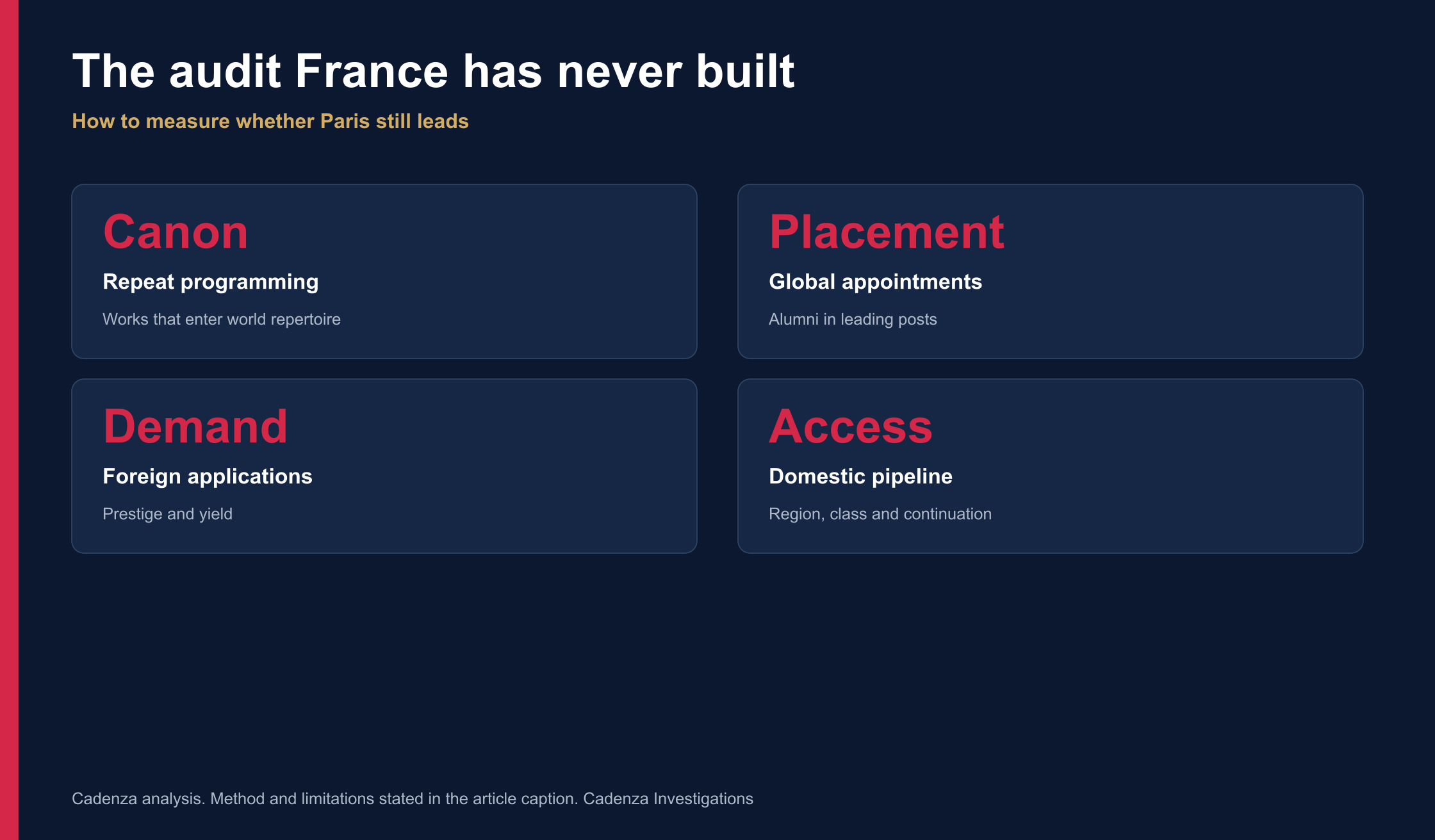
A proposed index separates measurable institutional activity from world influence.
33. A summit sustained by inherited prestige
The CNSMDP’s international students are not evidence that uncontrolled immigration displaced French students. Recent foreign enrollment is heavily shaped by East Asian recruitment and the normal international competition surrounding elite conservatoires. That international demand is evidence of prestige.
But prestige can be inherited long after leadership has weakened.
The school benefits from the Conservatoire name, the Paris address, the French repertoire, public subsidy, the national cultural apparatus and a history written by generations who made France central. The harder question is how much new prestige the present system creates rather than consumes.
A country living on accumulated cultural capital can remain impressive for decades. Its halls remain full. Its diplomas remain valuable. Its ceremonies remain elegant. Decline appears first in the distance between the language of greatness and the production of new greatness.
France has become exceptionally skilled at preserving the evidence that it was once indispensable.
34. Multiculturalism raised the burden; the Republic lowered the ambition
Immigration did not directly cause the loss of Paris’s musical hegemony. The chronology does not support that claim, and no evidence shows that immigrant or Muslim students lowered CNSMDP standards.
The indirect connection is nonetheless politically important.
A rapidly changing population requires a more ambitious system of common transmission: stronger language acquisition, safer schools, stable neighborhoods, early arts education, accessible local conservatoires, historical knowledge and an explicit demand that newcomers and native-born children alike inherit France.
Instead, France expanded the burden while weakening the ambition.
The state increasingly treated coexistence as integration, access as transmission and cultural consumption as formation. It built programmes around participation but failed to demonstrate that participation created common mastery. It admitted substantial demographic change while leaving entry into demanding cultural traditions heavily dependent on family knowledge, money, geography and social class.
Macron’s France imported people faster than it transmitted France.
That sentence does not accuse every immigrant of rejecting France. It accuses the state of failing to make assimilation proportionate to demographic change.
35. Islamism understood transmission better than the cultural state
France’s 2025 Interior Ministry report described Muslim Brotherhood-linked and inspired activism as operating through religious, educational, cultural, charitable, social and municipal networks. The report is a government assessment, not a judicial finding or an academic consensus, and it has been contested by scholars and by Muslim organisations who dispute both its method and its framing. It is cited here on that basis and on no other. It nevertheless identifies a political fact: ideological movements reproduce themselves through institutions. [S35]
The French cultural state increasingly behaved as if inherited culture would reproduce itself automatically once citizens were offered access.
One side invested in family, school, association, discipline, local relationships and a coherent worldview. The other distributed credits, published strategies, commissioned reports and assumed a common national culture would emerge from administrative inclusion.
This does not make Islam or Muslims responsible for French cultural decline. It exposes the asymmetry between movements confident enough to transmit what they believe and a Republic embarrassed to insist on what it inherited.
Where Islamism challenges civil law, equality between men and women, freedom to leave or criticize religion, Jewish security, artistic offence or common schooling, it directly conflicts with the conditions required for a free musical culture. A conservatoire depends on mixed ensembles, freedom of expression, bodily autonomy, historical study and the supremacy of civil rules over communal authority.
France’s failure was not having Muslim citizens. It was allowing the demand for assimilation to become politically suspect while organized anti-assimilation remained persistent enough to require national security attention.
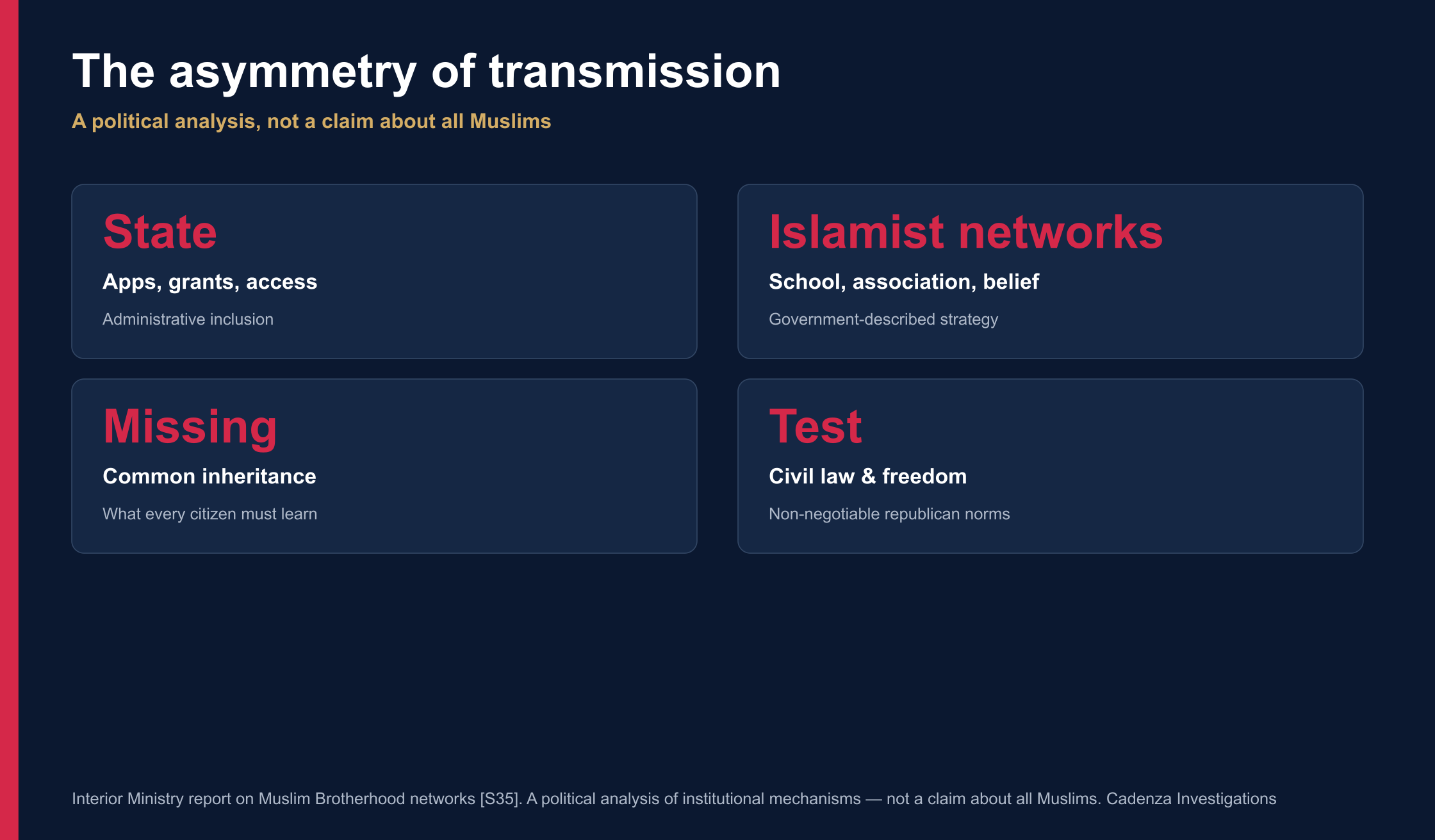
The comparison concerns institutional mechanisms, not populations or religions.
36. Crime is cultural policy when fear changes how children move
Public order is not separate from cultural life.
Instrumental study requires children to travel after school, carry expensive equipment, attend evening rehearsals and spend years moving between home, school, teacher and ensemble. Parents who do not trust transport, streets or institutions narrow their children’s radius. Teachers avoid difficult locations. Municipal programmes lose continuity. Concentrated insecurity becomes a tax on participation.
The available national data do not quantify how many French children abandoned music because of insecurity. That remains an evidence gap. But it would be absurd to pretend that rising violence, sexual offences, narcotics markets and geographic concentration of crime have no cultural consequences.
Macron’s defenders often separate the dashboard: crime belongs to Interior, immigration to administration, schools to Education and culture to Culture. Families experience one country.
A society unable to guarantee ordinary movement eventually preserves elite culture for those wealthy or organized enough to route around disorder.
WHO MACRON’S FRANCE PLACED LAST
37. French families
The French family was not abolished under Macron. It was administratively supported and rhetorically deprioritized.
Housing costs rose in the places where jobs and cultural institutions concentrate. Stable employment arrived later. Public services became less predictable. Parents encountered childcare, school and safety concerns that annual family-policy announcements did not resolve.
When births collapsed, the government treated the decline as a challenge to be managed rather than a signal that confidence in continuity had broken.
The phrase “French people first” is often used as exclusionary politics. There is a legitimate version: the state owes its citizens functioning schools, secure streets, affordable family formation and access to the national inheritance before it congratulates itself on abstract openness.
38. The provinces beneath Paris
France’s prestige is concentrated in Paris; much of its cultural labour is local. Municipal conservatories, regional orchestras, libraries, theatres and associations depend heavily on local budgets.
Local authorities spent €10 billion on culture in 2024 — €7.7 billion on operations and €2.3 billion on investment — and the municipal bloc carried 79% of territorial cultural expenditure. [S16]
A national government can announce record cultural spending while local institutions face hiring freezes, building costs and programme reductions. The French cultural state is too decentralized to be judged from one ministry figure.
Macronism’s metropolitan style reinforced the impression that the country outside Paris was a delivery network for national strategy rather than a source of culture in its own right.
39. Working-class children
The Cour des comptes found that Pass Culture activation was lower among working-class youth. That is not an isolated programme flaw. It reflects the difference between formal access and cultural capital. [S17]
A family that knows how to choose a teacher, rent an instrument, apply to a specialist class and travel to auditions gives a child advantages no app can reproduce.
France’s cultural state remains generous after a young person reaches the institution. It is less reliable at making sure the right child reaches the door.
40. Immigrants who actually wanted to become French
Macron’s integration failure also harmed immigrants who wanted assimilation, order and upward mobility.
A weak school cannot transmit French culture to anyone. A segregated neighbourhood limits contact. Employers who discount foreign qualifications slow integration. An administrative system that tolerates irregularity breeds suspicion toward legal migrants.
The state’s refusal to set clear expectations leaves the most integration-minded newcomers competing with the most separatist voices for the meaning of belonging.
A confident France would make naturalization solemn, demanding and desirable: strong French, knowledge of history and institutions, respect for secular law and evidence of participation in the national community.
41. Citizens living with disorder
The people most affected by crime concentration are not television commentators. They are residents of the communes in which the national averages become daily life.
They include native-born French citizens, naturalized citizens and immigrants. The state fails all of them when it treats order as a partisan issue.
Public safety is the precondition for cultural integration. People do not enter a common civic world when public space is controlled by fear, trafficking or intimidation.
42. The ruling class that explained instead of acting
France’s elite institutions are skilled at explanation. Every failure receives a commission, a strategy, a budget line and a vocabulary of complexity.
Complexity is real. It is not absolution.
Under Macron, citizens repeatedly heard why borders were constrained, removals difficult, crime data nuanced, births private and cultural identity multiple. They heard less about which outcomes the government would accept responsibility for delivering.
The result was not enlightened moderation. It was the accumulation of power without ownership.
THE LOST ALTERNATIVE AND THE COMING RUPTURE
43. Strauss-Kahn: the France that never happened
Dominique Strauss-Kahn has become a vessel for nostalgia because he represented something Macron never convincingly possessed: economic weight, institutional authority and the appearance of an adult political class that understood the machinery of the state.
A Strauss-Kahn presidency cannot be reconstructed as fact. He never implemented a presidential programme, and no serious counterfactual can know how he would have responded to the 2015 attacks, the migration crises, the pandemic, Ukraine or the post-2023 Middle East conflict.
The evidence permits a narrower judgment.
As finance minister and later managing director of the IMF, Strauss-Kahn was associated with macroeconomic competence, employment, European coordination and a more socially anchored management of globalization. A government built around that tradition might plausibly have protected municipal capacity, employment-led integration, housing investment and the institutional networks Macron attempted to bypass. [S28] [S29]
That could have mattered for culture. Local conservatoires depend on solvent municipalities. Assimilation is easier when employment, housing and schools function. A stronger social-democratic state might have reduced some of the territorial and economic conditions under which cultural separation hardened.
But Strauss-Kahn was not the restrictionist savior imagined by critics of Macron. In 2010 he publicly argued that less restrictive immigration could support long-run growth. There is no evidence that he would have dramatically reduced immigration, restored a strict assimilation doctrine, rebuilt the music pipeline or confronted political Islam more effectively. [S30]
The honest counterfactual is therefore both flattering and limiting:
Strauss-Kahn might have governed France with greater economic seriousness and institutional depth. He probably would not have closed the demographic or cultural question that Macron failed to answer.
The fascination with Strauss-Kahn says less about what he would certainly have achieved than about how weightless Macronism came to feel. France began imagining the disgraced candidate as a lost statesman because the president it elected increasingly looked like a consultant standing inside a civilization he could describe but not defend.
44. Le Pen: hope, rupture and legal baggage
Marine Le Pen presents herself as the answer to the failures documented here. In July 2026, an appeals court upheld her conviction for misuse of European Parliament funds but reduced the effective ineligibility period in a way that leaves her able to run in 2027. She announced a further appeal and maintained her candidacy. [S28]
For voters who believe Macronism placed immigration, Brussels and elite consensus above national continuity, Le Pen represents hope.
Hope is not evidence of capacity.
Any candidate promising restoration must answer concrete questions: numerical migration targets, legal routes, removals, family policy, school discipline, police and judicial capacity, cultural education, provincial institutions and the protection of artistic freedom.
A politician convicted of misusing public money does not receive a blank cheque to restore the state.
45. The RN lead—and the difference between anger and government
Early 2026 polling placed Jordan Bardella at 36% in one set of first-round scenarios and Le Pen between 34% and 35%, far ahead of tested centrist alternatives. [S29]
Polls are not forecasts. The second round, candidate eligibility, party finance and campaign events can change everything.
The numbers nevertheless show that a large share of France is seeking rupture.
The RN’s test is whether it can transform grievance into statecraft. Can it control migration without legal chaos? Restore order without collective punishment? Support families without fiscal fantasy? Rebuild transmission without turning culture into party propaganda?
The failure of Macronism does not guarantee the competence of its opponent.
46. The standard for the next president
The next president should be judged by measurable outcomes, not restoration language.
- Does fertility stabilize?
- Do first permits align with an explicit national target and capacity plan?
- Are removal decisions implemented more consistently?
- Do language, employment and housing outcomes improve?
- Do violent and sexual offences decline?
- Are drug markets displaced rather than temporarily disrupted?
- Does every child gain meaningful access to music, history and literature?
- Do regional conservatories and higher poles become less unequal?
- Can artists criticize the government without losing public support?
France does not need a new cultural patron. It needs a state capable of preserving freedom while demanding continuity.
A PROGRAMME OF NATIONAL TRANSMISSION
47. Support the formation of French families
Family policy should move from compensation to formation.
Housing supply in employment centres, childcare reliability, parental leave, tax stability and work schedules all affect decisions to have children. A government should publish a fertility impact statement for major housing, labour and family reforms.
The objective is not coercion or ethnic arithmetic. It is restoring the confidence required for citizens to build a future.
48. Control immigration by route, capacity and outcome
A serious immigration policy needs an annual parliamentary ceiling or target broken down by route, together with transparent exceptions for humanitarian emergencies.
Student migration should be connected to institutional quality and post-study pathways. Economic migration should be linked to verified shortages and wage protection. Family migration should be governed by enforceable income, housing and integration rules consistent with law. Humanitarian admissions should come with funded integration capacity.
The argument for control is not that foreigners are lesser people. It is that integration is a finite institutional task.
49. Make legal decisions real
France should publish a complete annual removal ledger: decisions issued, appeals, suspensions, consular obstacles, detention capacity, departures, forced removals and average time to execution.
Courts must remain independent and asylum obligations honoured. But a decision that is almost never implemented ceases to function as law.
Removal policy should prioritize convicted serious offenders and people who present a public-order threat, with bilateral pressure on states that refuse travel documents.
50. Integration must include inheritance
Employment and language are necessary. Citizenship should also require serious knowledge of French history, institutions, secularism and culture.
Every naturalization ceremony should mark entry into a common inheritance rather than completion of an administrative process. Every school should teach that Debussy, Hugo, Molière, Césaire, Ravel, Camus and the principles of the Republic belong to every French child.
Integration is not the erasure of family origin. It is the acceptance that the national inheritance has priority in public life.
51. Restore public order as cultural policy
Police numbers, prosecutor capacity, court delay, prison space, juvenile intervention and witness protection must be treated as one system.
Drug-market territories require sustained control, not periodic operations. Schools and cultural institutions in high-crime communes need protected staff, late transport and long-term funding.
Order is not the enemy of culture. It is the space in which culture can become common.
52. Rebuild the music pipeline
France should guarantee every child access to sustained musical training—not a one-off concert and not a consumer credit at eighteen.
A national programme should identify instrument shortages, subsidize rentals, integrate conservatory instruction with schools, fund accompanists and teachers, support transport from rural and outer-urban areas and publish progression data by income and territory.
The objective is not to force every child into classical music. It is to ensure that the culture France created is not inherited only by families who already know how to access it.
53. Measure the inheritance
France measures cultural spending, tickets and programme registrations. It should also measure cultural knowledge, repeated participation, school music provision, instrument study duration, regional progression and the share of families who regard major institutions as belonging to them.
Data cannot define civilization. It can expose whether rhetoric matches transmission.
WHO WILL INHERIT DEBUSSY?
54. The final verdict
France has not lost every orchestra, every conservatoire or every audience. That is precisely why the decline has been so easy to deny.
The Paris Opera remains full. The CNSMDP remains selective. The Ministry of Culture still spends billions. France can point to buildings, festivals, rankings, applications and attendance as proof that the cultural state survives.
But survival is not command.
A century ago, Paris helped decide what Western music would become. Today France administers prestigious institutions inside an international system whose direction is increasingly set elsewhere. The modern Conservatoire may produce excellent professionals. It does not occupy anything like the position held by the Paris musical civilization surrounding Ravel, Boulanger, Stravinsky, Dukas and the interwar avant-garde.
During Macron’s presidency, births fell sharply, the natural population balance turned negative, the immigrant share rose, serious categories of violence and narcotics offences increased, and the state’s own services continued warning about jihadism and political Islam. [S35] None of those facts proves that immigrants caused the decline of French music. Together they establish that the burden of national transmission grew while the state’s confidence in transmission weakened.
Macron maintained the monuments and mistook maintenance for continuity.
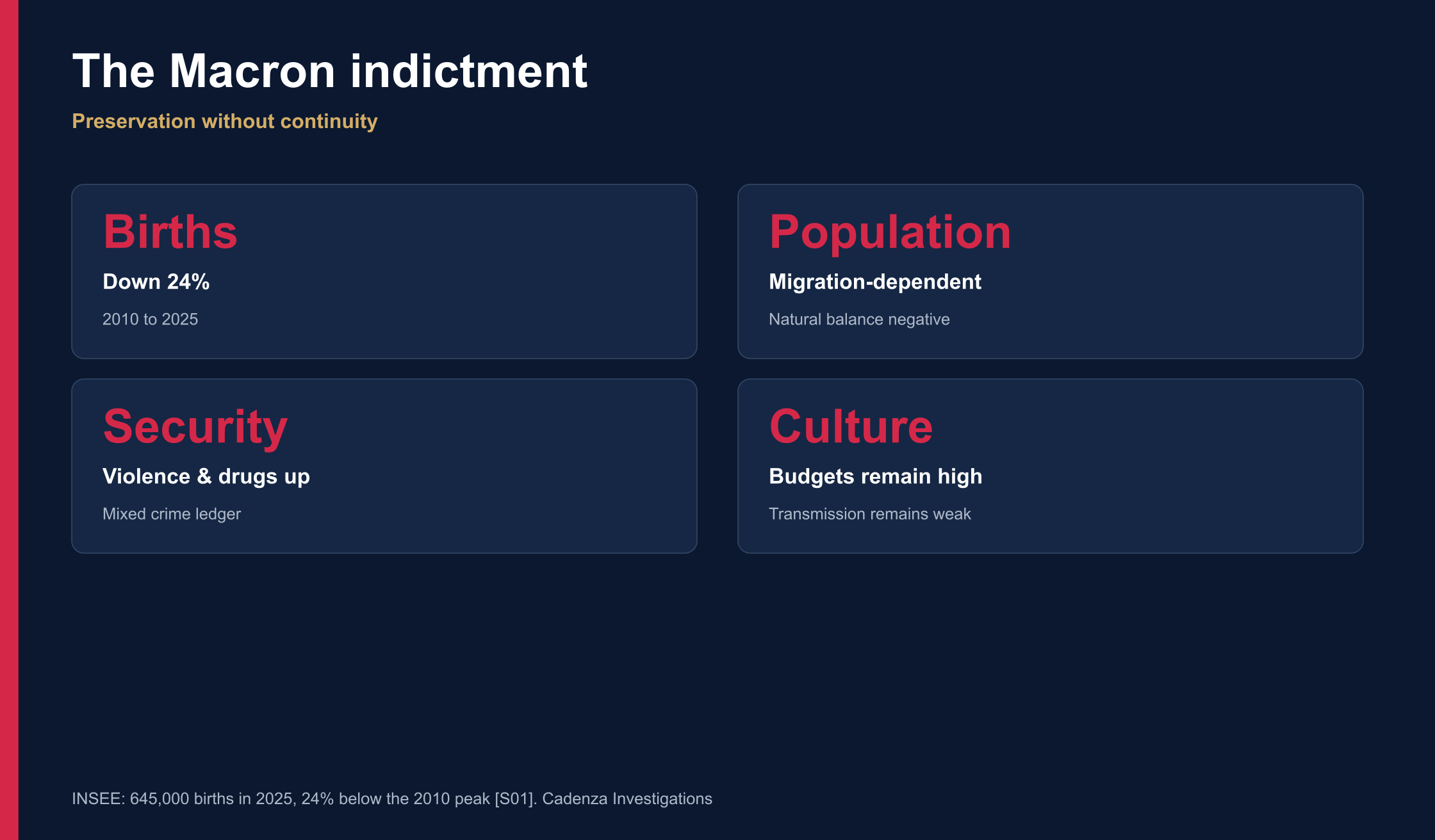
A summary of four measures examined in this article, each sourced in the chapter that discusses it. Their juxtaposition is a record of the same period, not a claim that any one caused another.
He funded access and mistook access for inheritance.
He managed immigration and mistook administration for assimilation.
He recorded crime and mistook measurement for order.
He commissioned reports on Islamism and mistook recognition for defeat.
He celebrated Europe, mobility and openness while the French family weakened, regional institutions remained fragmented and entry into the elite cultural pipeline continued to depend heavily on inherited knowledge and geography.
His historic failure was not that France changed.
It was that he governed change without establishing what had to remain.
France’s governing class did not literally replace greatness with immigrants. It abandoned the confidence, discipline and common institutions that had once generated greatness, then allowed demographic transformation to expose the abandonment. Newcomers arrived in a country whose leaders were increasingly embarrassed to demand assimilation into anything specific. Native-born citizens watched public order weaken in the places where the state was already least trusted. The cultural summit remained polished while the social base became narrower and more unequal.
Strauss-Kahn might have offered heavier economic management, but there is no evidence he would have closed the immigration question or restored French musical supremacy. Le Pen or another successor may offer rupture, but anger is not a programme and heritage imagery is not cultural transmission.
The standard for the next government must be harder:
- reduce immigration to levels matched by genuine integration capacity;
- enforce legal decisions and restore public order;
- make French language, history, secular civil law and cultural inheritance conditions of belonging;
- support the formation of French families;
- rebuild serious music education from childhood through the provinces;
- measure whether public cultural spending produces mastery rather than consumption;
- protect freedom of artistic expression against both bureaucratic conformism and religious intimidation;
- force elite institutions to prove that they create new authority rather than merely spend inherited prestige.
The final question is not whether Debussy belongs only to descendants of old France. He does not.
The question is whether France will still possess the courage to tell every child—whose grandparents came from Brittany, Algeria, Senegal, Portugal, Poland, China or anywhere else—that Debussy is part of a common French inheritance, that mastery requires discipline, and that belonging means accepting the duty to carry the inheritance forward.
A civilization does not die when the opera house closes.
It dies when the opera house remains open, the subsidy continues, the school keeps its ranking—and the country no longer knows why any of it must be inherited.
Macron did not leave France without culture. He left France with a museum of its former authority.
Methodology. Figures are quoted as their sources publish them. Where an institution states a percentage, that figure is used rather than one recomputed from underlying counts — INSEE publishes the birth decline as 24% against 2010, and the two raw counts do not reproduce it because the series differ in geographic scope. Where two official publications disagree, the disagreement is disclosed rather than resolved silently: the CNSMDP's Rapport d'activité and its “En chiffres” table publish different origin splits, and the graphic says so. Where a figure is Cadenza's own calculation rather than a published statistic, the graphic says that too. Recorded crime is not a direct measure of offending. AGIR outcome rates are calculated on those accompanied six months or more, not on all programme exits.
Right of reply. On 2 August 2026 Cadenza put written questions to the Élysée, the Ministry of Culture and pass Culture, the Conservatoire national supérieur de musique et de danse de Paris, the Rassemblement National, and the Ministry of the Interior and its statistical service SSMSI. No response had been received at the time of publication. Any institution or person named in this article may respond at any time, and this article will be updated to carry the response in full. Corrections are welcomed at hello@cadenza.work.
Images. All charts are original Cadenza analysis; each states the sources it draws on. The cover is original Cadenza artwork and depicts no person or place.
Related Cadenza coverage.
- Who Really Pays the Musicians? — how public money reaches musicians across Europe, Russia, China, the Gulf and Singapore
- Do Not Destroy What Orbán Built — Hungary's cultural inheritance after sixteen years
- The Most Dangerous Conductor in the World — state power and the classical institution
- The Concert Hall Is Not Your Protest Rally
Sources
Every figure in this investigation traces to one of the following. A few entries — S06, S07, S31 and S34 — are background or verification sources that underpin the reporting without being cited at a specific line; S34 is listed chiefly to record what it does not contain, so that its figures are not mistaken for the final crime bilan.
- S01: Demographic report 2025 — INSEE · 13 Jan 2026. https://www.insee.fr/en/statistiques/8726555 645,000 births, fertility 1.56, 651,000 deaths and a negative natural balance of 6,000.
- S02: Monthly and annual birth series, France — INSEE · updated 2026. https://www.insee.fr/en/statistiques/serie/001641590 Annual birth series used for the 2010–2025 trend chart.
- S03: Foreigners and immigrants in France, 2025 — INSEE · 2026. https://www.insee.fr/fr/outil-interactif/5367857/tableau/20_DEM/25_ETR Definitions and headline counts: 8.0 million immigrants and 6.3 million foreign nationals.
- S04: Immigrant population by origin — INSEE · 2026. https://www.insee.fr/fr/statistiques/3633212 Origin shares and the long-run increase in the immigrant share of the population.
- S05: Descendants of immigrants by age and origin — INSEE · 2026. https://www.insee.fr/fr/statistiques/4187125 Age profile of descendants, including the high share of minors among African-origin descendants.
- S06: Education by migration background — INSEE · 2026. https://www.insee.fr/fr/statistiques/4187349 Educational attainment by immigrant origin and descendant status.
- S07: Employment and unemployment by migration background — INSEE · 2026. https://www.insee.fr/fr/statistiques/4195420 Employment and unemployment rates by origin and generation.
- S08: First residence permits in 2025 — French Interior Ministry, DGEF · 30 Jun 2026. https://www.immigration.interieur.gouv.fr/documentation/etudes-et-statistiques/titres-de-sejour-en-2025-protections-subsidiaires-ont-plus-que-double.html 377,462 first permits, broken down by student, family, humanitarian, economic and other grounds.
- S09: Removals of irregular foreign nationals in 2025 — French Interior Ministry, DGEF · 2026. https://www.immigration.interieur.gouv.fr/chiffres-de-limmigration-en-france/eloignements-detrangers-en-situation-irreguliere-en-2025-dynamique-ascendante 23,549 removals and 175,051 apprehensions; these are not directly comparable with first permits.
- S10: Integration of foreign nationals in 2025: AGIR — French Interior Ministry, DGEF · 30 Jun 2026. https://www.immigration.interieur.gouv.fr/documentation/etudes-et-statistiques/programme-agir-sorties-du-programme.html Profile and outcomes for beneficiaries of international protection in the AGIR programme.
- S11: Policy against irregular immigration — Cour des comptes · 4 Jan 2024. https://www.ccomptes.fr/fr/publications/la-politique-de-lutte-contre-limmigration-irreguliere Found a fragmented policy, approximately €1.8 billion in annual direct cost and around 16,000 full-time personnel.
- S12: Crime and insecurity in 2025: final statistical report — French Interior Ministry, SSMSI · Jul 2026. https://www.interieur.gouv.fr/actualites/communiques-de-presse/insecurite-et-delinquance-en-2025-bilan-statistique-et-atlas-departemental Final 2025 trends for violence, sexual offences, homicide, drugs and property crime. The bilan also provides characterisation by age, sex and nationality for both declared victims and mis en cause; the suspect-nationality tables are in the Bilan statistique edition 2026 PDF.
- S13: Recorded victims of physical and sexual violence in 2025 — French Interior Ministry, SSMSI · 27 Feb 2026. https://www.interieur.gouv.fr/Interstats/Actualites/Victimes-de-violences-physiques-et-sexuelles-enregistrees-en-hausse-en-2025-en-particulier-pour-les-violences-physiques-envers-les-mineurs-en-2025-en-particulier-pour Interstats Analyse n.80. VERIFIED verbatim on the live page: 473,000 physical-violence victims of whom 114,500 are minors (24%), and 132,300 sexual-violence victims of whom 76,200 are minors (58%).
- S14: Geography of recorded crime at municipal level in 2025 — French Interior Ministry, SSMSI · 26 Mar 2026. https://www.interieur.gouv.fr/fr/Interstats/Analyses-territoriales/Geographie-de-la-delinquance-a-l-echelle-communale-en-2025 Concentration of recorded crime in roughly 1% of communes.
- S15: The 2025 Ministry of Culture budget — French Ministry of Culture · 11 Oct 2024. https://www.culture.gouv.fr/dossiers/le-budget-du-ministere-de-la-culture €4.45 billion in ministry budget credits and €4.03 billion for public broadcasting.
- S16: Tableau de bord des dépenses culturelles des collectivités territoriales, 2019-2024 — French Ministry of Culture, DEPS · 31 July 2026. https://www.culture.gouv.fr/espace-documentation/statistiques-ministerielles-de-la-culture2/statistiques-culturelles/tableau-de-bord-des-depenses-culturelles-des-collectivites-territoriales-2019-2024 €10 billion in 2024 (€7.7bn operations, €2.3bn investment); municipal bloc 79%. Not additive to central-government figures without accounting review.
- S17: First assessment of the Pass Culture — Cour des comptes · 17 Dec 2024. https://www.ccomptes.fr/fr/publications/premier-bilan-du-pass-culture High take-up but limited diversification; 25% of eligible youth did not benefit and the programme financed €16 million in escape games before eligibility changed.
- S18: Conservatoire de Paris: missions and 2025 key figures — CNSMDP · 2026. https://www.conservatoiredeparis.fr/fr/ecole/le-conservatoire/missions 1,326 students, 386 teachers, 227 events, €32 million operating expenditure and €27 million state operating subsidy.
- S19: CNSMDP student origins and enrolment — CNSMDP · 2026. https://www.conservatoiredeparis.fr/fr/en-chiffres-les-etudiants-et-les-inscriptions 24% foreign nationals from 56 countries; non-EU foreign students are predominantly from Asia.
- S20: Paris Conservatoire ranked in the global top five — CNSMDP / QS · 2025. https://www.conservatoiredeparis.fr/en/news/paris-conservatory-ranked-among-top-5-performing-arts-institutions-worldwide-5th-consecutive-year The school reports a third-place performing-arts ranking in 2025; rankings do not prove system-wide health.
- S21: Information on 2025 entrance examinations — CNSMDP · 2025. https://www.conservatoiredeparis.fr/fr/actualites/information-sur-le-deroulement-des-concours-dentree Documents the effect of strike action on some entrance examinations.
- S22: Higher-education institutions in the performing arts — French Ministry of Culture, IGAC · 24 Jul 2025. https://www.culture.gouv.fr/rechercher-une-publication-du-ministere-de-la-culture/publications-revues/le-paysage-des-etablissements-superieurs-dans-le-spectacle-vivant Fifteen higher music-and-dance poles remain fragile and heterogeneous, with territorial disparities and fragmented governance.
- S23: Specialized arts education and conservatories — French Ministry of Culture · 2026. https://www.culture.gouv.fr/thematiques/enseignement-superieur-et-recherche/l-enseignement-superieur-culture/enseignement-specialise-enseignement-superieur-et-metiers-du-spectacle-vivant Nearly 400 state-classified conservatories, approximately 300,000 students and 17,000 teachers.
- S24: Cour des comptes report response: Paris Opera activity — Opéra national de Paris · 2024. https://www.operadeparis.fr/actualites/rapport-de-la-cour-des-comptes-sur-lopera-de-paris 394 performances, 850,000 spectators, average audience age 46, 180,000 under 28 and nearly 300,000 tickets below €50 in 2023–24.
- S25: Naturalization speech in Orléans — Élysée · 27 Jul 2017. https://www.elysee.fr/emmanuel-macron/2017/07/27/discours-d-emmanuel-macron-a-la-ceremonie-de-naturalisation-a-la-prefecture-du-loiret Macron later affirmed that a French culture exists and described it as a river shaped by multiple tributaries.
- S26: Macron’s 2017 “culture in France” formulation — Europe 1 / AFP · 26 Feb 2017. https://www.europe1.fr/politique/bayrou-a-macron-pour-moi-il-y-a-une-culture-francaise-2988275 Reports the quotation that there is not one French culture but a culture in France, diverse and multiple.
- S27: Macron popularity, March 2026 — Ifop · 30 Mar 2026. https://www.ifopgroup.com/en/article/popularity-indexes-ifop-opinion-barometer-march-2026 23% satisfied in March 2026, up five points on February; a poll is a snapshot, not a referendum on every issue in this article.
- S28: Le Pen appeal ruling and 2027 eligibility — Euronews / AP · 7 Jul 2026. https://www.euronews.com/my-europe/2026/07/07/marine-le-pen-vows-to-remain-a-candidate-for-frances-2027-election-despite-conviction Appeal conviction upheld but effective ineligibility reduced, allowing a 2027 run; further appeal announced.
- S29: 2027 presidential voting intentions — Ifop-Fiducial, reported by AFP/RTL · 4 Mar 2026. https://infos.rtl.lu/news/monde/un-nouveau-sondage-place-le-rn-tres-largement-en-tete-en-2027-1599590945 Bardella 36%; Le Pen 34–35% in tested first-round scenarios. Polls are not predictions.
- S30: DSK versus Sarkozy poll, February 2011 — Le Parisien / CSA · 17 Feb 2011. https://www.leparisien.fr/elections/presidentielle/presidentielle-selon-un-sondage-csa-dsk-vainqueur-a-61-contre-sarkozy-17-02-2011-1320210.php A historical counterfactual only: DSK led Sarkozy 61–39 in one 2011 poll.
- S31: Emmanuel Macron: official biography — Élysée · current. https://www.elysee.fr/en/emmanuel-macron Confirms Macron remains President of the Republic.
- S32: Direct economic weight of culture in 2023 — French Ministry of Culture, DEPS · 17 Oct 2025. https://www.culture.gouv.fr/espace-documentation/statistiques-ministerielles-de-la-culture2/publications/collections-de-synthese/culture-chiffres-2007-2026/le-poids-economique-direct-de-la-culture-en-2023-cc-2025-2 Culture generated €49.5 billion in value added in 2023, 2.0% of the economy.
- S33: CNSMDP candidate origins — CNSMDP · 2026. https://www.conservatoiredeparis.fr/fr/en-chiffres-les-candidats 2,044 candidates and 460 admissions in the reported cohort, with geographic and institutional origin data.
- S34: Recorded crime: first 2025 statistical picture — French Interior Ministry, SSMSI · Jan 2026. https://www.interieur.gouv.fr/actualites/communiques-de-presse/insecurite-et-delinquance-en-2025-premiere-photographie First provisional 2025 picture. It does NOT contain the foreign-national suspect shares — those are in the final bilan [S12]; the 9% resident baseline is an INSEE figure [S03].
- S35: Frères musulmans et islamisme politique en France (declassified report) — French Interior Ministry · 21 May 2025. https://www.interieur.gouv.fr/actualites/dossiers-de-presse/publication-du-rapport-freres-musulmans-et-islamisme-politique-en-france Report commissioned by the executive and presented to the Defence and Security Council; declassified version published 21 May 2025. The report is contested by scholars and Muslim organisations, and the article says so.
- S36: Flux migratoires — 438 000 arrivées en France en 2024 — INSEE, Insee Première n°2107 · June 2026. https://www.insee.fr/fr/statistiques/8998082 438,000 arrivals in 2024, of whom 313,000 immigrants. INSEE publishes the series in thousands — the article does not imply unit-level precision.
Comments
Sign in to join the discussion.