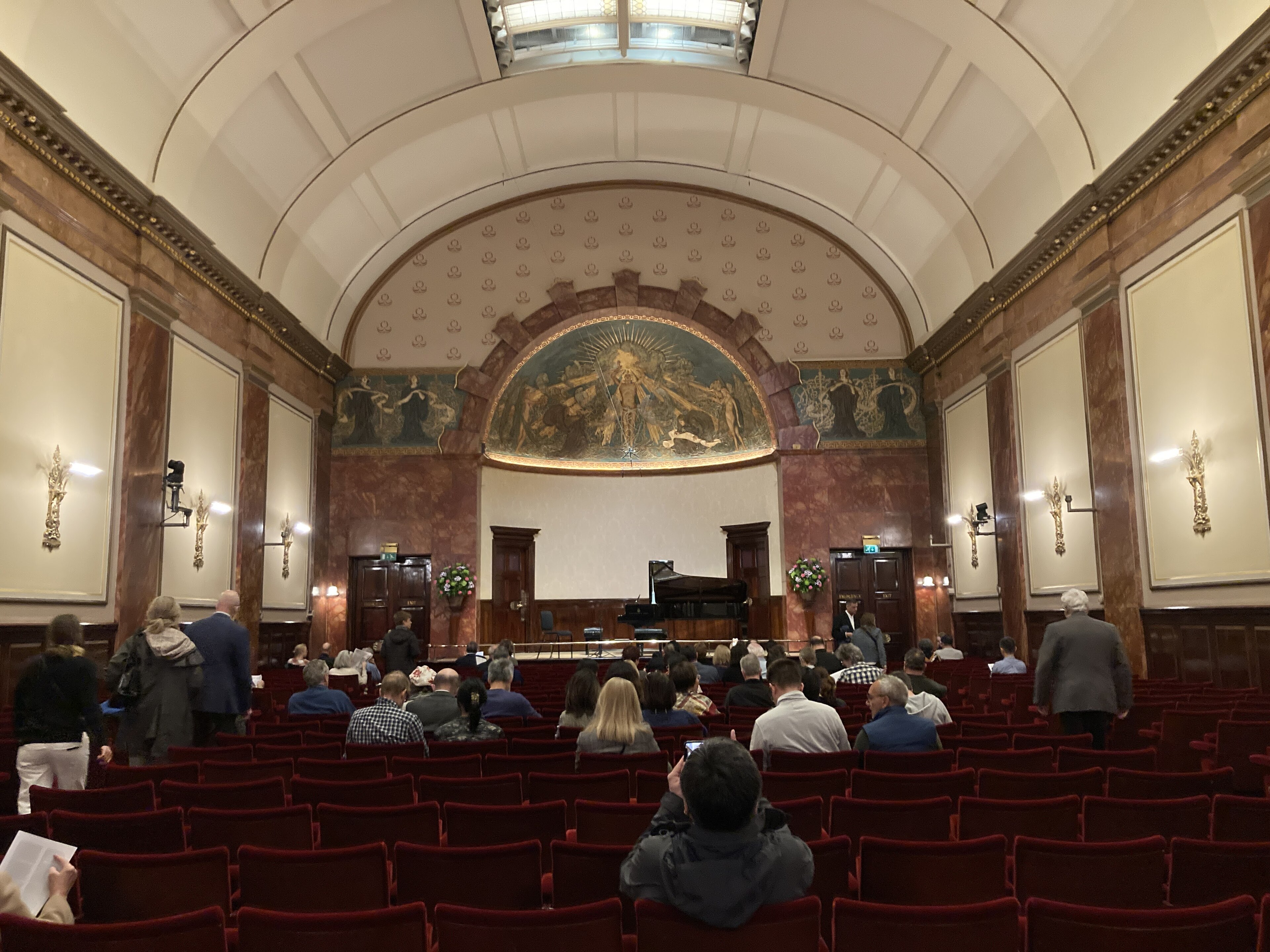
Wigmore Hall's 2026/27 season opened on 8 September, four days ago. It runs to July 2027 and contains more than six hundred concerts and events, which the Hall describes as the UK's largest programme of classical music.
From this month, more than 5,000 of the tickets to those concerts are free to anyone under 25.
The free tickets cover more than 200 concerts, which the Hall states is a third of its annual programme. There is no discount to apply for and no price to find. For a third of everything in that building, a person under 25 pays nothing.
The division nobody has printed
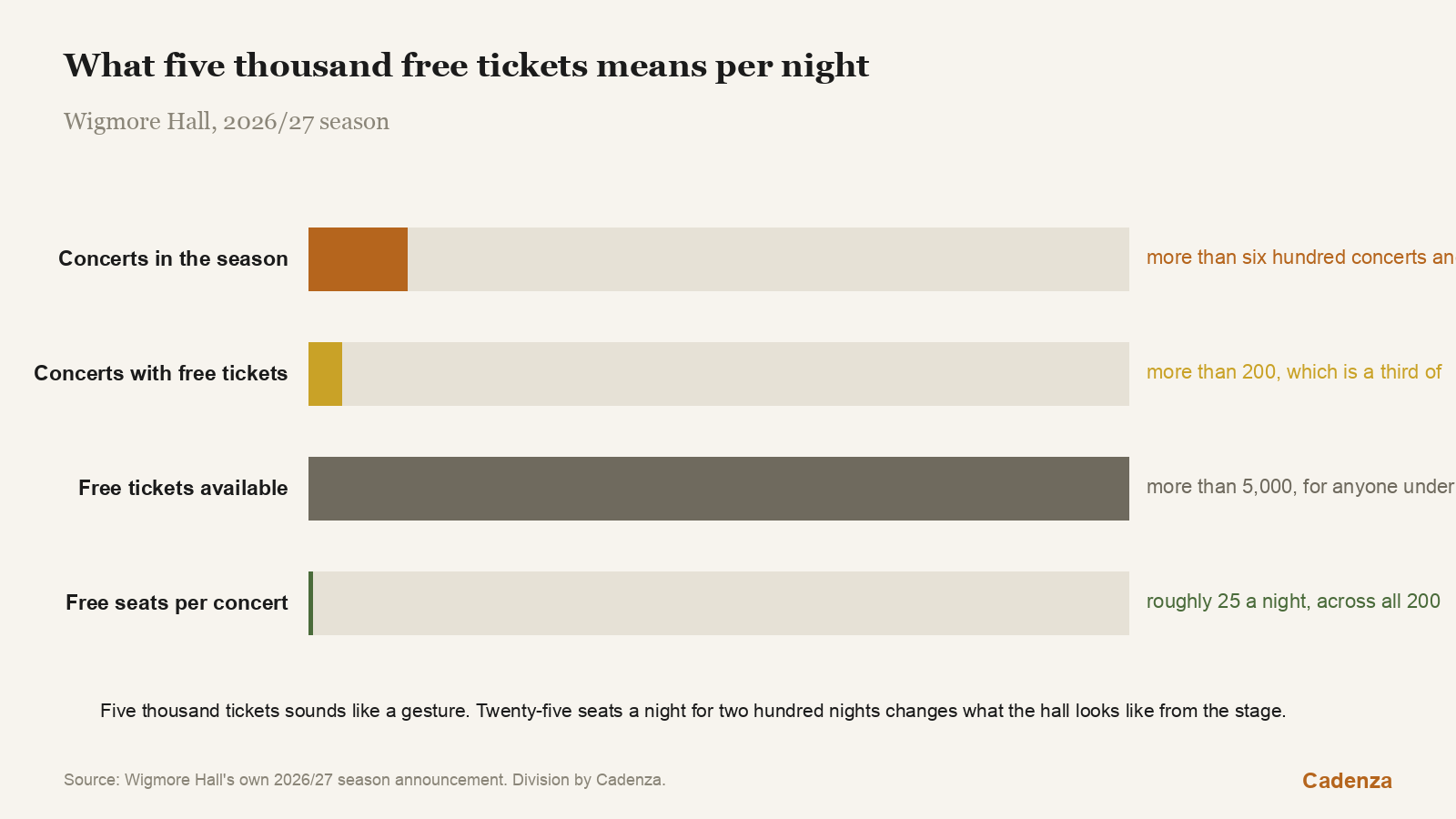
Five thousand tickets spread across two hundred concerts is roughly twenty-five free seats per concert, on average, at every one of those two hundred nights.
That is the figure that makes the scheme legible. A press release saying five thousand free tickets sounds like a marketing gesture. Twenty-five seats a night, two hundred nights, is a standing block of young people in the room for a third of the season. It is a different thing entirely, and it changes what the hall looks like from the stage.
Two hundred concerts out of more than six hundred is almost exactly a third, so the Hall's own description of the scale checks out against its own season figures.
It is built on something that already worked
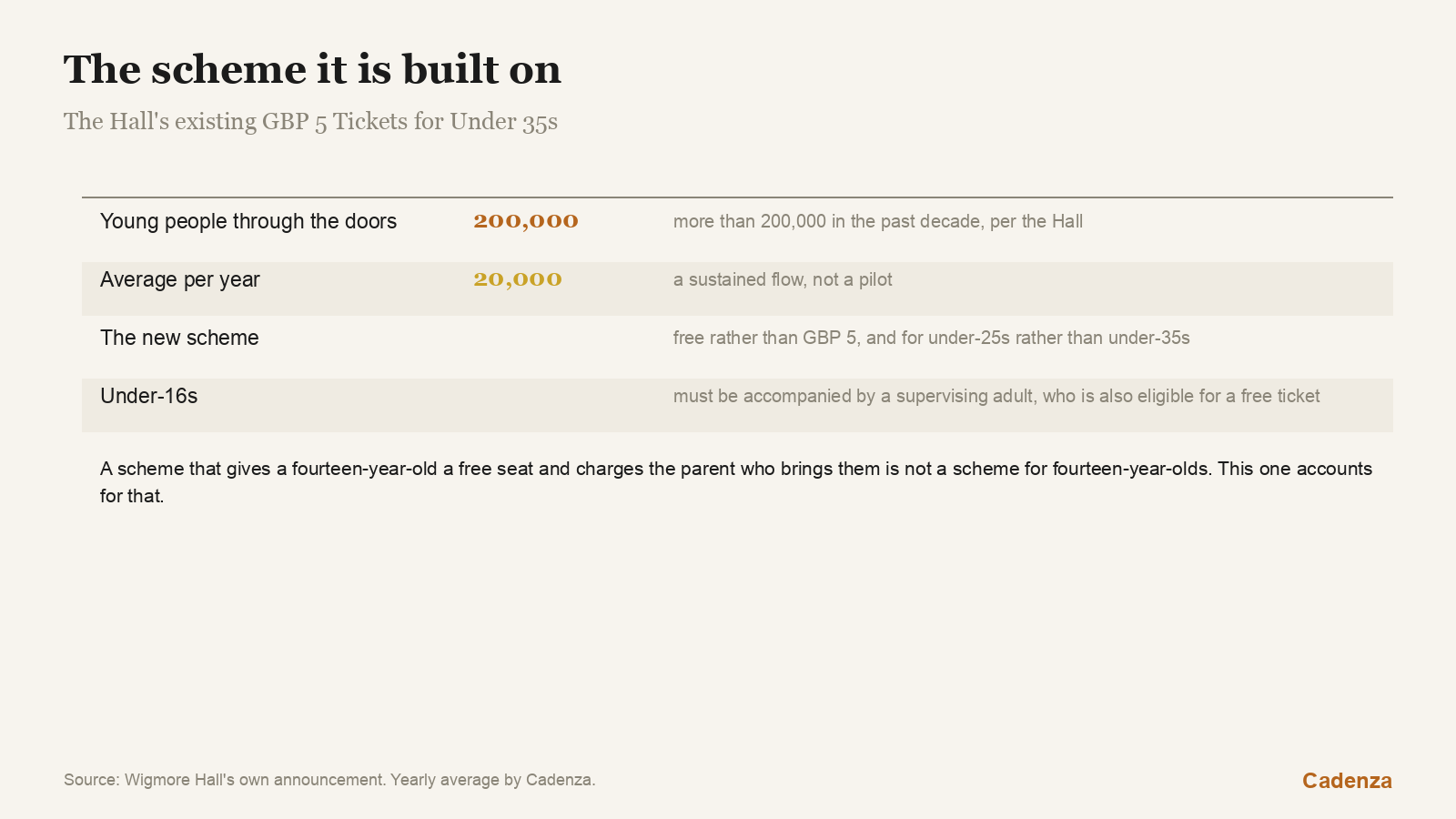
This is not a first attempt. The Hall has run a £5 Tickets for Under 35s scheme, and it says that scheme has brought more than 200,000 young people through its doors in the past decade.
Two hundred thousand over ten years is an average of about twenty thousand a year, which for a hall of Wigmore's size is a substantial and sustained flow rather than a pilot. The free-ticket scheme for under-25s is the next step up from a policy with a ten-year track record, which is the most persuasive argument for it.
The Hall's stated reasoning is direct. It says the initiative tackles financial barriers to accessing classical music amid rising living costs, and its own comment describes the scheme as removing the single biggest barrier between young people and classical concerts.
One detail in the terms is worth pulling out, because it is thoughtful in a way these schemes usually are not. Children under 16 must be accompanied by a supervising adult, and that adult is also eligible for a free ticket. A scheme that gives a fourteen-year-old a free seat and then charges the parent who has to bring them is not a scheme for fourteen-year-olds. This one accounts for that.
Surtitles, for the first time in 125 years
The second announcement in the same season is smaller in money and possibly larger in effect.
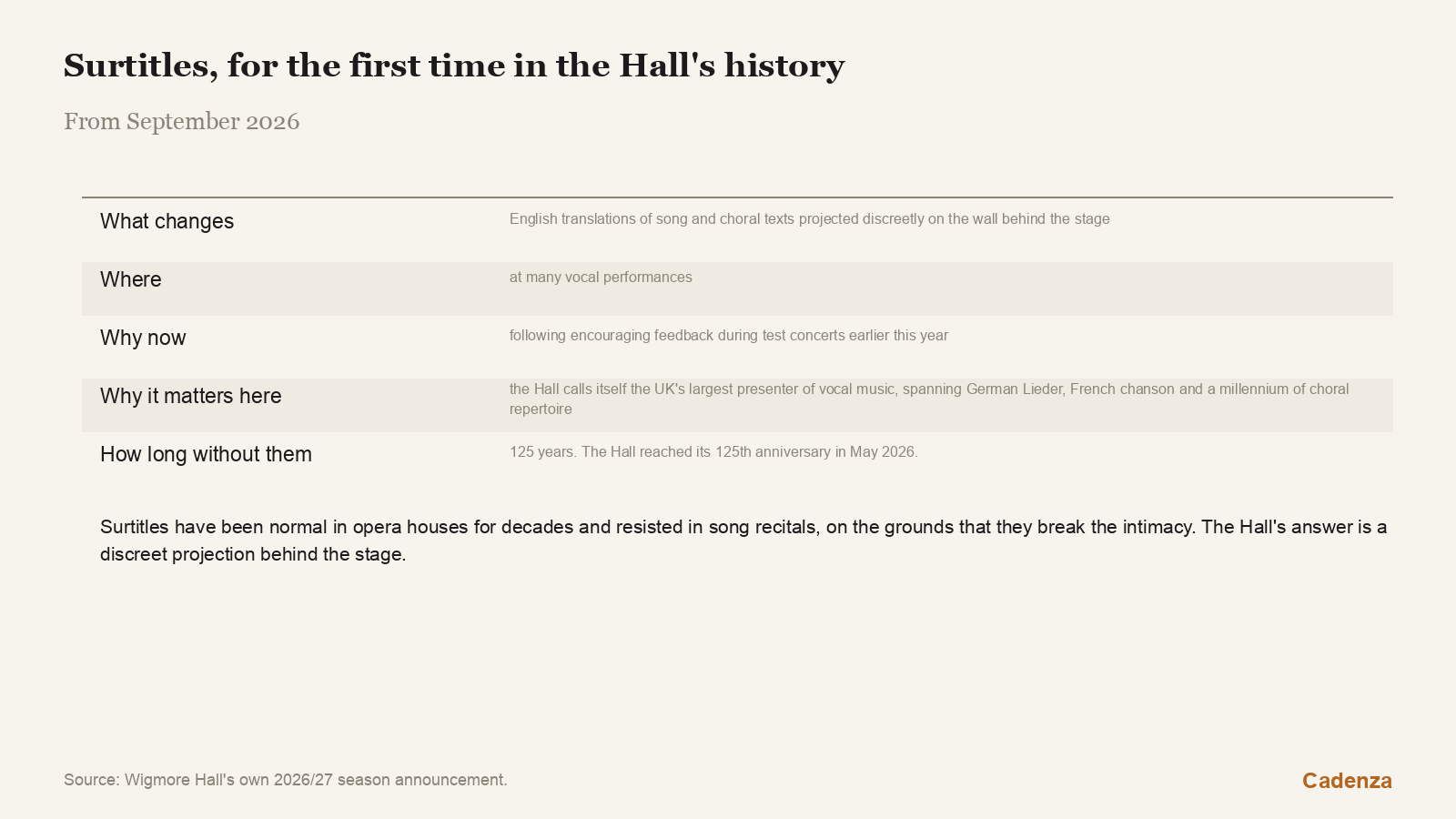
From September 2026, for the first time in the Hall's history, Wigmore will introduce surtitles at many vocal performances. English translations of song and choral texts will be projected discreetly on the wall behind the stage. The Hall says this follows encouraging feedback during test concerts earlier this year.
The significance depends on knowing what Wigmore is. It describes itself as the UK's largest presenter of vocal music, spanning German Lieder, French chanson and a millennium of choral repertoire. Song recital is the most text-dependent form in Western classical music and historically the least accommodating to anyone who cannot read the language or the programme in the dark.
Surtitles in an opera house have been normal for decades. In a song recital they have been resisted, on the grounds that they break the intimacy between singer and listener. The Hall's answer is the discreet projection behind the stage, and it explicitly frames the aim as enhancing engagement while preserving the intimate atmosphere.
The Hall reached its 125th anniversary in May 2026. Introducing surtitles in the season that follows means the institution went 125 years without them and then changed its mind after running tests.
What is actually in the season
The programme matters here, because a free ticket is only worth having if the concert is worth attending.
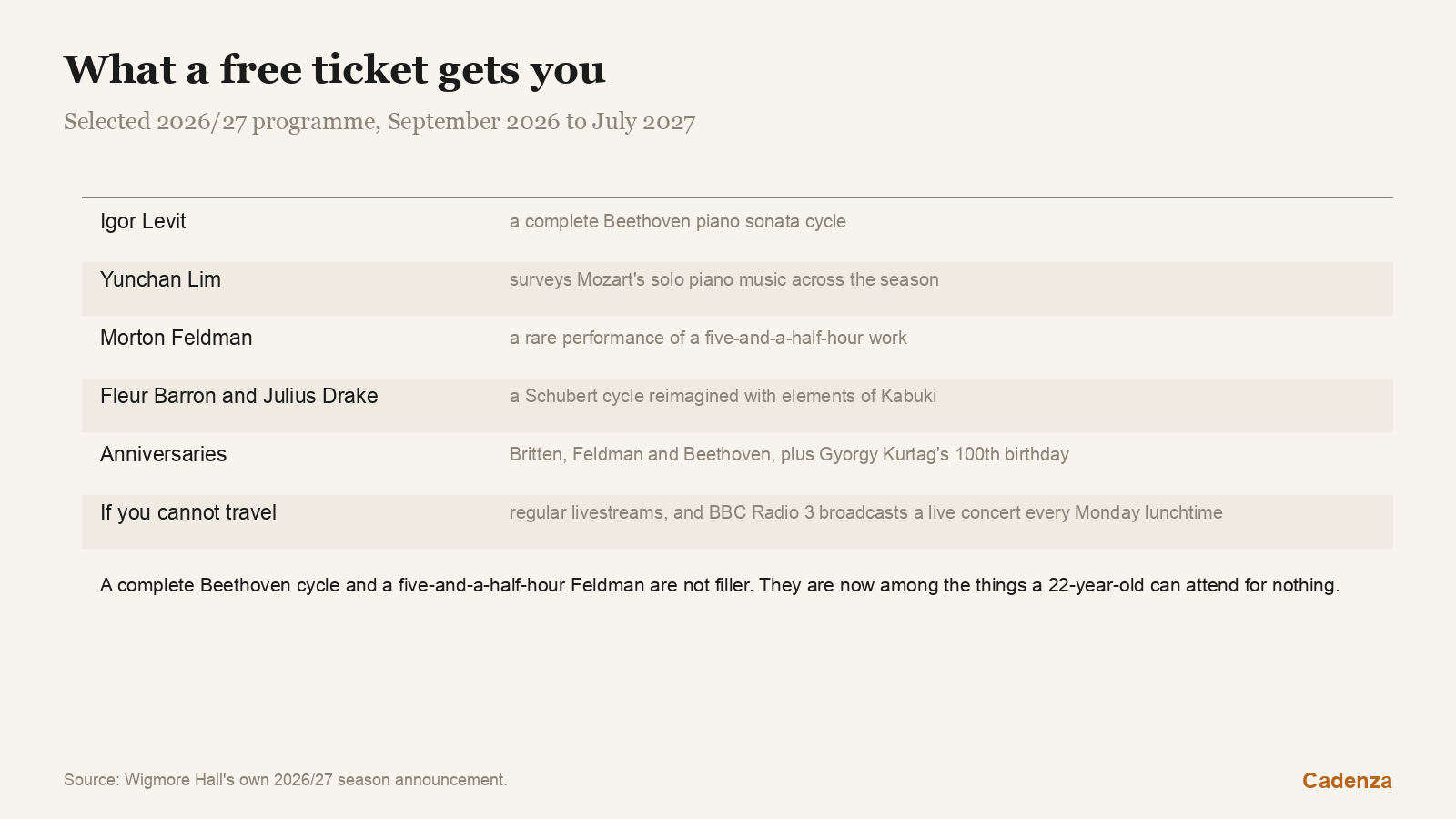
The season marks anniversaries for Benjamin Britten, Morton Feldman and Beethoven, and György Kurtág's 100th birthday. Igor Levit plays a complete Beethoven piano sonata cycle. Yunchan Lim surveys Mozart's solo piano music across the season. There is a rare performance of a five-and-a-half-hour Feldman work. Fleur Barron and Julius Drake perform a Schubert cycle reimagined with elements of Kabuki, the Japanese classical dance-drama.
A complete Beethoven sonata cycle and a five-and-a-half-hour Feldman are not filler. They are the kind of programming a hall does when it is confident of its audience, and they are now among the things a 22-year-old can attend for nothing.
For anyone who cannot get to London, the Hall livestreams concerts regularly through the season, and BBC Radio 3 broadcasts a live concert from the Hall every Monday lunchtime plus a selection of evening concerts.
Why this is the most useful kind of number
Cadenza has spent two days counting what institutions actually give musicians: a Linn Records contract at York, a four-year cello loan in Brussels, $100,000 unrestricted to twelve jazz veterans, thirty-four historic string instruments in Lübeck.
This one is the other side of the same ledger. It is not money for players, it is the removal of a price for listeners, and the two are connected more tightly than the sector usually admits. Every one of those instrument loans and recording contracts exists to produce concerts, and a concert needs somebody in the seat.
A hall that puts twenty-five free young people in the room two hundred times a season is doing something for the musicians on its stage as well as for the audience. Those are the people who will still be buying tickets in forty years.
It is also checkable, which is why Cadenza can write about it at all. The Hall published the ticket count, the concert count and the share of the programme, so anybody can do the division. Compare that with the access announcements Cadenza has read this year that give a percentage with no denominator, or a scheme with no numbers at all.
The under-25 cut-off is worth one note of realism. It is tighter than the existing £5 scheme, which runs to under-35, so somebody who is 27 gets the cheap ticket rather than the free one. That is a choice about where the money goes furthest rather than an oversight, and the Hall has kept both schemes running rather than replacing one with the other.
A year ago it was a policy decision
Nothing here was an accident. A hall ran a £5 scheme for a decade, counted 200,000 young people through the door, tested surtitles in front of real audiences, and then committed to both at scale in the season after its 125th anniversary.
Cadenza carries competitions and vacancies with open deadlines, free to musicians, on its competitions board and its jobs board.
If you are under 25. The scheme starts in September 2026 with the 2026/27 season, covers more than 200 concerts, and the tickets are free rather than discounted. If you are under 16 you need a supervising adult, and that adult gets a free ticket too. The season runs to July 2027, so there is no rush on any single concert, but a complete Beethoven cycle and a Kurtág centenary will not be repeated soon. If you cannot get to Wigmore Street, the Monday lunchtime concert is on BBC Radio 3 every week.
The question other halls will now be asked is the straightforward one. Wigmore has published a ticket count, a concert count and the share of its programme those cover, and the arithmetic holds up. Which other concert hall will publish the same three numbers?
Sources: Wigmore Hall's own 2026/27 season announcement, which carries the season dates of September 2026 to July 2027, the description of more than six hundred concerts and events as the UK's largest programme of classical music, the more than 5,000 free tickets for under-25s at more than 200 concerts described as a third of the annual programme, the September 2026 launch, the requirement that under-16s be accompanied by a supervising adult who is also eligible for a free ticket, the £5 Tickets for Under 35s scheme and its figure of more than 200,000 young people over the past decade, the first introduction of surtitles at many vocal performances with English translations projected behind the stage following test concerts, the Hall's description of itself as the UK's largest presenter of vocal music, its 125th anniversary in May 2026, the Britten, Feldman, Beethoven and Kurtág anniversaries, the Igor Levit Beethoven cycle, the Yunchan Lim Mozart survey, the Fleur Barron and Julius Drake Schubert with Kabuki elements, the livestreams and the BBC Radio 3 Monday lunchtime broadcasts, the 8 September 2026 season opening, and the quoted reasoning about removing the single biggest barrier between young people and classical concerts. The per-concert average, the yearly average from the decade figure and the share of the programme are Cadenza's arithmetic from those published numbers.
Cover photograph: the interior of Wigmore Hall before a concert, October 2022. Nick-D, CC BY-SA 4.0, via Wikimedia Commons. Charts by Cadenza.
Cover photograph: The interior of Wigmore Hall before a concert, photographed in October 2022. Nick-D, CC BY-SA 4.0, via Wikimedia Commons.
Comments
Sign in to join the discussion.