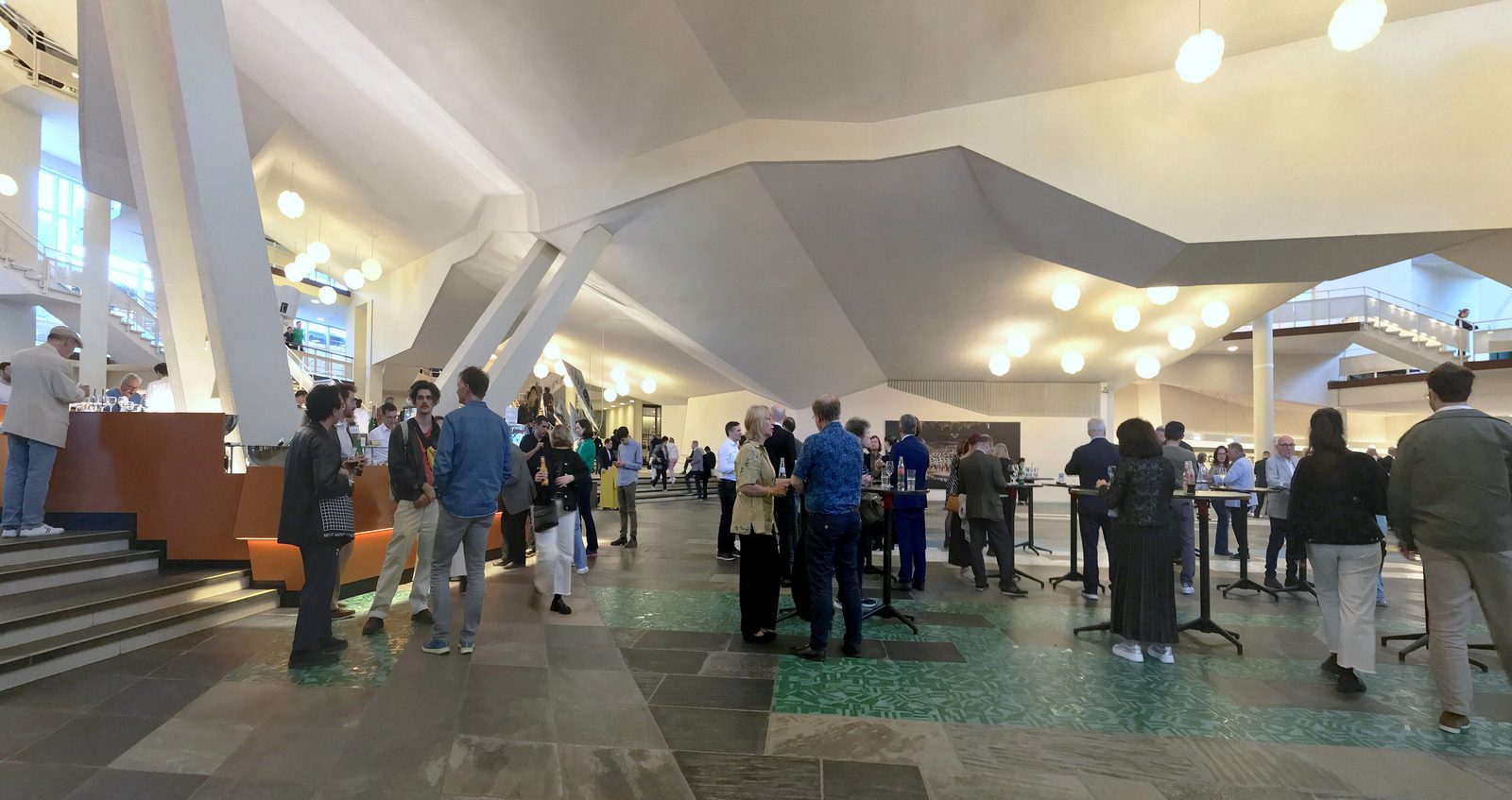
On Wednesday at one o'clock, in the foyer of Hans Scharoun's Philharmonie in Berlin, someone will play chamber music to whoever has walked in off Herbert-von-Karajan-Straße. Members of the Berliner Philharmoniker and its Karajan-Akademie play regularly, alongside guests from the Deutsches Symphonie-Orchester, the Staatskapelle Berlin and the city's music conservatories. There is no ticket. There is no booking. The orchestra's own description of the arrangement is disarming: "You can simply go to a concert at the Philharmonie, spontaneously, during your lunch break – and with free admission: every Wednesday at 1 pm between September and June."
The 2026–27 run opens on Wednesday 9 September and goes to 23 June 2027, on 39 Wednesdays: the calendar skips 23 and 30 December and 5 May. There is also no seating. You stand for the forty to fifty minutes, folding chairs are not allowed, and a limited number of seats are held for visitors with a valid disabled pass.
That is the best-known example of something the field does constantly and explains badly. A great deal of the finest music in the world is available for nothing, or for less than lunch, and almost none of it is listed anywhere a person could find it. The schemes are buried in ticketing pages, described in the language of concessions, and hedged with entry rules that decide whether you actually get in.
So here is the map, with the rules.
What it costs, and what you have to do
| Where | What you get | What it costs | The rule that decides it |
|---|---|---|---|
| Philharmonie, Berlin | Lunch concerts in the foyer of the main auditorium, almost every Wednesday at 1 p.m., 9 September 2026 to 23 June 2027 (39 dates; none on 23 or 30 December 2026 or 5 May 2027). No seating: you stand | Nothing | Numbers are capped for security. You take a chip at the Philharmonie entrance and hand it back at the barrier into the foyer on your way in. Chips cannot be reserved, and you cannot collect one and then leave the building, so this is a turn-up-early proposition |
| Wigmore Hall, London | Any concert on the under-35 scheme | £5 | You need a free Wigmore Hall account with your date of birth on it. Sign up before you want to book, not on the night |
| Wigmore Hall, London | A limited number of free tickets for young people aged 8 to 24, supported by the CAVATINA Chamber Music Trust | Nothing | Ages 8 to 15 must book in person or by telephone through the box office, not online. An under-16 must be accompanied by a supervising adult, who also gets a free ticket, to a maximum of two under-16s and two adults |
| New World Center, Miami Beach | WALLCAST concerts, the orchestra projected onto the outside of the building in SoundScape Park | "Free and open to the public" | Outdoors, so bring a blanket rather than a booking reference. The park also runs a free cinema series |
| Four Seasons Centre, Toronto | The Canadian Opera Company's free concert series, twice a week in the Richard Bradshaw Amphitheatre | Nothing | Register in advance. For the first fifteen minutes after doors, entry is restricted to registered ticket-holders; then it opens to everyone else as capacity allows, and the standby line is real |
| Royal Albert Hall, London | Promming places at the BBC Proms, around a thousand a concert by the Proms' long-standing practice | £8 | Standing, sold on the day. Mid-July to mid-September only; the 2026 season runs to 12 September, so this week is the last of it |
| Philharmonie de Paris | 700 standing places on the floor during Les Prem's, in front of orchestras including the Met Orchestra and the Concertgebouw | €15 | A ten-day festival each September, not a year-round scheme |
The ones we have already reported
Four of the most interesting cases are ones Cadenza has written up in the past week, and they are worth reading in full because each is a different answer to the same question.
Toronto is the endurance case. The Canadian Opera Company has given more than 1,500 free concerts in twenty seasons in a room seating about 120, and recorded 236,000 attendances doing it. The arithmetic only works because of the discipline around the door: the company overbooks deliberately, keeps a standby line, and releases unclaimed reservations fifteen minutes before the start.
Paris is the economics case. Les Prem's takes the seats out of the front of the Grande salle Pierre Boulez and sells the floor at €15, and its director says the first edition sold 14,000 tickets with about half the audience under 28, and did it without eating into revenue.
St. Louis is the civic case. The orchestra opens every season free on Art Hill in Forest Park, in front of tens of thousands, before a single subscription concert is played.
Louisville is the touring case. Its In Harmony programme plays free across the state, in towns of a few hundred people, and the Kentucky legislature has now funded it three times.
And New York is the case still under construction. Lincoln Center is building a 2,000-seat outdoor theatre intended for free performances, opening in 2028, on the side of its campus that used to be a wall.
What the good ones have in common
Read those side by side and three things separate the schemes that work from the ones that exist mainly in a press release.
They are on a fixed repeating slot. Wednesday at one. Every September on the hill. Twice a week in the amphitheatre. A free concert that happens occasionally is an event, and an event needs marketing; a free concert that happens most Wednesdays is a habit, and a habit markets itself.
They mostly use the musicians who are already in the building. Toronto's series draws on the company's orchestra, its Ensemble Studio and the singers who are already downstairs rehearsing a mainstage production. Berlin leans on players already on the campus, orchestra members and Karajan-Akademie scholars, though it also books guests from two other Berlin orchestras, which cuts against the rule. The attraction is obvious enough: an hour from a musician who is already at work does not cost a fee and a flight, which is the kind of arithmetic that lets a series run for twenty years.
They are honest about the door. This is the part that most listings omit and the part that decides whether you get in. Berlin's chip system is a queue by another name. Toronto's fifteen-minute rule rewards the people who registered. Wigmore's £5 seat requires an account created in advance, and its free tickets for children require a telephone call. None of that is hidden, but it lives on each institution's own pages, in the language of concessions, and a person who turns up without having read them can be turned away at the door.
The corollary is worth saying plainly, because "free" is doing a lot of work in this article. Free admission is not free to provide. Somebody is paying: an endowment in Toronto, a chamber-music trust at Wigmore, two governments and a bank in Berlin, a state legislature in Kentucky. What the audience is being spared is the ticket price, not the cost.
If you go
- Wednesdays at 1 p.m., 9 September 2026 to 23 June 2027, but not 23 or 30 December or 5 May: Philharmonie foyer, Berlin. Free, no booking, take a chip at the entrance and hand it back at the barrier into the foyer. You stand.
- Any time, if you are under 35: open a free Wigmore Hall account and put your date of birth on it. £5 seats across the season.
- If you are 8 to 24: ask Wigmore Hall for the CAVATINA free tickets. Ages 8 to 15 must book in person or by phone, and an under-16 must be accompanied by an adult, who also goes free.
- In Miami Beach: WALLCAST concerts in SoundScape Park, free and outdoors.
- In Toronto: register in advance for the Canadian Opera Company's series, and arrive before the doors if you have not.
- Until 10 September, in Paris: Les Prem's, €15 to stand at the front. The festival runs to Thursday 10 September, though the two remaining concerts — the Orchestre de Paris under Klaus Mäkelä on 9 and 10 September — are both marked complet.
Cadenza lists auditions, competitions and programmes for musicians, free to use, on its jobs and programmes board, and the chairs closing this month are in this month's ledger.
Every institution above has worked out that the cheapest seat in the house is the one that produces the next generation of audience, and each publishes its own door well enough: Berlin's lunch concerts, entry rule and all, are on visitBerlin in two languages. What nobody publishes is the map. Who is going to put these in one place, so that turning up is a plan rather than an accident?
Sources, read on 7 September 2026: Berliner Philharmoniker, Lunch Concerts; Wigmore Hall, Under 35 series; New World Symphony, WALLCAST concerts. The Toronto, Paris, St. Louis, Louisville and Lincoln Center figures are from Cadenza's own reporting, each linked above and separately fact-checked.
Cover photograph: The foyer of the Philharmonie in Berlin, where the orchestra's free lunch concerts are played on Wednesdays at one o'clock. Gunnar Klack, CC BY-SA 4.0, via Wikimedia Commons.
Comments
Sign in to join the discussion.