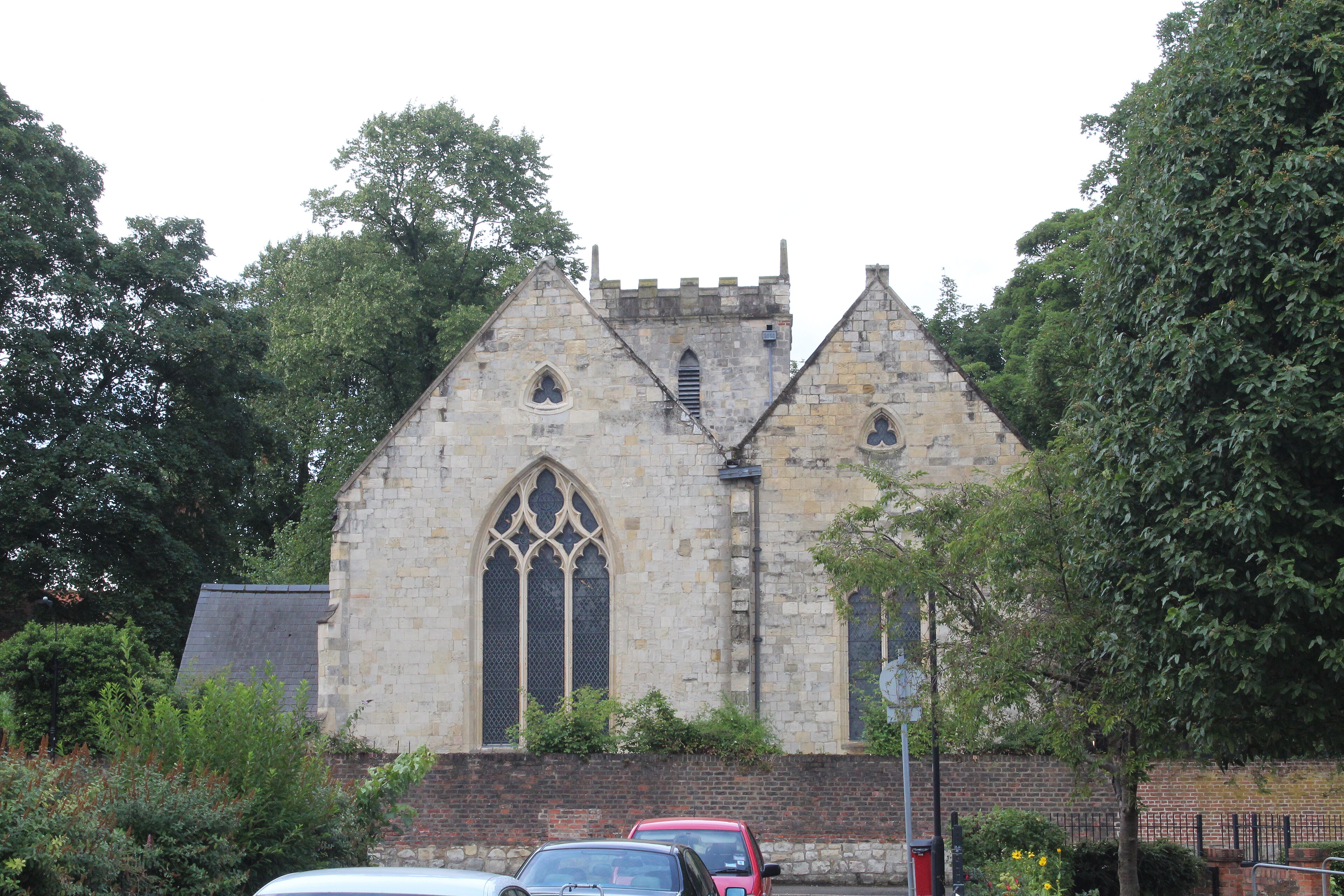
On 11 July, in a converted medieval church in York, nine early-music ensembles competed for a first prize that is not principally money.
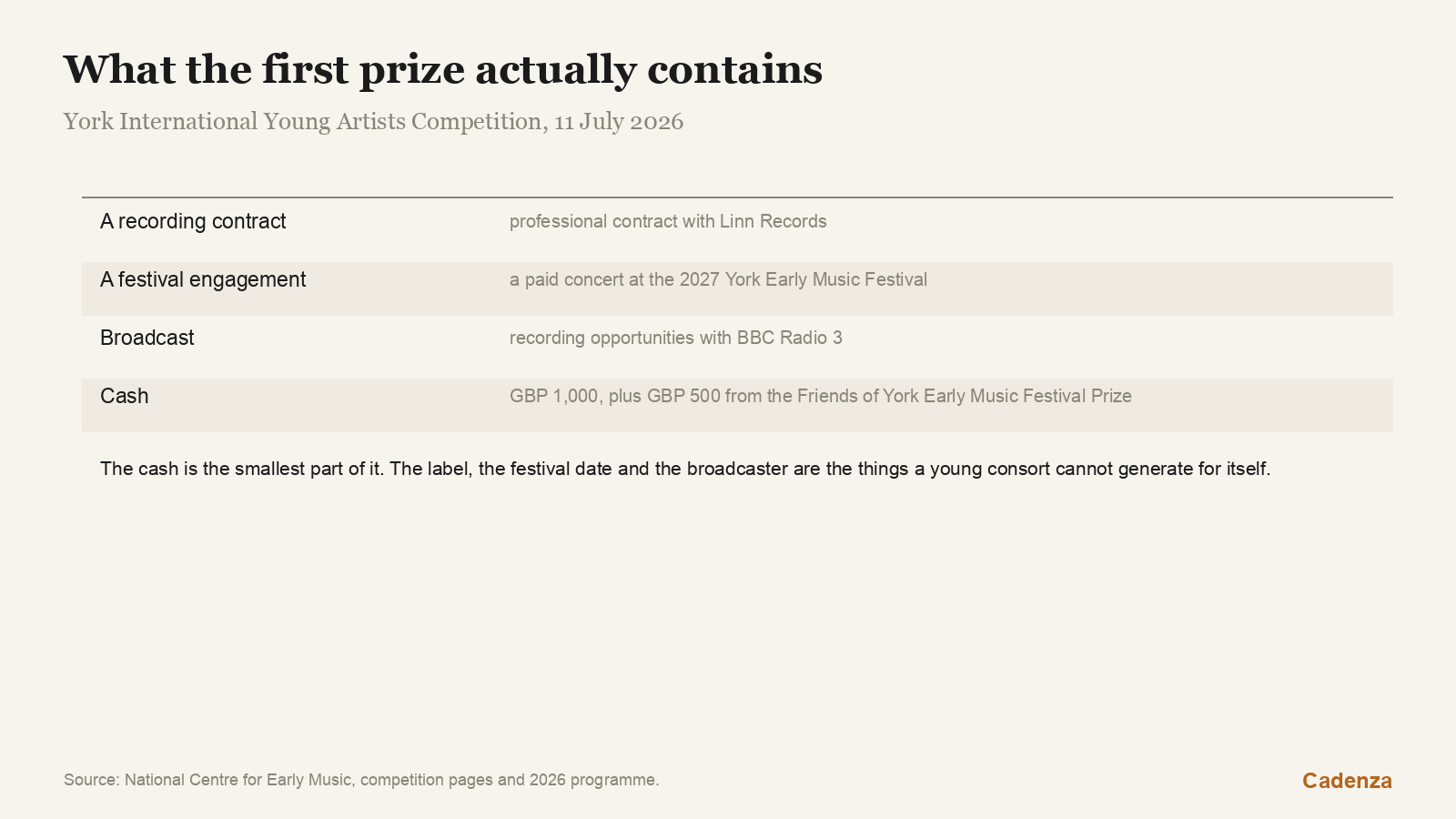
The winner takes a professional recording contract with Linn Records, a paid concert at the 2027 York Early Music Festival, recording opportunities with BBC Radio 3, and £1,000 in cash. The cash is the smallest part of it.
The Lyons Mouth won. The ensemble was founded in 2024.
A two-year-old group with a recording contract
The Lyons Mouth is a vocal group of six: the sopranos Ailsa Campbell and Elspeth Piggott, the alto and mezzo-soprano Ellie Stamp, the tenors James Botcher and Jacob Ewens, and the bass Thomas Lowen.
They met as students at the University of York and formed the group in 2024. They had tuition from Robert Hollingworth, who directs I Fagiolini. Their name refers to the university's Sir Jack Lyons Concert Hall.
Two years from founding to a recording contract is fast for a vocal consort, a format where groups typically spend years building a repertoire and a sound before a label will look at them. They also took the Friends of York Early Music Festival Prize of £500, so £1,500 in cash in total, against a prize package whose real value is the label, the festival date and the broadcaster.
One correction, because the ensemble's own website is loose about it. The Lyons Mouth won the main prize and the Friends prize. It did not win the Jury Prize, which went to somebody else entirely.
The new individual award
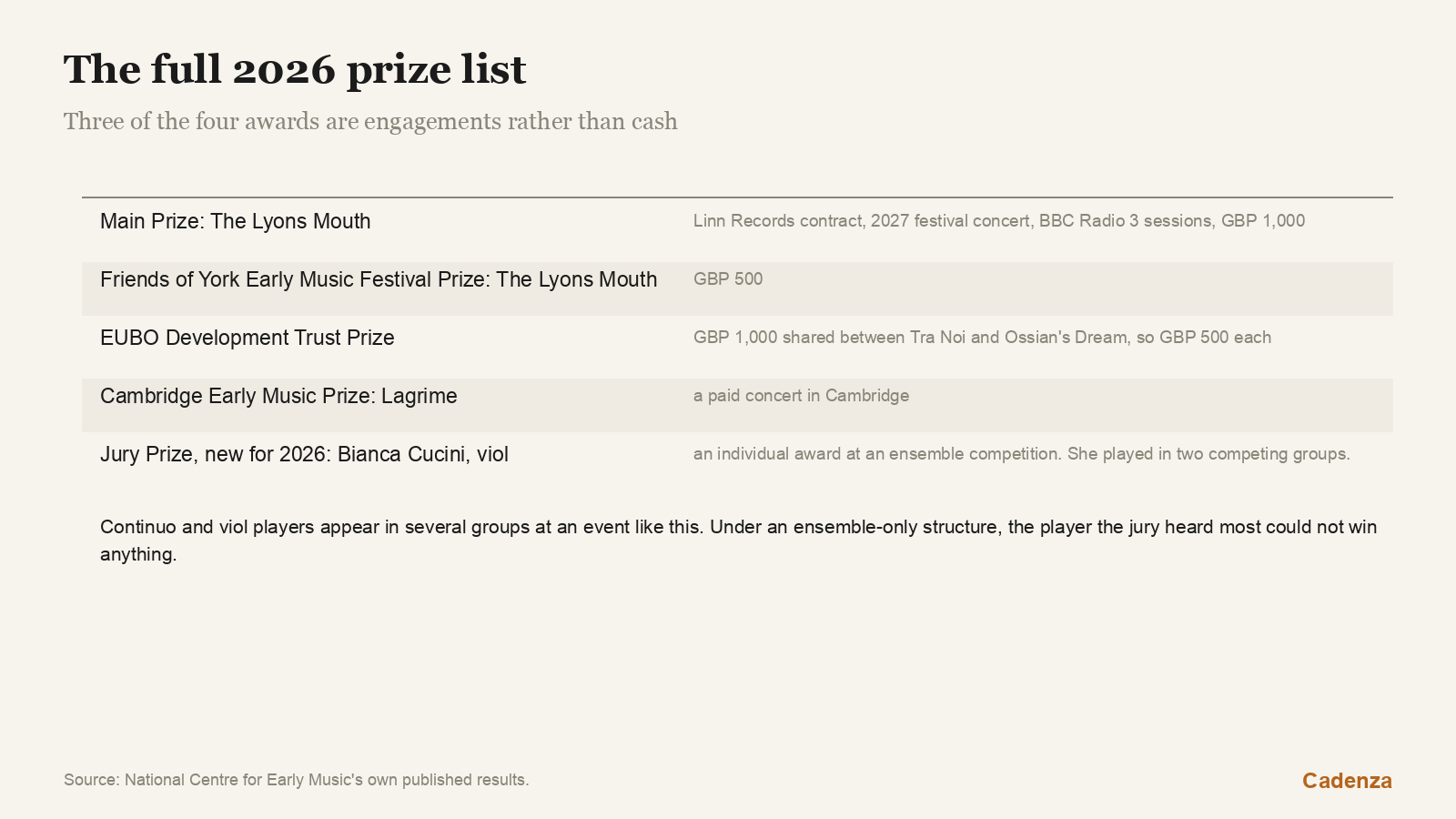
For 2026 the competition introduced a Jury Prize for an individual, which is a structural novelty in a competition for ensembles. It went to the viol player Bianca Cucini.
What makes that award interesting is how she qualified for it. Cucini played in two different competing ensembles during the competition, Tra Noi and I Mastricelli, and was not a member of the winning group at all. So the first holder of an individual prize at an ensemble competition is a player the jury noticed across two separate line-ups.
That is a real problem the new prize solves. Continuo and viol players are the musicians most likely to appear in several groups at an event like this, because small early-music ensembles borrow them. Under an ensemble-only prize structure, the player heard most often by the jury was the one player who could not win anything.
The EUBO Development Trust Prize for the Most Promising Young Artist or Artists, worth £1,000, was shared between Tra Noi and Ossian's Dream, so £500 each. The Cambridge Early Music Prize, which is a paid concert in Cambridge rather than cash, went to Lagrime.
Four of the nine finalists were Swiss
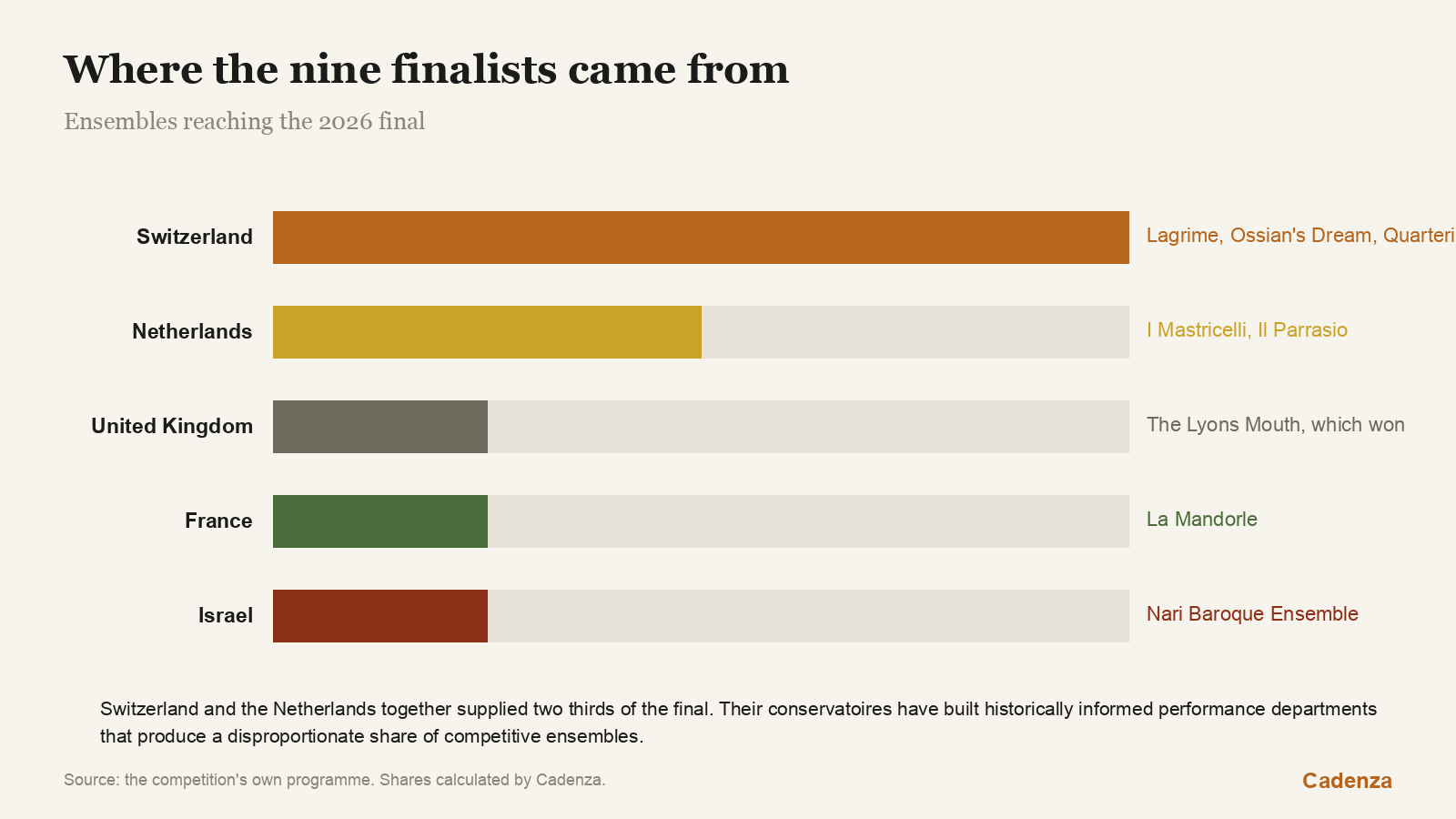
The nine finalists were I Mastricelli and Il Parrasio from the Netherlands, Lagrime, Ossian's Dream, Quarterino and Tra Noi from Switzerland, La Mandorle from France, the Nari Baroque Ensemble from Israel, and The Lyons Mouth from the United Kingdom.
Switzerland supplied four of the nine, which is 44 per cent of an international final from one small country. The Netherlands supplied two. Between them those two countries account for two thirds of the field.
That concentration is the finding worth recording. Cadenza has traced a centre of gravity in German-speaking Europe three times this week, in the destinations of British scholarship winners, in where a Ukrainian pianist trains, and in where a Japanese pianist studies. Early music adds a fourth data point, and it points at the same part of the map. The Swiss and Dutch conservatoires have built historically informed performance departments that now produce a disproportionate share of the ensembles good enough to reach a final like this one.
The British group won on home ground, which is worth noting without making too much of it. One result is one jury.
The borrowed-player problem, and why it matters beyond York
Bianca Cucini's prize points at something structural in early music that has no equivalent in the orchestral world.
A string quartet is four fixed people. A baroque ensemble is a core plus whoever is available, and the continuo players, the viol players, the theorbists and the organists move between groups constantly. That is how the repertoire works: a Monteverdi programme and a Marais programme need different forces, so ensembles borrow.
The consequence for a young specialist is a career built on being in several groups rather than one. It is good for the playing and bad for recognition, because prizes, profiles and management all attach to named ensembles. A player can be the most-heard musician at a competition and be invisible in its results.
York has now written that player into its prize list. It is a small award and a sensible one, and it is the kind of structural fix Cadenza has looked for all week: the Tenor Vinas separating oratorio and Lieder from opera so that a song specialist is not judged as an opera prospect, and the Queen Elisabeth paying all twelve finalists so that nobody finishes twelfth.
Who decided it
The panel was Paul Agnew, Anna Danilevskaia, Kati Debretzeni, Veerle Declerck and Philip Hobbs, with the harpsichordist Steven Devine as master of ceremonies.
Hobbs chaired, and he is from Linn Records. That is worth stating plainly because it is the right way to run a prize of this kind rather than a conflict. The first prize is a recording contract, so the label that will have to make the record sat on the panel and chose the group it will work with. A prize that hands out a contract decided by people who will not honour it would be worth less.
A biennial competition inside a fiftieth festival
The York International Young Artists Competition was founded in 1985 and runs every two years, as the finale of the York Early Music Festival. The festival marked its 50th edition in 2026.
Eligibility caps individual competitors at 36 years old, with an ensemble average of 35 or under. That is a notably generous ceiling, and it suits the repertoire: early-music specialists often arrive later, after a first career on a modern instrument or after a musicology degree, and a limit of 30 would exclude exactly the players who have done the archival work.
Cadenza has not published an applicant total for this edition. One local report gives a figure for how many ensembles were considered, and it appears in no other source, including the centre's own pages, so it is not printed here.
What a recording contract is worth against cash
The pattern of this week's competitions ends up in the same place again.
At the Premio Jaén the first prize came with a five-concert tour. At the Queen Elisabeth it came with a four-year loan of a 1733 Gofriller cello. At the Tenor Viñas it came with a contract at the Liceu. At the Takemitsu award the prize is an orchestra and a premiere.
York goes furthest in that direction. A young consort with a Linn record, a festival date and BBC Radio 3 sessions has the three things a consort cannot generate for itself, and £1,500 in cash would not have bought any of them.
A year ago it was an application
Every one of those nine ensembles applied to a biennial competition with published eligibility rules, and the next edition is two years away. The National Centre for Early Music publishes its finalists, its panel and its full prize list.
Cadenza carries competitions with open deadlines, free to musicians, on its competitions board, and orchestral and ensemble vacancies on its jobs board.
If you are in an early-music ensemble. The age ceiling here is 36 for an individual and an average of 35, which is more generous than most young-artist schemes and worth checking before you assume you have aged out. Note that the competition is biennial, so a missed year is a two-year wait. And read the prize list to the bottom: three of the four awards in 2026 were concerts, contracts or recordings rather than cash, which changes what winning is for.
The question the centre will be asked next is a friendly one. It has just created an individual Jury Prize in an ensemble competition, and the first winner was a viol player heard in two different groups. Will the next edition publish how many ensembles applied, so groups can see the odds before they enter?
Sources: the National Centre for Early Music's own competition pages at yorkcomp.ncem.co.uk and its printed 2026 programme, which carry the full prize list, the nine finalist ensembles with their countries, the judging panel, the eligibility ages and the competition's biennial pattern and 1985 founding; The Lyons Mouth's own website for the ensemble's six members, its 2024 founding, its tuition from Robert Hollingworth and the origin of its name; and reporting by Charles Hutchinson Press and Andrew Benson-Wilson's Early Music Reviews. Cadenza has excluded an applicant-total figure that appears in only one outlet, has used the competition's own spellings of every ensemble and singer's name in preference to press reports, and states no age for any laureate because no source gives one. The country distribution and the cash totals are Cadenza's arithmetic.
Cover photograph: the church of St Margaret of Antioch, York, home of the National Centre for Early Music, 2018. Chabe01, CC BY-SA 4.0, via Wikimedia Commons. Charts by Cadenza.
Cover photograph: The church of St Margaret of Antioch in York, which houses the National Centre for Early Music, where the 2026 York International Young Artists Competition final was held, photographed in 2018. Chabe01, CC BY-SA 4.0, via Wikimedia Commons.
Comments
Sign in to join the discussion.